
 100% FREE ACCESS
9th Standard Syllabus & Materials
9th Standard
TN 9th Tamil உள்ளத்தின் சீர் -கற்கண்டு (இலக்கணம்) - தொடர் இலக்கணம், ஆகுபெயர் Important Questions And Answers Study Material - QB365 Set A
NEW9th Standard
TN 9th Tamil உள்ளத்தின் சீர் -விரிவானம் (துணைப்பாடம்) - தாய்மைக்கு வறட்சி இல்லை! Important Questions And Answers Study Material - QB365 Set A
NEW9th Standard
TN 9th Tamil உள்ளத்தின் சீர் -கவிதை பேழை (செய்யுள்) - மார்கழி பெருவிழா Important Questions And Answers Study Material - QB365 Set A
NEW9th Standard
TN 9th Tamil உயிருக்கு வேர்-இலக்கணம் - பகுபத உறுப்பிலக்கணம் Important Questions And Answers Study Material - QB365 Set A
NEW9th Standard
TN 9th Tamil அமுதென்று பேர் - இலக்கணம்-எழுத்து -அளபெடை Important Questions And Answers Study Material - QB365 Set A
NEW9th Standard
TN 9th Tamil அமுதென்று பேர்-துணைப்பாடம் - ஆறாம்திணை Important Questions And Answers Study Material - QB365 Set A

Published on: 04/02/2020
9th Standard Science Annual Exam Model Question Paper 2019 - 2020
Download Tamil Nadu 9th Standard Science question papers, model tests, one-mark questions, important questions, and public exam papers in PDF format. Free study materials and answer keys for TN State Board students.
Questions + Answers key
Take MCQ Science Test1.
What is Hardware and Software?
2.
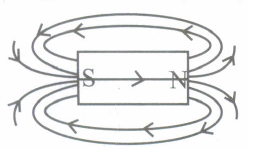
Draw magnetic field lines around a bar magnet
3.
2875 J of heat is required to melt 115 g of lead at its melting point. Calculate the specific latent heat capacity of fusion of lead.
4.
An atom has 17 protons, 17 electrons and 18 neutrons. What is the mass number?
5.
Explain the experiment to prove that chlorophyll is essential for photosynthesis.
6.
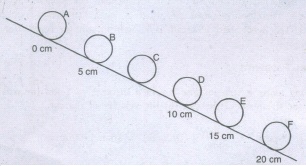
The diagram shows the position of a ball it rolls down a track - the ball took 0.5 s to roll from one position to other.
(a) State where the motion of the ball is uniform or non-uniform motion.
(b) What is the distance travelled by the ball in 2.5 s?
(c) Find the average velocity of the ball from A to F.
7.
Give an account on phylum Annelida.
8.
Pick out the concave and convex mirrors from the following and tabulate them Rear-view mirror, Dentist’s mirror, Torch-light mirror, Mirrors in shopping malls, Make-up mirror.
9.
Write the rules that are followed in writing the symbols of units in SI system.
10.
Define Apiculture
11.
What is zygotene?
12.
Which unique feature is seen in Echinoderms?
13.
Who was the first programmer?
14.
Is air a pure substance or Mixture? Justify.
15.
Place a coin at the bottom of a bucket filled with water. The apparent position of the coin differs from its actual position why?
16.
What is an adulterant?
17.
Compare the charge and mass of protons and electrons.
18.
Convert: 104°F into Celsius scale.
19.
Which of the following are infrasonic waves?
5 kHz
25 Hz
10 Hz
15000 Hz
20.
The symbiotic association of fungi and vascular plants is
Lichen
Rhizobium
Mycorhizae
Azotobacter
21.
_________is an Operating System.
Android
Chrome
Internet
Pendrive
22.
The resistance of a straight conductor is independent of__________
temperature
material
cross-sectional area
shape of cross-section
23.
Bile helps in the digestion of________
proteins
sugar
fats
carbohydrates
24.
If Dobereiner is related with 'law of triads', then Newlands is related with __________.
Modern periodic law
Hund's rule
Law of octaves
Pauli's Exclusion principle
25.
Internal factor which is responsible for food spoilage is ___________.
catabolic activities
anabolic activities
metabolic activities
enzymatic activities
26.
The centre of the sphere of which a spherical mirror is a part is called ______________________
pole
radius of curvature
focus
centre of curvature
27.
___________is the derived quantity.
Length
Volume
Mass
Time
28.
1. Abacus belongs to the first generation of the computer
2. ENIAC was used in the American military
Both the statements are correct
Statement 1 is wrong but 2 is correct
Statement 1 is correct but 2 is wrong
Both the statements are wrong.
29.
The area under velocity time graph represents
Velocity of the moving object
Displacement covered by the moving object
Speed of the moving object
30.
Among the following the odd pair is
8O18,9F19
18Ar40,7N14
14Si30, 15P31
24Cr54, 19K39
31.
Give some of the strategies to support water conservation.
32.
a) A cube of side 5 cm is immersed in water and then in saturated salt solution. In which case will it experience a greater buoyant force. If each side of the cube is reduced to 4 cm and then immersed in water, what will be the effect on the buoyant force experienced by the cube as compared to the first case for water. Give reason for each case.
b) A ball weighing 4 kg and density 4000 kg/m3 is completely immersed in water of density 103 kg/m3. Find the force of buoyancy on it. (Given g = 10ms-2).
33.
Suggest the immunization schedule for a new born baby till 12 months of age. Why it is necessary to follow the schedule?
34.
Explain simple epithelium and its types.
35.
Describe the alimentary canal of man.
36.
State any five features of modern periodic table.
1.
Hardware:
Hardware is the parts of a computer which we can touch and feel. Hardware includes input and output devices, cabinet, Hard disk, Mother board, SMPS, CPU, RAM, CD Drive and graphics card.
Software:
(i) Software are programmed and coded applications to process the input information
(ii) The software processes the data by converting the input information into coding or programmed language .
(iii) Touching and feeling the software is not possible but we can see the functions of the software in the form of output.
2.
3.
Mass of lead m = 115 g
Heat required Q = 2875 J
Specific latent heat of lead L = ?
We know that Q = m L
L = \(\frac { Q }{ m } =\frac { 2875 }{ 115 } \)
= 25 Jg-1
4.
Mass number = Number of protons + Number of neutrons = 17 protons + 18 neutrons
Mass number = 35.
5.
Aim: To show that chlorophyll is essential for photosynthesis.
Materials Needed: Croton plant, boiling water, alcohol and iodine solution.
Procedure:
(i) A potted croton plant is kept in dark room for 24 hours to de-starch the plant.
(ii) Then keep the plant in sunlight for 4-5 hours.
(iii) Variegated leaf is plucked from the plant.
(iv) On a plain sheet draw the outline of a plucked leaf showing green area and non-green area.
(v) The leaf is immersed in the boiling water then in alcohol it is tested for starch with iodine solution
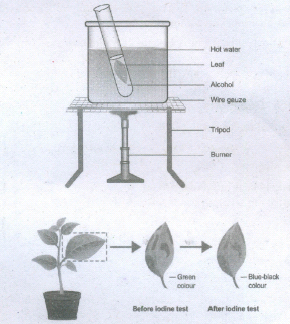
Observation: It is observed that the patches of leaf with chlorophyll turn blue-black the other portion remain colourless.
Conclusion: This proves that chlorophyll is essential for photosynthesis.
6.
(a) It is a non-uniform motion
(b) 20 cm
(c) Velocity = \(\frac { Displacement }{ time\ taken } \)
=\(\frac { Total\ distance }{ time\ taken } \)
=\(\frac { 20\times 10^{ -2 } }{ 2.5 } \)
= \(\frac { 2 }{ 2.5 } \) = 0.08 m/s (or) cm/s.
7.
This animals are characterized by the possession of a body cavity called coelom. Some animals of annelids have movable bristles called setae it is used to locomotion. Nephridia is the excretory structures and help to remove metabolic waste. They have central nervous system with a brain.
8.
| Concave mirror | Convex mirror |
| 1. Dentist's mirror | Rear view mirror |
| 2. Torch light mirror, Make up mirror | Mirrors in shopping malls |
9.
1. The units named after scientists are not written with a capital initial letter.
Ex: newton, henry, ampere and watt
2. The symbols of units named after scientists should be written by the initial capital letter.
Ex: N for newton, H for henry, A for ampere and W for watt.
3. Small letters are used as symbols for units not derived from a proper noun.
Ex: m for metre, kg for kilogram
4. No full stop or other punctuation marks should be used within or at the end of the symbols.
Ex: 50 m and not as 50 m.
5. The symbols of the units are not expressed in plural form.
Ex: 10 kg not as 10 kgs.
6. Accepted symbols should only be used.
Ex: ampere should not be written as amp and second should not be written as sec.
10.
11.
During zygotene of meiotic prophase I, the pairing of homologous chromosomes takes place. This is called synapsis
12.
Water vascular system and tube feet.
13.
Lady Augusta Ada Lovelace was honored as the first programmer as she gave the first programming to do arithmetic operations.
14.
Air is a mixture, because samples from different places give different percentage of its components.
15.
The apparent position of the coin differs from its actual position because of refraction.
16.
Adulterants are undesirable substances added to the food against the food safety standards.
17.
| Particle | Mass | Charge |
| Proton | 1.672 x 10⁻²⁴ g | 1.602 x 10⁻¹⁹ C |
| Electron | 9.108 x 10⁻²⁸ g | -1.602 x 10⁻¹⁹ |
18.
Celsius = (F – 32) × \(\frac{5}{9}\)= (104 - 32) ×\(\frac{5}{9}\) = 72 × \(\frac{5}{9}\) = 40°C.
19.
(c)
10 Hz
20.
(c)
Mycorhizae
21.
(a)
Android
22.
(d)
shape of cross-section
23.
(c)
fats
24.
(c)
Law of octaves
25.
(d)
enzymatic activities
26.
(d)
centre of curvature
27.
(b)
Volume
28.
(a)
Both the statements are correct
29.
(b)
Displacement covered by the moving object
30.
(d)
24Cr54, 19K39
31.
1. Rain water harvesting
2. Improved irrigation techniques
3. Active use of traditional water harvesting structures.
4. Minimizing domestic water consumption.
5. Awareness on water conservation.
6. Construction of farm ponds.
7. Recycling of water.
32.
a) Buoyant force depends upon volume of solid and density of water. Since, saturated salt solution has higher density than water, cube will experience a greater buoyant force.
If each side of the cube is reduced to 4cm, the volume of the cube will become less, so buoyant force will be less than as compared to the first case for water.
b) The buoyant force acting on the ball
F = volume of the ball x density of water x acceleration due to gravity
Volume of the ball = \(\frac {Mass of the ball}{Density of the ball}\)
= \(\frac {4 kg}{4000 kg {m}^{3}}\)
= 0.001 m3
The buoyant force acting on the ball
F = 0.001 m3 x 1000kg/m3 x 10m/s2.
F = 10 N
33.
| Age | Vaccine | Dosage |
| New born | BCG | 1st dose |
| 15 days | Oral Polio | 1st dose |
| 6th week | DPT and Polio | 1st dose |
| 10th week | DPT and Polio | 1st dose |
| 14th week | DPT and Polio | 1st dose |
| 9 - 12 months | Measles | 1st dose |
The immunization schedule indicates the age at which the vaccine should be administered to protect the children from infectious diseases.
34.
Simple Epithelium:
1. It is formed of single layer of cells. It forms a lining for the body cavities and ducts.
2. On the basis of structural modification of the cells, simple epithelium is further divided into following types.
(i) Squamous epithelium
(ii) Cuboidal epithelium
(iii) Columnar epithelium
(iv) Ciliated epithelium
(v) Glandular epithelium
(i) Squamous epithelium
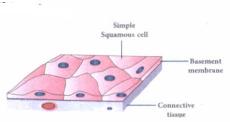
1. It is made up of thin, flat cells with prominent nuclei. These cells have irregular boundaries and bind with neighbouring cells
2. The squamous epithelium is also known as pavement membrane, which form delicate lining of the buccal cavity, alveoli of lungs, proximal tubule of kidneys, blood vessels etc
3. It protects the body from mechanical injury, drying and invasion of germs
4. It also helps in filtration by forming a selectively permeable membrane surface.
(ii) Cuboidal epithelium
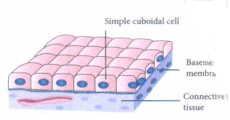
1. It is composed of single layer of cubical cells.
2. The nucleus is round and lies in the centre.
3. This tissue is present in the thyroid vesicles, salivary glands, sweat glands, exocrine pancreas etc.
4. Their main function is secretion and absorption.
(iii) Columnar epithelium
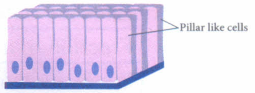
1. It is composed of a single layer of slender, elongated and pillar like cells.
2. Their nuclei are located at the base.
3. It is found lining the stomach, gall bladder, bile duct, small intestine, colon, oviducts etc.,
4. They are mainly involved in secretion and absorption.
(iv) Ciliated epithelium
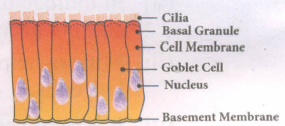
1. Certain columnar cells bear numerous delicate hair-like outgrowths called cilia and are called ciliated epithelium.
2. Their function is to move particles or mucus in a specific direction over the epithelium.
3. It is seen in the trachea of wind-pipe, bronchioles of respiratory tract, kidney tubules and fallopian tubes of oviducts.
(v) Glandular epithelium
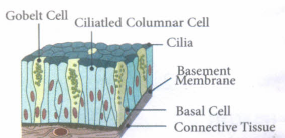
1. Epithelial cells are often modified to form specialized gland cells which secrete chemical substances at the epithelial surface.
2. Sometimes a portion of the epithelial tissue folds inward to form a multicellular gland, which lines the gastric glands, pancreatic tubules and intestinal gland
35.
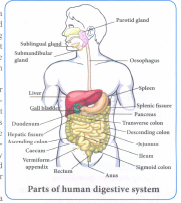
Alimentary canal of man:
Alimentary canal is a muscular coiled, tubular structure. It consists of mouth, buccal cavity, pharynx, oesophagus, stomach, small intestine (consisting of duodenum, jejunum and ileum), large intestine (consisting of caecum, colon and rectum) and anus.
Mouth: The mouth leads into the buccal cavity. The buccal cavity is a large space bound above by the palate (which separates the windpipe and food tube), below by the throat and on the sides by the jaws. The jaws bear teeth.
Teeth: Teeth are hard structures meant for holding, cutting, grinding and crushing the food. In human beings two sets of teeth (Diphyodont) are developed in their lifetime.
Each tooth has a root fitted in the gum (Thecodont). Permanent teeth are of four types (Heterodont), according to their structure and function namely incisors, canines, premolars and molars.
Dental formula represents the number of different type of teeth present in each half of a jaw (upper and lower jaw).
For Permanent teeth in each half of upper and lower jaw:
\(\cfrac { 2,1,2,3 }{ 2,1,2,3 } =16\times 2=32\)
Salivary glands: Three pairs of salivary glands are present in the mouth cavity. They are: parotid glands, sublingual glands and submaxillary or submandibular glands
i. Parotid glands are the largest salivary glands, which lie in the cheeks
ii. Sublingual glands are the smallest glands and lie beneath the tongue.
iii. Submaxillary or Submandibular glands lie at the angles of the lower Jaw.
Tongue: The tongue is a muscular, sensory organ which helps in mixing the food with the saliva.
Pharynx: The pharynx is a membrane lined cavity behind the nose and mouth, connecting them to the oesophagus. It serves as a pathway for the movement of food from mouth to oesophagus.
Oesophagus: Oesophagus or the food pipe is a muscular-membranous canal about 22 cm length. It conducts food from pharynx to the stomach by peristalsis (wave-like movement) produced by the rhythmic contraction and relaxation of the muscular walls of alimentary canal.
Stomach: The stomach is a wide J-shaped muscular organ located between oesophagus and the small intestine
Small intestine: The small intestine is the longest part of the alimentary canal, which is a long coiled tube measuring about 5 - 7 m. It comprises three parts duodenum, jejunum and ileum.
1. Duodenum is C-shaped and receives the bile duct (from liver) and pancreatic duct (from pancreas).
2. Jejunum is the middle part of the small intestine. It is a short region of the small intestine.
3. Ileum forms the lower part of the small intestine and opens into the large intestine. Ileum is the longest part of the small intestine. It contains minute finger like projections called villi (one millimeter in length) where absorption of food takes place. Internally, each villus contains fine blood capillaries and lacteal tubes. The small intestine serves both for digestion and absorption. It receives (i) the bile from liver and (ii) the pancreatic juice from pancreas in the duodenum.
Liver: It is the largest digestive gland of the body which is reddish brown in colour. Bile salts help in the digestion of fats by bringing about their emulsification (conversion of large fat droplets into small ones).
Pancreas: It is a lobed, leaf shaped gland situated between the stomach and duodenum. Pancreas acts both as an exocrine gland and as an endocrine gland.
Large intestine: The unabsorbed and undigested food is passed into the large intestine. It extends from the ileum to the anus. It is about 1.5 meters in length. It has three parts- caecum, colon and rectum .
The caecum is a small blind pouch like structure situated at the junction of the small and large intestine. From its blind end a finger-like structure called vermiform appendix arises. It is a vestigial (functionless) organ in human beings
The colon is much broader than ileum. It passes up the abdomen on the right (ascending colon), crosses to the left just below the stomach (transverse colon) and down on the left side (descending colon).
The rectum is the last part which opens into the anus. It is kept closed by a ring of muscles called anal sphincter which opens when passing stools.
36.
Features of modern periodic table:
(i) All the elements are arranged in the increasing order of their atomic number.
(ii) The horizontal rows are called periods. There are seven periods in the periodic table.
(iii) The elements are placed in periods based on the number of shells in their atoms.
(iv) Vertical columns in the periodic table starting from top to bottom are called groups. There are 18 groups in the periodic table.
(v) Based on the physical and chemical properties of elements, they are grouped into various families.

9th Standard Syllabus & Materials
9th Standard
TN 9th Tamil உள்ளத்தின் சீர் - திருக்குறள் Important Questions And Answers Study Material - QB365 Set A
NEW9th Standard
TN 9th Tamil உள்ளத்தின் சீர் - மணிமேகலை Important Questions And Answers Study Material - QB365 Set A
NEW9th Standard
TN 9th Tamil உள்ளத்தின் சீர் - ஏறு தழுவுதல் Important Questions And Answers Study Material - QB365 Set A
NEW9th Standard
TN 9th Tamil உயிருக்கு வேர் - தண்ணீர் Important Questions And Answers Study Material - QB365 Set A



Tamilnadu Stateboard 9th Standard Subjects
Tamilnadu Stateboard Standards





