
 100% FREE ACCESS
9th Standard Syllabus & Materials
9th Standard
TN 9th Tamil உள்ளத்தின் சீர் -கற்கண்டு (இலக்கணம்) - தொடர் இலக்கணம், ஆகுபெயர் Important Questions And Answers Study Material - QB365 Set A
NEW9th Standard
TN 9th Tamil உள்ளத்தின் சீர் -விரிவானம் (துணைப்பாடம்) - தாய்மைக்கு வறட்சி இல்லை! Important Questions And Answers Study Material - QB365 Set A
NEW9th Standard
TN 9th Tamil உள்ளத்தின் சீர் -கவிதை பேழை (செய்யுள்) - மார்கழி பெருவிழா Important Questions And Answers Study Material - QB365 Set A
NEW9th Standard
TN 9th Tamil உயிருக்கு வேர்-இலக்கணம் - பகுபத உறுப்பிலக்கணம் Important Questions And Answers Study Material - QB365 Set A
NEW9th Standard
TN 9th Tamil அமுதென்று பேர் - இலக்கணம்-எழுத்து -அளபெடை Important Questions And Answers Study Material - QB365 Set A
NEW9th Standard
TN 9th Tamil அமுதென்று பேர்-துணைப்பாடம் - ஆறாம்திணை Important Questions And Answers Study Material - QB365 Set A

Published on: 05/02/2020
9th Standard Science Annual Exam Model Question Paper III - 2019 - 2020
Download Tamil Nadu 9th Standard Science question papers, model tests, one-mark questions, important questions, and public exam papers in PDF format. Free study materials and answer keys for TN State Board students.
Questions + Answers key
Take MCQ Science Test1.
What is Hardware and Software?
2.
Draw magnetic field lines around a bar magnet
3.
Calculate the amount of heat required to convert 200g of ice at 00C into water at 00C Specific latent heat of fusion of ice = 336 Jg-1
4.
Illustrate the law of multiple proportion by an example.
5.
An organism A which cannot move from one place to another makes a simple food B from the substances C and D available in the environment. This food is made in the presence of green coloured substance E present in organs F in the presence of light energy in a process called G Some of the simple food B also gets converted into a complex food H for storage purposes. This food gives blue-black colour with iodine solution?
(a) What is (i) organism A (ii) food B and food H?
(b) What are C and D?
(c) Name (i) green coloured substance E and organ F.
(d) What is the process G?
6.
How do we separate cream from milk?
7.
How is the reproductive characters of mammals different from those of Aves?
8.
State the direction of incident ray which after reflection from a spherical mirror retraces its path. Give reason for your answer.
9.
Differentiate mass and weight.
10.
A Sonar device on a submarine sends out a signal and receives an echo 5 seconds later. Calculate the speed of sound in water if the distance of the object from the submarine is 3500 m.
1440 ms-1
1460 ms-1
1400 ms-1
1550 ms-1
11.
Which of the following is an high milk yielding variety of cow?
Holstein- Friesan
Dorset
Sahiwal
Red Sindhi
12.
Find out the Paid and Proprietary software from the given list
Windows
MAC OS
Adobe Photoshop
All the above
13.
Assertion (A) Electric current will not flow between two charged bodies when connected if their charges are same.
Reason (R) Current is the rate of flow of charge.
If both assertion and reason are true and reason is the correct explanation of assertion
If both assertion and reason are true but reason is not the correct explanation of assertion.
If assertion is true but reason is false
If assertion is false but reason is true.
14.
Which of the following is not a salivary gland?
Sublingual
Lachrymal
Submaxillary
Parotid
15.
Elements in the modern periodic table are arranged in__________ groups and __________ periods.
7,18
18,7
17,8
8, 17
16.
Identify the mineral which regulates nerve and muscles activity?
Iron
Iodine
Sodium
Potassium
17.
According of _______________________ of light, angle of incidence is equal to angle of reflection
refraction
dispersion
reflection
total internal reflection
18.
____________is the fundamental quantity.
Length
Area
Volume
Density
19.
_________ belongs to the generation IV of the computer
Microprocessor
Artificial intelligence
Transistor
Vacuum Tubes
20.
Change in the number of neutrons in an atom changes it to
an ion
an isotope
an isobar
another element
21.
Which one of the following is most likely not a case of uniform circular motion?
Motion of the Earth around the Sun
Motion of a toy train on a circular track
Motion of a racing car on a circular track.
Motion of hours' hand on the dial of the clock
22.
Define
a. Pisciculture
b. Apiculture
c. Vermiculture
d. Mariculture
e. Floriculture
f. Compost
g. Pomiculture
h. Pinning
23.
What is the role of RBC?
24.
Which unique feature is seen in Echinoderms?
25.
Write a note on ENIAC.
26.
1. Let us take two glass tumblers and fill one with cold water and the other with hot water.
2. Now add a drop of red ink into each of the glasses but do not stir. Observe.
3. In which glass does water turn red faster?
4. Does the rate of mixing change with temperature? What do you conclude?
27.
Write the mirror equation.
28.
What is an adulterant?
29.
Convert: 300 K into Celsius scale,
30.
What is the role played by the earthworms to improve the soil fertility? How does it adapt to light and temperature.
31.
Explain the working of Hydraulic press. Why are they called force multipliers.
32.
Name the causative agent of typhoid in human. How does the pathogen gain entry into the human body? Write the diagnostic symptoms and mention the organ that is affected in severe cases.
33.
Explain simple epithelium and its types.
34.
Explain the structure of kidney and the steps involved in the formation of urine
35.
State any five features of modern periodic table.
1.
Hardware:
Hardware is the parts of a computer which we can touch and feel. Hardware includes input and output devices, cabinet, Hard disk, Mother board, SMPS, CPU, RAM, CD Drive and graphics card.
Software:
(i) Software are programmed and coded applications to process the input information
(ii) The software processes the data by converting the input information into coding or programmed language .
(iii) Touching and feeling the software is not possible but we can see the functions of the software in the form of output.
2.
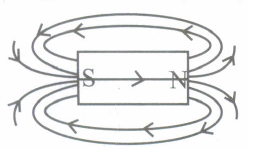
3.
Mass of ice m = 200 g
Specific latent heat of fusion of ice L = 336 Jg-1
Heat required Q = m L
= 200 x 336
Q = 67,200 J
4.
Carbon combines with an oxygen to form two oxides, carbon monoxide and carbon dioxide. The ratio of masses of oxygen in CO and CO2 for fixed mass of carbon is 1: 2.
5.
(i) Green Plants, (ii) B - Glucose, H - Starch
C = CO2 ; D = H2O
E = Chlorophyll ; F - Green leaf Photosynthesis.
6.
A separator is a high speed spinner. It acts on the same principle of centrifuge machines. The bowl spins at very high speed causing the heavier contents of milk to move outward in the bowl pushing the lighter contents inward towards the spinning axis. Cream is lighter than other components in milk. Therefore, skimmed milk which is denser than cream is collected at outer wall of the bowl. The lighter part of cream is pushed towards the centre from where it is collected through pipe.
7.
Reproductive characters of mammals differ from those of Aves by
1. The presence of mammary glands.
2. Testes lie outside the body cavity enclosed in scrotal sacs.
3. Alecithal eggs.
4. Fertilization is always internal.
5. They give birth to young ones and feed their young ones with milk.
6. Placenta is a characteristic feature of mammals.
8.
A ray of light going towards the centre of curvature is reflected back along the same path. It is a rule for construction of image formed by spherical mirrors.
9.
| Mass | Weight |
| 1. Fundamental quantity | Derived quantity |
| 2. It is a scalar quantity | It is a vector quantity |
| 3. The amount of matter contained in a body |
Normal force exerted by the surface on the object against gravitational pull |
| 4. It remains the same | Varies from place to place. |
| 5. Its unit is kilogram | Its unit is newton. |
10.
(c)
1400 ms-1
11.
(a)
Holstein- Friesan
12.
(d)
All the above
13.
(d)
If assertion is false but reason is true.
14.
(b)
Lachrymal
15.
(b)
18,7
16.
(d)
Potassium
17.
(c)
reflection
18.
(a)
Length
19.
(a)
Microprocessor
20.
(b)
an isotope
21.
(c)
Motion of a racing car on a circular track.
22.
a) Pisciculture
Pisciculture or Fish culture is the process of breeding and rearing of economically important fishes under controlled conditions in ponds, reservoirs, lakes, rivers and paddy fields.
b) Apiculture
Apiculture is the rearing of honey bee for honey. Honey bee is domesticated by farmers to produce honey.
c) Vermiculture
The artificial rearing or cultivation of earthworms for the production of vermicompost.
d) Mariculture
Culture of fishes and other aquatic organism in marine water near the sea coast.
e} Floriculture
Production of ornamental plants.
f} Compost
A decomposed organic matter which is rich in nutrients. It is a soil conditioner, fertilizer, natural pesticide.
g} Pomiculture
Growing (or) cultivation of fruits.
h} Pinning
During Mushroom cultivation, mycelium starts to form little bud, which will develop into mushroom. Those little white buds are called pins.
23.
They contain a respiratory pigment called haemoglobin which is involved in the transport of oxygen to tissues
24.
Water vascular system and tube feet.
25.
ENIAC- A computer had approximately 18,000 vacuum tubes. The size occupied by the ENIAC could be equivalent to a classroom. ENIAC, which was used by the American Military in 1946 to predict the trajectory of artillery shells, recognized as the world's first general purpose computer.
26.
Beaker with hot water turns red faster. The rate of change increases with increase in temperature.
27.
The mirror equation is \(\frac { 1 }{ f } =\frac { 1 }{ u } +\frac { 1 }{ v } \)
28.
Adulterants are undesirable substances added to the food against the food safety standards.
29.
Celsius = K - 273 = 300 - 273 = 27°C.
30.
1. Earthworms are commonly found living in soil, feeding on live and dead organic matter.
2. The faecal wastes are called worm castings which are rich in nitrogenous content adding fertility to the soil.
3. Earthworm plays a large role in keeping soil health facilitating aerators, water infiltration and producing organic matter to increase crop growth.
Adaptation to light - Nocturnality:
1. Earthworms are sensitive to light. It has no eyes but sensitive to light through light sensitive cells present in their skin.
2. They give the skin the capacity to detect light and changes its light intensity, They react negatively to bright light (Photophobic). It remains in its burrow during the day to avoid light.
Adaptation to temperature - Aestivation:
1. When the soil becomes too hot or dry, Earthworms become inactive and undergo a process called aestivation. Earthworm moves deeper into the soil. It secretes mucus and lowers their metabolic rate in order to reduce water loss.
2. They remain dormant until conditions become favourable, they come out of their burrow during rainy season. The ideal temperature range is 60 - 80°F.
31.
Hydraulic press works under the principle of Pascal's Law.
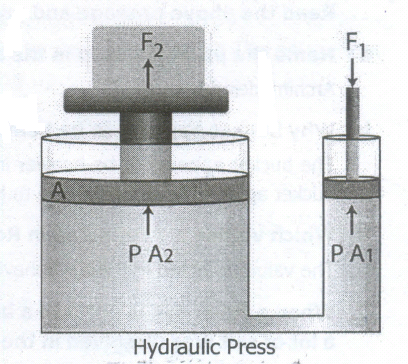
1. It consists of two cylinders of different cross-sectional area. They are fitted with pistons of cross-sectional areas 'A1' and 'A2' The object to be lifted is placed over the piston of large cross-sectional area A2.
2. The force F1 is applied on the piston of small cross-sectional area A1.
3. The pressure P produced by small piston is transmitted equally to large piston and a force F2 acts on A2 which is much larger than F1. Pressure on piston of small area 'A1' is given by
P = \(\frac { {F}_{1}}{{A}_{1}}\) ----------- (1)
Applying Pascal's law; the pressure on large piston of area A will be the same as that on small piston.
∴ P = \(\frac { {F}_{2}}{{A}_{2}}\) -------------(2)
Comparing equations (1) & (2). we get,
\(\frac { {F}_{1}}{{A}_{1}}\) = \(\frac { {F}_{2}}{{A}_{2}}\) or F2 = F1 x \(\frac { {A}_{2} }{{A}_{1}}\)
Since the ratio \(\frac { {A}_{2} }{{A}_{1}}\) is greater than 1, the force F2 that acts on the larger piston is greater than the force F1 acting on the smaller piston.
Hydraulic system working in this way are known as Force multipliers.
32.
Typhoid causative agent: Salmonella typhi
Mode of entry of the pathogen:
Through food and water contaminated with faeces of infected person and through houseflies.
Diagnostic symptoms:
High fever, weakness, abdominal pain, headache, loss of appetite, rashes on chest and upper abdomen.
Organ affected in severe cases:
Human Digestive system gets affected and the blood can carry the bacteria to other organs including the lungs, liver, gall bladder and kidneys.
33.
Simple Epithelium:
1. It is formed of single layer of cells. It forms a lining for the body cavities and ducts.
2. On the basis of structural modification of the cells, simple epithelium is further divided into following types.
(i) Squamous epithelium
(ii) Cuboidal epithelium
(iii) Columnar epithelium
(iv) Ciliated epithelium
(v) Glandular epithelium
(i) Squamous epithelium
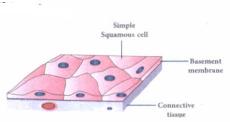
1. It is made up of thin, flat cells with prominent nuclei. These cells have irregular boundaries and bind with neighbouring cells
2. The squamous epithelium is also known as pavement membrane, which form delicate lining of the buccal cavity, alveoli of lungs, proximal tubule of kidneys, blood vessels etc
3. It protects the body from mechanical injury, drying and invasion of germs
4. It also helps in filtration by forming a selectively permeable membrane surface.
(ii) Cuboidal epithelium
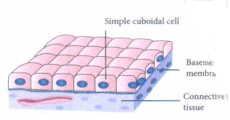
1. It is composed of single layer of cubical cells.
2. The nucleus is round and lies in the centre.
3. This tissue is present in the thyroid vesicles, salivary glands, sweat glands, exocrine pancreas etc.
4. Their main function is secretion and absorption.
(iii) Columnar epithelium
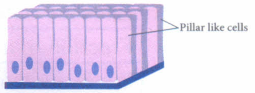
1. It is composed of a single layer of slender, elongated and pillar like cells.
2. Their nuclei are located at the base.
3. It is found lining the stomach, gall bladder, bile duct, small intestine, colon, oviducts etc.,
4. They are mainly involved in secretion and absorption.
(iv) Ciliated epithelium
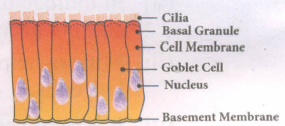
1. Certain columnar cells bear numerous delicate hair-like outgrowths called cilia and are called ciliated epithelium.
2. Their function is to move particles or mucus in a specific direction over the epithelium.
3. It is seen in the trachea of wind-pipe, bronchioles of respiratory tract, kidney tubules and fallopian tubes of oviducts.
(v) Glandular epithelium
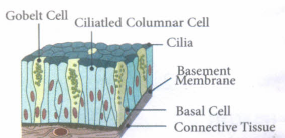
1. Epithelial cells are often modified to form specialized gland cells which secrete chemical substances at the epithelial surface.
2. Sometimes a portion of the epithelial tissue folds inward to form a multicellular gland, which lines the gastric glands, pancreatic tubules and intestinal gland
34.
Kidneys:
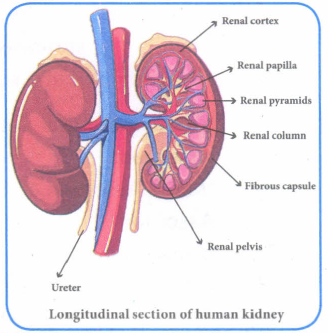
(i) Kidneys are bean-shaped organs reddish brown in colour.
(ii) The kidneys lie on either side of the vertebral column in the abdominal cavity attached to the dorsal body wall.
(iii) The right kidney is placed lower than the left kidney as the liver takes up much space on the right side.
(iv) Each kidney is about 11 cm long, 5 cm wide and 3 cm thick.
(v) Internally the kidney consists of an outer dark region, the cortex and an inner lighter region, the medulla.
(vi) The medulla consists of multitubular conical masses called the medullary pyramids or renal pyramids whose base are adjacent to cortex.
(vii) On the inner concave side of each kidney, a notch called hilum is present through which blood vessels and nerves enter in and the urine leaves through the ureter.
Process of Urine formation:
The process of urine formation includes the following three stages.
(i) Glomerular filtration
(ii) Tubular reabsorption and
(iii) Tubular secretion
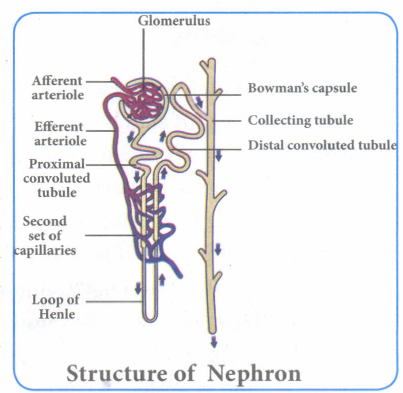
Glomerular filtration: Urine formation begins with the filtration of blood through epithelial walls of the glomerulus and Bowman's capsule. The filtrate is called as the glomerular filtrate. Both essential and non-essential substances present in the blood are filtered.
Tubular reabsorption: The filtrate in the proximal tubule consists of essential substances such as glucose, amino acids, vitamins, sodium, potassium, bicarbonates and water that are reabsorbed into the blood by a process of selective reabsorption.
Tubular secretion: Substances such as H+ or K+ ions are secreted into the tubule. Certain substances like potassium and a large number of drugs like penicillin and aspirin are passed into the filtrate in the distal convoluted tubule. This tubular filtrate is finally known as urine, which is hypertonic in man. Finally the urine passes into collecting ducts to the pelvis and through the ureter into the urinary bladder by urethral peristalsis (waves of constriction in the ureters). When the urinary bladder is full the urine is expelled out through the urethra. This process is called micturition
35.
Features of modern periodic table:
(i) All the elements are arranged in the increasing order of their atomic number.
(ii) The horizontal rows are called periods. There are seven periods in the periodic table.
(iii) The elements are placed in periods based on the number of shells in their atoms.
(iv) Vertical columns in the periodic table starting from top to bottom are called groups. There are 18 groups in the periodic table.
(v) Based on the physical and chemical properties of elements, they are grouped into various families.

9th Standard Syllabus & Materials
9th Standard
TN 9th Tamil உள்ளத்தின் சீர் - திருக்குறள் Important Questions And Answers Study Material - QB365 Set A
NEW9th Standard
TN 9th Tamil உள்ளத்தின் சீர் - மணிமேகலை Important Questions And Answers Study Material - QB365 Set A
NEW9th Standard
TN 9th Tamil உள்ளத்தின் சீர் - ஏறு தழுவுதல் Important Questions And Answers Study Material - QB365 Set A
NEW9th Standard
TN 9th Tamil உயிருக்கு வேர் - தண்ணீர் Important Questions And Answers Study Material - QB365 Set A



Tamilnadu Stateboard 9th Standard Subjects
Tamilnadu Stateboard Standards





