
 100% FREE ACCESS
9th Standard Syllabus & Materials
9th Standard
TN 9th Tamil உள்ளத்தின் சீர் -கற்கண்டு (இலக்கணம்) - தொடர் இலக்கணம், ஆகுபெயர் Important Questions And Answers Study Material - QB365 Set A
NEW9th Standard
TN 9th Tamil உள்ளத்தின் சீர் -விரிவானம் (துணைப்பாடம்) - தாய்மைக்கு வறட்சி இல்லை! Important Questions And Answers Study Material - QB365 Set A
NEW9th Standard
TN 9th Tamil உள்ளத்தின் சீர் -கவிதை பேழை (செய்யுள்) - மார்கழி பெருவிழா Important Questions And Answers Study Material - QB365 Set A
NEW9th Standard
TN 9th Tamil உயிருக்கு வேர்-இலக்கணம் - பகுபத உறுப்பிலக்கணம் Important Questions And Answers Study Material - QB365 Set A
NEW9th Standard
TN 9th Tamil அமுதென்று பேர் - இலக்கணம்-எழுத்து -அளபெடை Important Questions And Answers Study Material - QB365 Set A
NEW9th Standard
TN 9th Tamil அமுதென்று பேர்-துணைப்பாடம் - ஆறாம்திணை Important Questions And Answers Study Material - QB365 Set A

Published on: 05/02/2020
9th Standard Science Annual Exam Model Question Paper IV - 2019 - 2020
Download Tamil Nadu 9th Standard Science question papers, model tests, one-mark questions, important questions, and public exam papers in PDF format. Free study materials and answer keys for TN State Board students.
Questions + Answers key
Take MCQ Science Test1.
Differentiate Collenchyma and Sclerenchyma
2.
Which fluid fills in the body cavity?
3.
Write a note on ENIAC.
4.
Is air a pure substance or Mixture? Justify.
5.
What happens when a ray of light travels from rarer medium to the denser medium?
6.
For an atom ‘X’, K, L and M shells are completely filled. How many electrons will be present in it?
7.
What is the full form of SI system?
8.
What do you mean by Operating System? How it Works?
9.
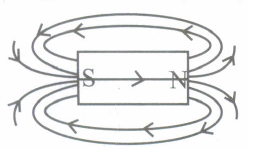
Draw magnetic field lines around a bar magnet
10.
A metal ball of heat capacity 50J/0C loses 2000 J of heat. By how much will its temperature fall?
11.
State Ohm’s law.
12.
Define quantum numbers
13.
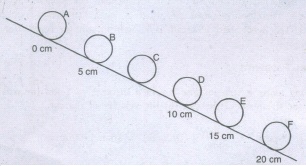
The diagram shows the position of a ball it rolls down a track - the ball took 0.5 s to roll from one position to other.
(a) State where the motion of the ball is uniform or non-uniform motion.
(b) What is the distance travelled by the ball in 2.5 s?
(c) Find the average velocity of the ball from A to F.
14.
Comment on the aquatic and terrestrial habits of amphibians.
15.
State the direction of incident ray which after reflection from a spherical mirror retraces its path. Give reason for your answer.
16.
What is the measuring unit of the thickness of a plastic carry bag?
17.
A Sonar device on a submarine sends out a signal and receives an echo 5 seconds later. Calculate the speed of sound in water if the distance of the object from the submarine is 3500 m.
1440 ms-1
1460 ms-1
1400 ms-1
1550 ms-1
18.
Which one of the following is an Italian species of honey bee?
Apis mellifera
Apis dorsata
Apis florae
Apis cerana
19.
Find out the part that is not found in CPU?
Mother Board
SMPS
RAM
Mouse
20.
If in the circuit, power dissipation is 150 W, then R - is___________
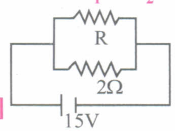
2\(\Omega \)
6\(\Omega \)
5\(\Omega \)
4\(\Omega \)
21.
To prevent the entry of food into the trachea, the opening is guarded by__________
epiglottis
glottis
hard palate
soft palate
22.
Elements in the modern periodic table are arranged in__________ groups and __________ periods.
7,18
18,7
17,8
8, 17
23.
Which vitamin causes bow legs?
Vitamin A
Vitamin C
Vitamin D
Vitamin E
24.
The point at which the rays are converged or diverged by a mirror is _____________________
pole
principal focus
principal axis
centre of curvature
25.
Many of the ancient system of measurement were based on the dimensions of___________.
Plants
Animals
Human body
God
26.
Data processing involves________ steps
seven
four
six
eight
27.
The correct electronic configuration of potassium is
2,8,9
2,8,1
2,8,8,1
2,8,8,3
28.
A car is being driven at a speed of 20 ms-1 when brakes are applied to bring it to rest in 5 s. The deceleration produced in this case will be
+4 ms-2
‒4 ms-2
‒0.25 ms-2
+0.25 ms-2
29.
There are 3 plants A, B and C. The flowers of A open their petals in bright light during the day but closes them when it gets dark at night. On the other hand, the flowers of plant B open their petals at night but closes them during the day when there is bright light. The leaves of plant C fold up and droop when touched when fingers or any other solid object.
(a) Name the phenomenon shown by the flowers of plant A and B.
(b) Name one plant each which behaves like the flowers of plant A and B.
(c) Name the phenomenon exhibited by the leaves of plant C.
(d) Name a plant which behave like those of plant C.
30.
The doctor advices an adolescent girl who is suffering from anaemia to include more of leafy vegetables and dates in her diet. Why so?
31.
List out the advantages of farm ponds.
32.
Name the instrument used to check the purity of milk. What is its principle? How does it work? Where it is used?
33.
Some human diseases are transmitted only when the blood of a patient comes in close contact with the blood of a healthy person. In one such disease, there is a progressive decrease in WBC of the patient.
a. Name the disease and its causative agent.
b. Name the type of WBC affected during infection.
c. How does the blood of a patient come in contact with blood of healthy patient?
d. Suggest three methods that help in preventing such infection.
34.
Explain simple epithelium and its types.
35.
Describe the alimentary canal of man.
36.
State any five features of modern periodic table.
1.
| Collenchyma | Sclerenchyma |
| It consists of living cells | It consists of dead cells |
| Cells contain protoplasm | Cells are empty |
| Cell walls are made of cellulose | Cell walls are lignified |
2.
Haemolymph.
3.
ENIAC- A computer had approximately 18,000 vacuum tubes. The size occupied by the ENIAC could be equivalent to a classroom. ENIAC, which was used by the American Military in 1946 to predict the trajectory of artillery shells, recognized as the world's first general purpose computer.
4.
Air is a mixture, because samples from different places give different percentage of its components.
5.
When a ray of light travels from rarer medium to the denser medium it bent towards the normal.
6.
28 Electrons.
7.
Full form of SI system is "International system of units"
8.
Operating system is a software that makes the hardware devices process the data fed by the user and to display the result on the output devices, like monitor.
Without the operating system, computer can not function on its own. Some of the popular operating system are Iinux, windows, Mac, Android etc.,
9.
10.
Heat capacity of ball = 50 J0C-1
Heat lost Q = 2000 J
Fall in temperature t = ?
Heat capacity = \(\frac { Q }{ t } \)
50 = \(\frac { 2000 }{ t } \)
t = \(\frac { 2000 }{ 50 } \)
t = 400C
11.
Ohm's law states that electric potential difference across two points in an electrical circuit is directly proportional to the current passing through it that is
V ∝ I
The proportionality constant is the resistance (R) offered between two points. Hence Ohm's law is written as
V = RI (or) V = IR
12.
The number which designate and distinguish various atomic orbitals and electrons present in an atom are called quantum numbers.
13.
(a) It is a non-uniform motion
(b) 20 cm
(c) Velocity = \(\frac { Displacement }{ time\ taken } \)
=\(\frac { Total\ distance }{ time\ taken } \)
=\(\frac { 20\times 10^{ -2 } }{ 2.5 } \)
= \(\frac { 2 }{ 2.5 } \) = 0.08 m/s (or) cm/s.
14.
Aquatic habits of amphibians:
1. The larva of amphibians (tadpole) lives in water and breathes with gills.
2. External fertilization occurs in frog with water as a medium of fertilization.
3. The adult frog has webbed feet to swim in water
4. The skin is moist and glandular which helps in Respiration.
Terrestrial habits of amphibians:
1. The adult live on land and breathe through lungs. Bucco-Pharynx also helps in respiration.
2. The fore limbs are short and help to hop on land.
15.
A ray of light going towards the centre of curvature is reflected back along the same path. It is a rule for construction of image formed by spherical mirrors.
16.
The measuring unit of the thickness of a plastic carry bag is micron.
17.
(c)
1400 ms-1
18.
(a)
Apis mellifera
19.
(d)
Mouse
20.
(b)
6\(\Omega \)
21.
(a)
epiglottis
22.
(b)
18,7
23.
(c)
Vitamin D
24.
(b)
principal focus
25.
(c)
Human body
26.
(c)
six
27.
(c)
2,8,8,1
28.
(a)
+4 ms-2
29.
(a) Photonasty phenomenon is shown by the flowers of plant A and B.
(b) A- Taraxacum officinale (common dandelion). B- Ipomoea alba (moon flower).
(c) Seismonasty or thigmonasty is exhibited by the leaves of plant C.
(d) Mimosa pudica leaves behave like those of plant C.
30.
The adolescent girl affected by Anaemia blood contain Haemoglobin is very low because she takes very less amount of micro-nutrients like iron. So doctor advised to her to take leafy vegetables and dates. It contain large amount of Iron.
31.
1. They provide water to growing crops, without waiting for rainfall.
2. They provide water for irrigation even when there is no rain.
3. They reduce soil erosion.
4. They recharge ground water.
5. They improve drainage.
6. The excavated soil can be used to enrich soil in fields and ·Ievelling lands.
7. They promote fish rearing.
8. They provide water for domestic purposes and livestock.
32.
1. The instrument used to measure the purity of milk is Lactometer.
2. Lactometer works on the principle of gravity of milk.
Working:
1. The lactometer consists of a long graduated test tube with a cylindrical bulb with the graduation ranging from 15 at the top to 45 at the bottom. The test tube is filled with air. This air chamber causes the instrument to float.
2. The spherical bulb is filled with mercury to cause the lactometer to sink up to the proper level and to float in an upright position in the milk.
3. Inside the lactometer there may be a thermometer extending from the bulb up into the upper part of the test tube where the scale is located.
4. The correct lactometer reading is obtained only at the temperature of 60oC.
5. A lactometer measures the cream content of milk. More the cream, lower the lactometer floats in the milk. The average reading of normal milk is 32.
6. Lactometers are used highly at milk processing units and at the dairies.
33.
In one such disease, there is a progressive decrease in WBC of the patient.
a) Name the disease and its causative agent.
Name of the disease : AIDS
Causative agent :. HIV - Human immuno deficiency virus
b) Name the type of WBC affected during infection.
Type of WBC affected by HIV : T-Iymphocytes
c) How does the blood of a patient come in contact with blood of healthy patient?
Mode of Transmission : Sexual contact, transfusion of unscreened blood, by surgical equipments from infected mother to the foetus.
d) Suggest three methods that help in preventing such infection.
Prevention :
1. Disposable syringes and needles should be used .
2. Protected and safe sexual contact.
3. Screening of blood before blood transfusion .
4. Avoid sharing shaving blades/razors.
34.
Simple Epithelium:
1. It is formed of single layer of cells. It forms a lining for the body cavities and ducts.
2. On the basis of structural modification of the cells, simple epithelium is further divided into following types.
(i) Squamous epithelium
(ii) Cuboidal epithelium
(iii) Columnar epithelium
(iv) Ciliated epithelium
(v) Glandular epithelium
(i) Squamous epithelium
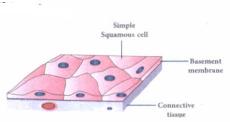
1. It is made up of thin, flat cells with prominent nuclei. These cells have irregular boundaries and bind with neighbouring cells
2. The squamous epithelium is also known as pavement membrane, which form delicate lining of the buccal cavity, alveoli of lungs, proximal tubule of kidneys, blood vessels etc
3. It protects the body from mechanical injury, drying and invasion of germs
4. It also helps in filtration by forming a selectively permeable membrane surface.
(ii) Cuboidal epithelium
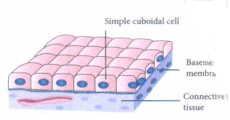
1. It is composed of single layer of cubical cells.
2. The nucleus is round and lies in the centre.
3. This tissue is present in the thyroid vesicles, salivary glands, sweat glands, exocrine pancreas etc.
4. Their main function is secretion and absorption.
(iii) Columnar epithelium
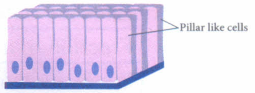
1. It is composed of a single layer of slender, elongated and pillar like cells.
2. Their nuclei are located at the base.
3. It is found lining the stomach, gall bladder, bile duct, small intestine, colon, oviducts etc.,
4. They are mainly involved in secretion and absorption.
(iv) Ciliated epithelium
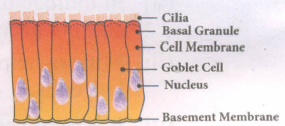
1. Certain columnar cells bear numerous delicate hair-like outgrowths called cilia and are called ciliated epithelium.
2. Their function is to move particles or mucus in a specific direction over the epithelium.
3. It is seen in the trachea of wind-pipe, bronchioles of respiratory tract, kidney tubules and fallopian tubes of oviducts.
(v) Glandular epithelium
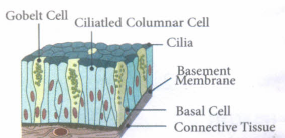
1. Epithelial cells are often modified to form specialized gland cells which secrete chemical substances at the epithelial surface.
2. Sometimes a portion of the epithelial tissue folds inward to form a multicellular gland, which lines the gastric glands, pancreatic tubules and intestinal gland
35.
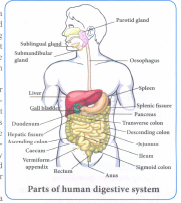
Alimentary canal of man:
Alimentary canal is a muscular coiled, tubular structure. It consists of mouth, buccal cavity, pharynx, oesophagus, stomach, small intestine (consisting of duodenum, jejunum and ileum), large intestine (consisting of caecum, colon and rectum) and anus.
Mouth: The mouth leads into the buccal cavity. The buccal cavity is a large space bound above by the palate (which separates the windpipe and food tube), below by the throat and on the sides by the jaws. The jaws bear teeth.
Teeth: Teeth are hard structures meant for holding, cutting, grinding and crushing the food. In human beings two sets of teeth (Diphyodont) are developed in their lifetime.
Each tooth has a root fitted in the gum (Thecodont). Permanent teeth are of four types (Heterodont), according to their structure and function namely incisors, canines, premolars and molars.
Dental formula represents the number of different type of teeth present in each half of a jaw (upper and lower jaw).
For Permanent teeth in each half of upper and lower jaw:
\(\cfrac { 2,1,2,3 }{ 2,1,2,3 } =16\times 2=32\)
Salivary glands: Three pairs of salivary glands are present in the mouth cavity. They are: parotid glands, sublingual glands and submaxillary or submandibular glands
i. Parotid glands are the largest salivary glands, which lie in the cheeks
ii. Sublingual glands are the smallest glands and lie beneath the tongue.
iii. Submaxillary or Submandibular glands lie at the angles of the lower Jaw.
Tongue: The tongue is a muscular, sensory organ which helps in mixing the food with the saliva.
Pharynx: The pharynx is a membrane lined cavity behind the nose and mouth, connecting them to the oesophagus. It serves as a pathway for the movement of food from mouth to oesophagus.
Oesophagus: Oesophagus or the food pipe is a muscular-membranous canal about 22 cm length. It conducts food from pharynx to the stomach by peristalsis (wave-like movement) produced by the rhythmic contraction and relaxation of the muscular walls of alimentary canal.
Stomach: The stomach is a wide J-shaped muscular organ located between oesophagus and the small intestine
Small intestine: The small intestine is the longest part of the alimentary canal, which is a long coiled tube measuring about 5 - 7 m. It comprises three parts duodenum, jejunum and ileum.
1. Duodenum is C-shaped and receives the bile duct (from liver) and pancreatic duct (from pancreas).
2. Jejunum is the middle part of the small intestine. It is a short region of the small intestine.
3. Ileum forms the lower part of the small intestine and opens into the large intestine. Ileum is the longest part of the small intestine. It contains minute finger like projections called villi (one millimeter in length) where absorption of food takes place. Internally, each villus contains fine blood capillaries and lacteal tubes. The small intestine serves both for digestion and absorption. It receives (i) the bile from liver and (ii) the pancreatic juice from pancreas in the duodenum.
Liver: It is the largest digestive gland of the body which is reddish brown in colour. Bile salts help in the digestion of fats by bringing about their emulsification (conversion of large fat droplets into small ones).
Pancreas: It is a lobed, leaf shaped gland situated between the stomach and duodenum. Pancreas acts both as an exocrine gland and as an endocrine gland.
Large intestine: The unabsorbed and undigested food is passed into the large intestine. It extends from the ileum to the anus. It is about 1.5 meters in length. It has three parts- caecum, colon and rectum .
The caecum is a small blind pouch like structure situated at the junction of the small and large intestine. From its blind end a finger-like structure called vermiform appendix arises. It is a vestigial (functionless) organ in human beings
The colon is much broader than ileum. It passes up the abdomen on the right (ascending colon), crosses to the left just below the stomach (transverse colon) and down on the left side (descending colon).
The rectum is the last part which opens into the anus. It is kept closed by a ring of muscles called anal sphincter which opens when passing stools.
36.
Features of modern periodic table:
(i) All the elements are arranged in the increasing order of their atomic number.
(ii) The horizontal rows are called periods. There are seven periods in the periodic table.
(iii) The elements are placed in periods based on the number of shells in their atoms.
(iv) Vertical columns in the periodic table starting from top to bottom are called groups. There are 18 groups in the periodic table.
(v) Based on the physical and chemical properties of elements, they are grouped into various families.

9th Standard Syllabus & Materials
9th Standard
TN 9th Tamil உள்ளத்தின் சீர் - திருக்குறள் Important Questions And Answers Study Material - QB365 Set A
NEW9th Standard
TN 9th Tamil உள்ளத்தின் சீர் - மணிமேகலை Important Questions And Answers Study Material - QB365 Set A
NEW9th Standard
TN 9th Tamil உள்ளத்தின் சீர் - ஏறு தழுவுதல் Important Questions And Answers Study Material - QB365 Set A
NEW9th Standard
TN 9th Tamil உயிருக்கு வேர் - தண்ணீர் Important Questions And Answers Study Material - QB365 Set A



Tamilnadu Stateboard 9th Standard Subjects
Tamilnadu Stateboard Standards





