
 100% FREE ACCESS
9th Standard Syllabus & Materials
9th Standard
TN 9th Tamil உள்ளத்தின் சீர் -கற்கண்டு (இலக்கணம்) - தொடர் இலக்கணம், ஆகுபெயர் Important Questions And Answers Study Material - QB365 Set A
NEW9th Standard
TN 9th Tamil உள்ளத்தின் சீர் -விரிவானம் (துணைப்பாடம்) - தாய்மைக்கு வறட்சி இல்லை! Important Questions And Answers Study Material - QB365 Set A
NEW9th Standard
TN 9th Tamil உள்ளத்தின் சீர் -கவிதை பேழை (செய்யுள்) - மார்கழி பெருவிழா Important Questions And Answers Study Material - QB365 Set A
NEW9th Standard
TN 9th Tamil உயிருக்கு வேர்-இலக்கணம் - பகுபத உறுப்பிலக்கணம் Important Questions And Answers Study Material - QB365 Set A
NEW9th Standard
TN 9th Tamil அமுதென்று பேர் - இலக்கணம்-எழுத்து -அளபெடை Important Questions And Answers Study Material - QB365 Set A
NEW9th Standard
TN 9th Tamil அமுதென்று பேர்-துணைப்பாடம் - ஆறாம்திணை Important Questions And Answers Study Material - QB365 Set A

Published on: 30/07/2019
Atomic Structure
Download Tamil Nadu 9th Standard Science question papers, model tests, one-mark questions, important questions, and public exam papers in PDF format. Free study materials and answer keys for TN State Board students.
Questions + Answers key
Take MCQ Science Test1.
Explain the postulates of Bohr’s atomic model.
2.
Hydrogen sulphide (H2S) contains 94.11% sulphur, water (H2O) contains 11.11% hydrogen and sulphur dioxide (SO2) contains 50% of oxygen. Show that the results are in agreement with the law of reciprocal proportions
3.
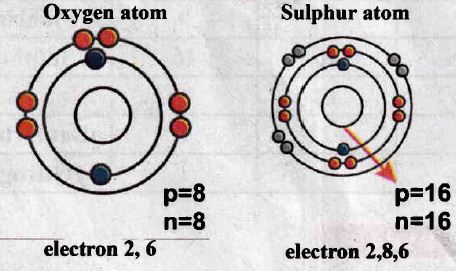
Draw the structure of oxygen and sulphur atoms.
4.
List the uses of isotopes?
5.
Methane burns in oxygen to form carbon dioxide and water vapour as given by the equation
CH4(g) + 2O2(g) ➝ CO2(g)+ 2H2O(g)
Calculate: (i) the volume of oxygen needed to burn completely 50 cm3 of methane and (ii) the volume of carbon dioxide formed in this case.
6.
An alpha particle is identical with a ___________Nucleus.
Argon
Chlorine
Neon
Helium
7.
Law of multiple proportions was proposed by _________
J. Richter
Rutherford
John Dalton
J.J Thomson
8.
The correct electronic configuration of potassium is
2,8,9
2,8,1
2,8,8,1
2,8,8,3
9.
The term nucleons refer to
Protons and electrons
only Neutrons
electrons and neutrons
Protons and neutrons
10.
Among the following the odd pair is
8O18,9F19
18Ar40,7N14
14Si30, 15P31
24Cr54, 19K39
11.
Orbit is the path by which electrons revolve around the nucleus.
12.
Atoms of an element combine in small whole numbers to form molecules.
13.
The maximum number of electron in L Shell is 10
14.
Smaller the size of the orbit, lower is the energy of the orbit
15.
In an atom, electrons revolve around the nucleus in fixed orbits
16.
__________has no neutron.
17.
Matter consists of very small and indivisible particles called________
18.
The law of reciprocal proportions was proposed by
19.
The valency of Argon is ________
20.
_________ isotope is used in the nuclear reactors.
21.
Calcium and Argon are examples of a pair of __________
22.
Law of combining volumes
23.
Law of multiple proportion·
24.
Mass of proton
25.
Rutherford
26.
Dalton
27.
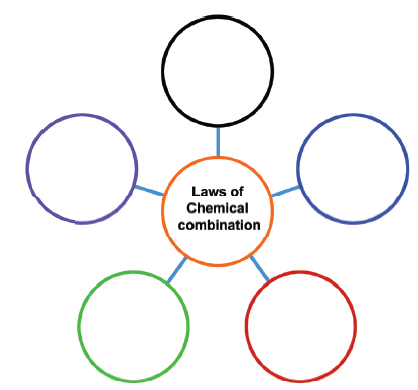
Copy the following and write the names of the laws and their simple definitions in the space provided.
28.
Arrange the following in the increasing order of atomic number
Calcium, Silicon, Boron, Magnesium, Oxygen, Helium, Neon, Sulphur, Fluorine and Sodium
29.
Ca2+ has completely filled outer shell. Justify your answer
30.
Compare the charge and mass of protons and electrons.
31.
Name an element which has the same number of electrons in its first and second shell
1.
(i) In atoms, electrons revolve around the nucleus in certain special or permissible orbits known as discrete orbits or shells or energy levels.
(ii) While revolving in these discrete orbits the electrons do not radiate energy.
(iii) The circular orbits are numbered as 1, 2, 3, 4, ... or designated as K, L, M, N, shells. These numbers are referred to as principal quantum numbers (n)
(iv) K shell (n = 1) is closest to the nucleus and is associated with lowest energy. L, M, N, .... etc are the next higher energy levels. As the distance from the nucleus increases the energy of the shells also increases.
(v) The energy of each orbit or shell is a fixed quantity and the energy is quantized.
(vi) As the distance from the nucleus increases, the size of the orbits also increases.
(vii) Maximum number of electrons that can be accommodated in an energy level is given by 2n2 where n is the principal quantum number of the orbit.
(viii) When an electron absorbs energy, it jumps from lower energy level to higher energy level.
(ix) When an electron returns from higher energy level to lower energy level, it gives off energy.
2.
In 100g of water, the weight of hydrogen = 11.11 g
The weight of oxygen = 100 – 11.11 = 88.89 g
In 100g of sulphur dioxide, the weight of sulphur = 50 g
Weight of oxygen = 100 – 50 = 50 g
The ratio between the weight of oxygen and Hydrogen is 88.89:11.11 i.e. 8:1 ..... (1)
In hydrogen sulphide, the weight of sulphur = 94.11 g
The weight of hydrogen = 100 – 94.11 = 5.89 g
The ratio between the weight of sulphur and hydrogen is 94.11: 5.89 ie. 16: 1 ..... (2)
The two ratios 1 and 2 are related as 8/1: 16/1 (or) 1: 2
These are simple multiples of each other. The ratio between the weight of sulphur (32) and oxygen (16) which combine separately with the weight of Hydrogen (2) supports the law of reciprocal proportions
3.
4.
Uses of radioactive isotopes:
1. Uranium 235 is used as fuel in nuclear reactor.
2. Cobalt 60 is used in the treatment of cancer.
3. Iodine 131 is used in the treatment of goitre.
4. C-14 is used in carbon dating.
5.
CH4(g) +2O2(g) → CO2(g) +2H2O(g)
1 2 1 2
volume volumes volumes volumes
1x 2x 1x 2x
50cm3 50cm3 50cm3 50cm3
50cm3 100cm3 50cm3 100cm3
Volume of oxygen used = 100 cm3
Volume of carbon dioxide formed = 50 cm3
6.
(d)
Helium
7.
(c)
John Dalton
8.
(c)
2,8,8,1
9.
(d)
Protons and neutrons
10.
(d)
24Cr54, 19K39
11.
(a)
12.
(a)
13.
(b)
14.
(a)
15.
(a)
16.
()
Hydrogen
17.
()
Atoms
18.
()
Jeremias Richter
19.
()
zero
20.
()
Uranium-235
21.
()
isobars
22.
Gay Lussac
23.
John Dalton
24.
1.67 x 10⁻²⁴g
25.
Discovery of nucleus
26.
First atomic theory
27.
1. Laws of conservation of mass:
In a chemical change the total mass of the reactant is equal to the total mass of the products.
2. Law of definite proportion:
"A pure chemical compound prepared by any method consists of the same elements combined together in the fixed proportion by mass".
3. Law of multiple proportion:
When two elements A and B combine together to form more than one compound, then masses of A which separately combines with a fixed mass of B are in simple ratio.
4. Laws of Reciprocal proportion:
"If two elements combine separately the same weight of a third element, the ratios of the masses in which they do so are either the same or a simple multiple of the mass ratio in which they combine.
5. Gay Lussac's law of combining volumes:
Whenever gases react together, the volumes of the reacting gases as well as the products bear a simple whole number ratio, provided all the volumes are measured under similar conditions of temperature and pressure.
28.
The elements in the increasing order of atomic no.
Helium, Boron, Oxygen, Neon, Sodium, Magnesium, Calcium, Silicon, Sulphur.
29.
Atomic number of calcium is 20. When it loses 2 electrons Ca2+ is formed.
\(Ca\quad -\quad 2e\quad \longrightarrow \quad C{ a }^{ +2 }\)
2,8,8,2 2,8,8
According to Bohr and Bury rule the outermost shell cannot have more than 8 electrons. So Ca2+ has completely filled outer shell.
30.
| Particle | Mass | Charge |
| Proton | 1.672 x 10⁻²⁴ g | 1.602 x 10⁻¹⁹ C |
| Electron | 9.108 x 10⁻²⁸ g | -1.602 x 10⁻¹⁹ |
31.
Beryllium.

9th Standard Syllabus & Materials
9th Standard
TN 9th Tamil உள்ளத்தின் சீர் - திருக்குறள் Important Questions And Answers Study Material - QB365 Set A
NEW9th Standard
TN 9th Tamil உள்ளத்தின் சீர் - மணிமேகலை Important Questions And Answers Study Material - QB365 Set A
NEW9th Standard
TN 9th Tamil உள்ளத்தின் சீர் - ஏறு தழுவுதல் Important Questions And Answers Study Material - QB365 Set A
NEW9th Standard
TN 9th Tamil உயிருக்கு வேர் - தண்ணீர் Important Questions And Answers Study Material - QB365 Set A



Tamilnadu Stateboard 9th Standard Subjects
Tamilnadu Stateboard Standards





