
 100% FREE ACCESS
9th Standard Syllabus & Materials
9th Standard
TN 9th Tamil உள்ளத்தின் சீர் -கற்கண்டு (இலக்கணம்) - தொடர் இலக்கணம், ஆகுபெயர் Important Questions And Answers Study Material - QB365 Set A
NEW9th Standard
TN 9th Tamil உள்ளத்தின் சீர் -விரிவானம் (துணைப்பாடம்) - தாய்மைக்கு வறட்சி இல்லை! Important Questions And Answers Study Material - QB365 Set A
NEW9th Standard
TN 9th Tamil உள்ளத்தின் சீர் -கவிதை பேழை (செய்யுள்) - மார்கழி பெருவிழா Important Questions And Answers Study Material - QB365 Set A
NEW9th Standard
TN 9th Tamil உயிருக்கு வேர்-இலக்கணம் - பகுபத உறுப்பிலக்கணம் Important Questions And Answers Study Material - QB365 Set A
NEW9th Standard
TN 9th Tamil அமுதென்று பேர் - இலக்கணம்-எழுத்து -அளபெடை Important Questions And Answers Study Material - QB365 Set A
NEW9th Standard
TN 9th Tamil அமுதென்று பேர்-துணைப்பாடம் - ஆறாம்திணை Important Questions And Answers Study Material - QB365 Set A

Published on: 31/07/2019
Living World of Plants - Plant Physiology
Download Tamil Nadu 9th Standard Science question papers, model tests, one-mark questions, important questions, and public exam papers in PDF format. Free study materials and answer keys for TN State Board students.
Questions + Answers key
Take MCQ Science Test1.
Maize plant transpire _____________ gallons of water during its life span.
34
44
64
54
2.
Sunflower follows the path of the sun from__________________.
south to north
North to south
East to West
west to east.
3.
Transpiration takes place through _____________.
fruit
seed
flower
stomata
4.
Dandelion flowers open the petals in bright light during the day time but close the petals in dark at night. This response of Dandelion flowers is called ___________.
geonasty
thigmonasty
chemonasty
photonasty
5.
The root of the plant is __________.
i) positively phototropic but negatively geotropic
ii) positively geotropic but negatively phototropic
iii) negatively phototropic but positively hydrotropic
iv) negatively hydrotropic but positively phototropic
(i) and (ii)
(ii) and (iii)
(iii) and (iv)
(i) and (iv)
6.
The bending of root of a plant in response to water is called _________
thigmonasty
phototropism
hydrotropism
photonasty
7.
The chemical reaction occurs during photosynthesis is ________.
CO2 is reduced and water is oxidized
water is reduced and CO2 is oxidized
both CO2 and water are oxidized
both CO2 and water are produced
8.
A big tree falls in a forest but its roots are still in contact with the soil. The branches of this fallen tree straight up. This happens in response to __________
water and light
water and minerals
gravity and water
light and gravity
9.
Shoots are said to have negative phototropism while the roots have positive phototropism
10.
The stalk of the Helianthus annuus follows the path of the sun from dawn to dusk and during night it moves from west to east.
11.
Plants lose water when the stomata on leaves are closed.
12.
When the weather is hot, water evaporates lesser which is due to opening of stomata.
13.
The response of a part of plant to the chemical stimulus is called phototropism.
14.
The leaves of __________closes on touching.
15.
Plants utilize only _______% of the absorbed water for photosynthesis and the other activities.
16.
When iodine solution is added for testing starch, part of the leaf with _______ turn blue-black colour.
17.
The response of a plant part towards gravity is __________.
18.
Towards a stimulus :_____________ Away from the stimulus : Negative tropism.
19.
The shoot system grows upward in response to ___________.
20.
Fill in the blanks:
6CO2+________\(\overset { Sunlight }{ \underset { Chlorophyll }{ \longrightarrow } } \) _____ +6H2O+6O2 \(\uparrow\)
21.
What is the other name for thigmonasty?
22.
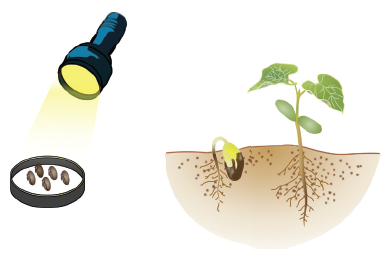
Study the pictures below and then complete the table by putting a plus (+) if the shoot or root grows towards the stimulus and a minus (-) if it grows away from it.
| Stimulus | Light | Gravity |
|---|---|---|
| Shoot | + | - |
| Root | ? | + |
23.
What is the end product of photosynthesis?
24.
Give an example for a plant whose leaf shows a mesmerizing movement.
25.
Give one example of the insect which traps solar energy
26.
What does "photosynthesis" literally mean?
27.
Name the types of tropisms in plants.
28.
Which is a mesmerizing plant?
29.
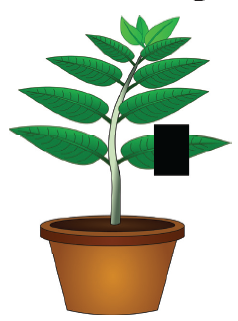
In the given photosynthetic experiment, what will happen to the leaf closed with black paper in starch test? Why?
30.
Define photosynthesis.
31.
Define transpiration.
32.
What is nastic movement?
33.
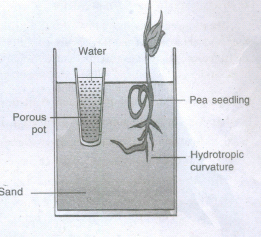
Design an experiment to demonstrate hydrotropism.
1.
(d)
54
2.
(c)
East to West
3.
(d)
stomata
4.
(d)
photonasty
5.
(b)
(ii) and (iii)
6.
(c)
hydrotropism
7.
(a)
CO2 is reduced and water is oxidized
8.
(a)
water and light
9.
(b)
10.
(a)
11.
(b)
12.
(b)
13.
(b)
14.
()
Mimosa pudica
15.
()
1
16.
()
Starch
17.
()
Geotropism or Gravitropism
18.
()
positive tropism
19.
()
Light
20.

21.
The other for thigmonasty is seismonasty
22.
'-'
23.
Glucose.
24.
Non-directional response of a plants part to stimulus is known as nastic movement.
25.
Vespa Orientalis
26.
"Photosynthesis" literally means building up with the help of light.
27.
1. Phototropism
2. Geotropism
3. Hydrotropism
4. Thigmotropism
5. Chemotropism.
28.
Desmodium gyrans is a mesmerizing plant. It is also called as dancing plant
29.
The covered part of the leaf does not turn blue-black because the leaf did not receive the sunlight and unable to synthesize starch.
30.
'Photo' means 'light' and 'synthesis' means 'to build' thus photosynthesis literally means "building up with the help of light". During this process, the light energy is converted into chemical energy. Green plants are autotrophic in their mode of nutrition because they prepare their food materials through a process called photosynthesis.
31.
The loss of water in the form of water vapour from the aerial parts of the plant body is called transpiration.
32.
In plants the movement of opening and closing of the flowers are not directed towards stimuli. Such movement in plants are called as Nastic movements.
33.
Materials required: Glass trough, sand, flower pot, plugged at the bottom, pea or bean seeds and water.
Procedure:
1. A glass trough is taken and is filled with sand. A flower pot containing water, plugged at the bottom is kept at the centre of the glass trough.
2. Soaked pea or bean seeds are placed around the pot in the sand, what do we observe after 6 or 7 days?
Observation: It will be observed that radicle has grown towards the pot and moisture instead of growing vertically downward.
Inference: It proves that primary root is positively hydrotropic.

9th Standard Syllabus & Materials
9th Standard
TN 9th Tamil உள்ளத்தின் சீர் - திருக்குறள் Important Questions And Answers Study Material - QB365 Set A
NEW9th Standard
TN 9th Tamil உள்ளத்தின் சீர் - மணிமேகலை Important Questions And Answers Study Material - QB365 Set A
NEW9th Standard
TN 9th Tamil உள்ளத்தின் சீர் - ஏறு தழுவுதல் Important Questions And Answers Study Material - QB365 Set A
NEW9th Standard
TN 9th Tamil உயிருக்கு வேர் - தண்ணீர் Important Questions And Answers Study Material - QB365 Set A



Tamilnadu Stateboard 9th Standard Subjects
Tamilnadu Stateboard Standards





