
 100% FREE ACCESS
9th Standard Syllabus & Materials
9th Standard
TN 9th Tamil உள்ளத்தின் சீர் -கற்கண்டு (இலக்கணம்) - தொடர் இலக்கணம், ஆகுபெயர் Important Questions And Answers Study Material - QB365 Set A
NEW9th Standard
TN 9th Tamil உள்ளத்தின் சீர் -விரிவானம் (துணைப்பாடம்) - தாய்மைக்கு வறட்சி இல்லை! Important Questions And Answers Study Material - QB365 Set A
NEW9th Standard
TN 9th Tamil உள்ளத்தின் சீர் -கவிதை பேழை (செய்யுள்) - மார்கழி பெருவிழா Important Questions And Answers Study Material - QB365 Set A
NEW9th Standard
TN 9th Tamil உயிருக்கு வேர்-இலக்கணம் - பகுபத உறுப்பிலக்கணம் Important Questions And Answers Study Material - QB365 Set A
NEW9th Standard
TN 9th Tamil அமுதென்று பேர் - இலக்கணம்-எழுத்து -அளபெடை Important Questions And Answers Study Material - QB365 Set A
NEW9th Standard
TN 9th Tamil அமுதென்று பேர்-துணைப்பாடம் - ஆறாம்திணை Important Questions And Answers Study Material - QB365 Set A

Published on: 18/01/2019
9th Science - Sound and Universe Complete Material
Download Tamil Nadu 9th Standard Science question papers, model tests, one-mark questions, important questions, and public exam papers in PDF format. Free study materials and answer keys for TN State Board students.
Questions + Answers key
Take MCQ Science Test1.
The Big Bang occurred ________ years ago.
13.7 billion
15 million
15 billion
20 million
2.
The period of revolution of planet A around the Sun is 8 times that of planet B. How many times is the distance of planet A as great as that of planet B?
4
5
2
3
3.
Ceres is a _______.
Meteor
Star
Planet
Asteroid
4.
Which of the following is not a part of outer solar system?
Mercury
Saturn
Uranus
Neptune
5.
Who proposed the heliocentric model of the universe?
Tycho Brahe
Nicolaus Copernicus
Ptolemy
Archimedes
6.
The velocities of sound waves in four media P, Q, R and S are 1800 km/h, 900 km/h, 0 km/h, and 1200 km/h respectively. Which could be a liquid medium?
R
Q
P
S
7.
Which of the following can produce longitudinal waves as well as transverse waves under different conditions?
TV transmitter
tuning fork
water
slinky
8.
When the pitch of note by a harmonium is lowered, then the wave length of the note
first decreases and then increases
decreases
remains the same
increases
9.
The sound waves travel faster
in liquids
in gases
in solids
in vacuum
10.
The maximum speed of vibrations which produces audible sound will be in
seawater
ground glass
dry air
Human blood
11.
Which of the following statement best describes frequency?
the number of complete vibrations per second.
the distance travelled by a wave per second.
the distance between one crest of wave and the next one.
the maximum disturbance caused by a wave.
12.
If the speed of a wave is 340 m s-1 and its frequency is 1700 Hz, then wavelength λ for this wave in cm will be
34
20
15
0.2
13.
A musical instrument is producing continuous note. This note cannot be heard by a person having a normal hearing range. This note must then be passing through
wax
vacuum
water
empty vessel
14.
Sound travels in air:
if there is no moisture in the atmosphere.
if particles of medium travel from one place to another.
if both particles as well as disturbance move from one place to another.
if disturbance moves.
15.
Which of the following vibrates when a musical note is produced by the cymbals in an orchestra?
stretched strings
stretched membranes
air columns
metal plates
16.
The third law of Kepler is also known as the Law of ________.
17.
The rotational period of the Sun near its poles is ________.
18.
A sound wave has a frequency of 4 kHz and wavelength 2 m. Then the velocity of sound is ____________ .
19.
The velocity of sound in solid is ____________ than the velocity of sound in air.
20.
Vibration of object produces_________.
21.
What factors have made life on Earth possible?
22.
Write short notes on Gaganyaan
23.
State Kepler’s laws.
24.
Write about comets.
25.
Write a note on the inner planets
26.
How does the sound produced by a vibrating object in a medium reach your ears?
27.
What is meant by supersonic speed?
28.
Name the physical quantity whose SI unit is ‘hertz’. Define.
29.
Can sound travel through vacuum?
30.
What should an object do to produce sound?
31.
Through which medium sound travels faster, iron or water? Give reason.
32.
Name the device which is used to produce sound in laboratory experiments.
33.
Write a note on orbital velocity.
34.
Give an account of all the planets in the solar system.
35.
Explain the working of human ear with diagram.
36.
List the applications of sound.
37.
Verify experimentally the laws of reflection of sound.
38.
At an orbital height of 400 km, find the orbital period of the satellite.
39.
A stone is dropped from the top of a tower 750 m high into a pond of water at the base of the tower. Calculate the number of seconds for the splash to be heard?
(Given g = 10 m s–2 and speed of sound = 340 m s–1)
40.
The frequency of a source of sound is 600 Hz. Calculate the number of times it
vibrates in a minute?
41.
What is a satellite? What are the two types of satellites?
42.
Define time period of a satellite.
43.
Define orbital velocity.
44.
What is a cosmic year?
45.
What is the solar system?
1.
(a)
13.7 billion
2.
(a)
4
3.
(d)
Asteroid
4.
(a)
Mercury
5.
(b)
Nicolaus Copernicus
6.
(d)
S
7.
(a)
TV transmitter
8.
(d)
increases
9.
(c)
in solids
10.
(b)
ground glass
11.
(a)
the number of complete vibrations per second.
12.
(b)
20
13.
(b)
vacuum
14.
(d)
if disturbance moves.
15.
(d)
metal plates
16.
()
harmonics
17.
()
more
18.
()
800 m/s or 8000 rns-1
19.
()
faster
20.
()
sound
21.
1. The earth is the only planet in the solar system which supports life .
2. Due to its right distance from the sun, it has the right temperature, the presence of water and suitable atmosphere and a blanket of ozone.
3. All these factors have made continuation of life possible on the Earth.
22.
Gaganyaan is an Indian crewed orbital space craft.
1. It is India's first manned spaceflight is expected to send three persons into the space for seven days
2. This spacecraft will be placed in a low earth orbit of 300 - 400 kms.
3. GSLV MK - III, the three stage heavy lift launch vehicle, will be used to launch gaganyaan, as it has the necessary payload capability.
4. The programme is expected to be completed before 2022 and is expected to cost less than 10,000 crore.
23.
Kepler's three laws of planetary motion.
First Law: The Law of Ellipses
The path of the planets about the Sun is elliptical in shape, with the center of the Sun being located at one of the foci.
Second Law: The Law of Equal areas.
An imaginary line drawn from the center of the Sun to the center of the planet will sweep out equal areas in equal intervals of time.
Third Law: The Law of Harmonies
The ratio of the squares of the periods of any two planets is equal to the ratio of the cubes of their semi major axis from the Sun.
24.
1. Comets are lumps of dust and ice that revolve around the Sun in highly elliptical orbits. Their period of revolution is very long .
2. When approaching the Sun, a comet vaporizes and forms a head and tail .
3. Some of the biggest comets had tails of length 160 million km long .
4. Many comets are known to appear periodically.
5. Ex. Halley's comet, which appears nearly every 76 years.
25.
1. The first four planets Mercury, Venus, Earth and Mars are relatively close together and close to the Sun. They form inner solar system and so they are called as inner planets .
2. They have a surface of solid rock crust and so are called terrestrial or rocky planets .
3. Their insides, surfaces and atmospheres are formed in a similar way and form similar pattern.
26.
When an object vibrates sound is produced, these vibrations cause the nearby molecules to vibrate. These vibrations are nothing but to and fro movement of particles. When these vibrations reach our ear we hear the sound.
27.
When an object travels at a speed higher than that of sound in air, it produces shock waves. These shock waves carry a large amount of energy. The air pressure variations associated with this type of shock waves produce a very sharp and loud sound called sonic boom or supersonic speed.
28.
The number of vibrations (complete waves or cycles) produced in one second is called frequency. Its SI unit is hertz.
29.
No, sound cannot travel through vacuum.
Because, sound can travel only when there are particles, which can be compressed and rarefied in the medium.
30.
An object should vibrate to produce sound. The vibrating body causes the medium around it to vibrate.
31.
Reason: In solid, particles are packed closer than in liquid and gaseous. So sound waves travel easily in solid. Sound travels faster in iron.
32.
Tuning fork
33.
1. Artificial satellites are made to revolve in an orbit at a height of few hundred kilometers. At this altitude, the friction due to air is negligible.
2. The satellite is carried by a rocket to the desired height and released horizontally with a high velocity, so that it remains moving in a nearly circular orbit.
3. The horizontal velocity that has to be imparted to a satellite at the determined height so that it makes a circular orbit around the planet is called orbital velocity.
4. The orbital velocity of the satellite depends on its altitude above Earth.
5. Nearer the object to the earth, the faster is the required orbital velocity.
6. The orbital speed and distance permit the satellite to make one revolution in 24 hours. Since earth also rotates once in 24 hours, a satellite stays in a fixed position relative to a point on earth's surface. Because the satellite stays over the same spot all the time, this kind of orbit is called 'geostationary'.
Orbital velocity can be calculated using the following formula.
V = \(\sqrt {\frac {GM }{R + h }}\)
Where
G - gravitational constant (6.673 x 10⁻¹¹ Nm2 kg-2)
M - Mass of the earth (5.972 x 1024kg)
R - Radius of the earth (6371 km)
h - height of the satellite from the surface of the earth.
34.
The first four planets Mercury, Venus, Earth and Mars form inner solar system called as inner planets.
Other, four large planets Jupiter, Saturn, Uranus and Neptune spread out in solar system called as outer planets.
Mercury:
1. It is the first rocky planet nearest to the Sun. It is very hot during day time and very cold during night time.
2. One day is equal to 58.65 earth days and one year is 87.99 days.
3. It moves around the sun faster than any other planet.
4. It always appears in the eastern horizon or western horizon of the sky.
Venus:
1. It is the second brightest and hottest planet almost the same size as that of the earth.
2. A day of venus is longer than its year. Day is 243 earth days and year is 224.7 earth days
3. It spins in the opposite direction to all the other planets and so sun rises in the west and sets in the east here.
4. It appears in the horizon of eastern or western sky.
The Earth:
1. It is the third planet in the solar system which supports life.
2. Due to its right distance from the Sun, it has the right temperature, the presence of water and suitable atmosphere and a blanket of ozone.
3. It moves around the sun in 365.25 days and its rotation period is 24 hours.
4. It is slightly tilted on its own axis, due to that, seasons are possible on earth .
5. Earth appears bluish green due to the reflection of light from water and land mass on its surface
Mars:
1. It appears slightly reddish and so it is called as Red planet. It is the fourth planet in solar system.
2. It has two small moons called Deimos and Phobos.
3. One day on this planet is of 24 hours 37 minutes and one year is 687 earth days.
Jupiter:
1. It is the fifth planet and called as Giant planet
2. It is the largest and fastest planet having 3 rings and 65 moons.
3. Its moon Ganymede is the largest moon of our solar system.
4. One day is 9 hrs 55 min. One year in Jupiter equals earth's 11.86 years.
Saturn:
1. It is the sixth and yellowish planet having bright shiny rings.
2. It is the second biggest and giant gas planet in the outer solar system.
3. It rotates very fast, being 10.7 hours and revolution period 29.46 Earth years.
4. It has 60 moons, the largest one is Titan.
5. It is the only moon in the solar system which has clouds.
Uranus:
1. It is a cold gas giant and seventh planet of the solar system.
2. It has greatly tilted axis of rotation.
3. Its revolution period is 84 earth years and the rotation period is 17.2 hours.
4. Due to its peculiar tilt, It has the longest summers and winters each lasting 42 years.
Neptune:
1. It appears as greenish star. It is the eighth planet from the Sun and is the windiest planet.
2. Every 248 years, Pluto crosses its orbit.
3. It has 13 moons - Triton being the largest and it is the only moon moves in the opposite direction to the direction in which its planet spins.
35.
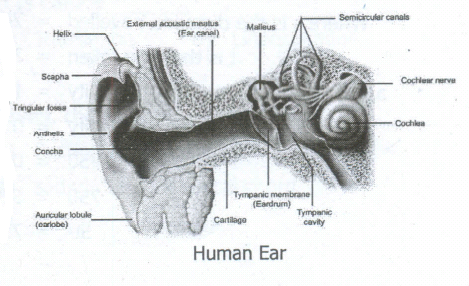
1. Sound from the surroundings is collected by the outer ear, called as 'pinna' .
2. The collected sound passes through the auditory canal.
3. At the end of the ear is eardrum or tympanic membrane.
4. When a compression of the medium reaches the eardrum the pressure on the outside of the membrane increases and forces the eardrum inward.
5. Similarly the eardrum moves outward when a rarefaction reaches it.
6. In this way the eardrum vibrates.
7. The vibrations are amplified several times by three bones called as the hammer, anvil and stirrup in the middle ear.
8. The middle ear transmits the amplified pressure variations received from the sound wave to the inner ear.
9. In the inner ear the pressure variations are turned into electrical signals by 'cochlea'
10. These electrical signals are sent to the brain via the auditory nerve and the brain interprets them as sound.
36.
1. Musical instruments such as shehnai, trumpets and Nathaswaram, Megaphones, loudspeakers use the property of reflection of sound to guide most of the sound waves from the source in the forward direction towards the audience.
2. In stethoscopes, sound produced in the body reaches doctor's ears by multiple reflection of sound that happen in the connecting tube.
3. Echo is used to find the distance between two distant objects.
4. Ultrasound is used in examining inner parts of the body and also in marine surveying.
5. Ultrasound is used in cleaning technology, to detect cracks and flaws to form the image of the heart through 'echocardiography'.
6. Ultrasound is employed to break stones formed in the kidney.
7. 'SONAR' is a device that uses ultrasonic waves to measure the distance, direction and speed of the underwater objects.
8. In Electrocardiogram (ECG) the sound variation produced by the heart is converted into electrical signals, which represents the electrical activity of the heart muscle.
37.
The Laws of reflection of sound are:
1. The angle in which the sound is incident is equal to the angle in which sound is reflected.
2. Direction of incident sound, direction of the reflected sound and the normal are in the same plane.
Experimental verification:
1. Take two identical pipes, the pipes can be made using chart paper also.
2. The length of the pipes should be sufficiently long.
3. Arrange them on the table near the wall or keep a hard plywood at one end of the pipes and soft wood in the middle of the two pipes as shown in the figure.
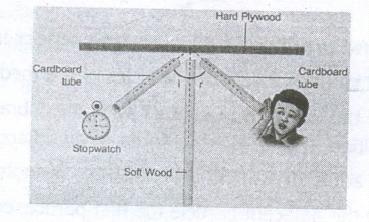
4. keep a clock near the open end of one of the pipes and try to hear the sound of the clock through the other pipe. Adjust the position of the pipes so that we can best hear the sound of the clock.
5. Now measure the angle of incidence and angle of reflection.
6. It is observed that for every angle of incidence, say 30°, 35°, 40°, the angle of reflection is same as 30°, 35° and 40°.
7. Thus it is proved that angle of incidence is equal to the angle of reflection and direction of incident and reflected sounds and normal lie in the same plane.
38.
Orbital period = T = \(\frac { 2 \pi (R + h)}{V}\)
h = 400 x 103 m
R = 6371 x 103 m
V = 7616 x 103 km s-1
substituting the values,
T = 2 x \(\frac { 22 }{ 7 } \times \frac {(6371 + 400)}{7616}\)
= 5.5876 x 10³s
= 5587 seconds
This is T ≈ 93 min.
Time period is approximately equal to 93 minutes.
39.
Velocity of sound = 340 ms-1
Height of tower = 750 m
Total distance travelled = 2 x 750 = 1500 m
\(Valocity=\frac {distance}{time}\)
\(340=\frac {1500}{time}\)
\(time=\frac {1500}{340}=4.4s\)
After 4.4 s, the splash is heard.
40.
The frequency of 600 Hz means that the source of sound vibrates 600 times in 1 second.
1 minute = 60 sec.
Number of vibrations in one second = 600
∴ Number of vibrations in 60 seconds = 60 x 600
= 36000
Hence the source of sound vibrates 36000 times in a minute.
41.
A body moving in an orbit around a planet is called Satellite.
They are two types.
i) Man made or Artificial Satellites
ii) Natural Satellites.
42.
Time taken by a satellite to complete one revolution round the earth is called time period.
Time period T = \(\frac { Distances covered }{ Orbital velocity }\)
43.
The horizontal velocity that has to be imparted to a satellite at the determined height, so that it makes a circular orbit around the planet is called orbital velocity.
44.
It is the time duration required for the Sun to orbit once around the centre of the Milky Way galaxy. It takes 250 million years to do that.
45.
The Sun and celestial bodies which revolve around it form the solar system.

9th Standard Syllabus & Materials
9th Standard
TN 9th Tamil உள்ளத்தின் சீர் - திருக்குறள் Important Questions And Answers Study Material - QB365 Set A
NEW9th Standard
TN 9th Tamil உள்ளத்தின் சீர் - மணிமேகலை Important Questions And Answers Study Material - QB365 Set A
NEW9th Standard
TN 9th Tamil உள்ளத்தின் சீர் - ஏறு தழுவுதல் Important Questions And Answers Study Material - QB365 Set A
NEW9th Standard
TN 9th Tamil உயிருக்கு வேர் - தண்ணீர் Important Questions And Answers Study Material - QB365 Set A



Tamilnadu Stateboard 9th Standard Subjects
Tamilnadu Stateboard Standards





