
 100% FREE ACCESS
9th Standard Syllabus & Materials
9th Standard
TN 9th Tamil உள்ளத்தின் சீர் -கற்கண்டு (இலக்கணம்) - தொடர் இலக்கணம், ஆகுபெயர் Important Questions And Answers Study Material - QB365 Set A
NEW9th Standard
TN 9th Tamil உள்ளத்தின் சீர் -விரிவானம் (துணைப்பாடம்) - தாய்மைக்கு வறட்சி இல்லை! Important Questions And Answers Study Material - QB365 Set A
NEW9th Standard
TN 9th Tamil உள்ளத்தின் சீர் -கவிதை பேழை (செய்யுள்) - மார்கழி பெருவிழா Important Questions And Answers Study Material - QB365 Set A
NEW9th Standard
TN 9th Tamil உயிருக்கு வேர்-இலக்கணம் - பகுபத உறுப்பிலக்கணம் Important Questions And Answers Study Material - QB365 Set A
NEW9th Standard
TN 9th Tamil அமுதென்று பேர் - இலக்கணம்-எழுத்து -அளபெடை Important Questions And Answers Study Material - QB365 Set A
NEW9th Standard
TN 9th Tamil அமுதென்று பேர்-துணைப்பாடம் - ஆறாம்திணை Important Questions And Answers Study Material - QB365 Set A

Published on: 18/01/2019
Term 3- Fluids - Important Questions
Download Tamil Nadu 9th Standard Science question papers, model tests, one-mark questions, important questions, and public exam papers in PDF format. Free study materials and answer keys for TN State Board students.
Questions + Answers key
Take MCQ Science Test1.
A drinking straw works on the existence of _________.
2.
The magnitude of buoyant force acting on an object immersed in a liquid depends on ___________of the liquid.
3.
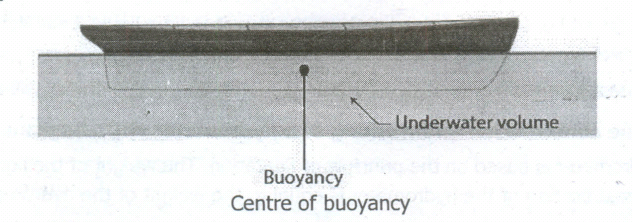
The instrument used to measure atmospheric pressure is _____________.
4.
The weight of the body immersed in a liquid appears to be_____________ than its actual weight.
5.
In a fluid, buoyant force exists because pressure at the ____________ of an object is greater than the pressure at the top.
6.
Hydraulic press is used in the extraction of oil from oil seeds.
7.
Archimede's principle can also be applied to gases.
8.
The foundations of high-rise buildings are kept wide so that they may exert more pressure on the ground
9.
The shape of an object helps to determine whether the object will float.
10.
The weight of fluid displaced determines the buoyant force on an object.
11.
A body of volume 100 cc is immersed completely in water contained in a jar. The weight of water and the jar before immersion of the body was 700 g. Calculate the weight of water and jar after immersion.
12.
State Pascal’s law.
13.
What is meant by atmospheric pressure?
14.
Why it is easy to swim in river water than in sea water?
15.
Why does a helium balloon float in air?
16.
On what factors the pressure exerted by the liquid depends on?
17.
Lactometer
18.
Pressure exerted by a fluid
19.
Pascal’s law
20.
1 gwt
21.
Density
22.
You have a bag of cotton and an iron bar, each indicating a mass of 100 kg when measured on a weighing machine. In reality, one is heavier than other. Can you say which one is heavier and why?
23.
State the laws of flotation.
24.
Explain the construction and working of a hydrometer with diagram.
25.
How does an object’s density determine whether the object will sink or float in water?
26.
Describe the construction and working of mercury barometer.
27.
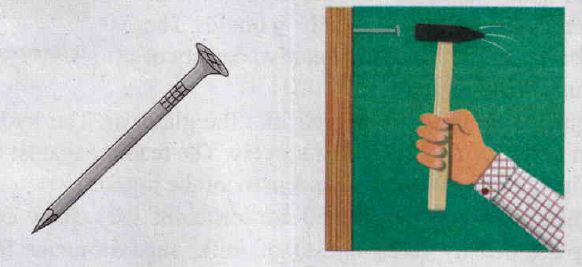
With an appropriate illustration prove that the force acting on a smaller area exerts a greater pressure.
28.
Calculate the apparent weight of wood floating on water if it weighs 100g in air.
29.
The density of water is 1g cm–3. What is its density in S.I. units?
30.
Density of mercury is 13600 kg m–3. Calculate the relative density.
31.
A block of wood of weight 200 g floats on the surface of water. If the volume of block is 300 cm3 calculate the upthrust due to water.
32.
Why does a boat with a hole in the bottom would eventually sink?
33.
If you put one ice cube in a glass of water and another in a glass of alcohol, what would you observe? Explain your observations.
34.
How does a fish manage to rise up and move down in water?
35.
How high does the mercury barometer stand on a day when atmospheric pressure is 98.6 kPa?
1.
()
Atmospheric pressure
2.
()
Density
3.
()
Barometer
4.
()
lesser
5.
()
bottom
6.
(a)
7.
(a)
8.
(b)
9.
(b)
10.
(a)
11.
Before the body is immersed,
The weight of water and jar = 700 grams.
A body of volume 100cc is immersed in water in the jar.
The weight of body = 100 grams.
Because 1cc = 19m.
(Since SI unit for volume is 1m3 = 1000000 grams or 1000000 cc)
The weight of the water and jar after immersion = 700g + 100g = 800g or 0.8kg.
12.
Pascal's Law states that the external pressure applied on an incompressible liquid is transmitted uniformly throughout the liquid.
13.
The layer of the air around the earth up to certain height of about 300 km, is called as the atmosphere of the earth. Since air occupies space and has weight, it also exerts pressure. This pressure is called atmospheric pressure.
14.
It is easier to swim in the sea water as compared to river water, because sea water has dissolved salts in it, which increases the density of water and also increases its upthrust, so the body sinks less and we can easily swim in it as compared to the river water, because river water is less dense than sea water.
15.
Helium in the balloon is lighter than the air around it, it receives an upward thrust known as buoyancy. Because helium weighs less than the amount of air it has displaced. So it floats.
16.
Pressure exerted by a liquid at a point is determined by
i) depth (h)
ii) density of the liquid (ρ)
iii) acceleration due to gravity (g)
17.
Milk
18.
hpg
19.
Pressure
20.
980 dyne
21.
\(\frac { Mass }{ volume }\)
22.
1. Weighing machines gives weight not the mass.
2. As far as weight is concerned, cotton is heavier than iron
3. Because, Density of cotton is less than that of iron, so cotton will occupy more space than iron, and hence it displaces more volume of air
4. And since, upthrust is directly proportional to the volume of fluid displaced, cotton will experience more upthrust than iron bar.
23.
Laws of flotation are:
1. The weight of a floating body in a fluid is equal to the weight of the fluid displaced by the body.
2. The centre of gravity of the floating body and the centre of buoyancy are in the same vertical line.
The point through which the force of buoyancy is supposed to act is known as centre of buoyancy.
24.
Hydrometer is based on the principle of floatation. The weight of the liquid displaced by the immersed portion of the hydrometer is equal to the weight of the hydrometer
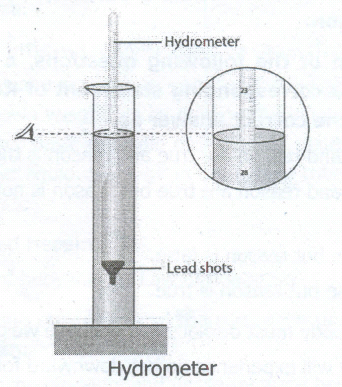
1. It is a direct reading instrument used for measuring the density or relative density of the liquid.
2. It consists of a cylindrical stem having a spherical bulb at its lower end, and a narrow tube at its upper end.
3. The lower spherical bulb is partially filled with lead shots or mercury. This helps hydrometer to float or stand vertically in liquids.
4. The narrow tube has markings so that relative density of a liquid can be read directly.
5. The liquid to be tested is poured into the glass jar. The hydrometer is gently lowered into the liquid until it floats freely.
6. The reading against the level of liquid touching the tube gives the relative density of the liquid.
25.
1. An object will sink or float in a liquid is determined by the density of the object compared to the density of the liquid.
2. If the density of a substance is less than the density of the liquid it will float. For example, a piece of wood which is less dense than water will float on it.
3. Any substance having more density than water for example a stone, will sink into water.
26.
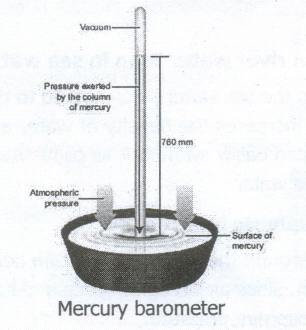
1. The instrument used to measure atmospheric pressure is called Barometer.
2. It consists of a long glass tube which is closed at one end, open at the other filled with mercury and turned upside down in a container of mercury.
3. This is done by closing the open end of the mercury filled tube with the thumb and then opening it after immersing it into a trough of mercury.
4. The Barometer works by balancing the mercury in the glass tube against the outer air pressure.
5. If the air pressure increases, it pushes more of the mercury up into the tube and if the air pressure decreases, more of the mercury drains from the tube.
6. The space between mercury and closed end is vacuum, since vacuum cannot exert any pressure, the level of mercury in the tube provides a precise measure of air pressure, which is called atmospheric pressure.
7. This type of instrument can be used in a lab or weather station.
27.
1. Take a nail. It has two ends. One end is sharp and other end is bulged head.
2. We usually keep the pointed end on the wall or wood and hammer on the bulged head
3. So very small area creates a large pressure.
4. Thus the nail penetrates into the wall or wood.
28.
Wood piece of mass 100g floating in water, it will experience an upthrust due to water displaced by the immersed part of the wood.
For a floating body, upthrust will be equal to the weight of the body. Therefore the apparent weight of the body will be zero.
(ie. the weight of the body in air - upthrust)
29.
Density of water = 1g cm-3
Density in SI unit = ?
1 g = 0.001 kg/m3
1 cm3 = 1 x 10⁻⁶m3
1 g / cm3 = \(= \frac{10^-3}{10^-6}\)= 1000 kg/m3
In SI unit density of water is 1000 kg/m3.
30.
Relative density is a measure of how dense one thing is when compared to a reference, the reference is usually water.
With respect to water, the relative density of 13600 kg m-3 of mercury is 13.6.
ie = \(\frac {13600}{1000}\) = 13.6 times dense as water. (where 1000kg m-3 is the density of water).
31.
Density of water (p) = 1000 km/m3
Volume of block (v) = 300 cm3 = 300 x 10-6 m3
Gravitational force (g) = 10 ms-2
Up thrust = pgv
= 1000 x 10 x 300 x 10-6
= 3000000 x 10-6 (10-6 = 1000000)
\(\frac{3000000}{1000000}\)
Upthrust due to water = 3N
32.
The hole in the boat is below the water level. That means the boat is heavier. So it starts to sink because the hydrostatic pressure at the hole is always higher than the atmospheric pressure pushing down on the surface of the water in the boat. So the boat will sink.
33.
When we put the ice cube in a glass of water it will float because density of ice cube is lesser than water. So it will float.
When we put the ice cube in a glass of alcohol it will sink because density of ice cube is greater than alcohol. So it will sink.
Density of water = 1 g cm-3
Density of ice cube = 0.917 g cm-3
Density of alcohol = 0.789 g cm-3
34.
The fish maintains buoyancy. Fishes have the ability to make themselves lighter to float up or heavier to sink down by using its swim bladder. The swim bladder is filled with air it will float.
35.
P = hpg
Given Atmospheric pressure = 98.6 kPa
Density of mercury is = 13.6 x 10³ kg m-3
Acceleration due to gravity = 9.8 ms-2
h = \(\frac { P }{ \rho g } \) = \(\frac { 98.6 \times {10}^{3}}{13.6\times{10}^{3}\times9.8}\) = 0.739 m ⇒ 740 mm

9th Standard Syllabus & Materials
9th Standard
TN 9th Tamil உள்ளத்தின் சீர் - திருக்குறள் Important Questions And Answers Study Material - QB365 Set A
NEW9th Standard
TN 9th Tamil உள்ளத்தின் சீர் - மணிமேகலை Important Questions And Answers Study Material - QB365 Set A
NEW9th Standard
TN 9th Tamil உள்ளத்தின் சீர் - ஏறு தழுவுதல் Important Questions And Answers Study Material - QB365 Set A
NEW9th Standard
TN 9th Tamil உயிருக்கு வேர் - தண்ணீர் Important Questions And Answers Study Material - QB365 Set A



Tamilnadu Stateboard 9th Standard Subjects
Tamilnadu Stateboard Standards





