
 100% FREE ACCESS
9th Standard Syllabus & Materials
9th Standard
TN 9th Tamil உள்ளத்தின் சீர் -கற்கண்டு (இலக்கணம்) - தொடர் இலக்கணம், ஆகுபெயர் Important Questions And Answers Study Material - QB365 Set A
NEW9th Standard
TN 9th Tamil உள்ளத்தின் சீர் -விரிவானம் (துணைப்பாடம்) - தாய்மைக்கு வறட்சி இல்லை! Important Questions And Answers Study Material - QB365 Set A
NEW9th Standard
TN 9th Tamil உள்ளத்தின் சீர் -கவிதை பேழை (செய்யுள்) - மார்கழி பெருவிழா Important Questions And Answers Study Material - QB365 Set A
NEW9th Standard
TN 9th Tamil உயிருக்கு வேர்-இலக்கணம் - பகுபத உறுப்பிலக்கணம் Important Questions And Answers Study Material - QB365 Set A
NEW9th Standard
TN 9th Tamil அமுதென்று பேர் - இலக்கணம்-எழுத்து -அளபெடை Important Questions And Answers Study Material - QB365 Set A
NEW9th Standard
TN 9th Tamil அமுதென்று பேர்-துணைப்பாடம் - ஆறாம்திணை Important Questions And Answers Study Material - QB365 Set A

Published on: 25/09/2019
Heat
Download Tamil Nadu 9th Standard Science question papers, model tests, one-mark questions, important questions, and public exam papers in PDF format. Free study materials and answer keys for TN State Board students.
Questions + Answers key
Take MCQ Science Test1.
Define thermal capacity.
2.
Differentiate convection and radiation
3.
Define conduction.
4.
Give the difference between heat and temperature.
5.
What are the changes of state in water? Explain.
6.
Explain convection in daily life.
7.
What is the minimum possible temperature? Is there also a maximum possible temperature?
8.
Define one calorie.
9.
Define latent heat of fusion?
10.
What is the heat in joules required to raise the temperature of 25 grams of water from 0ºC to 100ºC? What is the heat in Calories?
(Specific heat of water = 4.18 J/gºC)
11.
Which one of the following scales has lower fixed point at 0°C?
Kelvin scale
Fahrenheit scale
Celsius scale
All of these
12.
The temperature at which a liquid gets converted into its vapour state is called its________
melting point
boiling point
dew point
freezing point
13.
A device in which the loss of heat due to conduction, convection and radiation is minimized in
Solar cell
Solar cooker
Thermometer
Thermos flask
14.
The specific heat capacity of water is
4200 Jkg-1K-1
420 Jg-1K-1
0.42 Jg-1K-1
4.2 Jkg-1K-1
15.
Calorie is the unit of
heat
work
temperature
food
16.
Black marks appearing on the ceiling above a lamp or fan caused by dust being carried upwards in air __________ produced by hot lamp or the running fan.
17.
______________is greater for liquids than for solids and maximum in case of gases.
18.
__________ is the degree of hotness or coldness of a body.
19.
___________is a process just reverse of melting
20.
During day time, air blows from________________to_____________
21.
Specific heat capacity of water
22.
Latent heat of fusion of ice
23.
Boiling point of water
24.
m x s x t
25.
Heat
1.
Heat capacity or thermal capacity is defined as the amount of heat energy required to raise the temperature of a body by 1°C.
2.
| S.No | Convection | Radiation |
| 1. | It needs particles for transfer of heat | It does not need particles for transfer of heat. |
| 2. | It lacks in electromagnetic waves | Heat flows from one place to another by means of electromagnetic waves |
| 3. | It flows from higher temperature to lower temperature. |
It occurs in a vacuum. |
3.
The process of transfer of heat in solids from a region of higher temperature to a region of lower temperature without the actual movement of molecules is called conduction.
4.
| Heat | Temperature | |
| 1. | Heat is a form of energy due to which we feel hot or cold. | The degree of hotness or coldness of a body is known as temperature |
| 2. | It's SI unit is joule (J) | Its SI unit is kelvin (K). |
| 3. | It depends upon mass, nature and temperature of the body. | It does not depend upon mass, nature and temperature of the body. |
| 4. | It is a form of energy. | It is a condition which determines the direction of flow of heat. |
| 5. | It is measured by a calorimeter. | It is measured by a thermometer. |
5.
The process of changing of a substance from one physical state to another at a definite temperature is defined as change of state.
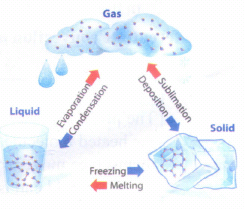
For example, water molecules are in liquid state at normal temperature. When water is heated to 100oC, it becomes steam which is a gaseous state of matter. On reducing the temperature of the steam it becomes water again. If we reduce the temperature further to 0oC, it becomes ice which is a solid state of water. Ice on heating, becomes water again. Thus, water changes its state when there is a change in temperature. There are different such processes in the change of state in matter. The figure shows various processes of change state.
6.
Hot air balloons:
Air molecules at the bottom of the balloon get heated by a heat source and rise. As the warm air rises, cold air is pushed downward and it is also heated. When the hot air is trapped inside the balloon, it rises.
Breezes:
During day time, the air in contact with the land becomes hot and rises. Now the cool air over the surface of the sea replaces it. It is called sea breeze. During night time, air above the sea is warmer. As the warmer air over the surface of the sea rises, cooler air above the land moves towards the sea. It is called land breeze.
Winds:
Air flows from area of high pressure to area of low pressure. The warm air molecules over hot surface rise and create low pressure. So, cooler air with high pressure flows towards low pressure area. This causes wind flow.
Chimneys:
Tall chimneys are kept in kitchen and industrial furnaces. As the hot gases and smoke are lighter, they rise up in the atmosphere.
7.
The minimum possible temperature is 0K. There is no limit to maximum temperature.
8.
The amount of heat energy required to raise the temperature of 1 g water by 10C is called one calorie.
9.
Heat energy is absorbed by a solid during melting and an equal amount of heat energy is liberated by the liquid during freezing, without any temperature change. It is called latent heat of fusion.
10.
Mass of water = 25 grams
\(\triangle\)T = (100oC - 0oC) =100oC
C = 4.18 J/goC
Heat energy required Q = M x C x \(\triangle\)T
= 25 x 4.18 x 100oC
= 10450 J
11.
(c)
Celsius scale
12.
(b)
boiling point
13.
(d)
Thermos flask
14.
(a)
4200 Jkg-1K-1
15.
(a)
heat
16.
()
convection currents
17.
()
Expansion
18.
()
Temperature
19.
()
Freezing
20.
()
sea to land
21.
4.2 J/g0C
22.
336 J/g
23.
1 millennium
24.
Heat gained or lost when there is no change of state
25.
Form of energy

9th Standard Syllabus & Materials
9th Standard
TN 9th Tamil உள்ளத்தின் சீர் - திருக்குறள் Important Questions And Answers Study Material - QB365 Set A
NEW9th Standard
TN 9th Tamil உள்ளத்தின் சீர் - மணிமேகலை Important Questions And Answers Study Material - QB365 Set A
NEW9th Standard
TN 9th Tamil உள்ளத்தின் சீர் - ஏறு தழுவுதல் Important Questions And Answers Study Material - QB365 Set A
NEW9th Standard
TN 9th Tamil உயிருக்கு வேர் - தண்ணீர் Important Questions And Answers Study Material - QB365 Set A



Tamilnadu Stateboard 9th Standard Subjects
Tamilnadu Stateboard Standards





