
 100% FREE ACCESS
9th Standard Syllabus & Materials
9th Standard
TN 9th Tamil உள்ளத்தின் சீர் -கற்கண்டு (இலக்கணம்) - தொடர் இலக்கணம், ஆகுபெயர் Important Questions And Answers Study Material - QB365 Set A
NEW9th Standard
TN 9th Tamil உள்ளத்தின் சீர் -விரிவானம் (துணைப்பாடம்) - தாய்மைக்கு வறட்சி இல்லை! Important Questions And Answers Study Material - QB365 Set A
NEW9th Standard
TN 9th Tamil உள்ளத்தின் சீர் -கவிதை பேழை (செய்யுள்) - மார்கழி பெருவிழா Important Questions And Answers Study Material - QB365 Set A
NEW9th Standard
TN 9th Tamil உயிருக்கு வேர்-இலக்கணம் - பகுபத உறுப்பிலக்கணம் Important Questions And Answers Study Material - QB365 Set A
NEW9th Standard
TN 9th Tamil அமுதென்று பேர் - இலக்கணம்-எழுத்து -அளபெடை Important Questions And Answers Study Material - QB365 Set A
NEW9th Standard
TN 9th Tamil அமுதென்று பேர்-துணைப்பாடம் - ஆறாம்திணை Important Questions And Answers Study Material - QB365 Set A

Published on: 04/02/2020
9th Standard Science Important Questions
Download Tamil Nadu 9th Standard Science question papers, model tests, one-mark questions, important questions, and public exam papers in PDF format. Free study materials and answer keys for TN State Board students.
Questions + Answers key
Take MCQ Science Test1.
The member of our solar system, with highly tilted orbit is _____________.
Earth
Pluto
Mars
Saturn
2.
Which of the following is not a planet of our solar system?
Sirius
Mercury
Saturn
Earth
3.
An iron ball is weighed in air and then in water by a spring balance.
Its weight in air is more than in water.
Its weight in water is more than in air
Its weight is same both in air and water.
Its weight is zero in water.
4.
Instrument used to measure relative density
Hydrometer
Lactometer
Barometer
Pycnometer
5.
__________ is the method of growing plants without soil.
Horticulture
Hydroponics
Pomology
None of these.
6.
Mosquito borne viral diseases are
malaria and yellow fever
dengue and chikungunya
filariasis and typhus
kala azar and diphtheria
7.
Increased amount of ___________ in the atmosphere, results in greenhouse effect and global warming
carbon monoxide
sulphur dioxide
nitrogen dioxide
carbon dioxide
8.
1% solution of Iodoform is used as
antipyretic
antimalarial
antiseptic
antacid
9.
If the speed of a wave is 340 m s-1 and its frequency is 1700 Hz, then wavelength λ for this wave in cm will be
34
20
15
0.2
10.
Graphene is one atom thick layer of carbon obtained from
Diamond
Fullerene
Graphite
Gas Carbon
11.
The property which is characteristics of an Ionic compound is that
it often exists as gas at room temperature
it is hard and brittle
it undergoes molecular reactions
it has low melting point
12.
Assertion (A) : A bird perches on a high power line and nothing happens to the bird.
Reason (R) : The level of bird is very high from the ground.
If both assertion and reason are true and reason is the correct explanation of assertion.
If both assertion and reason are true but reason is not the correct explanation of assertion.
If assertion is true but reason is false
If assertion is false but reason is true
13.
NaOH & KOH are____
strong bases
metal oxides
weak bases
diacidic bases
14.
Bases ionise in water to form______ions
H+
H3O+
OH-
O2-
15.
_____&_______metals do not react with HCl or HNO3
Gold & Magnesium
Silver & Magnesium
Gold & Silver
Zinc & Silver
16.
Two resistances R1 and R2 are connected in parallel. Their equivalent resistance is__________
R1+R2
\(\cfrac { { R }_{ 1 }{ R }_{ 2 } }{ { R }_{ 1 }+{ R }_{ 2 } } \)
\(\cfrac { { R }_{ 1 }+{ R }_{ 2 } }{ { R }_{ 1 }{ R }_{ 2 } } \)
\(\sqrt { { R }_{ 1 }+{ R }_{ 2 } } \)
17.
A current of 2A passing through conductor produces 80 J of heat in 10 seconds. The resistance of the conductor is__________
0.5\(\Omega \)
2\(\Omega \)
4\(\Omega \)
20\(\Omega \)
18.
Gastric glands do not secrete__________
renin
pepsin
lipase
none of the above
19.
The act of bringing swallowed food back to the mouth is called___________
egestion
ingestion
micturition
regurgitation
20.
__________is the smallest gland
Pancreas
Sublingual
Parotid
Submaxillary
21.
Statement (A) : Covalent compounds are bad conductor of electricity.
Reason (B) Covalent compounds contain charged particles (ions)
B explains A
B does not explain A
Both A & B are right
Both A & B are wrong
22.
The bond which is formed by mutual sharing of electrons is called ________bond.
ionic
covalent
co-ordinate covalent bond
all the above
23.
___________compounds are highly brittle
Ionic
Covalent
Co-ordinate covalent
Covalent
24.
Assertion (A): Noble gases are chemically inert in nature.
Reason (R) : Noble gases have stable electronic structures
Both A & R are right
Both A & R are wrong
A is right R is wrong
A is wrong R is right
25.
Assertion (A): Group 2 elements in the modern periodic table are called alkaline earth metals.
Reason (R): The oxides of group 2 elements produce alkaline solutions when they are dissolved in water
A is right R is wrong
R explains A
R does not explain A
R is right A is wrong
26.
Noble gases are placed in_____________ group in the modern periodic table.
13th
18th
17th
2nd
27.
In an electrolyte the current is due to the flow of
electrons
positive ions
both (a) and (b)
neither (a) nor (b)
28.
White fibres of connective tissue are made up of
elastin
reticular fibres
collagen
myosin
29.
Pen drive is _______ device.
Output
Input
Storage
connecting cable
30.
Which one of the following is an example for wireless connections?
Wi-Fi
Electric wires
VGA
USB
31.
On a cold day, it is hard to open the lid of a tight container. But when you gently heat the neck you can easily open the lid. why?
On heating Glass expands and lid contracts
On heating lid expands more than the neck and thus slides easily
Neck becomes slippery on heating
Lid of the bottle cannot bear the heat.
32.
Sweating causes cooling because water has a_______
high specific heat
low specific heat
high latent heat of fusion
high latent heat of vaporisation
33.
The amount of heat required to raise the temperature through 10C is called_________
thermal energy
calorie
heat capacity
specific heat capacity
34.
The unit of magnetic flux density is
weber
weber/metre
weber/metre2
weber. metre2
35.
The specific heat capacity of water is
4200 Jkg-1K-1
420 Jg-1K-1
0.42 Jg-1K-1
4.2 Jkg-1K-1
36.
Philippine goby is found in___________.
marine water
brackish water
salt water
fresh water
37.
Which one is the Mammal-like reptile?
Dimetrodon
Crocodile
Lizard
Snake
38.
The smallest bat lives in_________.
America
Thailand
Africa
Canada
39.
Lipases are enzymes which breaks down __________.
Proteins
Fats
Carbohydrates
Food
40.
Vitamin E is otherwise known as _________ .
Riboflavin
Thiamine
Tocopherol
Calciferol
41.
Any disease caused by the presence of excess vitamin is _________ .
Night blindness
Osteoporosis
Vitaminosis
Hypervitaminosis
42.
The outermost shell of an atom is called its________ shell.
inner
outer
valence
sub shell
43.
The circular orbits are numbered as 1,2,3,4, .... These numbers are referred as _________
Principal Quantum Number
Azimuthal Quantum Number
Magnetic Quantum Number
Spin Quantum Number
44.
Law of multiple proportions was proposed by _________
J. Richter
Rutherford
John Dalton
J.J Thomson
45.
To separate two or more miscible liquids which do not differ much in the boiling points_______is employed
distillation
filtration
decantation
fractional distillation
46.
Energy is neither given out nor absorbed in the preparation of_____
element
compound
mixture
solvent
47.
Light, sound, heat, etc., are not matter. They are different forms of
solids
liquids
gases
energy
48.
Maize plant transpire _____________ gallons of water during its life span.
34
44
64
54
49.
To form a real image -________________mirror is required.
parallel
plane
convex
concave
50.
A virtual and equal sized image is formed by ___________________mirrors.
convex
plane
convex
spherical
51.
Van Helmont conducted his experiment in the year_____________.
1684
1468
1864
1648.
52.
Rhizophora is an example for_________________.
positive geotropism
Positive phototropism
Positive hydrotropism
Negative geotropism
53.
The diameters of spherical objects are measured with a_________scale.
pitch
meter
head
vernier
54.
The hands of the clock, the spokes of wheel are example of _______
linear motion
circular motion
oscillatory motion
revolutionary motion
55.
Transpiration takes place through _____________.
fruit
seed
flower
stomata
56.
Dysentery is caused by
Entamoeba
Euglena
Plasmodium
Paramecium
57.
The focal length of a concave mirror is 5 cm. Its radius of curvature is
5 cm
10 cm
2.5 cm
58.
Filtration method is effective in separating _______ mixture
Solid-solid
solid-liquid
liquid-liquid
liquid-gas
59.
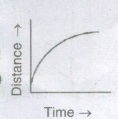
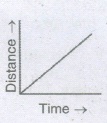
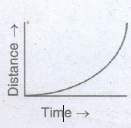
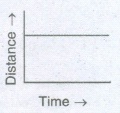
Which of the following graph represents uniform motion of a moving particle?
60.
Rulers, measuring tapes and metre scales are used to measure
Mass
Weight
Time
Length
61.
What are Biometrics?
62.
Write any two practical application of sound waves.
63.
What is the nutritional importance of fish liver oils? Name any two marine fishes which yield these oils.
64.
Sanjay had an attack of chicken pox and has just recovered. The health officer of his locality says that the disease would not occur again for him. What would be the reason for this?
65.
According to you, which process of water cycle is adversely affected by human activities?
66.
What is meant by atmospheric pressure?
67.
What are organic acids? Given examples?
68.
Reproductive organs are also considered as endocrine glands
69.
Ionic compounds are crystalline solids at room temperature.
70.
Can two magnetic lines of force intersect? Justify your answer.
71.
What are the types of monitor?
72.
What is complex tissue? Name the various kinds of complex tissues.
73.
Explain Octet rule with an example.
74.
What are the limitations of Mendeleev's periodic table?
75.
What are isotones? Give example.
76.
What is Pasteurization?
77.
Distinguish between dispersed phase and dispersion medium.
78.
What is the unit of refractive index?
79.
The mass of an object is 5 kg. What is its weight on the earth?
80.
Comment on the aquatic and terrestrial habits of amphibians.
81.
What is data processing?
82.
What remains constant in uniform circular motion? And What Changes continuously in uniform circular motion?
83.
Methane burns in oxygen to form carbon dioxide and water vapour as given by the equation
CH4(g) + 2O2(g) ➝ CO2(g)+ 2H2O(g)
Calculate: (i) the volume of oxygen needed to burn completely 50 cm3 of methane and (ii) the volume of carbon dioxide formed in this case.
84.
Oxygen is very essential for us to live. It forms 21% of air by volume. Is it an element or compound?
85.
Differentiate mass and weight.
86.
What is a satellite? What are the two types of satellites?
87.
What is Chemotherapy?
88.
Who is called 'Father of Modern Organic Chemistry'?
89.
Complete the equation Na2CO3+2HCl ⟶ ?+? +CO2↑
90.
What is parturition?
91.
State Newlands' Law of Octaves
92.
Define magnetic effect of electric current.
93.
What is crossing over?
94.
Water is used as a coolant in car radiators. Why?
95.
Are Reptilian eggs covered with shells?
96.
What is combination reaction ?
97.
How computer generations are categorised?
98.
Is air a pure substance or Mixture? Justify.
99.
How many types of adulterants are there?
100.
What is principal axis?
101.
What is convex mirror?
102.
How is washing machine wash the clothes?
103.
What is acceleration?
104.
Complete the table:
| Power of 10 | Prefix | Symbol |
| 1012 | ___(i)___ | T |
| ___(ii)___ | Kilo | K |
| 1015 | Peta | ___(iii)__ |
| 109 | ___(iv)__ | ___(v)__ |
105.
Calculate the correct readings of the Vernier caliper L.C. 0.01 cm Zero correction - Nil.
| S.No. | M.S.R | V.C | Observed Reading = M.S.R + (V.C x L.C) | Correct Reading |
| 1 | 3 | 4 | ||
| 2 | 3 | 7 |
106.
Define taxonomy?
107.
If an object is placed at the focus of a concave mirror, where is the image formed?
108.
Differentiate : Kwashiorkor from Marasmus
109.
Which flowering plant shows photonasty just opposite to that of Dandelion?
110.
Arrange the following in the increasing order of atomic number
Calcium, Silicon, Boron, Magnesium, Oxygen, Helium, Neon, Sulphur, Fluorine and Sodium
111.
Convert: 104°F into Celsius scale.
112.
Fill in the numbered blanks to make the heating curve meaningful.
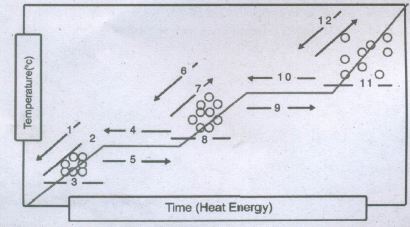
113.
List out the drawbacks of Nanomaterials in chemistry.
114.
Write any five applications of ultrasonic waves.
115.
a) When a golf ball is lowered into a measuring cylinder containing water, the water level rises by 40cm3, when the ball is completely submerged. If the mass of the ball in air is 44g. Calculate its density.
b) A 5kg sheet of tin sinks in water but if the same sheet is converted into a boat or a box, it floats. Give reason.
116.
Calculate the effective resistance between A and B as shown is the figure
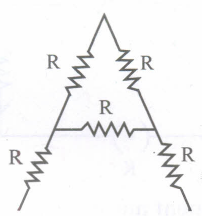
117.
Describe the classification of bases based on their acidity.
118.
Write a note on functions of liver in digestion.
119.
Write the advantages of Modern Periodic Table.
120.
Explain the principle, construction and working of an AC generator.
121.
Explain the components of phloem tissue
122.
Convert the following:
(1) 1000F to 0C
(2) 400C to Fahrenheit (0F)
(3) 350C to Kelvin
(4) 800K to 0C
123.
List down the differences between Ionic and Covalent compounds.
124.
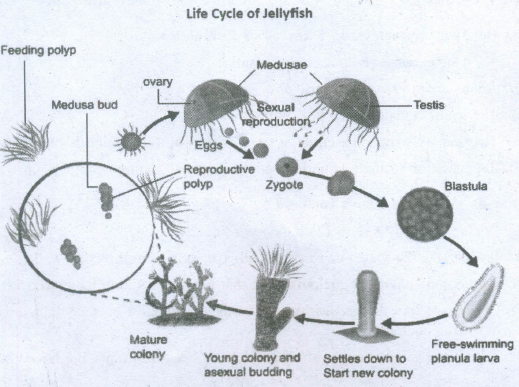
Draw the life cycle of jellyfish.
125.
Lead forms three oxides A, B and C. The quantity of oxygen in each of the oxides A, B and C is 7.143%, 10.345% and 13.133% respectively. Show that the law of multiple proportions is obeyed.
126.
Write a brief note on mineral nutrients.
127.
The ray of light enters from air to Kerosene? Refractive index of Kerosene is 1.41. Calculate the velocity of light in Kerosene.
128.
Write the properties of mixture.
129.
Explain the method to find the diameter of the sphere.
130.
List out the generations of computer
131.
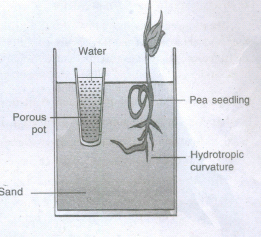
Design an experiment to demonstrate hydrotropism.
132.
A racing car has a uniform acceleration of 4 ms-2. What distance it covers in 10 s after start?
133.
Imagine that student A studied the importance of certain factors in photosynthesis. He took a potted plant and kept it in dark for over 24 hours. In the early hours of the next morning, he covered one of the leaves with dark paper in the centre only. Then he placed the plant in sunlight for a few hours and tested the leaf which was covered with black paper for starch.
(a) What aspect of photosynthesis was being investigated
(b) Why was the plant kept in the dark before the experiment?
(c) How will you prove that starch is present in the leaves?
(d) Name the raw materials needed for photosynthesis?
134.
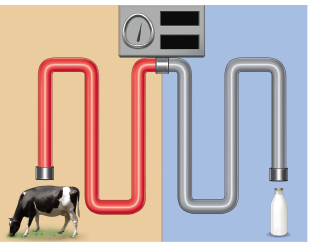
Look at the picture and answer the question that follows
a) Name the process involved in the given picture.
b) Which dairy food is preserved by this process?
c) What is the temperature required for the above process?
135.
Does a solar cell always maintain the potential across its terminals constant? Discuss.
1.
(b)
Pluto
2.
(a)
Sirius
3.
(a)
Its weight in air is more than in water.
4.
(d)
Pycnometer
5.
(b)
Hydroponics
6.
(b)
dengue and chikungunya
7.
(d)
carbon dioxide
8.
(c)
antiseptic
9.
(b)
20
10.
(c)
Graphite
11.
(a)
it often exists as gas at room temperature
12.
(c)
If assertion is true but reason is false
13.
(a)
strong bases
14.
(c)
OH-
15.
(c)
Gold & Silver
16.
(b)
\(\cfrac { { R }_{ 1 }{ R }_{ 2 } }{ { R }_{ 1 }+{ R }_{ 2 } } \)
17.
(b)
2\(\Omega \)
18.
(c)
lipase
19.
(d)
regurgitation
20.
(b)
Sublingual
21.
(b)
B does not explain A
22.
(b)
covalent
23.
(a)
Ionic
24.
(a)
Both A & R are right
25.
(b)
R explains A
26.
(b)
18th
27.
(c)
both (a) and (b)
28.
(c)
collagen
29.
(c)
Storage
30.
(a)
Wi-Fi
31.
(b)
On heating lid expands more than the neck and thus slides easily
32.
(d)
high latent heat of vaporisation
33.
(c)
heat capacity
34.
(c)
weber/metre2
35.
(a)
4200 Jkg-1K-1
36.
(b)
brackish water
37.
(a)
Dimetrodon
38.
(b)
Thailand
39.
(b)
Fats
40.
(c)
Tocopherol
41.
(c)
Vitaminosis
42.
(c)
valence
43.
(a)
Principal Quantum Number
44.
(c)
John Dalton
45.
(d)
fractional distillation
46.
(c)
mixture
47.
(d)
energy
48.
(d)
54
49.
(d)
concave
50.
(c)
convex
51.
(d)
1648.
52.
(d)
Negative geotropism
53.
(d)
vernier
54.
(b)
circular motion
55.
(d)
stomata
56.
(a)
Entamoeba
57.
(b)
10 cm
58.
(b)
solid-liquid
59.
(b)
60.
(d)
Length
61.
1. The science that involves the study and analysis of human body prints is known as Biometrics.
2. This system compares the body prints to the specimen data stored in the system to verify the identity of a person.
62.
1. Echo, which is used to find the distance between the two distant objects.
2. Sound navigation and ranging (SONAR) which is used to find the depth of the Ocean.
63.
Fish liver oil are of great medicinal value and are rich in vitamin A, D and E.
Liver oil of cod, Tuna, Halibut and shark, yield these oils.
64.
1. Yes, Chicken pox would not occur again for sanjay .
2. Because, once it occured, his body will derive immunity against that disease .
3. This kind of immunity is developed by our body, during the first infection of chicken pox pathogen .
4. The antibodies produced in the blood remain for a long period and kill the simile pathogens, whenever they enter the body.
65.
Major human activities affecting the water cycle on land are urbanisation, dumping of plastic waste on land and into water, polluting water bodies and deforestation.
66.
The layer of the air around the earth up to certain height of about 300 km, is called as the atmosphere of the earth. Since air occupies space and has weight, it also exerts pressure. This pressure is called atmospheric pressure.
67.
Acids present in plants and animals (living things) are organic acids.
Example: HCOOH, CH3COOH
68.
The testes apart from producing sperms also produces male sex hormone called testosterone. Similarly the ovary apart from producing the ovum also produces the female sex hormone called oestrogen. Hence the gonads are also considered as endocrine glands.
69.
Ionic compounds are formed because of the strong electrostatic force between cations and anions which are arranged in a well-defined geometrical pattern. Thus ionic compounds are crystalline solids at room temperature
70.
No, if two magnetic lines of force intersect then there will be two tangents and hence two directions of the magnetic field at the point of intersection. This is not possible.
71.
There are two types of monitor namely.
(i) Cathode Ray Tube monitors (CRT)
(ii) Thin Film Transistor Monitors (TFT)
72.
(i) Complex tissues are made of more than one type of cells that work together as a unit.
(ii) Complex tissues consist of parenchyma and sclerenchyma cells. However, collenchymatous cells are not present in such tissues. Common examples are xylem and phloem.
73.
1. The tendency of atoms to have eight electrons in the valence shell is known as the 'Octet rule' or the 'Rule of eight'.
2. For example, Sodium with atomic number 11 will readily lose one electron to attain Neon's stable electronic configuration.
74.
(i) Elements with large difference in properties were included in the same group.
Eg: Hard metals like copper (Cu) and silver (Ag) were included along with soft metals like sodium (Na) and potassium (K).
(ii) No proper position could be given to the element hydrogen. Non-metallic hydrogen was placed along with metals like lithium (Li), sodium (Na) and potassium (K).
(iii) The increasing order of atomic mass was not strictly followed throughout.
Eg: Co & Ni, Te & I.
(iv) No place for isotopes in the periodic table.
75.
Atoms of different elements with different atomic numbers and different mass numbers, but with the same number of neutrons are called isotones.
Example : Atomic number of Boron is 5, atomic number of carbon is 6. But Boron and Carbon has the same number of neutrons that is 6.
76.
Pasteurization is a process of food preservation, which involves boiling of milk to a temperature of 63°C for about 30 minutes and suddenly cooling to destroy the microbes present in the milk.
77.
| Dispersed Phase | Dispersion Medium |
| (i) Component present in smaller proportion | Component present in larger proportion |
| (ii) Analogous to solute of a true solution | Analogous to solvent of a true solution |
78.
No unit for refractive index.
79.
Mass m = 5 kg
Acceleration due to gravity g = 9.8 ms-1
Weight W = m x g = 5 x 9.8 = 49 N
Therefore the weight of an object is 49 N
80.
Aquatic habits of amphibians:
1. The larva of amphibians (tadpole) lives in water and breathes with gills.
2. External fertilization occurs in frog with water as a medium of fertilization.
3. The adult frog has webbed feet to swim in water
4. The skin is moist and glandular which helps in Respiration.
Terrestrial habits of amphibians:
1. The adult live on land and breathe through lungs. Bucco-Pharynx also helps in respiration.
2. The fore limbs are short and help to hop on land.
81.
The data processing in a computer is collecting data and converting it into information according to our needs and requirements.
82.
Speed is constant. The direction of motion is changed at every point. Velocity also changes continuously.
83.
CH4(g) +2O2(g) → CO2(g) +2H2O(g)
1 2 1 2
volume volumes volumes volumes
1x 2x 1x 2x
50cm3 50cm3 50cm3 50cm3
50cm3 100cm3 50cm3 100cm3
Volume of oxygen used = 100 cm3
Volume of carbon dioxide formed = 50 cm3
84.
It is an element.
85.
| Mass | Weight |
| 1. Fundamental quantity | Derived quantity |
| 2. It is a scalar quantity | It is a vector quantity |
| 3. The amount of matter contained in a body |
Normal force exerted by the surface on the object against gravitational pull |
| 4. It remains the same | Varies from place to place. |
| 5. Its unit is kilogram | Its unit is newton. |
86.
A body moving in an orbit around a planet is called Satellite.
They are two types.
i) Man made or Artificial Satellites
ii) Natural Satellites.
87.
Treatment of certain diseases by destroying the invading organism without damaging the cells of the host, by the use of certain organic compounds is known as Chemotherapy. It is widely used for treating cancer.
88.
Friedrich Wohler
89.
Na2CO3+2HCl ⟶ 2NaCl+H2O+CO2↑
90.
Child birth is called parturition
91.
Every eighth element had properties similar to those of the first element like the eighth note in an octave of music is similar to the first.
92.
A current carrying conductor is always associated with a magnetic field around it is called the magnetic effect of current. It was first discovered by Hans Christian Oersted in 1820
93.
During pachytene of Meiotic prophase I, the chromatids break and the broken segments are interchanged between homologous chromosomes. The points of exchange are the chiasmata. This is called crossing over
94.
Water is used as a coolant in car radiators because it has high specific heat capacity. As a result, it can absorb large amounts of heat from the car engine without any substantial increase in its temperature.
95.
Yes.
96.
A reaction where two or more substances combine to form a single substance.
97.
The main difference between the generations is the speed and efficiency of the computer. On the basis of performance and speed, the generations of the computer was categorised.
98.
Air is a mixture, because samples from different places give different percentage of its components.
99.
Three
100.
The perpendicular line joining the pole and the centre of curvature of the mirror.
101.
A convex mirror is a spherical mirror whose reflecting surface is curved outward.
102.
A spin dryer removes excess water from clothing by rotating a perforated drum at high speed. The water is thrown out through the holes. The clothes keep moving in a circle because the contact force of the drum provides centripetal force.
103.
Acceleration is the rate of change of velocity or it is the change of velocity in unit time.
104.
(i) tera
(ii) 103
(iii) P
(iv) giga
(v) G
105.
| S.No. | M.S.R | V.C | Observed Reading = M.S.R + (V.C x L.C) | Correct Reading |
| 1 | 3 | 4 | 3 + (4 x 0.01) | 3.04 |
| 2 | 3 | 7 | 3 + (7 x 0.01) | 3.07 6.11 ____ 2 |
Correct reading = 3.55 cms.
106.
Taxonomy is the theoretical study of classification including its basic principles, procedures and rules.
107.
At infinity.
108.
| Kwashiorkor | Marasmus |
| 1. It is a protein deficiency disease. | It is a carbohydrate deficiency disease. |
| 2. It affects the children between 1-5 years of age. |
It affects the infants below the age of one. |
109.
Moon flower (or) Ipomoea alba shows photonasty just opposite to that of Dandelion.
110.
The elements in the increasing order of atomic no.
Helium, Boron, Oxygen, Neon, Sodium, Magnesium, Calcium, Silicon, Sulphur.
111.
Celsius = (F – 32) × \(\frac{5}{9}\)= (104 - 32) ×\(\frac{5}{9}\) = 72 × \(\frac{5}{9}\) = 40°C.
112.
1. Solidifies
2. Solid.
3. Solid.
4. Liquid.
5. Melting.
6. Freezing.
7. Liquation.
8. Liquid.
9. Boiling.
10. Liquified vaporisation.
11. Liquid vapour, gas.
12. Condensation
113.
1. Nano particles are unstable when they contact with oxygen .
2. Their exothermic combustion with oxygen can easily cause explosion .
3. Because nanoparticles are highly reactive, they inherently interact with impurities as well.
4. Nanoparticles are usually considered biologically harmful and toxic .
5. It is difficult to synthesis, isolate and apply them .
6. There are no hard-and-fast safe disposal policies for nanomaterials.
114.
1. Ultrasound is used in cleaning technology. Minute foreign particles can be removed from objects placed in a liquid bath through which ultrasound is passed.
2. Ultrasounds can also be used to detect cracks and flaws in metal blocks.
3. Ultrasonic waves are used to get images of the heart by the technique called as Echocardiography'
4. Ultrasound is employed to break 'small stones' formed in the kidney into fine grains.
5. Animals such as bats and dolphins use ultrasound to navigate and communicate.
6. SONAR is a device uses ultrasonic waves to measure the distance, direction and speed of the underwater objects.
115.
a) Mass of the ball m = 44g
Volume of water displaced = 40cm3
Density of the ball when it is completely submerged = \(\frac {mass}{volume}\)
= \(\frac {44}{40}\) = 1.1 g/cm2
Density = 1.1 g/cm3.
b) The density of tin is higher than that of water, so the sheet of tin sinks in water But when the same sheet of tin is converted into a boat or box, a lot of air is trapped in the boat or box. Then the average density of boat or box, made of tin sheet, becomes lower than that of water, therefore it floats in water.
116.
The equivalent circuit diagram of the given network is as shown is the figure.
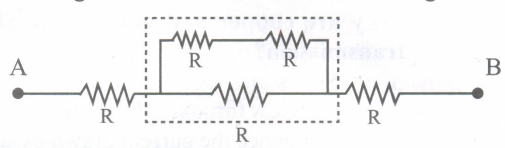
\(\cfrac { 1 }{ { R }_{ 1 } } =\cfrac { 1 }{ 2R } +\cfrac { 1 }{ R } \)
\(\cfrac { 1+2 }{ R } =\cfrac { 3 }{ 2R } \)
\({ R }^{ 1 }=\cfrac { 2R }{ 3 } \)
The effective resistance between A and B is
R11 = R + R1 + R
\(R+\cfrac { 2R }{ 3 } +R=\cfrac { 8R }{ 3 } \)
117.
(a) Monoacidic Base:
It is a base that ionises in water to give one hydroxide ion per molecule.
Example: NaOH, KOH
(b) Diacidic Base:
It is a base that ionises in water to give two hydroxide ions per molecule.
Example: Ca(OH)2, Mg(OH)2
(c) Triacidic Base:
It is a base that ionises in water to give three hydroxide ions per molecule.
Example: AI(OH)3, Fe(OH)3
118.
(i) It is the largest digestive gland of the body which is reddish brown in colour.
(ii) It is divided into two main lobes, right and left lobes. The right lobe is larger than the left lobe.
(iii) On the under surface of the liver, gall bladder is present. The liver cells secrete bile which is temporarily stored in the gall bladder.
(iv) Bile is released into small intestine when food enters in it. It has bile salts (sodium glycolate and sodium tauraglycolate) and bile pigments (bilirubin and biliverdin).
(v) Bile salts help in the digestion of fats by bringing about their emulsification (conversion of large fat droplets into small ones).
119.
(i) The table is based on a more fundamental property i.e., atomic number.
(ii) It correlates the position of the element with its electronic configuration more clearly.
(iii) The completion of each period is more logical. In a period, as the atomic number increases, the energy shells are gradually filled up until an inert gas configuration is reached.
(iv) It is easy to remember and reproduce.
(v) Each group is an independent group and the idea of subgroups has been discarded.
(vi) One position for all isotopes of an element is justified, since the isotopes have the same atomic number.
(vii) The position of the eighth group (in Mendeleev's table) is also justified in this table. All transition elements have been brought in the middle as the properties of transition elements are intermediate between left portion and right portion elements of the periodic table.
(viii) The table completely separates metals from nonmetals. The nonmetals are present in upper right corners of the periodic table.
(ix) The positions of certain elements which were earlier misfit (interchanged) in the Mendeleev's periodic table are now justified because it is based on atomic number of the elements.
(x) Justification has been offered for placing lanthanides and actinides at the bottom of the periodic table.
120.
(i) An alternating current (AC) generator, consists of a rotating rectangular coil ABCD called armature placed between the two poles of a permanent magnet.
(ii) The two ends of this coil are connected to the two slip rings S1 and S2. The inner sides of these rings are insulated.
(iii) Two conducting stationary brushes B1 and B2 are kept separately on the rings S1 and S2 respectively. The two rings S1 and S2 are internally attached to an axle.
(iv) The axle may be mechanically rotated from outside to rotate the coil inside the magnetic field. Outer ends of the two brushes are connected to the external circuit
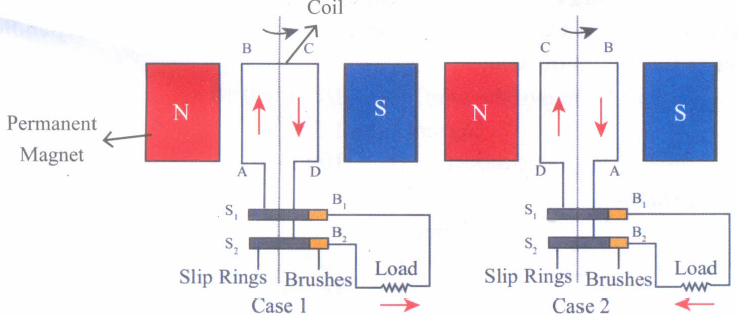
(v) When the coil is rotated, the magnetic flux linked with the coil changes. This change in magnetic flux will lead to generation of induced current.
(vi) The direction of the induced current, as given by Fleming's Right Hand Rule, is along ABCD in the coil and in the outer circuit it flows from B2 to B1.
(vii) During the second half of rotation, the direction of current is along DCBA in the coil and in the outer circuit it flows from B1 to B2
(viii) As the rotation of the coil continues, the induced current in the external circuit is changing its direction for every half a rotation of the coil
121.
Phloem like xylem is a complex tissue and consists of the following elements.
(i) Sieve elements
(ii) Companion cells.
(iii) Phloem fibres
(iv) Phloem parenchyma
(i) Sieve elements
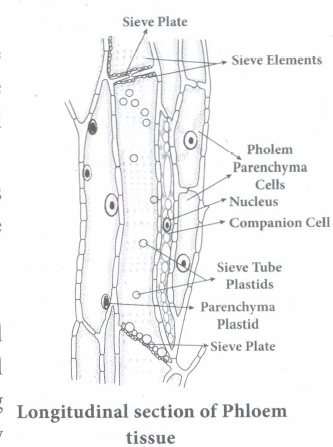
1. The conducting elements of phloem are collectively called as Sieve elements.
2. They may be segregated into less specialised Sieve cells and more specialised sieve tube elements.
3. Sieve tubes are elongated, tube-like slender cells placed end to end. The transverse walls at the ends are perforated and are known as sieve plates.
4. The main function of sieve tubes is translocation of food, from leaves to the storage organs of the plants.
ii. Companion cells
These are elongated cells attached to the lateral wall of the sieve tubes. A companion cell may be equal in length to the accompanying sieve tube element or the mother cell may be divided transversely, forming a series of companion cells
iii. Phloem parenchyma
The phloem parenchyma are living cells which have cytoplasm and nucleus. Their function is to store food materials.
iv. Phloem
fibers Sclerenchymatous cells associated with primary and secondary phloem are commonly called phloem fibers. These cells are elongated, lignified and provide mechanical strength to the plant body.
122.
(1) 1000F to 0C
T(0C) = (T(0F)- 32) / 1.8
= (1000F - 32) / 1.8
T(0C) = 37.70C
(2) 400C to Fahrenheit (0F)
T(0F) = (T(0C) x 1.8) + 32
= 400C x 1.8 + 32
= 72 + 32
T(0F) = 1040F
(3) 350C to Kelvin
(TK) = (T0c)+ 273.15
= 35 + 273.15
(TK) = 308.15 K
(4) 800K to 0C
(T0c) = (TK) - 273.15
(T0c) = 800 - 273.15
(T0C) = -193.150C
123.
| S.No | Ionic Compounds | Covalent Compounds |
| 1. | Formed by the transfer of electrons from a metal to a non-metal atom. | Formed by sharing of electrons between non-metal atoms. |
| 2. | Strong electrostatic force of attraction between cations and anions | Mutual sharing of electrons and so weak force of attraction between atoms. |
| 3. | Solids at room temperature. | Gases, liquids and soft solids |
| 4. | Conducts electricity in molten state or in solutions | Non-conductors of electricity |
| 5. | Have high melting and boiling points | Have low melting and boiling points. |
| 6. | Soluble in polar solvents. | Soluble in non-polar solvents |
| 7. | Hard and brittle | Soft and waxy. |
| 8. | Undergo ionic reaction which are fast and instantaneous. | Undergo molecular reactions which are slow. |
124.
125.
Weight of Lead oxide (A) = 100.00g
Weight of Oxygen = 7.143g
Weight of Lead (A) = 92.857 g
Weight of Lead Oxide (B) = 100.000 g
Weight of Oxygen = 10.345 g
Weight of Lead (B) = 89.655 g
Weight of Lead Oxide (C) = 100.000 g
Weight of Oxygen = 13.133 g
Weight of Lead (C) = 86.867 g
Pb(A) : 0 Pb(B) : 0 Pb(C) = 0
92.857: 7.143 89.66 : 10.34 86.867 : 13.133
92.857 g of lead (A) requires = 7.143 g of oxygen
100 g of lead requires = \(100\times7.143\over 89.66\)
= 7.6924 g
89.66 g of lead (B) requires = 10.34 g of oxygen
100 g of lead requires = \(100\times10.34\over 89.66\)
= 13.133 g
86.867 g of lead (C) requires = 13.133 g of oxygen
100 g of lead requires = \({100\times13.133\over 86.867}=15.345g\)
Ratio between the three
7.6924 : 13.133 : 15.345
7.6924 : 13.133 :13.133
_______ _______ _____
1 : 1.499 : 1.99
1 : 1.5 : 2
2 : 3 : 4
The fixed weight of lead combines with oxygen in the ratio of 2 : 3 : 4
So this obeyed the law of multiple proportions.
126.
Mineral nutrients:
(i) A mineral is a chemical element required as an essential nutrient by organisms to perform various functions necessary for life.
(ii) Minerals originate in the earth and cannot be made by living organisms.
(iii) Minerals are very important to maintain the physiological processes in our body.
(iv) They are the constituents of teeth, bones, tissues, blood, muscle and nerve cells.
(v) The five major minerals in the human body are calcium, phosphorus, potassium, sodium and magnesium.
(vi) All of the remaining elements in the human body are called "trace elements", such as sulfur, iron, chlorine, cobalt, copper, zinc, manganese, molybdenum, iodine and selenium.
127.
\(Refractive\ index\ of\ kerosene=\frac { Velocity\ of\ light\ in\ air }{ Velocity\ of\ light\ in\ kerosene } \\ \mu =\frac { { C }_{ air } }{ C_{ kerosene } } =\frac { { C }_{ 4 } }{ { C }_{ k } } \\ 1.41=\frac { 3\times { 10 }^{ 8 } }{ { C }_{ k } } \\ { C }_{ k }=\frac { 3{ \times 10 }^{ 8 } }{ 1.41 } =2.1\times { 10 }^{ 8 }m/s\\ Velocity\ of\ light\ in\ kerosene=2.1\times { 10 }^{ 8 }\ m/s\)
128.
1. The constituents of a mixture retain their individual properties.
2. A mixture can be prepared by mixing the constituents in any proportion.
3. Formation of mixtures does not involve any exchange of energy.
4. Mixtures do not have any characteristic set of properties.
5. Components of a mixture can be separated by physical methods.
129.
(i) The first step in using the Vernier caliper is to find out its least count, range and zero error.
(ii) \(Least\ count\ of\ the\ instrument(LC)=\frac{Value\ of\ one\ smallest\ main\ scale\ division}{Total\ number\ of\ vernier\ scale\ division}\)
The main scale division can easily be obtained by inspecting the main scale. It will be in centimeter, further divided into millimetre. The value of the smallest, main scale division is 1 mm. The Vernier scale division is obtained by counting number of division in it. In the Vernier scale there will be 10 divisions.
\(LC=\frac{1mm}{10}=0.1\ mm\)
(iii) Unscrew the slider and move it to the left, such that both the jaws touch each other.
(iv) If they are not coinciding with each other, the instrument is said to possess zero error. Zero error may be positive or negative. If the zero mark of the Vernier is shifted to the right, it is called negative error. On the other hand, if the Vernier zero is shifted to the left of the main scale zero marking, then the error is positive.
(v) Once you are able to calculate the zero error, you can get the correct reading using the formula:
The correct reading = Main scale reading + (VC x LC) - (Zero correction)
(vi) We can use Vernier caliper to find different dimensions of any familiar object.
130.
Generations of Computer:
| Generation | Digital devices |
|---|---|
| 1940-1956 - I Generation | Vacuum tubes |
| 1956-1963 - II Generation | Transistor |
| 1964-1971 - III Generation | Integrated circuits |
| 1972-2010 - IV Generation | Microprocessors |
| After 2010 - V Generation | Artificial Intelligence |
131.
Materials required: Glass trough, sand, flower pot, plugged at the bottom, pea or bean seeds and water.
Procedure:
1. A glass trough is taken and is filled with sand. A flower pot containing water, plugged at the bottom is kept at the centre of the glass trough.
2. Soaked pea or bean seeds are placed around the pot in the sand, what do we observe after 6 or 7 days?
Observation: It will be observed that radicle has grown towards the pot and moisture instead of growing vertically downward.
Inference: It proves that primary root is positively hydrotropic.
132.
Acceleration (a) =4 m / s
Time (t) =10 second
distance (s) = ?
Initial velocity = 0
According to second equation of motion
\(s =u t+1 / 2 a t^{2} \)
\(=0+1 / 2 \times 4 \times(10)^{2} \)
\(=0+\frac{1}{\not 2} \times \not4^{2} \times 100 \)
= 0 + 200
= 200
Distance covers = 200 m.
133.
(a) To prove that sunlight is essential for photosynthesis.
(b) To destarch the plant.
(c) By Iodine test
(d) CO2, H2O and Chlorophyll
134.
(a) Pasteurization
(b) Milk
(c) 63°C for 30 minutes followed by sudden cooling.
135.
No, its terminals are not constant because it is the source of direct current. The dc is due to the unidirectional flow of electric charges. In electrical circuits electrons move from lower to higher electrical potential. So battery is used to maintain a potential difference between the two ends.

9th Standard Syllabus & Materials
9th Standard
TN 9th Tamil உள்ளத்தின் சீர் - திருக்குறள் Important Questions And Answers Study Material - QB365 Set A
NEW9th Standard
TN 9th Tamil உள்ளத்தின் சீர் - மணிமேகலை Important Questions And Answers Study Material - QB365 Set A
NEW9th Standard
TN 9th Tamil உள்ளத்தின் சீர் - ஏறு தழுவுதல் Important Questions And Answers Study Material - QB365 Set A
NEW9th Standard
TN 9th Tamil உயிருக்கு வேர் - தண்ணீர் Important Questions And Answers Study Material - QB365 Set A



Tamilnadu Stateboard 9th Standard Subjects
Tamilnadu Stateboard Standards





