
 100% FREE ACCESS
9th Standard Syllabus & Materials
9th Standard
TN 9th Tamil உள்ளத்தின் சீர் -கற்கண்டு (இலக்கணம்) - தொடர் இலக்கணம், ஆகுபெயர் Important Questions And Answers Study Material - QB365 Set A
NEW9th Standard
TN 9th Tamil உள்ளத்தின் சீர் -விரிவானம் (துணைப்பாடம்) - தாய்மைக்கு வறட்சி இல்லை! Important Questions And Answers Study Material - QB365 Set A
NEW9th Standard
TN 9th Tamil உள்ளத்தின் சீர் -கவிதை பேழை (செய்யுள்) - மார்கழி பெருவிழா Important Questions And Answers Study Material - QB365 Set A
NEW9th Standard
TN 9th Tamil உயிருக்கு வேர்-இலக்கணம் - பகுபத உறுப்பிலக்கணம் Important Questions And Answers Study Material - QB365 Set A
NEW9th Standard
TN 9th Tamil அமுதென்று பேர் - இலக்கணம்-எழுத்து -அளபெடை Important Questions And Answers Study Material - QB365 Set A
NEW9th Standard
TN 9th Tamil அமுதென்று பேர்-துணைப்பாடம் - ஆறாம்திணை Important Questions And Answers Study Material - QB365 Set A

Published on: 04/01/2019
IX STD Model Question
Download Tamil Nadu 9th Standard Science question papers, model tests, one-mark questions, important questions, and public exam papers in PDF format. Free study materials and answer keys for TN State Board students.
Questions + Answers key
Take MCQ Science Test1.
Binomial name of Nilavembu is
Leucas aspera
Andrographis paniculata
Crotolaria juncea
Cassia fistula
2.
_________is an Operating System.
Android
Chrome
Internet
Pendrive
3.
The major constituent of vinegar is
citric acid
acetic acid
oxalic acid
hydrochloric acid
4.
Which of the following is not an adaptation of hydrophytes?
poorly developed root system
reduced plant body
water storing parenchymatous tissues
finely divided submerged leaves
5.
Ceres is a _______.
Meteor
Star
Planet
Asteroid
6.
Chlorinated hydrocarbons are used as
fertilizers
pesticides
food colourants
preservatives
7.
The speeds of sound in four different media are given below. Which of the following is the most likely speed in ms-1 with which the two underwater whales in a sea can talk to each other when separated by a large distance?
5170
1280
340
1530
8.
Diamond is not a good conductor of electricity because
it is very hard
it has no free electron
its structure is uniform
it is insoluble in water
9.
A phenomenon in which an element exists in different modifications in same physical state is called
Isomerism
Allotropy
Catenation
Crystallinity
10.
Clouds float in atmosphere because of their low
density
pressure
velocity
mass
11.
Mention any two mushroom preservation methods.
12.
A baby is suffering from diarrhoea, while other babies in the same locality do not. Mention the possible causes that you think. What would be the possible solutions for this?
13.
What is IUCN? What is the vision of IUCN?
14.
Write about comets.
15.
Can sound travel through vacuum?
16.
Through which medium sound travels faster, iron or water? Give reason.
17.
Carbon does not form ionic compounds. Why?
18.
Why does a helium balloon float in air?
19.
On what factors the pressure exerted by the liquid depends on?
20.
Assertion: Wide wooden sleepers are kept below railway lines to reduce pressure on the railway tracks and prevent them from sinking in the ground.
Reason: Pressure is directly proportional to the area in which it is acting.
(a) If both assertion and reason are true and reason is the correct explanation of assertion.
(b) If both assertion and reason are true but reason is not the correct explanation of assertion.
(c) If assertion is true but reason is false.
(d) If assertion is false but reason is true.
21.
Assertion: To float, body must displace liquid whose weight is equal to the actual weight.
Reason: The body will experience no net downward force in that case.
(a) If both assertion and reason are true and reason is the correct explanation of assertion.
(b) If both assertion and reason are true but reason is not the correct explanation of assertion.
(c) If assertion is true but reason is false.
(d) If assertion is false but reason is true.
22.
Differentiate Pollen and Nectar
23.
Define Compost
24.
Define time period of a satellite.
25.
Define orbital velocity.
26.
What is the need for chemical fertilizers in crop fields?
27.
How many valence electrons are there in carbon?
28.
Why do carbon exist mostly in combined state?
29.
Why does a boat with a hole in the bottom would eventually sink?
30.
Write short notes on;
a) Importance of greenhouses
b) Uzhavan mobile Application
c) Major floriculture zones
d) Azospirillum
31.
Name the causative agent of typhoid in human. How does the pathogen gain entry into the human body? Write the diagnostic symptoms and mention the organ that is affected in severe cases.
32.
What is water recycling? Explain the conventional wastewater recycling treatment methods?
33.
Write a note on orbital velocity.
34.
Draw the cell diagram of Daniel cell. Give its reactions.
35.
Verify experimentally the laws of reflection of sound.
1.
(b)
Andrographis paniculata
2.
(a)
Android
3.
(b)
acetic acid
4.
(c)
water storing parenchymatous tissues
5.
(d)
Asteroid
6.
(b)
pesticides
7.
(d)
1530
8.
(b)
it has no free electron
9.
(a)
Isomerism
10.
(a)
density
11.
i) Freezing
ii) Drying
iii) Canning
iv) Vacuum cooling
v) Gamma radiation and storing at 15oC
12.
Possible causes: Infected by the virus through, contaminated food and water and oral route.
Possible solution: Proper sanitation and hygiene in the babies family.
13.
1. IUCN is an International organization working in the field of nature conservation and sustainable use of natural resources.
2. It provides public, private and non-governmental organisations with the knowledge to enable human progress, economic development and nature conservation to take place together.
Vision of IUCN:
The vision of IUCN is 'A just world that values and conserves nature'.
14.
1. Comets are lumps of dust and ice that revolve around the Sun in highly elliptical orbits. Their period of revolution is very long .
2. When approaching the Sun, a comet vaporizes and forms a head and tail .
3. Some of the biggest comets had tails of length 160 million km long .
4. Many comets are known to appear periodically.
5. Ex. Halley's comet, which appears nearly every 76 years.
15.
No, sound cannot travel through vacuum.
Because, sound can travel only when there are particles, which can be compressed and rarefied in the medium.
16.
Reason: In solid, particles are packed closer than in liquid and gaseous. So sound waves travel easily in solid. Sound travels faster in iron.
17.
1. Covalent bonding is the sharing of electron between atoms. This type of bonding occurs between two atoms of the same element.
2. To form Ionic compounds carbon must gain four electrons forming C4- anions but it would be difficult for its nucleus with six protons to hold onto ten electrons .
3. It could lose four electrons to form C4+ cations, but it would require a large amount of energy to remove four electrons .
4. These two conditions are highly unfavourable. Therefore carbon molecules share their four valence electrons through single, double, and triple bonds so that each atom can achieve noble gas configuration.
18.
Helium in the balloon is lighter than the air around it, it receives an upward thrust known as buoyancy. Because helium weighs less than the amount of air it has displaced. So it floats.
19.
Pressure exerted by a liquid at a point is determined by
i) depth (h)
ii) density of the liquid (ρ)
iii) acceleration due to gravity (g)
20.
a) Both assertion and reason are true and reason is the correct explanation of assertion.
21.
a) Both assertion and reason are true and reason is the correct explanation of assertion.
22.
23.
24.
Time taken by a satellite to complete one revolution round the earth is called time period.
Time period T = \(\frac { Distances covered }{ Orbital velocity }\)
25.
The horizontal velocity that has to be imparted to a satellite at the determined height, so that it makes a circular orbit around the planet is called orbital velocity.
26.
1. The crop supply to the field micro and macronutrients required for a crop growth in a field.
2. It gives the NPK (Nitrogen, Phosphorus, potassium).
27.
Four valence electrons termed as tetravalency.
28.
1. In the Biosphere all the living things are made up of carbon compounds.
2. All the fossil fuels are also made up of carbon like hydro carbon.
3. In biogeochemical cycle carbon is exchanged among biosphere, geosphere; hydrosphere and atmosphere of the Earth.
4. It is the main compound of nitrogen cycle, water cycle. So, it is mostly in combined state.
29.
The hole in the boat is below the water level. That means the boat is heavier. So it starts to sink because the hydrostatic pressure at the hole is always higher than the atmospheric pressure pushing down on the surface of the water in the boat. So the boat will sink.
30.
a) Importance of greenhouses
1. Disease-free plants can be produced continuously.
2. Water requirement of the crop is very low
3. Yield is very high compared to outdoor cultivation.
4. A limited pesticide is needed.
5. It protects plants from uncertain weather.
b) Uzhavan mobile Application
Government of Tamilnadu has launched Uzhavan mobile application. It can be used by farmers to gather information on farm subsidies, farm equipment, crop insurance and weather conditions. It also provides information on available stock of seeds and fertilizers in local government and private stores.
c) Major floriculture zones
Hosur, Chennai, Madurai, Trichy, Coimbatore, Kanyakumari and Hill area zones are some of the major floriculture zones,
d) Azospirillum
1. Azospirillum has the ability to use atmospheric nitrogen and transport this nutrient to the crop plants. It is inoculated on maize, barley, oats and sorghum crops.
2. It increases productivity of cereals by 5-20% of millets by 30% and fodder by over 50%.
31.
Typhoid causative agent: Salmonella typhi
Mode of entry of the pathogen:
Through food and water contaminated with faeces of infected person and through houseflies.
Diagnostic symptoms:
High fever, weakness, abdominal pain, headache, loss of appetite, rashes on chest and upper abdomen.
Organ affected in severe cases:
Human Digestive system gets affected and the blood can carry the bacteria to other organs including the lungs, liver, gall bladder and kidneys.
32.
Water recycling is reusing treated wastewater for beneficial purposes such as agricultural and landscape irrigation, industrial processes, flushing in toilets and ground water recharge.
Conventional waste water treatment involves the following stages:
Primary treatment:
Primary treatment involves temporary holding of the wastewater in a tank. The heavy solids get settled at the bottom while oil, grease and lighter solids float over the surface. The settled and floating materials are removed. The remaining liquid may be sent for secondary treatment.
Secondary treatment:
Secondary treatment is used to remove the biodegradable dissolved organic matter. This is performed in the presence of oxygen by aerobic microorganisms. The microorganisms must be separated from treated water waste by sedimentation.
After separating the sediments of biological solids, the remaining liquid is discharged for tertiary treatment.
Tertiary treatment:
It involves removal of inorganic constituents such as nitrogen, phosphorus and microorganisms. The fine colloidal particles in the sewage water are precipitated by adding chemical coagulants like alum or ferric sulphate.
33.
1. Artificial satellites are made to revolve in an orbit at a height of few hundred kilometers. At this altitude, the friction due to air is negligible.
2. The satellite is carried by a rocket to the desired height and released horizontally with a high velocity, so that it remains moving in a nearly circular orbit.
3. The horizontal velocity that has to be imparted to a satellite at the determined height so that it makes a circular orbit around the planet is called orbital velocity.
4. The orbital velocity of the satellite depends on its altitude above Earth.
5. Nearer the object to the earth, the faster is the required orbital velocity.
6. The orbital speed and distance permit the satellite to make one revolution in 24 hours. Since earth also rotates once in 24 hours, a satellite stays in a fixed position relative to a point on earth's surface. Because the satellite stays over the same spot all the time, this kind of orbit is called 'geostationary'.
Orbital velocity can be calculated using the following formula.
V = \(\sqrt {\frac {GM }{R + h }}\)
Where
G - gravitational constant (6.673 x 10⁻¹¹ Nm2 kg-2)
M - Mass of the earth (5.972 x 1024kg)
R - Radius of the earth (6371 km)
h - height of the satellite from the surface of the earth.
34.
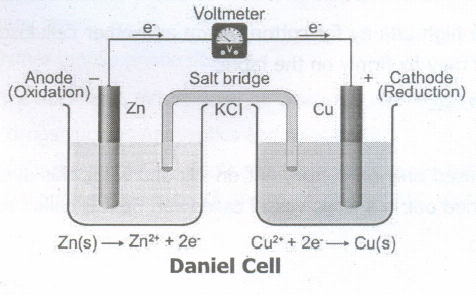
1. In Daniel cell zinc metal acts as anode and copper metal acts as cathode .
2. Aqueous zinc sulphate solution makes the anodic electrolyte. Whereas aqueous copper sulphate solution makes the cathodic electrolyte.
3. Saturated solution of potassium chloride (KCl) acts as salt bridge .
4. At anode, zinc undergoes oxidation losing its electrons .
. Zn(S) ⟶ Z2++ 2e- (Oxidation)
5. At cathode, copper ions from cathodic electrolyte gain electrons at the surface of cathode and get reduced to copper metal.
Cu2+ + 2e- ⟶ Cu(S)(Reduction)
Net reaction,
Zn + Cu2+ ⟶ Zn2+ + Cu(s)
6. Cell potential of Daniel cell is 1.1V
35.
The Laws of reflection of sound are:
1. The angle in which the sound is incident is equal to the angle in which sound is reflected.
2. Direction of incident sound, direction of the reflected sound and the normal are in the same plane.
Experimental verification:
1. Take two identical pipes, the pipes can be made using chart paper also.
2. The length of the pipes should be sufficiently long.
3. Arrange them on the table near the wall or keep a hard plywood at one end of the pipes and soft wood in the middle of the two pipes as shown in the figure.
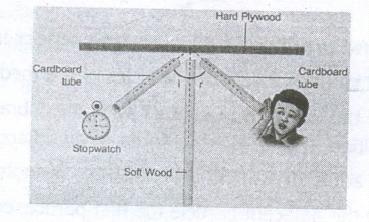
4. keep a clock near the open end of one of the pipes and try to hear the sound of the clock through the other pipe. Adjust the position of the pipes so that we can best hear the sound of the clock.
5. Now measure the angle of incidence and angle of reflection.
6. It is observed that for every angle of incidence, say 30°, 35°, 40°, the angle of reflection is same as 30°, 35° and 40°.
7. Thus it is proved that angle of incidence is equal to the angle of reflection and direction of incident and reflected sounds and normal lie in the same plane.

9th Standard Syllabus & Materials
9th Standard
TN 9th Tamil உள்ளத்தின் சீர் - திருக்குறள் Important Questions And Answers Study Material - QB365 Set A
NEW9th Standard
TN 9th Tamil உள்ளத்தின் சீர் - மணிமேகலை Important Questions And Answers Study Material - QB365 Set A
NEW9th Standard
TN 9th Tamil உள்ளத்தின் சீர் - ஏறு தழுவுதல் Important Questions And Answers Study Material - QB365 Set A
NEW9th Standard
TN 9th Tamil உயிருக்கு வேர் - தண்ணீர் Important Questions And Answers Study Material - QB365 Set A



Tamilnadu Stateboard 9th Standard Subjects
Tamilnadu Stateboard Standards





