
 100% FREE ACCESS
9th Standard Syllabus & Materials
9th Standard
TN 9th Tamil உள்ளத்தின் சீர் -கற்கண்டு (இலக்கணம்) - தொடர் இலக்கணம், ஆகுபெயர் Important Questions And Answers Study Material - QB365 Set A
NEW9th Standard
TN 9th Tamil உள்ளத்தின் சீர் -விரிவானம் (துணைப்பாடம்) - தாய்மைக்கு வறட்சி இல்லை! Important Questions And Answers Study Material - QB365 Set A
NEW9th Standard
TN 9th Tamil உள்ளத்தின் சீர் -கவிதை பேழை (செய்யுள்) - மார்கழி பெருவிழா Important Questions And Answers Study Material - QB365 Set A
NEW9th Standard
TN 9th Tamil உயிருக்கு வேர்-இலக்கணம் - பகுபத உறுப்பிலக்கணம் Important Questions And Answers Study Material - QB365 Set A
NEW9th Standard
TN 9th Tamil அமுதென்று பேர் - இலக்கணம்-எழுத்து -அளபெடை Important Questions And Answers Study Material - QB365 Set A
NEW9th Standard
TN 9th Tamil அமுதென்று பேர்-துணைப்பாடம் - ஆறாம்திணை Important Questions And Answers Study Material - QB365 Set A

Published on: 18/10/2019
Organ Systems in Animals
Download Tamil Nadu 9th Standard Science question papers, model tests, one-mark questions, important questions, and public exam papers in PDF format. Free study materials and answer keys for TN State Board students.
Questions + Answers key
Take MCQ Science Test1.
What is parturition?
2.
What is succus entericus?
3.
Name the bile salts.
4.
Name the salivary glands.
5.
Write the names of male and female sex hormone.
6.
State any two vital functions of human kidney.
7.
Why do we sweat?
8.
Arrange the following five steps of nutrition in correct sequence: (digestion, assimilation, ingestion, egestion, absorption)
9.
Explain the structure of nephron.
10.
What are the end products of digestion of starch, proteins and fats respectively?
11.
Name the types of teeth present in an adult human being. Mention the functions of each.
12.
List the function of the liver
13.
Explain the structure of kidney and the steps involved in the formation of urine
14.
The act of bringing swallowed food back to the mouth is called___________
egestion
ingestion
micturition
regurgitation
15.
__________is the smallest gland
Pancreas
Sublingual
Parotid
Submaxillary
16.
Which of the following is not a part of female reproductive system?
Ovary
Uterus
Testes
Fallopian tube
17.
Which one of the following substance is not a constituent of sweat?
Urea
Protein
Water
Salt
18.
Stomach of human beings mainly digests
carbohydrates
proteins
fat
sucrose
19.
Which of the following is not a salivary gland?
Sublingual
Lachrymal
Submaxillary
Parotid
20.
The oviducts are also known as___________
21.
_________is the smallest cell in males
22.
The largest cell in the human body of a female is___________
23.
The human body functions normally at a temperature of about____________
24.
The longest part of alimentary canal is_________.
25.
The process of release of ovum from ovary is called gestation
26.
Besides the normal constituents, the urine may pass out excess vitamins and not the antibiotics.
27.
During digestion, proteins are broken down into amino acids.
28.
Nitric acid in the stomach kills micro-organisms in the food.
1.
Child birth is called parturition
2.
The intestinal glands secrete intestinal juice called succus entericus which contains enzymes like maltase, lactase, sucrase, lipase etc.
3.
Sodium glycolate and sodium tauraglycolate
4.
Parotid glands, sublingual glands and submaxillary or submandibular glands.
5.
Male sex hormone - Testosterone
Female sex hormone - Oestrogen
6.
1. Maintain the fluid and electrolytes balance in our body.
2. Regulate acid-base balance of blood.
3. Maintain the osmotic pressure in blood and tissues.
4. Help to retain the important plasma constituents like glucose and amino acids.
7.
The human body functions normally at a temperature of about 37°C. When it gets hot sweat glands start secreting sweat, which contains water with small amounts of other chemicals like ammonia, urea, lactic acid and salts (mainly sodium chloride). The sweat passes through the pores in the skin and gets evaporated which reduces the body temperature.
8.
ingestion, digestion, absorption, assimilation, egestion
9.
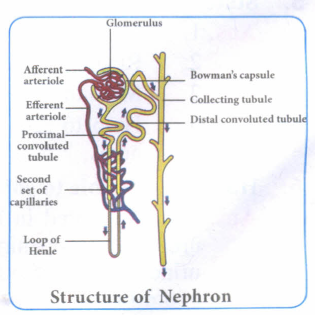
Each kidney consists of more than one million nephrons. Nephrons or uriniferous tubules are structural and functional units of the kidneys. Each nephron consists of Renal corpuscle or Malpighian corpuscle and renal tubule. The renal corpuscle consists of a cup-shaped structure called Bowman's capsule containing a bunch of capillaries called glomerulus. Blood enters the glomerular capillaries through afferent arterioles and leaves out through efferent arterioles. The Bowman's capsule continues as the renal tubule which consists of three regions proximal convoluted tubule, U-shaped hairpin loop, the loop of Henle and the distal convoluted tubule. The distal convoluted tubule opens into the collecting tubule. The nitrogenous wastes are drained into renal pelvis of kidney which leads to ureters and stored in the urinary bladder. Urine is expelled out through the urethra.
10.
Starch - Glucose
Proteins -Amino acids
Fats Fatty -acids and glycerol
11.
Permanent teeth are of four types (Heterodont), according to their structure and function namely incisors, canines, premolars and molars.
| Types of teeth | Number of teeth | Functions |
| Incisors | 8 | Cutting and biting. |
| Canines | 4 | Tearing and piercing. |
| Premolars | 8 | Crushing and grinding |
| Molars | 12 | Crushing, grinding and mastication. |
12.
(i) Synthesizes foetal red blood cells.
(ii) Produces fibrinogen and prothrombin, used for clotting of blood.
(iii) Destroys red blood cells.
(iv) Stores iron, copper, vitamins A and D.
(v) Produces heparin (an anticoagulant).
(vi) Excretes toxic and metallic poisons.
(vii) Detoxifies substances including drugs and alcohol.
13.
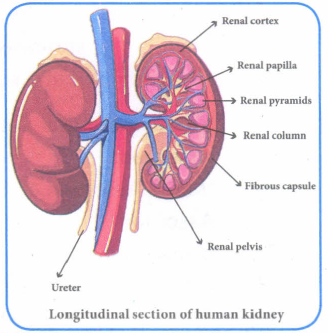
Kidneys:
(i) Kidneys are bean-shaped organs reddish brown in colour.
(ii) The kidneys lie on either side of the vertebral column in the abdominal cavity attached to the dorsal body wall.
(iii) The right kidney is placed lower than the left kidney as the liver takes up much space on the right side.
(iv) Each kidney is about 11 cm long, 5 cm wide and 3 cm thick.
(v) Internally the kidney consists of an outer dark region, the cortex and an inner lighter region, the medulla.
(vi) The medulla consists of multitubular conical masses called the medullary pyramids or renal pyramids whose base are adjacent to cortex.
(vii) On the inner concave side of each kidney, a notch called hilum is present through which blood vessels and nerves enter in and the urine leaves through the ureter.
Process of Urine formation:
The process of urine formation includes the following three stages.
(i) Glomerular filtration
(ii) Tubular reabsorption and
(iii) Tubular secretion
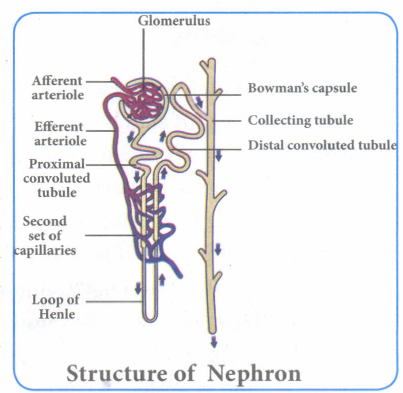
Glomerular filtration: Urine formation begins with the filtration of blood through epithelial walls of the glomerulus and Bowman's capsule. The filtrate is called as the glomerular filtrate. Both essential and non-essential substances present in the blood are filtered.
Tubular reabsorption: The filtrate in the proximal tubule consists of essential substances such as glucose, amino acids, vitamins, sodium, potassium, bicarbonates and water that are reabsorbed into the blood by a process of selective reabsorption.
Tubular secretion: Substances such as H+ or K+ ions are secreted into the tubule. Certain substances like potassium and a large number of drugs like penicillin and aspirin are passed into the filtrate in the distal convoluted tubule. This tubular filtrate is finally known as urine, which is hypertonic in man. Finally the urine passes into collecting ducts to the pelvis and through the ureter into the urinary bladder by urethral peristalsis (waves of constriction in the ureters). When the urinary bladder is full the urine is expelled out through the urethra. This process is called micturition
14.
(d)
regurgitation
15.
(b)
Sublingual
16.
(c)
Testes
17.
(b)
Protein
18.
(b)
proteins
19.
(b)
Lachrymal
20.
()
fallopian tubes
21.
()
Sperm
22.
()
Ovum
23.
()
37°C
24.
()
small intestine
25.
(b)
26.
(a)
27.
(a)
28.
(b)

9th Standard Syllabus & Materials
9th Standard
TN 9th Tamil உள்ளத்தின் சீர் - திருக்குறள் Important Questions And Answers Study Material - QB365 Set A
NEW9th Standard
TN 9th Tamil உள்ளத்தின் சீர் - மணிமேகலை Important Questions And Answers Study Material - QB365 Set A
NEW9th Standard
TN 9th Tamil உள்ளத்தின் சீர் - ஏறு தழுவுதல் Important Questions And Answers Study Material - QB365 Set A
NEW9th Standard
TN 9th Tamil உயிருக்கு வேர் - தண்ணீர் Important Questions And Answers Study Material - QB365 Set A



Tamilnadu Stateboard 9th Standard Subjects
Tamilnadu Stateboard Standards





