
 100% FREE ACCESS
9th Standard Syllabus & Materials
9th Standard
TN 9th Tamil உள்ளத்தின் சீர் -கற்கண்டு (இலக்கணம்) - தொடர் இலக்கணம், ஆகுபெயர் Important Questions And Answers Study Material - QB365 Set A
NEW9th Standard
TN 9th Tamil உள்ளத்தின் சீர் -விரிவானம் (துணைப்பாடம்) - தாய்மைக்கு வறட்சி இல்லை! Important Questions And Answers Study Material - QB365 Set A
NEW9th Standard
TN 9th Tamil உள்ளத்தின் சீர் -கவிதை பேழை (செய்யுள்) - மார்கழி பெருவிழா Important Questions And Answers Study Material - QB365 Set A
NEW9th Standard
TN 9th Tamil உயிருக்கு வேர்-இலக்கணம் - பகுபத உறுப்பிலக்கணம் Important Questions And Answers Study Material - QB365 Set A
NEW9th Standard
TN 9th Tamil அமுதென்று பேர் - இலக்கணம்-எழுத்து -அளபெடை Important Questions And Answers Study Material - QB365 Set A
NEW9th Standard
TN 9th Tamil அமுதென்று பேர்-துணைப்பாடம் - ஆறாம்திணை Important Questions And Answers Study Material - QB365 Set A

Published on: 07/08/2019
Download Tamil Nadu 9th Standard Science question papers, model tests, one-mark questions, important questions, and public exam papers in PDF format. Free study materials and answer keys for TN State Board students.
Questions + Answers key
Take MCQ Science Test1.
The radius of curvature of a convex mirror is 40 cm. Find its focal length
2.
List out the generations of computer
3.
Explain the postulates of Bohr’s atomic model.
4.
During an experiment, a signal from a spaceship reached the ground station in five seconds. What was the distance of the spaceship from the ground station? The signal travels at the speed of light that is 3 × 10⁸ ms-1?
5.
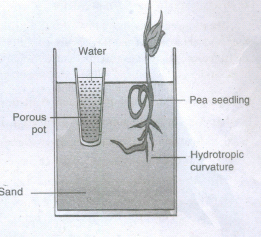
Design an experiment to demonstrate hydrotropism.
6.
Write the differences between elements and compounds and give an example for each.
7.
Find the size, nature and position of image formed when an object of size 1 cm is placed at a distance of 15 cm from a concave mirror of focal length 10 cm.
8.
Find the mass of an object weighing 98 N.
1.
\(Radius\ of\ curvature=40cm\\ focal\quad length=?\\ R=2f\\ 40=2\times f\\ f=\frac { 40 }{ 2 } =20cm\\ Focal\ length=20cm\)
2.
Generations of Computer:
| Generation | Digital devices |
|---|---|
| 1940-1956 - I Generation | Vacuum tubes |
| 1956-1963 - II Generation | Transistor |
| 1964-1971 - III Generation | Integrated circuits |
| 1972-2010 - IV Generation | Microprocessors |
| After 2010 - V Generation | Artificial Intelligence |
3.
(i) In atoms, electrons revolve around the nucleus in certain special or permissible orbits known as discrete orbits or shells or energy levels.
(ii) While revolving in these discrete orbits the electrons do not radiate energy.
(iii) The circular orbits are numbered as 1, 2, 3, 4, ... or designated as K, L, M, N, shells. These numbers are referred to as principal quantum numbers (n)
(iv) K shell (n = 1) is closest to the nucleus and is associated with lowest energy. L, M, N, .... etc are the next higher energy levels. As the distance from the nucleus increases the energy of the shells also increases.
(v) The energy of each orbit or shell is a fixed quantity and the energy is quantized.
(vi) As the distance from the nucleus increases, the size of the orbits also increases.
(vii) Maximum number of electrons that can be accommodated in an energy level is given by 2n2 where n is the principal quantum number of the orbit.
(viii) When an electron absorbs energy, it jumps from lower energy level to higher energy level.
(ix) When an electron returns from higher energy level to lower energy level, it gives off energy.
4.
Speed of the signal = Speed of the light = 3 x 10⁸ ms-1
Time taken by the signal to reach the ground = 5 seconds
Speed = \(\frac { Distance }{ time\ taken } \)
3 x 10⁸ ms-1 =\(\frac { Distance }{ 5s } \)
Distance = 3 x 108 x 5
= 15 x 108 m
Distance of the spaceship from the ground station = 15 x 108 m.
5.
Materials required: Glass trough, sand, flower pot, plugged at the bottom, pea or bean seeds and water.
Procedure:
1. A glass trough is taken and is filled with sand. A flower pot containing water, plugged at the bottom is kept at the centre of the glass trough.
2. Soaked pea or bean seeds are placed around the pot in the sand, what do we observe after 6 or 7 days?
Observation: It will be observed that radicle has grown towards the pot and moisture instead of growing vertically downward.
Inference: It proves that primary root is positively hydrotropic.
6.
| ELEMENTS | COMPOUNDS |
| 1. Contains only one kind of atoms. | Contains more than one kind of atoms |
| 2. It is a pure substance. | It is not a pure substance |
| 3. Cannot be broken down further into simpler substances by chemical methods |
Can be broken down further into simpler substances by chemical methods |
| 4. Has definite physical and chemical properties. | Has definite physical and chemical properties. |
| 5. Example: Hydrogen, Oxygen | Example : Water, Cane sugar. |
7.
Position of image
Object distance u = − 15 cm (to the left of mirror )
Image distance v = ?
Focal length f = − 10 cm (concave mirror) Using mirror formula.
\(\frac { 1 }{ v } +\frac { 1 }{ u } =\frac { 1 }{ f } \)
\(\frac { 1 }{ v } +\frac { 1 }{ -15 } =\frac { 1 }{ -10 } \)
\(\frac { 1 }{ v } -\frac { 1 }{ 15 } =\frac { -1 }{ 10 } \)
\(\frac { 1 }{ v } =\frac { -1 }{ 10 } +\frac { 1 }{ 15 } \)
\(\frac { 1 }{ v } =\frac { -1 }{ 30 } \)
∴ Image distance v = -30cm (negative sign indicates that the image is on the left side of the mirror)
∴ Position of image is 30 cm in front of the mirror
2.Nature of image: Since the image is in front of the mirror it is real and inverted.
3.Size of image: To find the size of the image, we have to calculate the magnification
\(m=\frac { -v }{ u } \)
Object distance u = − 15cm
Image distance v = − 30 cm
\(m=\frac { -(-30) }{ (-15) } \)
m = − 2
We know that,\(m=\frac { { h }_{ 2 } }{ { h }_{ 1 } } \)
Here, height of the object h1 = 1 cm
-2 =\(\frac { { h }_{ 2 } }{ 1 } \)
h2 = -2\(\times\) 1
= -2 cm
The height of image is 2 cm (negative sign shows that the image is formed below the principal axis).
8.
9.8 = 1 kg mass
98 N = ?
\(\text{Mass of the object }=\frac{98\times1}{9.8}=10\ kg\)

9th Standard Syllabus & Materials
9th Standard
TN 9th Tamil உள்ளத்தின் சீர் - திருக்குறள் Important Questions And Answers Study Material - QB365 Set A
NEW9th Standard
TN 9th Tamil உள்ளத்தின் சீர் - மணிமேகலை Important Questions And Answers Study Material - QB365 Set A
NEW9th Standard
TN 9th Tamil உள்ளத்தின் சீர் - ஏறு தழுவுதல் Important Questions And Answers Study Material - QB365 Set A
NEW9th Standard
TN 9th Tamil உயிருக்கு வேர் - தண்ணீர் Important Questions And Answers Study Material - QB365 Set A



Tamilnadu Stateboard 9th Standard Subjects
Tamilnadu Stateboard Standards





