
 100% FREE ACCESS
9th Standard Syllabus & Materials
9th Standard
TN 9th Tamil உள்ளத்தின் சீர் -கற்கண்டு (இலக்கணம்) - தொடர் இலக்கணம், ஆகுபெயர் Important Questions And Answers Study Material - QB365 Set A
NEW9th Standard
TN 9th Tamil உள்ளத்தின் சீர் -விரிவானம் (துணைப்பாடம்) - தாய்மைக்கு வறட்சி இல்லை! Important Questions And Answers Study Material - QB365 Set A
NEW9th Standard
TN 9th Tamil உள்ளத்தின் சீர் -கவிதை பேழை (செய்யுள்) - மார்கழி பெருவிழா Important Questions And Answers Study Material - QB365 Set A
NEW9th Standard
TN 9th Tamil உயிருக்கு வேர்-இலக்கணம் - பகுபத உறுப்பிலக்கணம் Important Questions And Answers Study Material - QB365 Set A
NEW9th Standard
TN 9th Tamil அமுதென்று பேர் - இலக்கணம்-எழுத்து -அளபெடை Important Questions And Answers Study Material - QB365 Set A
NEW9th Standard
TN 9th Tamil அமுதென்று பேர்-துணைப்பாடம் - ஆறாம்திணை Important Questions And Answers Study Material - QB365 Set A

Published on: 12/02/2020
9th Standard Social Science All Chapter Creative Questions-I-2019-2020
Download Tamil Nadu 9th Standard Social Science question papers, model tests, one-mark questions, important questions, and public exam papers in PDF format. Free study materials and answer keys for TN State Board students.
Questions + Answers key
Take MCQ Social Science Test
1.
Assertion (A): Biosphere Reserves are established in India.
Reason (R): Today's loss of biodiversity is habitat alteration caused by human activities
a) Both assertion (A) and reason (R) are true; R explains A
b) Both assertion(A) and reason (R) are true; R does not explain A
c) A is true; R is false
d) Both A and R are false
Both assertion (A) and reasonrk) are true; R explains A
Both assertion(A) and reasontk) are true; R does not explain A
A is true; R is false
Both A and R are false
2.
Assertion (A): The Ashokan inscriptions datable to third century BCE refer to the Cheras, Cholas, Pandyas and Satyaputras outside his empire in Tamilagam.
Reason (R): Ancient kings of Tamilagam commenced their political rule in the Iron Age.
(a) A and R are correct and R explains A
(b) A and R are correct but R doesn’t explain A
(c) A is correct but R is incorrect
(d) A and R both are incorrect
A and R are correct and R explains A
A and R are correct but R doesn’t explain A
A is correct but R is incorrect
A and R both are incorrect
3.
The driving force among men to migration is
work
employment
tourism
both a and b
4.
The Communlty Development Programme was introduced in the year_________.
1950
1952
1953
1954
5.
Manila (groundnut) is grown in ______________ percent if the cultivated land.
6
3
10
12
6.
Gps technology has tremedous applications in _________
Moblie phones
Watches
ATMs
All the these
7.
In India the first census was carried out in the year ___________
1800
1821
1872
1880
8.
Djakarta was called ______
Batavia
Malacca
Bantam
Manila
9.
Whiteman's burden was to_______
educate
civilise
Conquer
invent
10.
In the industrial factories and mines ___________
No legislation to monitor the service conditions
Workers had few rights
Working conditions were harsh
All of above three statements
11.
‘Drop, Cover, Hold’ is a mock drill a vowal for
Fire
Earthquake
Tsunami
Riot
12.
Which family introduced steam engine in France?
de Wendel
de Hindal
de Arman
de Renault
13.
The moderate liberals who wanted to retain Louis XVI as a limited monarchy were called ________
Girondins
Jacobins
Emigres
Royalists
14.
The 73rd and 74th constitutional Amendment Acts, was enacted during the year in __________.
1992
1995
1997
1990
15.
According to the 2011 census, the total population of India was ___________
121 crore
221 crore
102 crore
100 crore
16.
The productivity of paddy during the year 2014-2015
3,039 kg
4,429 kg
2,775 kg
3,519 kg
17.
All external influences and factors that affect the growth and development of living organisms is ___________.
Environment
Ecosystem
Biotic factors
Abiotic factors
18.
(i) Pathitrupathu speaks about the Pandya kings and their territory.
(ii) The Akanaanuru describes the trading activities at Kaveripoompattinum.
(iii) The Chola Emblem was the tiger and they issued square copper coins with images of a tiger.
(iv) Neythal is a sandy desert region.
(i) incorrect
(ii) incorrect
(iii) is correct
(iv) incorrect
19.
Odes was contributed by___________
Pliny the Elder
Livy
Horace
Tacitus
20.
'Nayakas' were __________officers.
Administritive
Special
Military
Police
21.
The author of Don Quixote, Cervantes belonged to______
Persia
Italy
Spain
Portugal
22.
One rupee and two rupee notes were first printed in India in the year_______
1917
1927
23.
Which of the following statements are ture?
(i) The general explanations of Human Rights by UDHR is not a legally binding document
(ii) UDHR has a political and moral importance.
(i) is correct (ii) is wrong
(i) is wrong (ii) is correct
Both (i) and (ii) are wrong
Both (i) and (ii) are correct
24.
Hideyoshi was a_________
Noble
Trader
Peasant
Warrior
25.
The central or high Middle Ages witnessed__________
rapid development
territorial expansion
urban growth
all of the above
26.
Consider the following statements.
1. Sylvia Earle is a famous American oceano-grapher
2. The continental shelves have extensive deposits of mineral fuels.
3. Submarine fans are located in continental slope.
4. Abyssal plains are otherwise called shallow sea plains
1 and 2 are correct
2 and 4 are correct
3 and 4 are correct
1, 2, and 3 are correct
27.
According to tbe UNO, a cbild is, a person wbo bas not completed tbe age of_________ years
12
14
16
18
28.
Nutrients are recycled in the atmosphere with the help of certain micro organisms, referred to as
Producers
Decomposers
Consumers
None of the above
29.
The continent of America was named after________
Amerigo Vespucci
Christopher Columbus
Vasco da Gama
Hernando Cortez
30.
The Peloponnesian War was fought between ______and______
Greeks and Persians
Plebeians and Patricians
Spartans and Athenians
Greeks and Romans
31.
(i) The nature and magnitude of weathering differs from place to place and region to region.
(ii) Granular disintegration takes place due to the action of volcanoes.
(iii) Weathering is a pre-requisite in the formation of soil
(i), (ii) and (iii) are right
(i) & (ii) are right
(i) & (iU) are right
only (i) is right.
32.
The enrolment for higher education in the highest in _______ in India.
Kerala
Tamil Nadu
West Bengal
Maharashtra
33.
This is the wettest place of India.
Mawsynram
Western Ghats
Shillong
Pune
34.
Which country has single party system?
USA
UK
Cuba
France
35.
This is the dominant form of government in the contemporary world.
Oligarchy
Monarchy
Theocracy
Democracy
36.
The discovery of _______ marked the beginning of the second phase in the history of civilisations.
Iron
Gold
Copper
Bronze
37.
This is a dead volcano.
Mt. St. Helens
Mt. Kilimanjaro
Mt. Fuji
Paricutin
38.
The movement of tectonic plates is due to __________________ energy from the mantle
Atomic energy
Hydro energy
Wind energy
Thermal energy
39.
During the Sangam Age ______ landscape followed the pastoral way of life.
Marutham
Neithal
Mullai
Palai
40.
The beginning of history writing can be traced to the ancient________
Greeks
Egyptians
Romans
Africans
41.
(i) The Egyptian king was known as the Pharaoh.
(ii) The preserved dead body is called the mummy.
(iii) The Egyptians have no belief in life after death.
(iv) Paprus was used for making paper.
(i) is incorrect
(ii) is incorrect
(iii) is correct
(iv) is incorrect
42.
Inter-generational equality is ensured under the process of
Industrial progress
Economic development
Sustainable development
Economic growth
43.
The largest democratic country in the world is
Canada
India
USA
China
44.
The Magadha king influenced by the teachings of Mahavira
Dhananandha
Chandragupta
Bimbisara
Shishunaga
45.
The average global surface temperature is ______
120°C
130°C
140°C
150°C
46.
Which one of the following is not a depositional feature of a glacier?
cirque
Moraines
Drumlins
Eskers
47.
______ is the rigid outer layer of the Earth
core
mantle
Crust
inner core
48.
Historic Transition in Bhutan.
49.
Do to determine the extent and nature of migration?
50.
E plain the term Town Panchayat.
51.
What is National Ayush Movement?
52.
Remote sensing can be either passive or active - Explain
53.
What is National Increase of population?
54.
How did European colonisation of Africa take place without any outbreak of war?
55.
Mention the causes for the growth of labour unions?
56.
Write a note on the National Assembly formed during the cource of the French Revolution.
57.
What was the condition of labourer's houses during Industrial Revolution?
58.
Colonel Pennycuick.
59.
Define remote sensing.
60.
Mention the important functions of the Village Panchayat.
61.
On what factors does crop cultivation depend? List out the factors on which crop cultivation depend.
62.
What was witnessed by the period of Principate?
63.
Write about the reign of Alexander, the Great
64.
Why did the first Persian attack on Greece fail?
65.
How was the economic condition of the peasantry during Medieval period of lndia?
66.
Who were Jesuit missionaries?
67.
Fall of Constantinople
Who captured Constantinople?
68.
What subject were taught in the Italian universities?
69.
Explain the following terms
a) Herbivorous
b) Carnivorus
c) Ommivorous
d) Scavengers
70.
What phenomenon increased the importance of the market and money?
71.
What do the 30 articles of UDHR guarantee?
72.
Explain the terms a) Isobath b) Isohaline
73.
Differentiate: Fundamental Rights and Human Rights.
74.
Why was money invented?
75.
What does the term ‘biodiversity’ mean?
76.
What is hydrological cycle?
77.
Impact of Crusades.
78.
Pacific Ring of Fire - Most seismically and volcanically active. Why?
79.
What are Transverse Dunes?
80.
Why do we say that investment in education and health of people can result in a high rate of returns?
81.
Cuddalore and Nagapattinam are always affected by cyclones. Why?
82.
Mention the recent trends in the working pattern of the employees.
83.
Glaciers do not form deep narrow valleys. Why?
84.
What do you know about Voters Verified Paper Audit Trail?
85.
Mention the salient features of Democracy.
86.
What kind of life Mahavira and Buddha live?
87.
What are fossils?
88.
What does the third section of the Tholkappiyam describe?
89.
Discuss when the earth was formed
90.
What is Egyptian civilisation known for?
91.
Elaborate the term “Tri-ratnas”.
92.
The Tamil rulers were independent of Mauryan authority. What explanation would you offer.
93.
What are wave cut platforms?
94.
Mention the various features formed by wind erosion
95.
What do you mean by biological weathering?
96.
State the salient features of the Ziggurats.
97.
Enumerate the distinctive characteristics of Neanderthals.
98.
Locate the following on the world outline map.
1. Priairies
2. Downs
3. Tundra Biomes
4. Equatorial Biomes
99.
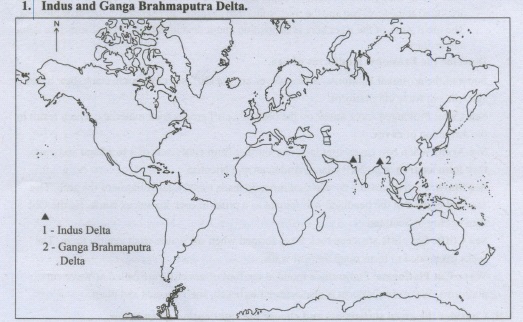
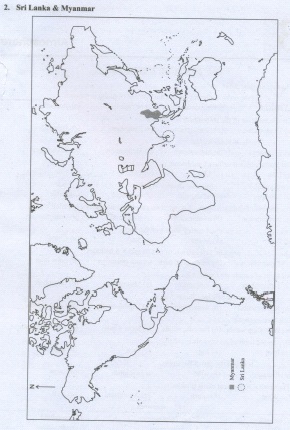
Indus and Ganga Brahmaputra Delta
100.
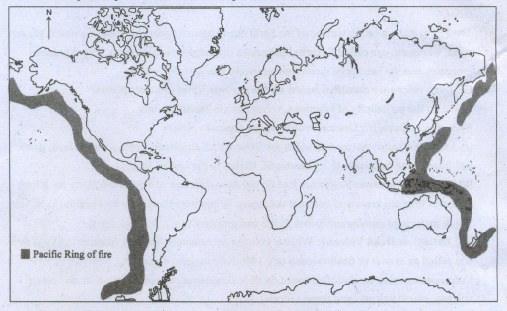
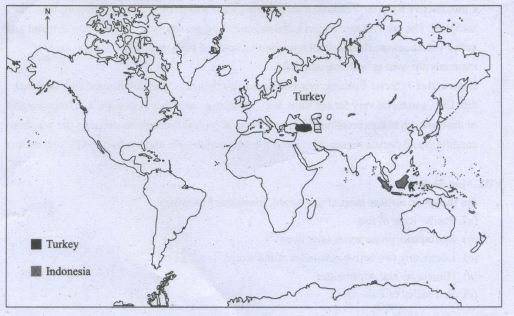
On the given outline map of the world, mark the following:
a. Pacific Ring of fire
b. Earthquake prone zones (any two)
c. Locate any two active volcanoes of the world.
d. Himalayas and Alps ranges
e. Rift valley of East Africa.
101.
Mention about the Unitary feature of Indian constitution.
102.
What is to be done after a Tsunami?
103.
What are the merits of a federal government?
104.
What is labour force of the economy?
105.
Why NNP is not considered as an useful measure to compare a country’s development with other countries?
106.
What are the indicators of development?
107.
Distinguish between two-party system and the multi-party system.
108.
Mention the forms of democracy.
109.
Agriculture, Forestry, Fishery and Mining
110.
Mention the rules to ensure Road Safety for children.
111.
How different factors contribute to road accidents?
112.
Write note the Parliamentary form of Government.
113.
Explain the concept of migration.
114.
Write about the Gandhi's Concept of Gram Swaraj.
115.
Explain the term Virtual water.
116.
Explain the Global Navigation Satellite System (GNSS).
117.
Do to dispose a Waste?
118.
Explain the term 'Indentured Labour'.
119.
Mention the main attributes of the Industrial Revolution.
120.
State the results of the American war of Independence
121.
Study your area and write down about its settlement pattern.
122.
Highlight the contribution of Greece to World Civilization
123.
Write a note on the following
Fatehpur Sikri
124.
Explain the term Renaissance.
125.
Explain the relationship between Money and Price.
126.
Explain Child Rights.
127.
Iron and Steel industries became highly organised in China - Prove.
128.
Write a note on Fresh Water
129.
Explain about the aquatic biomes on Earth.
130.
Describe the Erosional landforms of Sea
131.
Describe sustainability of Development.
132.
Give an account of Mobilisation and Democratic Participation.
133.
Though democracy in India has been appreciated worldwide for its working there is still a lot of scope for improvement - Discuss.
134.
Explain the teachings of Lao- Tse (Taoism).
135.
Give an account of 'Tsunami'
136.
Explain the "Archaeological sites".
137.
Domestication of Animals and plants. A milestone in Human History. Explain
138.
Compare the Indus Civilization with Tamil Civilization.
139.
Explain:
(a) primary sector;
(b) secondary sector;
(c) tertiary sector.
140.
Pacific ocean and Atlantic ocean
1.
Both assertion (A) and reason (R) are true; R explains A
2.
A and R are correct and R explains A
3.
(d)
both a and b
4.
(b)
1952
5.
(a)
6
6.
(d)
All the these
7.
(c)
1872
8.
(a)
Batavia
9.
(b)
civilise
10.
(d)
All of above three statements
11.
(b)
Earthquake
12.
(a)
de Wendel
13.
(a)
Girondins
14.
(a)
1992
15.
(a)
121 crore
16.
(b)
4,429 kg
17.
(a)
Environment
18.
(c)
(iii) is correct
19.
(c)
Horace
20.
(c)
Military
21.
(c)
Spain
22.
(a)
1917
23.
(d)
Both (i) and (ii) are correct
24.
(c)
Peasant
25.
(d)
all of the above
26.
(a)
1 and 2 are correct
27.
(d)
18
28.
(d)
None of the above
29.
(a)
Amerigo Vespucci
30.
(c)
Spartans and Athenians
31.
(c)
(i) & (iU) are right
32.
(b)
Tamil Nadu
33.
(a)
Mawsynram
34.
(c)
Cuba
35.
(d)
Democracy
36.
(a)
Iron
37.
(b)
Mt. Kilimanjaro
38.
(d)
Thermal energy
39.
(c)
Mullai
40.
(a)
Greeks
41.
(c)
(iii) is correct
42.
(d)
Economic growth
43.
(b)
India
44.
(c)
Bimbisara
45.
(a)
120°C
46.
(a)
cirque
47.
(c)
Crust
48.
(a) The fourth king of Bhutan Jigme Singye Wangchuck travelled to all the 20 districts of the tiny kingdom.
(b) The purpose of the travel is to explain the importance of historic transition to the people of Bhutan.
(c) Transition from the hereditary monarchy to the Parliamentary Democracy.
(d) In 2006 the king as abdicated the throne 34 years after ascending it. Now Bhutan is a Parliamentary Democracy and King Jigme a constitutional monarch.
49.
(i) The extent and nature of migration in any society is basically determined by the nature of the development process experienced by that society.
(il) That is, the type and scale of development achieved by the agricultural and industrial sectors in an economy would determine the migratory patterns.
50.
(i) The area where more than 10,000 people are living is called as Town Panchayat.
(ii) Members and President of the Town Panchayat are directly elected by the people.
(iii) There is one Executive Officer to look after the administration of the Town Panchayat and their term of office is five years.
51.
(i) The National Ayush Movement scheme is implemented by the central government.
(ii) Its main aim is to save and extend the life of many medicinal herbs that grow only in the forest.
(iii) This scheme is carried out with 60:40 shares from the central and state governments
52.
(i) Remote sensing can be either passive or active.
(ii) Active systems emit their own source of light energy such as RADAR:
(iii) Passive systems depend on sunlight as energy source
53.
National increase of population is the difference between the birth rate and death rate.
54.
(i) The interior of Africa was unexplored.
(ii) After 1875, European penetration and colonisation began on a large scale.
(iii) The Berlin Colonial Conference of 1884-85 resolved to divide Africa into sphers of influence of the various European powers.
(iv) European Colonisation of Africa was thus accomplished smoothly without any outbreak of war amongst major European powers.
55.
The difficult working conditions in the factories, long hours of work, low wages, exploitation of women and children contributed to the growth of labour unions.
56.
(i) The National Assembly comprised moderate liberals, who wanted a constitution on the model of England and America.
(ii) Their leader was Mirabeau. The Assembly was controlled by the middle classes.
(iii) There was no representation to the peasants and the common masses.
(iv) This National Assembly abolished serfdom, feudal privileges, including exempting nobles and clergy from taxation, even titles, and feudal courts.
(v) The Assembly then passed a Declaration of the Rights of the Man and the Citizen.
57.
(i) The houses were tiny, dirty and sickly for the labouring class.
(ii) Workers had no time to clean or change their own atmosphere even if they wished to, led to the out break of typhoid, cholrea and small pox.
58.
(i) Pennycuick was an army engineer and civil servant who also served as a member of the Madras legislative council.
(ii) He decided to divert the west flowing Periyar river draining into the Arabian sea to the east, so that it could irrigate lakhs of acres of dry land dependent on the Vaigai river.
(iii) Though Pennycuick and other British engineers went ahead with the construction braving nature's fury and the dangers of poisonous insects and wild animals, the construction was disrupted by relentless rain.
(iv) Since he could not get adequate funds from the British government, Pennycuick went to England and sold his family property to mobilise money to fund the project which was completed in 1895.
(v) The Mullai Periyar Dam continues to irrigate agricultural lands in Theni, Dindigul, Madurai, Sivagangai and Ramanathapuram districts.
59.
(i) Remote Sensing refers to the observation and measurement of earthly objects without touching them.
(ii) 'Remote' means far away and 'Sensing' means observing or collecting information.
(iii) Remote sensing means acquiring information of things/places from a distance, using a variety of tools and methods.
60.
Important functions of the Village Panchayat are
(i) Supply of drinking water
(ii) Maintenance of street lights
(iii) Maintenance of Road
(iv) Maintenance of village libraries
(v) Maintenance of small bridges
(vi) Maintenance of drainage
(vii) Maintenance of burial grounds
(viii) Granting permission to housing plots
(ix) Construction of group houses
(x) Cleaning of streets
(xi) Maintenance of common lavatory facilities
61.
The crop cultivation depends on the amount of land being cultivated, productivity of crops, source of water weather, rainfall etc.
62.
(i) The period witnessed a great influx of luxury goods such as silk, spices, and gems from the east.
(ii) Cities were built on a grand scale, with temples, theatres, stadia and colosseum, gymnasia, aqueducts, baths and markets.
(iii) The rich people distracted the attention of the poor by organizing games and contests in circuses.
(iv) Gladiators were forced to fight and kill each other.
63.
(i) Under Alexander the Great, the Greeks were able to establish a kingdom in Macedonia.
(ii) This kingdom succeeded in annexing two historic empires of Egypt and the Middle East.
(iii) But the entire period of Alexander's reign was spent on wars.
(iv) The Greek school of Science, Mathematics and Philosophy reached its peak in the Greek- Egyptian city of Alexandria.
64.
(i) The first Persian attack on Greece failed.
(ii) This was due to the fact that Persian army suffered from disease and lack of food, during its march.
(iii) During the second attack, they avoided the land route and came by sea. 3.
65.
(i) The economic condition of the bulk of the peasantry, was poor.
(ii) They generally lived only at a very basic level of subsistence.
(iii) Poor peasants sold themselves and their families into slavery.
(iv) The shipping lists of the Dutch East India Company regularly mention men and women slaves who
66.
(i) Jesuit missionaries were active especially among the fishing communities on the Pandyan coast.
(ii) The best known among the Jesuit missionaries was St Francis Xavier who was instrumental in making the fishing community to take to Christianity in the Tuticorin region.
(iii) Another notable Jesuit was Roberto de Nobili, a scholar, who was based in Madurai.
67.
In 1453 A.D. Constantinople, the capital of the Byzantine Empire, was captured by the Ottoman Turks.
68.
(i) Italian universities taught humanities namely language, grammar, rhetoric, history and ethics which prepared the students for public life, commerce and administration.
(ii) The study of humanities was so popular in the Italian Universities. Students from all over the world flocked there
69.
a)Herbivorous: A herbivores is an animal that gets its energy from eating plants and only plants. Many herbivores have special digestive systems that let them digest all kinds of plants including grasses. Eg., deer, rabbits, cows, sheep, goats, elephants, giraffes, horses and pandas.
b) Carnivores: A Carnivore is an animal that gets food from killing and eating other animals. Or they scavenge their dead flesh. Eg., Hyenas, Wolves, Mountains lions, Polar Bears.
c) Omnivores: An omnivore is a kind of animal that eats either other animals or plants. Eg. Raccoons, pigs, rats, chickens, crows etc.
d) Scavengers: Scavengers feed partly or wholly on the bodies of dead animals. Eg., Jackals, Leopards, Lions, Vulture etc.
70.
(i) Growing crops and production are done on a commercial basis, rather than on a subsistence level.
(ii) This phenomenon also increased the importance of the market and money.
71.
(i) There are 30 articles in the Universal Declaration of Human Rights.
(ii) It guarantees freedom of expression as well as Civil, Political, Social, Economic and Cultural rights.
(iii) These rights apply to all people, irrespective of their race, gender and nationality, as all people are born free and equal.
72.
(a) Isobath - An imaginary line on a map joining the points of equal depths.
(b) Isohaline - An imaginary line on a map joining the points of equal salinity in oceans.
73.
| Fundamental Rights | Human Rights |
| (i) The elemental rights of the citizens of a country, which are listed in the constitution and enforceable under the law is known as fundamental rights |
(i) The rights that a human being deserves to survive with respect and freedoms |
| (ii) Fundamental rights includes only those rights which are basic to a normal life. | (ii) Human rights include those rights which are basic to a real life and are absolute, i.e. it cannot be taken away |
| (Hi)Fundamental rights are guaranteed under the constitution. of the country | (iii)H urn an rights are recognised at international level |
74.
(i) The barter system flourished wherever civilizations thrived.
(ii) This system was active not only within a civilization, but also among civilizations.
(iii) As years went by, there were issues found in barter system.
(iv) To solve these issues, they fixed a common item with a standard value, for the effective exchange of goods.
(v) It was usually in the form of some metal.
(vi) Hence, the metals can be termed as the first form of money.
75.
(i) Bio diversity refers to a wide variety of Iiving organisms, which live in a habitat.
(ii) It is highly influenced by topography, climate as well as human activities.
76.
(i) The Earth's water is not static.
(ii) It is always in motion.
(iii) This continuous movement of water on, above and below the earth's surface is called the Hydrological Cycle.
(iv) The three major processes involved in the water cycle are evaporation, condensation and precipitation.
77.
(i) Crusades ended the feudal relations.
(ii) Many of the nobles who went to East to take part in the Crusades either stayed too long a period or did not return.
(iii) The serfs took advantage of their absence to break away from their bondage to the soil.
(iv) Increasing demand for products of the east Ied to expansion of trade.
(v) Venice, Genoa, and Pisa emerged as important commercial centres in the mediterranean region.
(vi) Constantinople ceased to be the middle man in the trade between the East and the West.
(vii) The elemination of powerful nobles had its influence in strengthening the monarchy in France and England. One notable outcome of Crusades was the loss of prestige suffered by Pope and Papacy.
78.
The Ring of Fire is a ring of volcanoes around the Pacific Ocean. These volcanoes result from subduction of oceanic plates beneath lighter continental plates, A subduction zone is a place where one plate of oceanic lithosphere is shoved under another plate. As it is shoved into the hotter mantle the plate heats up. The addition of volatiles such as water to the hot overlying mantle causes partial melting and the production of magma. This magma rises up through the over-lying plate to erupt at the surface. Hence, the Pacific Ring of Fire is most seismically and volcanically active.
79.
(i) Transverse Dunes are asymmetrical in shape.
(ii) They are formed by alternate slow and fast winds that blow from the same direction
80.
If a child is invested with good education and health, he or she may turn to be very productive in future in the form of higher earnings and greater contribution to the society. Therefore that. investment in education and health of people can result in a high rate of returns.
81.
(i) Coastal zone is exposed to natural forces including cyclones and Tsunamis.
(ii) Cuddalore and Nagapattinam are situated on the Sea-Shore.
(iii) Cuddalore and Nagapattinam are vulnerable to storms.
(iv) During Summer Bay of Bengal subject to intense heat cause to raise the humid and unstable air masses that produce cyclone.
82.
The trends are
(a) Increasing self-employment.
(b) Firms using fewer full-time employees and tending to offer more short-term contracts.
(c) There has been a growth in part-time employment.
83.
(i) A valley is made deeper by a stream of water (or) a river as it flows from the high land.
(ii) The valleys are either 'U' shaped or 'V' shaped.
(iii) The glacier debris get deposited in the low lying areas. So glaciers do not form deep narrow valleys.
84.
(i) Voters Verified Paper Audit Trail (VVPAT) is the way forward to enhance credibility and transparency of the election process.
(ii) This system was first introduced in 2014 General election.
85.
(i) Elected representatives of people and final decision-making power to the representatives.
(ii) Free and fair elections.
(iii) Universal adult franchise with each vote having equal value.
(iv) Fundamental rights and protection of individual freedom.
86.
Mahavira and Buddha lived a life of purity and exemplified simplicity and self-denial.
87.
The bodies of plants and animals that fall on the sedimentary rock deposits get embedded in the layers and form fossils.
88.
The third section of Tholkappiyam describes poetic conventions that provide information on Tamil social life.
89.
(i) The earth was formed approximately 4.54 billion years ago.
(ii) Gradually, conditions emerged for the growth of organisms.
(iii) Then plants and animals came into being and thereby foundation was laid for the evolution of humans.
(iv) The long span of time in earth's history is divided into eras periods and epochs by the geologists.
90.
As one of the oldest civilisations, the Egyptian civilisation is known for its monumental architecture, art, sciences and crafts at a very early age.
91.
The three principles of Jainism are known as Tri-ratnas. They are Right faith, Right knowledge, Right action.
92.
(i) The Tamil rulers were independent of Mauryan authority because Ashokan inscriptions found in present day Odisha, Karnataka, Telangana and Andhra Pradesh are not seen in Tamil Nadu and Kerala.
(ii) So we can conclude the status of Tamil rulers.
93.
Flat surface found at the foot of the sea cliffs are called as wave cut platforms, wave cut platform is also referred as beach, shelf, terrace and plain.
94.
The erosional landforms of wind: Mushroom rocks, Inselbergs and Yardangs
The Depositional Landforms of wind: Sand dunes, Barchans and loess.
95.
Biological weathering occurs due to the penetration and expansion of plant roots, earth worms, burrowing animals (rabbits, rats) and some human activities.
96.
1. The Ziggurats were at the city centre on a platform and appeared like steep pyramids, with staircases leading to the top.
2. Around this temple were complexes of ceremonial courtyards, shrines, burial chambers for the priests and priestesses, ceremonial banquet halls, along with workshops, granaries storehouses and administrative buildings.
97.
(i) The people of Middle Palaeolithic culture were called Neanderthals.
(ii) They buried the dead people systematically.
(iii) They were the first human ancestors to mourn death properly and bury the dead.
(iv) They did not have needles, sewn clothes and warm houses essential for survival in colder climates.
98.

99.
a)
b)
100.
a) Pacific Ring of fire: It is a major area and an arc in the basin of the Pacific ocean where many earthquakes and volcanic eruptions occur.
(b) Earthquake-prone zones (any two): Turkey, Indonesia
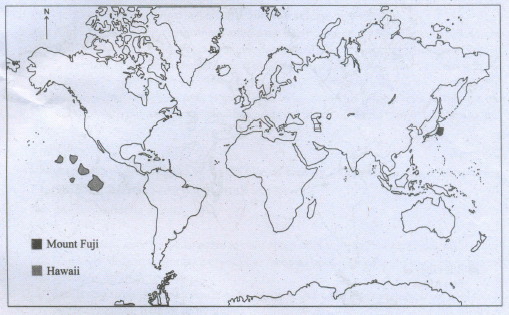
(c) Locate any two active volcanoes of the world: Hawaii, Mount Fuji
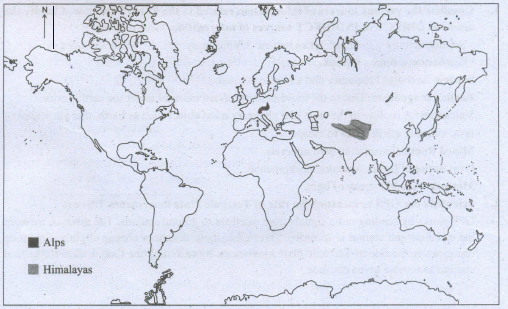
(d) Himalayas and Alps ranges
101.
Unitary features of Indian constitution are
(1) Strong Centre
(2) Central Government's control over state territory
(3) Single Constitution.
(4) Flexibility of the Constitution
(5) Unequal representation of states
(6) Emergency Provisions
(7) Single citizenship
(8) Single Integrated Judiciary
(9) All India Services
(10) Appointment of Governor by the central government.
102.
(i) You should continue using a Weather Radio or staying tuned to a Coast Guard emergency frequency station or a local radio or television station for updated emergency information.
(ii) Check yourself for injuries and get first aid if necessary before helping injured or trapped persons.
(iii) If someone needs to be rescued, call professionals with the right equipment to help.
(iv) Help people who require special assistance Infants, elderly people, those without transportation, large families who may need additional help in an emergency situation, people with disabilities, and the people who care for them.
(v) Stay out of a building if water remains around it. Tsunami water, like floodwater, can undermine foundations, causing buildings to sink, floors to crack, or walls to collapse.
(vi) Check for gas leaks. If you smell gas or hear a blowing or hissing noise, open a window and get everyone outside quickly.
103.
The merits of federal government are
(a) Reconciliation of local autonomy with national unity.
(b) Division power between centre and states leads to administrative efficiency.
(c) It gives rise to big states.
d) Distribution powers checks the despotism of central government.
(e) More suitable for bigger countries
(f) It is good for economic and cultural progress.
104.
(i) Labour force of the economy is the number of people in the country who work and are also capable of working.
(ii) We take the age group of 15-60 years for the computation of work force.
105.
(i) The Net National Product (NNP) is considered as a true measure of national output. It is also known as national income.
(ii) A rise in per capita income means an increase in aggregate real output. Hence, this is a better indicator than national income for measuring development.
(iii) For measuring a country's development, its income is considered to be one of the most important factors. Countries with higher income are considered to be more developed than those with lesser income.
(iv) So, income itself is considered to be one of the indicators of economic development.
106.
The major indicators to measure the level of economic development are
1. Net National Product (NNP),
2. Per Capita Income (PCI),
3. Purchasing Power Parity (PPP),
3. Human Development Index (HDI).
107.
| Two party system | Multi-party system |
|---|---|
| Two party system in which only two major parties exist, for example, USA, UK. | Multi-party system in which there are more than two political parties, for example India, Srilanka, France and Italy. |
108.
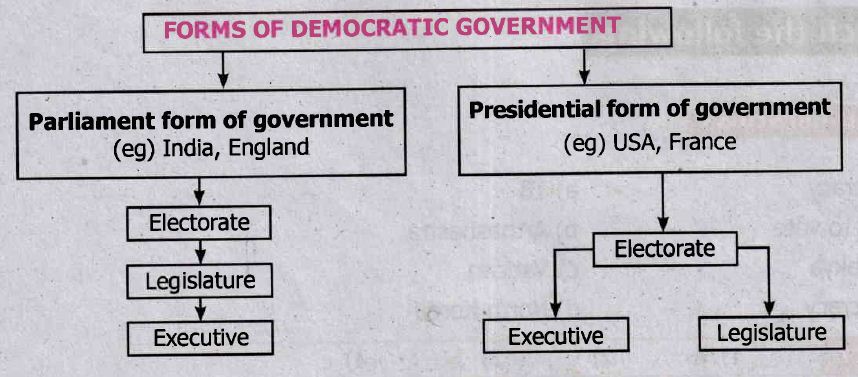
109.
Unorganised sector
110.
Rules to Ensure Road Safety for chlldren
It is impportant for children to know about road safety rules and regulatioins. Here are a few
basic road safety rules for children.
i) Know Your Signals
ii) Stop, Look and Cross
iii) Pay Attention - Listen
iv) Don't Run on Roads
v) Always Use Sidewalks
vi) Never Stick Hands outside the Vehicle
vii) Never cross Road at Bends
viii) Don't Rush.
111.
The different factors contribute to road accident are,
i) Drivers: Over speeding, rash driving, violation of rules, failure to understand signs, fatigue, alcohol.
ii) Pedestrians: Carelessness, illiteracy, crossing at wrong places, jaywalkers.
iii) Passengers: Projecting their body parts outside vehicles, talking to drivers, alighting and boarding vehicles from the wrong side, travelling on footboards, catching a running bus etc.,
iv) Vehicles: Failure of brakes or steering, tyre burst, insufficient headlights, overloading.
v) Road Conditions: Potholes, damaged roads, eroded roads merging of rural roads with highways and illegal speed breakers.
vi) Weather conditions: Fog, snow, heavy rainfall, wind storms, hail storms.
112.
Parliamentary form of Government
(i) The parliamentary system of government is the one in which the executive is responsible to the legislature for its policies and acts.
(ii) It is also known as cabinet government or responsible government or Westminster model of government and is prevalent in Britain, Japan, Canada, India among others.
Features of Parliamentary form of government
(i) Nominal and Real Executives.
(ii) Majority Party Rule
(iii) Collective Responsibility
(iv) Double Membership
(v) Leadership of the Prime Minister
Merill of the parliamentary form of government
(i) Harmony between Legislature and Executive.
(ii) Responsible Government
(iii) Prevents Dictatorship.
(iv) Wide Representation.
Demerits of the parliamentary form of government
(i) Unstable Government.
(ii) No Continuity of Policies.
(iii) Dictatorship of the Cabinet.
(iv) Against Separation of Powers.
113.
(i) In any settlement-village or town change in population occurs due to birth, death and migration.
(ii) Of these three components of population change, birth and death is clearly identifiable events while migration poses the maximum amount of problem with regards to its definition and measurement.
(iii) As almost everyone keeps moving most of the time, it is not easy to define which of these moves have to be classified as migratory moves.
(iv) In the Census of lndia, migration is enumerated on two bases - Place of birth and Place of residence.
114.
(i) Gandhi really wanted 'Swaraj', The self rule by the people of India who represent the rural mass.
(ii) He observed "India's soul lives in the village".
(iii) He dreamt of village republics in term of Panchayat in the free India.
(iv) Mahatma Gandhi advocated Panchayat Raj, a decentralized form of government where each village is responsible for its own affairs.
(v) Gandhi's ideal village should be basically self-reliant, making provision for all necessities of life, food clothing, clean water, sanitation, housing, education and other requirements, including government and self-defense.
(vi) According to Gandhi Gram Swaraj should be a complete republic, independent of its neighbor.
(vii) Every village should be a democracy in which they will not depend even on neighbor for major needs.
115.
(i) The term virtual water was introduced by Tony Allen in 1990.
(ii) The water consumed in the production process of an agriculture or industrial product has been called the virtual water.
(iii) It is a hidden flow of water when food or other commodities are traded from one place to another.
(iv) For instance it takes 1340 cubic meters of water to produce one metric ton of wheat.
(v) That is, if one metric ton of wheat is exported to another country, then, it means that 1340 cubic metre of water used to cultivate this amount of wheat is also being exported.
(vi) India is the largest global freshwater user .
(vii) India has been the fifth largest exporter of virtual water in the world.
116.
(i) In the 2151 century, GNSS has become a part of our lives to promote the safety and convenience of transport.
(ii) Global Navigation Satellite System (GNSS) is a satellite system connected with a small electronic receiver or tracker to locate, monitor and track a user's vehicle wherever in the world.
(iii) It can also set up instant alerts when a driver of a vehicle speeds or deviates from a particular area.
(iv) GNSS applications are used in tracking or mapping vehicles, ships and aircraft.
(v) A group of satellites (Space Segment) working with a network of ground stations (Control Segment) provide location data.
(vi) The receiver (User Segment) converts satellite signals into location, speed and time data.
(vii) Examples of GNSS:
(a) Europe's Galileo
(b) USA's NAVSTAR Global Positioning System (GPS)
(c) Russia's Global'naya Navigatsionnaya Sputnikovaya Sistema (GLONASS)
(d) China's BeiDou Navigation Satellite System
(e) India's NAVIC satellite system
117.
(i) Do not litter your surroundings. Use a proper waste bin to store your wastes.
(ii) People should practise to segregate degradable and non-degradable wastes and should dispose them in proper coloured bins. Wastage is generally classified into three types. They are
(a) Wet Waste: It comes from the kitchen/cooking/food, etc.
(b) Dry Recyclable Waite: Such as newspapers, cardboard, packing plastics, bottles, cans, etc., should go to a different bin
(e) Rejected Waste: which does not belong to the above two categories, including bio waste like diapers and bandages, etc.
(d) Sewage: sewage slude is produced by waste water treatment processes. Due to rapid urbanization, there has been an increase in municipal waste water.
(e) Electronic Waite (e-waste):
(i) It can be defined as any electrical goods, devices or components that you no longer want or have already thrown away. For example, computers, televisions, mobiles and fax machines.
(ii) This waste can take many years to break down.
(iii) It can contain toxic chemicals such as mercury, lead and lithium that leach into the ground and cause illness.
(iv) Instead of sending e-waste to the dump, components from electronics can be reused to make new products.
118.
(i) The Indentured Labour System was a form of debt bondage.
(ii) By this system 3.5 million Indians were transported to various British colonies to provide labour for the plantations (mainly sugar).
(iii) It started from 1843, the year of abolition of slavery in India and continued until 1920.
(iv) This resulted in the development of a large Indian diaspora, which spread from the Indian Ocean (Reunion and Mauritius) to Pacific Ocean (Fiji), as well as contributing to the growth of Indo-Caribbean and Indo-African population.
(v) The Indenture system was a penal contract system.
(vi) The contract made punishable the refusal of an indentured labourer to work or his abstention from work, or his defiance of the orders of his master or absconding.
119.
The main attributes of the Industrial Revolution were technological, socio-economic and cultural.
(i) Use of new basic materials: iron and steel
(i) Use of new energy sources: coal, electricity, petroleum
(iii) Invention of new machines such as the spinning jenny and the power loom that increased the production with a minimum expending of human energy
(iv) Emergence of a new organization known as the factory system, which entailed increased division of labour and specialisation of work
(v) Development in transportation and communication
(vi) Increasing application of science to industry
(vii) The use of new technology
120.
(i) For the first time a colonial power was overthrown by the colonies, leading to the establishment of a republican government in the United States.
(ii) The Declaration of Independence of 1776 stated that, "all men are born equal." But in reality America had to fight a bitter civil war in the succeeding century to abolish slavery.
(iii) By 1777 nearly all the colonies had a written constitution. These constitutions protected individual rights, freedom of press and freedom of religion. The church and the state were separated
(iv) The intellectuals of the time believed that the republican state was the only political structure in which individuals could preserve their basic freedom including property and political rights.
(v) The conception of people's right to a government of their choice encouraged the Latin American revolutionaries to strive for the overthrow of the Spanish empire in South America.
(vi) Mirabeau quoted the Declaration of Independence with enthusiasm during the French Revolution.
(vii) Lafayette, who fought the British on Washington's side through to the conclusive battle at Yorktown in 1781, later during the French Revolution served the French National Guard as its Commander
121.
(i) A settlement pattern refers to the way that buildings and houses are distributed in a rural settlement.
(ii) Settlement patterns are of interest to geographers, historians and anthropologists for the insight they offer in how a community has developed over time.
Linear : In a linear settlement pattern, the buildings are arranged in lines. These lines often follow the route of a road or body of water.
Dispersed : In a dispersed settlement pattern, the buildings are scattered over a wide area. Dispersed settlement patterns are often associated with agricultural activity and are frequently surrounded by farmland.
Nucleated: In a nucleated settlement pattern, the buildings are grouped around a central core. Nucleated settlement patterns are usually associated with patterns of agriculture in which the settlement is surrounded two or three fields, and each field divided into strips that were formed b individual farmers.
122.
(i) The ancient Greeks created the world's first democracy. Athens started on with a monarchy and then advanced to an oligarchy until it finally reached a democracy.
(ii) The Greek Alphabet was the first alphabet in the western sense of the word, featuring distinct letters for vowels and consonants.
(iii) The first library in the world, the library of Alexandria was actually built in Egypt.
(iv) The Olympic games started in ancient Greece specially in the city of Olympia.
(v) Science and Mathematics - Eratosthenes was the first mathematician to calculate the circumference of the Earth. Aristarchus, Archimedes and Hipparchus were great mathematicians and scientists.
(vi) One of the common examples of Greek Architecture in the modular world is the Column in Pillar.
(vii) Greek mythology has pervaded nearly every form of popular culture imaginable. Many Greek myths have been adapted into modem novels, movies, TV, shows etc.
(viii) The first lighthouse in the world was located in the Greek controlled Egyptian Kingdom of Alexandria.
(ix) The democratic people of ancient Greece, especially Athens, were the first to employ trial by jury as we know it today.
123.
Fatehpur Sikri:
(i) Fatehpur Sikri is a town in the Agra District in Uttar Pradesh.
(ii) The city was founded as the Capital of Mughal empire in 1571 by Emperor Akbar.
(iii) Fatehpur Sikri means the city of victory.
(iv) The Buland Darwaza was built in honour of his successful campaign in Gujarat.
(v) The city was built massively and preferably with red sand stone.
(vi) The city's architecture reflects both the Hindu and Muslim form of domestic architecture popular in India at that time.
(vii) Buland Darwaza, Jama masjid, Tomb of Salim Chirti, Panch Mahal, Naubat-khana, Birbal's House, Hiran Minar and other buildings are seen here.
124.
(i) The Italian city-states were centres of cultural activities since the fourteenth century.
(ii) With the coming of the scholars and artists from Constantinople, there was a surge of enthusiasm and interest in studying classical literature and art of Greeks and Romans.
(iii) This creative upsurge was reflected in their writings, art, architecture and music.
(iv) This cultural florescence is known as the renaissance.
(v) The origin of the word renaissance is from the Italian word 'renascita' meaning rebirth.
(vi) It is called renaissance because there was a rebirth or revival of classical Greek and Latin literature.
(vii) Many scholars in Italy went in search of manuscripts of classical literature.
(viii) Greek scholar Manuel Chrysoloras who taught Greek classics in Italy, Guarino and Giovanni Aurispa, to name just a few, visited Constantinople several times to collect Greek manuscripts.
(ix) Later they printed what they collected.
(x) This provided stimulus to the flowering of renaissance.
125.
(i) The relationship between money and price is connected with the Monetary policy.
(ii) There is a close relationship between the growth of money supply and inflation.
(iii) Price controls play a very important role in a country's economic stability.
(iv) This role is played by RBI.
(v) Currency is the medium of exchange in a country.
(vi) The Indian currency is called the Indian Rupee (INR).
(vii) In a country the foreign currency is called foreign exchange.
(viii)Purchasing capacity of all currencies in the world are compared using the US dollar as the standard currency.
(ix) This value differs from country to country.
(x) Most of the international trade transactions are carried out in US dollar
126.
Child Rights are
(a) Right to life:
(i) A child has the right to survive even before its birth.
(ii) The right to survival also includes the right to be born, the right to basic needs of food, shelter and clothing and a dignified living.
(b) Right to Family environment:
(i) A child has the right to live a normal childhood in a family environment.
(ii) Children who have been left destitute, abandoned or orphaned also have the right to live.
(iii) These children can be given for adoption to caring families.
(c) Right to benefit from Social security:
Children should get financial support from the country when their parents or guardians are unable to provide them with a good standard of living by themselves, due to any illness, disability or old age.
(d) Right to Education:
Right to Education Act is an Act of the Parliament of India enacted in 2009 for free and compulsory education for children from 6 to 14 years of age as under Article 21A of the Constitution.
(e) Right to sale or trafficking:
(i) Children should be treated as individuals with fundamental human rights.
(ii) They are subjected to sale or trafficking for various reasons like economic exploitation, sexual exploitation, sexual abuse, drug trafficking and child labour
(f) Right to sexual exploitation:
(i) The state should protect children from sexual exploitation and abuse.
(ii) This is done through POCSO Act - Protection of Children from Sexual Offences Act in 2012.
(g) Right against other forms of exploitation like Child labour:
(i) Children are often employed in several industries.
(ii) These children are deprived of their childhood, health and education.
(h) Child Rights in the Indian Constitution:
(i) Article 24 - No child below the age of 14 must be employed in hazardous employment.
(ii) Article 45 - Free and compulsory education for all children until they attain the age of 14 years.
127.
(i) Iron and Steel industries became highly organised.
(ii) The quantity of iron China produced in 1078 A.D. exceeded 114,000 tons (England produced only 68,000 tons even in 1788).
(iii) China excelled in ceramics and porcelain-making.
(vi) This technique was not known to Europe for another 700 years.
(v) Gun powder was in use by 1044.
128.
(i) Rain water is considered to be the purest form of water, as it contains very less proportion of salts when compared to the oceans and seas.
(ii) Hence it is called fresh water.
(iii) A major part of fresh water is found in the frozen state in the form of ice caps and glaciers.
(iv) Around 0.5 to 1% of it, is found in the liquid state as rivers, streams, lakes, ponds etc.
(v) Surface water may also penetrate through porous rocks and gets collected beneath the Earth's surface.
(vi) This is called groundwater
129.
Aquatic biome is a group of living organisms that live and interact with one another and its aquatic environment for nutrients and shelter. It is broadly classified as fresh water biomes and marine biomes.
A. Fresh water Biomes:
(i) Fresh water biomes comprises lakes, ponds, rivers, streams, wetlands etc.
(ii) It is influenced by various abiotic components such as the volume of water, water flow, composition of oxygen, temperature, etc.
(iii) Humans rely on freshwater biomes for drinking water, crop irrigation, sanitation and industry.
(iv) Water lily, lotus, duck weeds etc. are the common plants found here.
(v) Trout, salmon, turtles, crocodiles etc. are the animals found here.
B. Marine Biomes:
(i) They are the largest aquatic biomes on earth.
(ii) They are continuous bodies of salt water and provide a wide range of habitats for marine plants and animals.
(ii) Coral reefs are a second kind of marine biomes within the ocean.
(iv) Estuaries, coastal areas where salt water and fresh water mix, form a third unique marine biome.
(v) As water provides maximum mobility to marine organisms, nutrients are circulated more quickly and efficiently here than the terrestrial biomes.
(vi) Apart from animals, plants such as kelp, algae, phytoplankton etc. also grow in water.
(vii) Some of the threats and issues to aquatic biomes are overfishing, pollution and rise in sea level.
130.
Some of the erosional landforms of sea waves are sea cliff, sea cave, arch, stack, beach, bar and spit and wave cut platform.
Sea Cave: Prolonged wave attack on the base of a cliff erodes rock materials, which result in the formation of caves.
Sea Arch: When two caves approach one another from either side of a headland and unite, they form an arch. e.g., Neil Island, Andaman and Nicobar.
Sea Stack: Further erosion by waves ultimately leads to the total collapse of the arch. The seaward portion of the headland will remain as a pillar of rock known as stack. Eg the Old man of Hoy in Scotland.
Sea Cliffs: Sea cliffs are steep rock faces formed when sea waves dash against them. The rocks get eroded to form steep vertical walls.
Wave Cut Platforms: Flat surface found at the foot of sea cliffs are called as wave-cut platforms. Wave cut platform is also referred as beach, shelf, terrace and plain.
131.
Sustainable economic development is taken to mean development without damaging the environment and not compromising with the needs of the future generation. The consequences of environmental degradation do not respect national or state boundaries. Sustainability of development is comparatively a new area of knowledge in which scientists, economists, philosophers and other social scientists are working together. Natural resources can be divided into renewable resources and non-renewable resources. Groundwater is an example of a renewable resource. The question arises as to how sustainable development is possible if the resources are over-used rather than getting replenished. Nonrenewable resources get exhausted after certain number of years of extracting and using them and they cannot be replenished. To achieve real sustainability, we need to balance economic, social and environmental sustainability in equal harmony. In general, the question of development or progress is continuous. At all times, as a member of society and as individuals, we need to ask where we want to go, what we wish to become and what our goals are.
132.
Mobilising people towards socially productive activities that lead to the overall betterment of people's lives is essential. Sometimes earthquakes, tsunamis, floods and other such natural disasters on a massive scale occur and people's immediate mobilisation for evacuation and emergency relief becomes most essential.
Democratic Participation: Democracy can succeed only when smaller local groups and, in fact, every citizen can take action that supports the tax and revenue collection systems, observance of national norms in environmental protection, cleanliness, health and hygiene, sanitary drives and immunisation programmes like pulse polio. However, we must keep in mind that there is no better form of government than Democratic government. To create a better society and nation, the people of India along with the union and state governments should come together to fight against the miseries of human life.
133.
Though democracy in India has been appreciated worldwide for its working, there is still a lot of scope for improvement. The above-mentioned steps must be taken to ensure smooth functioning of democracy in the country.
Indian democracy can be successful and vibrant only when its citizens imbibe and reflect in their behavior the basic democratic values like equality, freedom, social justice, accountability and respect for all. Their mindset, thinking and behavior are expected to be in tune with the essential conditions of democracy. They have to appreciate the opportunities for their desired roles like participation, making the system accountable, fulfilling obligations, and playing proactive roles to actualize the goals of democracy.
134.
(i) The cause of human unhappiness in the world is human selfishness. Selfishness creates unlimited human desires, which can never be satisfied.
(ii) In nature, all the things act in a natural way. The law of human conduct must correspond with nature.
(iii) Humans live a life under the regulation of someone. This is because they have acquired knowledge and have not remained innocent. On the basis of their acquired knowledge, they have built up an urban civilisation and have made themselves unhappy.
135.
The word 'Tsunami' is a Japanese term, meaning harbour waves. It is adapted to describe large seismically generated sea waves caused by Earthquakes, submarine explosions and landslides. These waves travel at a great speed (more than 500 km per hour) and the length of the waves exceeds 600 km. These waves reach to a height of more than 15 m near the sea shore and are capable of causing destruction along the coastal area.
The 2004 Indian Ocean Earthquake that caused tsunami is.the sixth-deadliest natural disaster which travelled at a speed of 6.00km per hour with an estimated death toll of 2,80,000. The Earthquake which occurred near Indonesia at 00.58 hours took nearly 7 hours to reach Chennai.
136.
(i) Archaeological excavation refers to systematically digging a site to recover material evidence for exploring and interpreting societies of the past.
(ii) Archaeological excavations at the early historic sites are the source of evidence of the activities of the Sangam Age people.
(iii) Excavations at Arikkamedu, Azhagankulam, Uraiyur, Kanchipuram, Kaveripoom pattinam, Korkai, Vasavasamudram, Keezhadi, Kodumanal in Tamil Nadu, and. Pattanam in Kerala provide the evidence we have of this period.
(iv) Arikkamedu, near Puducherry, is a Sangam Age port, excavated by the Archaeological Survey of India (ASI). British archaeologist, Robert Eric Mortimer Wheeler, French Archaeologist, J.M. Casal, and Indian archaeologists, A. Ghosh and Krishna Deva, excavated this site. They found evidence of a planned town, warehouse, streets, tanks and ring wells.
137.
(i) Rice was probably cultivated in India and China around 7000 BCE or even earlier.
(ii) Wheat and barley were cultivated at Mehrgarh in northwestern part of the Indian subcontinent (Pakistan) before 6000 BCE.
(iii) Animal domestication developed as part of symbiotic life.
(iv) Dogs may have been domesticated first. Friendly animals were gradually domesticated. Sheep and goat were domesticated around 10,000 BCE in Southwest Asia.
(v) Oxen were used in Sumerian civilisation for tilling the land. Mehrgarh in Pakistan has evidence of sheep, goat and cattle domestication in the Neolithic period.
138.
(i) The similarity of the graffiti found on the megalithic burial pots of South India with the Indus script and the identical place names of Tamil Nadu and Indus region of Pakistan are presented as arguments to establish the relationship between the Indus civilisation and Tamil culture
(ii) Researchers like Father Henry Heras, Asko Parpola and Iravatham Mahadevan find similarity between the Indus script and the Dravidian Tamil language.
(iii) Archaeological evidence points out that several groups of people have been living in Tamil Nadu and South India continuously from the Mesolithic period.
(iv) A few groups from the Indus region might have migrated into southern India.
(v) Some of the ideas and technologies of the Indus civilisations had reached South India in the Iron Age.
(vi) The carnelian beads, shell bangles and bronze mirrors found in the Megalithic/Early Historic sites of Tami Nadu were first introduced by the people of the Indus civilisation, More research is needed to arrive at any definite conclusion in this matter.
(vii) The towns of ancient Tamilagam such as Arikkamedu, Uraiyur and Keezhadi that flourished are part of the second urbanisation of India and these towns are much different from the Indus cities. These towns emerged approximately 1,200 years after the decline of the Indus civilisation.
139.
The structure of employment denotes the number of workers engaged in different sectors of the economy.
Primary Sector: Agriculture, forestry, animal husbandry, poultry, dairy farming, fishing, etc.
Secondary Section: Manufacturing, small and large scale industries and constructional activities.
Tertiary Sector: Transport insurance banking, trade, communication, real estate, government and non-government services.
In developing countries like India that a large work force will be engaged in Primary Sector, while a small proportion in Secondary and Tertiary sectors.
140.
| S.No | Pacific ocean | Atlantic ocean |
| (i) | Pacific ocean is spread between the western coast of America to the fareast coast (China) | Atlantic ocean is spread between Europe and eastern coast of America |
| (ii) | It has less sea traffic | It has served as an important sea route for trade in the earlier countries and has contributed to the discovery of America |
| (iii) | It is larger in Size | It has stronger ocean currents |
| (iv) | Deepest point - Mariana Trench (10,924 m | Deepest point - Puerto Rico Trench (8,605 m) |

9th Standard Syllabus & Materials
9th Standard
TN 9th Tamil உள்ளத்தின் சீர் - திருக்குறள் Important Questions And Answers Study Material - QB365 Set A
NEW9th Standard
TN 9th Tamil உள்ளத்தின் சீர் - மணிமேகலை Important Questions And Answers Study Material - QB365 Set A
NEW9th Standard
TN 9th Tamil உள்ளத்தின் சீர் - ஏறு தழுவுதல் Important Questions And Answers Study Material - QB365 Set A
NEW9th Standard
TN 9th Tamil உயிருக்கு வேர் - தண்ணீர் Important Questions And Answers Study Material - QB365 Set A



Tamilnadu Stateboard 9th Standard Subjects
Tamilnadu Stateboard Standards




