
 100% FREE ACCESS
9th Standard Syllabus & Materials
9th Standard
TN 9th Tamil உள்ளத்தின் சீர் -கற்கண்டு (இலக்கணம்) - தொடர் இலக்கணம், ஆகுபெயர் Important Questions And Answers Study Material - QB365 Set A
NEW9th Standard
TN 9th Tamil உள்ளத்தின் சீர் -விரிவானம் (துணைப்பாடம்) - தாய்மைக்கு வறட்சி இல்லை! Important Questions And Answers Study Material - QB365 Set A
NEW9th Standard
TN 9th Tamil உள்ளத்தின் சீர் -கவிதை பேழை (செய்யுள்) - மார்கழி பெருவிழா Important Questions And Answers Study Material - QB365 Set A
NEW9th Standard
TN 9th Tamil உயிருக்கு வேர்-இலக்கணம் - பகுபத உறுப்பிலக்கணம் Important Questions And Answers Study Material - QB365 Set A
NEW9th Standard
TN 9th Tamil அமுதென்று பேர் - இலக்கணம்-எழுத்து -அளபெடை Important Questions And Answers Study Material - QB365 Set A
NEW9th Standard
TN 9th Tamil அமுதென்று பேர்-துணைப்பாடம் - ஆறாம்திணை Important Questions And Answers Study Material - QB365 Set A

Published on: 12/02/2020
9th Standard Social Science All Chapter Questions-I-2019-2020
Download Tamil Nadu 9th Standard Social Science question papers, model tests, one-mark questions, important questions, and public exam papers in PDF format. Free study materials and answer keys for TN State Board students.
Questions + Answers key
Take MCQ Social Science Test
1.
Of the international migrants ___________ percent are women.
85
25
15
20
2.
In India local self government was introduced in 1882 by Lord_________.
Ripon
Richard
William
Cornwallis
3.
Both agricultural productivity and food productivity has
decreased
not stable
remained stable
increased
4.
All external influences and factors that affect the growth and development of living organisms is ___________.
Environment
Ecosystem
Biotic factors
Abiotic factors
5.
King Ferdinand and Queen Isabella of Spain supported________
Amerigo Vespucci
Henry
Columbus
Ptolemy
6.
Barter system involved exchange of________
Goods
Money
7.
Li Yuan belonged to_____dynasty.
Tang
Sui
Sung
Ming
8.
_____________right exercises in the formation and administration of a government
Social
Economic
Political
Cultural
9.
The guild known as "the five hundred" (ainnurruvar) had its headquarters in_______
Nagapattinam
Ajanta
Calicut
Aihole
10.
_______is the Greek city-state which resisted the Persians to the end.
Acropolis
Sparta
Athens
Rome
11.
The________________ is elected by members of the Lok Sabha.
Prime Minister
President
Governor
Cabinet Minister
12.
The largest democratic country in the world is
Canada
India
USA
China
13.
______ inscriptions datable to third century BCE refer to the Cheras, Cholas and Pandyas in ancient Tamilagam.
Pulakesin
Ashoka
Chandragupta
Dhanananda
14.
Mention the direct consequences of accidents?
15.
Write a note river Cauvery.
16.
Explain the Quinary Activities.
17.
Highlight any two important results of Industrial Revolution.
18.
List out the salient features of Tamil Nadu Panchayat Raj Act 1994.
19.
What are the major factors responsible for female migrants in India?
20.
Unitary and federal forms of government.
21.
Why were coins of low value printed in large quantities?
22.
Mention the various terrestrial biomes.
23.
What is hydrological cycle?
24.
Mention the two natural advantages that India had in cotton weaving.
25.
What is Geology?
26.
What does Erythrean sea refer to?
27.
Who proposed the idea of the Three Age system?
28.
State the salient features of the Ziggurats.
29.
Mention the rules to ensure Road Safety for children.
30.
Write a note on Micro Irrigation
31.
Explain the term sustainable development. Why should we balance the economic, social and environmental factors of sustainability in equal harmony?
32.
Enumerate the causes for the Second Industrialization in the USA.
33.
During and earthquake, why should we exit through staircase and not use elevators?
34.
Write in details about the salient features of the 73rd & 74th Constitutional Amendment Act (1992).
35.
Elucidate about some of the interesting findings on migration in Tamil Nadu.
36.
Write about the merits of unitary form of government.
37.
How is currency printed in India?
38.
Iron and Steel industries became highly organised in China - Prove.
39.
Examine the outcome of the geographical discoveries.
40.
The river channels in the lower course are wider than the upper course
41.
Give an account of Mobilisation and Democratic Participation.
42.
Domestication of Animals and plants. A milestone in Human History. Explain
43.
What are the challenges to Indian democracy? explain
44.
What are the Federal features of Indian Constitution?
45.
What do you do if you are indoors during an earthquake?
1.
(c)
15
2.
(a)
Ripon
3.
(d)
increased
4.
(a)
Environment
5.
(b)
Henry
6.
(a)
Goods
7.
(a)
Tang
8.
(c)
Political
9.
(d)
Aihole
10.
(c)
Athens
11.
(a)
Prime Minister
12.
(b)
India
13.
(b)
Ashoka
14.
The direct consequences of Accidents are
i) Fatality (Death) ii) Injury iii) Damage to Property
15.
(i) River Cauvery is the third largest river in India. Its length is 765 km.
(ii) Cauvery passes Thiruchirapalli, Tanjavur, Srirangapattinam, Kumbakonnam.
(iii) The dams constructed across Cauvery in Tamil Nadu are Mettur Dam, Kallanai.
16.
(i) The activities that focus on the creation, rearrangement, and interpretation of new and existing ideas are called quinary activities.
(ii) It includes the highest levels of decision making in a society or economy.
(iii) Eg. Senior business executives, scientists and policy makers in the Government.
17.
(i) Expansion of trade.
(ii) The Production of more food.
(iii) Emergence of factory workers as a new class.
(iv) Development in transport and communication.
18.
The salient features of the Tamil Nadu Panchayat Raj Act of 1994-
(i) A three tier system,
(ii) Gram Sabha
(iii) Establishment of Election Commission
(iv) Constitution of Finance Commission
(v) Reservation of Seats for SS/ST's proportionate to their population.
(vi) One third reservation of seats for women and
(vii) Constitution of District Planning Committees.
19.
(i) Among female migrants, 70 % in India and 51 % in Tamil Nadu report marriage as their reason for migration, in 2011.
(ii) Marriage and the movement associated with marriage appear to be a major factor responsible for women's mobility in India and in Tamil Nadu.
20.
| S.No | Unitary form of government | Federal form of government |
|---|---|---|
| 1 | Only one level of government or subunits | Two levels of government |
| 3 | Mostly single citizenship | Dual citizenship |
| 4 | Subunits cannot operate independently | Federal units are answerable to central government |
| 5 | No division of power. | Division of power. |
| 6 | Centralisation of power. | Decentralisation of power. |
21.
(i) As days went by, issues arose while trade prospered, there were insufficient reserves of gold and silver.
(ii) Mines also had a limited reserve of these metals.
(iii) An alternative was found and coins were made using metals with lesser value.
(iv) These were used to buy and sell goods of lesser value.
22.
(i) Terrestrial biomes is a group of living organisms that live and interact with one another on land.
(ii) They are mainly determined by temperature and rainfall.
(iii) Some of the major terrestrial biomes of the world are
a. Tropical Forest Biomes
b. Tropical Savanna Biomes
c. Desert Biomes
d. Temperate Grassland Biomes and
e. Tundra Biomes
23.
(i) The Earth's water is not static.
(ii) It is always in motion.
(iii) This continuous movement of water on, above and below the earth's surface is called the Hydrological Cycle.
(iv) The three major processes involved in the water cycle are evaporation, condensation and precipitation.
24.
(i) The first was that cotton grew in almost all parts of India, so that the basic raw material was easily available.
(ii) Second, the technology of producing a permanent colour on cotton using vegetable dyes was known from very early times in India.
(iii) Indigo was the most important dye crop that was grown in India.
25.
The science that deals with the physical structure and substances of the earth their history and the processes which act on them.
26.
(i) Erythrean sea refers to the waters around the red sea.
(ii) It makes references to the Sangam Age, Ports of Muciri, Thondi, Korkai and Kumari as well as the Cheras and the Pandyas.
27.
(i) The idea of the Three Age system proposed by C.J. Thomsen became the basis for understanding early human history.
(ii) He classified the artefacts in the Danish National Museum, Copenhagen, into Stone Age, Bronze Age and Iron Age.
28.
1. The Ziggurats were at the city centre on a platform and appeared like steep pyramids, with staircases leading to the top.
2. Around this temple were complexes of ceremonial courtyards, shrines, burial chambers for the priests and priestesses, ceremonial banquet halls, along with workshops, granaries storehouses and administrative buildings.
29.
Rules to Ensure Road Safety for chlldren
It is impportant for children to know about road safety rules and regulatioins. Here are a few
basic road safety rules for children.
i) Know Your Signals
ii) Stop, Look and Cross
iii) Pay Attention - Listen
iv) Don't Run on Roads
v) Always Use Sidewalks
vi) Never Stick Hands outside the Vehicle
vii) Never cross Road at Bends
viii) Don't Rush.
30.
(i) Micro irrigation technology is a very good remedial to tackle shortage in irrigational water.
(ii) This irrigation technology helps to have a higher yield when compared to the traditional irrigational methods.
(iii) As only required amount of water is supplied at regular intervals, it increases the ability of water usage and productivity of the crop resulting in reduction of labour expenses and weed growth in the field.
(iv) The government has taken many measures to implement micro irrigation for proper distribution of water to crops that require more water.
31.
(i) "Sustainable development is development that meets the needs of the present without compromising the ability of future generation to meet their own needs".
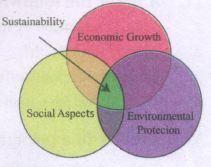
(ii) For sustainable development to be achieved, it is crucial to harmonize three core elements: economic growth, social aspects and environmental protection.
(iii) These elements are interconnected and are crucial for the well-being of individuals and societies
(iv) To achieve true sustainability, we need to balance the economic, social and environmental factors of sustainability in equal harmony.
Social Sustainability:
(i) The ability of a social system such as a country, family or organization to function at a defined level of social well being and harmony is called social sustainability.
(ii) The balancing capacity of a government in maintaining peaceful existence towards other countries and at the same time providing the requirements of its citizens without affecting the environment creates social sustainability.
Economic Sustainability:
(i) The economic sustainability is successfully implemented through strong Public Distribution System.
(ii) Economic sustainability ensures that our economic growth maintains a healthy balance with our ecosystem.
Environment Sustainability:
(i) It is the ability of the environment to support a defined level of environmental quality and natural resource extraction rates forever to mankind.
(ii) Unnecessary disturbances to the environment should be avoided whenever.
32.
1. A shift from manual labour based to more technical and machine based manufacturing industry marked the industrial revolution in the United States.
2. Samuel Slater, a citizen of England having worked at a cotton mill from the age of 10 had gained enough experience to operate a mill.
3. On learning that Americans were interested in the new techniques, Slater departed for New York in 1789 illegally. Slater offered his service to Moses Brown, who had earlier made an unsuccessful attempt to operate a mill.
4. Brown agreed and in consequence the mill became operational in 1793 being the first water-powered roller spinning textile mill in America.
5. By 1800, Slater's mill had been duplicated by many other entrepreneurs as Slater grew wealthier and his techniques became more and more popular.
6. Andrew Jackson, the U.S. President hailed him as Father of the American Industrial revolution.
7. In the Nineteenth Century America began to show technological innovation.
8. Robert Fulton established the steamboat service on the Hudson River.
9. Samuel E. B. Morse invented the telegraph and Elias Howe invented the sewing machine. This was the main cause for the industrialisation.
10. In 1869 the first transcontinental railroad was completed to transport people, raw materials and products.
11. The invention of electric bulb of Thomas Alva Edison and telephone by Alexander Graham Bell changed the world beyond recognition.
33.
34.
Salient features of the 73rd and 74th Constitutional Amendment Acts (1992)
(i) Panchayats and Municipalities will be "Institutions of Self Government".
(ii) Basic Units of Democratic System - Grama Sabhas (Villages) and Ward Committees (Municipalities) comprising all the adult members registered.
(iii) Three tier system of panchayats at village, intermediate block/taluk/mandal and district levels. Smaller states with population below 2 million only two tiers.
(iv) Seats at all levels filled by direct election.
(v) Seats reserved for SCs and STs at all levels in proportion to their population.
(vi) One third of the total number of seats-reserved for women. One third of the seats reserved for SCs and STs also reserved for women. One third of offices of Chairpersons at all levels reserved for women.
(vii) Uniform five year term and election to constitute new bodies to be completed before the expiry of the term. In the event of dissolution, elections compulsorily within six months.
35.
(i) Change in population occurs due to births, deaths and migration.
(ii) Almost everyone keeps moving most of the time, it is not easy to define which of these moves have to be classified as migratory moves.
(iii) According to the census of 2011 the population was 7.2 crore in Tamil Nadu.
(iv) 3.13 crore people were counted as migrants.
(v) The mobility of population in rural areas is greater than in urban areas.
(vi) Mobility is usually associated with male rather than female.
(vii) The poorer sections of the people migrate for survival but migrations from better off sections is to improve their living standards
(viii) Of the International migrants 15% are women while 85% are men.
36.
Merits of unitary form of government
(i) Suitable for small countries.
(ii) There is no conflict of authority and responsibility.
(iii) A unitary government will make prompt decisions and take speedy action.
(iv) A unitary government is less expensive.
(v) Amendments to the constitution are easy.
(vi) There is unity, uniformity of law, policy and administration.
37.
(i) In 1925, the British government established a government press at Nasik in Maharashtra.
(ii) Currencies were printed three years later.
(iii) In 1974, a press was started in Dewas, Madhya Pradesh.
(iv) In the 1990s two more presses were started in Mysuru, Karnataka and Salboni in West Bengal to print banknotes.
(v) The Reserve Bank of India has the authority to decide the value of currency to be printed and how the amount should reach its destination safely.
(vi) Though the RBI has the power to print up to ten-thousand-rupee notes, at present a maximum of up to rupees two thousand is printed.
38.
(i) Iron and Steel industries became highly organised.
(ii) The quantity of iron China produced in 1078 A.D. exceeded 114,000 tons (England produced only 68,000 tons even in 1788).
(iii) China excelled in ceramics and porcelain-making.
(iv) This technique was not known to Europe for another 700 years.
(v) Gunpowder was in use by 1044.
39.
1. As a result of the discovery of new lands and new sea routes, the economic centre of Europe shifted from the Italian city states to spain and Portugal.
2. They brutally killed the natives in their conquest and the remaining were employed under harsh conditions in gold and silver mines, and in plantations.
3. Many natives also died because of epidemic diseases brought by the colonizers.
4. The native people faced the dangers of deadly diseases.
5. The natives had to encounter from these deadly diseases.
6. The introduction of sugarcane led to the establishment of sugarcane plantations in the Caribbean islands and South America.
7. The mass extinction of the native population led to the import of slaves from Africa. Africa became the centres of slave trade.
8. Geographical discoveries led to commercial revolution.
9. The seventeenth century witnessed the emergence of various East India companies.
10. They are English East India Company the Dutch East India Company and the French East India Company.
11. The Portuguese enforced its monopoly on the spice trade of East Indies.
12. The Spaniards established monopoly over the mining and transportation of gold and silver in its colonies in the New World.
13. The English East India Company had monopoly trade in India and amassed huge wealth.
14. Thus, the chief feature of mercantilism was exploitation of the resources of the colonies for the benefit of the colonisers.
15. It represented an important stage in the development of modern capitalism.
40.
(i) The river channels of the upper course has more energy gradient then the channels of lower course.
(ii) As the river flows in the lower course it corrodes sideways and makes it wider.
41.
Mobilising people towards socially productive activities that lead to the overall betterment of people's lives is essential. Sometimes earthquakes, tsunamis, floods and other such natural disasters on a massive scale occur and people's immediate mobilisation for evacuation and emergency relief becomes most essential.
Democratic Participation: Democracy can succeed only when smaller local groups and, in fact, every citizen can take action that supports the tax and revenue collection systems, observance of national norms in environmental protection, cleanliness, health and hygiene, sanitary drives and immunisation programmes like pulse polio. However, we must keep in mind that there is no better form of government than Democratic government. To create a better society and nation, the people of India along with the union and state governments should come together to fight against the miseries of human life.
42.
(i) Rice was probably cultivated in India and China around 7000 BCE or even earlier.
(ii) Wheat and barley were cultivated at Mehrgarh in northwestern part of the Indian subcontinent (Pakistan) before 6000 BCE.
(iii) Animal domestication developed as part of symbiotic life.
(iv) Dogs may have been domesticated first. Friendly animals were gradually domesticated. Sheep and goat were domesticated around 10,000 BCE in Southwest Asia.
(v) Oxen were used in Sumerian civilisation for tilling the land. Mehrgarh in Pakistan has evidence of sheep, goat and cattle domestication in the Neolithic period.
43.
Democracy is the dominant form of government in the contemporary world. It has not faced a serious challenge or a rival so far. In the last hundred years, there has been an expansion of democracy all over the world. The various aspects of democracy and its challenges are:
1. Illiteracy
2. Poverty
3.. Gender discrimination
4. Regionalism
5. Casteism, communalism and religious fundamentalism
6. Corruption
7. Criminalisation of politics.
8. Political violence
44.
Federal features of Indian Constitution are,
(1) Dual Government
(2) Written constitution
(3) Division of Powers
(4) Supremacy of the Constitution
(5) The constitution is the supreme law of the land. The laws enacted by the Centre and the states must confirm to its provisions.
(6) Rigid Constitution
(7) Independent Judiciary
(8) Bicameralism
45.
During earthquake if you are indoor:
(i) DROP to the ground; take COVER by getting under a sturdy table or other piece of furniture and HOLD ON until the shaking stops. If there is no table or desk near you, cover your face and head with your arms and crouch in an inside corner of the building.
(ii) Protect yourself by staying under the lintel of an inner door, in the corner of a room, under a table or even under a bed.
(iii) Stay away from glass windows, outside doors and walls, and anything that could fall, (such as lighting fixtures or furniture).
(iv) Stay inside until the shaking stops and afterwards it is safe to go outside.

9th Standard Syllabus & Materials
9th Standard
TN 9th Tamil உள்ளத்தின் சீர் - திருக்குறள் Important Questions And Answers Study Material - QB365 Set A
NEW9th Standard
TN 9th Tamil உள்ளத்தின் சீர் - மணிமேகலை Important Questions And Answers Study Material - QB365 Set A
NEW9th Standard
TN 9th Tamil உள்ளத்தின் சீர் - ஏறு தழுவுதல் Important Questions And Answers Study Material - QB365 Set A
NEW9th Standard
TN 9th Tamil உயிருக்கு வேர் - தண்ணீர் Important Questions And Answers Study Material - QB365 Set A



Tamilnadu Stateboard 9th Standard Subjects
Tamilnadu Stateboard Standards




