
 100% FREE ACCESS
9th Standard Syllabus & Materials
9th Standard
TN 9th Tamil உள்ளத்தின் சீர் -கற்கண்டு (இலக்கணம்) - தொடர் இலக்கணம், ஆகுபெயர் Important Questions And Answers Study Material - QB365 Set A
NEW9th Standard
TN 9th Tamil உள்ளத்தின் சீர் -விரிவானம் (துணைப்பாடம்) - தாய்மைக்கு வறட்சி இல்லை! Important Questions And Answers Study Material - QB365 Set A
NEW9th Standard
TN 9th Tamil உள்ளத்தின் சீர் -கவிதை பேழை (செய்யுள்) - மார்கழி பெருவிழா Important Questions And Answers Study Material - QB365 Set A
NEW9th Standard
TN 9th Tamil உயிருக்கு வேர்-இலக்கணம் - பகுபத உறுப்பிலக்கணம் Important Questions And Answers Study Material - QB365 Set A
NEW9th Standard
TN 9th Tamil அமுதென்று பேர் - இலக்கணம்-எழுத்து -அளபெடை Important Questions And Answers Study Material - QB365 Set A
NEW9th Standard
TN 9th Tamil அமுதென்று பேர்-துணைப்பாடம் - ஆறாம்திணை Important Questions And Answers Study Material - QB365 Set A

Published on: 12/02/2020
9th Standard Social Science All Chapter Creative Questions-I-2020
Download Tamil Nadu 9th Standard Social Science question papers, model tests, one-mark questions, important questions, and public exam papers in PDF format. Free study materials and answer keys for TN State Board students.
Questions + Answers key
Take MCQ Social Science Test
1.
Historic Transition in Bhutan.
2.
What do the extent and nature of the migrant streams depend?
3.
Mention the importance of the Ashok Mehta Committee.
4.
Write a note river Cauvery.
5.
Write about the hardware and software functions of a GIS.
6.
What is demography?
7.
How did the British emerge as a territorial power in India?
8.
How did Germany surpassed the home of the industrial revolution, Great Britain?
9.
Why was Towshed Act introduced?
10.
Account for urbanisation in England.
11.
Colonel Pennycuick.
12.
Mention a few surveying instruments.
13.
Mention the important functions of the Village Panchayat.
14.
Give two examples for each food crop and non-food crops
15.
Who were Patricians and Plebeians?
16.
Write a note on Socrates
17.
What is Classical World?
18.
What were Karkhanas?
19.
When was the Mughal rule consolidated in India?
20.
Fall of Constantinople
What was promoted by them?
21.
Bring out the main features of India at the dawn of Modern Age in Europe.
22.
In India where do we find hot spots?
23.
What is meany by SHG?
24.
What does the term Civil rights refer to?
25.
Explain the term a) Water Table b) Aquifers
26.
Differentiate: Fundamental Rights and Human Rights.
27.
What is ancient money?
28.
What does the term ‘biodiversity’ mean?
29.
What are the factors that generate the ocean currents?
30.
Mention the various relief features of ocean floor.
31.
Contribution of Arabs to Science and Technology
32.
Pacific Ring of Fire - Most seismically and volcanically active. Why?
33.
Define Granular Disintegration.
34.
For comparing the development of various countries, total income is not an useful measure. How?
35.
Cuddalore and Nagapattinam are always affected by cyclones. Why?
36.
Mention the recent trends in the working pattern of the employees.
37.
Is weathering a pre-requisite in the formation of soil
38.
What do you know about Voters Verified Paper Audit Trail?
39.
What do you mean by "Republic"?
40.
Write a short note on "split in Jainism".
41.
What is Geology?
42.
What do you know about the Hero stones of the Post-Sangam Age?
43.
Why were the Levalloisian tools called so?
44.
What is Egyptian civilisation known for?
45.
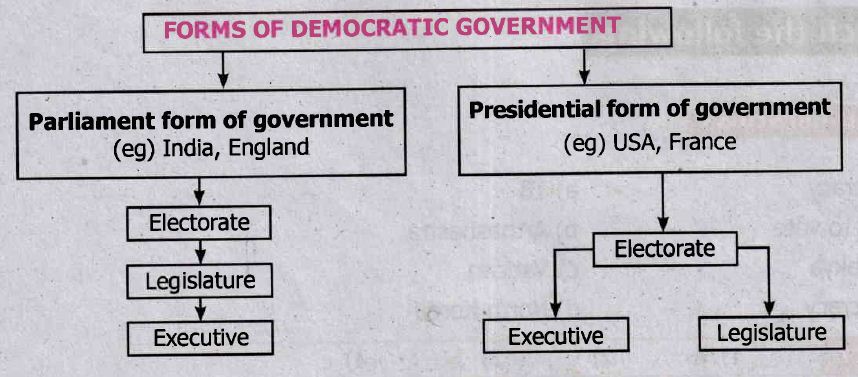
Elaborate the term “Tri-ratnas”.
46.
The Tamil rulers were independent of Mauryan authority. What explanation would you offer.
47.
Define :
a) Moraine
b) Drumlin
c) Esker
48.
List out any four karst topographical areas found in India.
49.
Define weathering.
50.
Write a note on the Great Wall of China.
51.
Examine the tool making technical skills of lower Palaeolithic people.
52.
Locate the following on the world outline map.
1. Priairies
2. Downs
3. Tundra Biomes
4. Equatorial Biomes
53.
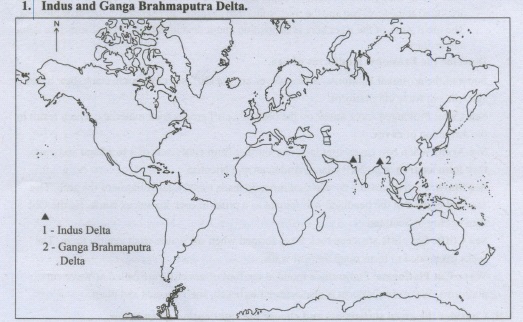
Indus and Ganga Brahmaputra Delta
54.
On the given outline map of the world, mark the following:
a. Pacific Ring of fire
b. Earthquake prone zones (any two)
c. Locate any two active volcanoes of the world.
d. Himalayas and Alps ranges
e. Rift valley of East Africa.
55.
Consider the following statements
Assertion (A): Child marriages should be avoided.
Reason (R): When girls get married early, they lose many privileges thereby affecting the society as a whole.
a) Both A and R are correct and R explains A
b) Both A and R are correct but R does not explain A
c) A is correct but R is false
d) A is false but R is correct
Both (A) and (R) are correct and (R) explains (A)
Both (A) and (R) are correct but (R) does not explain (A)
(A) is correct and (R) is false
(A) is false and (R) is correct.
56.
Assertion (A): Parties shape public opinion.
Reason (R): They raise and highlight issues of importance.
(a) Both (A) and (R) are true and (R) explains (A)
(b) Both (A) and (R) are true and (R) does not explain (A)
(c) (A) is correct and (R) is false
(d) (A) is false and (R) is true
Both (A) and (R) are true and (R) explains (A)
Both (A) and (R) are true and (R) does not explain (A)
(A) is correct and (R) is false
(A) is false and (R) is true
57.
Assertion (A): India has a parliamentary form of democracy.
Reason (R): The Indian Parliament comprises the elected representatives of people.
(a) Both (A) and (R) are true and (R) explains (A)
(b) Both (A) and (R) are true (A) explains (R)
(c) (A) is correct and (R) is false
(d) (A) is false and (R) is true
Both (A) and (R) are true and (R) explains (A)
Both (A) and (R) are true (A) explains (R)
(A) is correct and (R) is false
(A) is false and (R) is true
58.
Assertion (A): Assyrians of Mesopotamian civilisation were contemporaries of Indus civilisation.
Reason (R): The Documents of an Assyrian ruler refer to the ships from Meluha
(a) A and R are correct and A explains R
(b) A and R are correct but A doesn’t explain R
(c) A is incorrect but R is correct
(d) Both A and R are incorrect
A and R are correct and A explains R
A and R are correct but A doesn’t explain R
A is incorrect but R is correct
Both A and R are incorrect
59.
The driving force among men to migration is
work
employment
tourism
both a and b
60.
James Munroe was the Governor of _________ Presidency.
Calcutta
Bombay
Madras
None of the above
61.
Krishi Karman award in related to
cotton textile
industrial growth
food grain production
educational growth
62.
__________was the first state adopted Balwan Rai Mehta Committee's recommendations.
Andhra Pradesh
Rajasthan
Bihar
Maharashtra
63.
International boundaries are marked in ______ colour codes.
Brown
Blue
Red
Pink
64.
The percentage of people in a given population who can read and write a language refer to _____________
Infant mortality
Literacy rate
Sex ratio
Population density
65.
Albuquerque belonged to_____
Spain
Portugal
Italy
England
66.
Whiteman's burden was to_______
educate
civilise
Conquer
invent
67.
Siemens a well known company in __________.
France
Germany
U.S.A
England
68.
When you happen to see a fire break out you will make a call to
114
112
115
118
69.
Which family introduced steam engine in France?
de Wendel
de Hindal
de Arman
de Renault
70.
Candide was written by ______
Voltaire
Rousseau
Montesquieu
Danton
71.
According to the 2011 census, the total population of India was ___________
121 crore
221 crore
102 crore
100 crore
72.
The North-East monsoon period in Tamilnadu
August – October
September – November
October – December
November – January
73.
The Secondary sector of the economy produces ____________from raw materials.
Semi finished goods
Finished goods
Economic goods
raw materials
74.
(i) Pathitrupathu speaks about the Pandya kings and their territory.
(ii) The Akanaanuru describes the trading activities at Kaveripoompattinum.
(iii) The Chola Emblem was the tiger and they issued square copper coins with images of a tiger.
(iv) Neythal is a sandy desert region.
(i) incorrect
(ii) incorrect
(iii) is correct
(iv) incorrect
75.
The basic theorems of Geometry was formulated by___________
Hipparchus
Ptolemy
Euclid
Eratosthenes
76.
Vascodagama reached the west-coast of India in________
1490
1560
1498
1500
77.
Manuel Chrysoloras was a________scholar.
Roman
Italian
Greek
British
78.
The life supporting layer is known as
Atmosphere
Hydrosphere
Lithosphere
Biosphere
79.
One rupee and two rupee notes were first printed in India in the year_______
1917
1927
80.
Trade and industry flourished during the reign of________dynasty.
Shogun
Yuan
Sung
Tang
81.
The central or high Middle Ages witnessed__________
rapid development
territorial expansion
urban growth
all of the above
82.
The deepest point in the Arctic ocean is___________
Java Trench
Fram basin
Puerto Rico
South Sandwich Trench
83.
Which one of the following rights has increased the inouence of the people over bureaucracy?
Right to equality
Right to information
Right to education
Right to freedom
84.
To which climatic conditions are Xerophytic plants specifically adapted to?
Saline and sandy
Limited moisture availability
Cold temperature
Humid
85.
Who wrote the book Institutes of Christian Religion?
Martin Luther
Zwingli
John Calvin
Cervantes
86.
The other name for Greeks was_______
Hellenists
Hellenes
Phoenicians
Spartans
87.
(i) The nature and magnitude of weathering differs from place to place and region to region.
(ii) Granular disintegration takes place due to the action of volcanoes.
(iii) Weathering is a pre-requisite in the formation of soil
(i), (ii) and (iii) are right
(i) & (ii) are right
(i) & (iU) are right
only (i) is right.
88.
This is a renewable resource.
Metals
Glass
Wind energy
Diesel
89.
The wind blowing from the east is________
Planetary winds
Easterly winds
Variable winds
Local winds
90.
The discovery of _______ marked the beginning of the second phase in the history of civilisations.
Iron
Gold
Copper
Bronze
91.
The sixth deadliest natural disaster due to Tsunami caused in the year_____________ .
1996
1998
2000
2004
92.
This is the store house of rocks.
crust
core
mantle
None of the above
93.
During the Sangam Age ______ landscape followed the pastoral way of life.
Marutham
Neithal
Mullai
Palai
94.
The ______was a formative period and the foundation for the Sangam Age.
Iron Age
Bronze Age
Stone Age
Age of Information Technology
95.
Confucius was famous among the Chinese Philosophers.
Lao Tze
Confucius
Mencius
Sun Tzu
96.
__________ continues to be the largest employer in Tamil Nadu
Agriculture
Manufacturing
Banking
Small Scale Industry
97.
_______ resources are those which will get exhausted after years of use.
Natural
Renewable
Non-Renewable
New
98.
Which Article of the Constitution provides for an Election Commission?
Article 280
Article 315
Article 324
Article 325
99.
The meaning of Franchise is
Right to elect
Right to vote for the poor
Right to vote
Right to vote for the rich
100.
Identify the founder of a new sect who exemplified simplicity and self-denial.
Buddha
Lao-tze
Confucius
Zoroster
101.
_____ clouds are called 'Sheep clouds'
Alto-cumulus
Alto-Stratus
Nimbo - stratus
Cirro-stratus
102.
The disintegration or decomposition of rocks is generally called as
weathering
erosion
transportation
deposition
103.
Write about the demerits of unitary form of government.
104.
What is to be done after a Tsunami?
105.
What are the merits of a federal government?
106.
Expand the following:
1. NNP
2. PCI
107.
Why NNP is not considered as an useful measure to compare a country’s development with other countries?
108.
What is a pressure group?
109.
Mention the forms of democracy.
110.
Mention the rules to ensure Road Safety for children.
111.
How different factors contribute to road accidents?
112.
Write note the Parliamentary form of Government.
113.
Write a short note on "Red Tea".
114.
Mention the Role of Ripon and Munroe in Madras Presidency.
115.
Explain the term Virtual water.
116.
Explain the Global Navigation Satellite System (GNSS).
117.
What are the effects of Deforestation?
118.
Write a note on the famines which occurred in British India.
119.
Mention the development in textiles due to industrial revolution in Great Britain.
120.
Ring out the impact of the French Revolution.
121.
Study your area and write down about its settlement pattern.
122.
Highlight the contribution of Greece to World Civilization
123.
Write a note on the following
Hampi
124.
Explain the term Renaissance.
125.
How is currency printed in India?
126.
Democracy- Development - Fundamental Rights - establish a positive link among these three factors.
127.
Write about Chengiz Khan.
128.
What does this picture depict? Write a note on the processes involved in it.
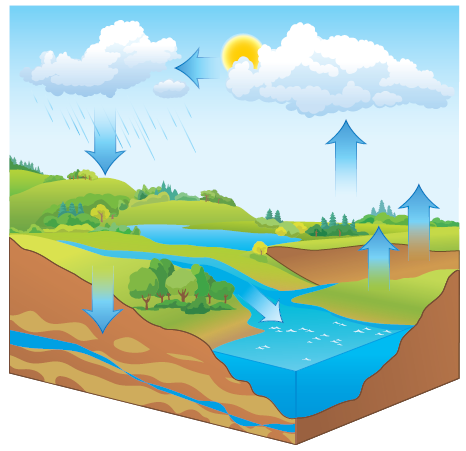
129.
Explain the terms a) Continental Rise b) Oceanic ridge
130.
Explain the various components of ecosystem
131.
Describe the Erosional landforms of Sea
132.
Describe sustainability of Development.
133.
Tertiary sector is in top position in the world now. Justify
134.
Give an account of Mobilisation and Democratic Participation.
135.
Though democracy in India has been appreciated worldwide for its working there is still a lot of scope for improvement - Discuss.
136.
Explain the teachings of Lao- Tse (Taoism).
137.
Give an account of 'Tsunami'
138.
Explain the "Archaeological sites".
139.
Discuss the Neolithic culture in Tamilnadu
140.
How did the Egyptians excel in att and architecture? Explain.
141.
Explain:
(a) primary sector;
(b) secondary sector;
(c) tertiary sector.
1.
(a) The fourth king of Bhutan Jigme Singye Wangchuck travelled to all the 20 districts of the tiny kingdom.
(b) The purpose of the travel is to explain the importance of historic transition to the people of Bhutan.
(c) Transition from the hereditary monarchy to the Parliamentary Democracy.
(d) In 2006 the king as abdicated the throne 34 years after ascending it. Now Bhutan is a Parliamentary Democracy and King Jigme a constitutional monarch.
2.
The extent and nature of these migrant streams would essentially depend on:
(i) Pressures and aspirations experienced by people at the origin of migration.
(ii) Constraints imposed on mobility at the origin of migration.
(iii) Opportunities at the destination and availability of information regarding these opportunities.
(iv) The cost of migration.
3.
(i) In December 1977, The Jana government appointed a committee on Panchayati Raj institutions under the Chairmanship of Ashok Mehta.
(ii) The main recommendation of the Committee were Two tier system with Zila Parishad at the district level and below it the MandaI Panchayat.
(iii) It also insisted that all political parties should participate at all levels in election.
4.
(i) River Cauvery is the third largest river in India. Its length is 765 km.
(ii) Cauvery passes Thiruchirapalli, Tanjavur, Srirangapattinam, Kumbakonnam.
(iii) The dams constructed across Cauvery in Tamil Nadu are Mettur Dam, Kallanai.
5.
The hardware and software functions of a GIS are
(i) Data input and verification
(ii) Compilation
(iii) Storage
(iv) Updating and changing
(v) Management and exchange
(vi) Manipulation
(vii) Retrieval and presentation
(viii) Analysis and combination
6.
(i) In ancient Greek, 'demos' means people and 'graphis' means study of measurement.
(ii) So 'Demography' is the statistical study of human population.
7.
(i) In the rivalry among four major European powers- Portuguese, Dutch, French and English the English, after three carnatic wars, eliminated the French by the end of the eighteenth century.
(ii) The British conquered all the regional powers, in particular, the most potential challengers, the Mysore Sultans and the Marathas by defeating them in three Anglo-Mysore wars and three Anglo-Maratha wars.
(iii) The conquest of the Gurkhas in 1816, the Sindhis in 1843 and the Sikhs in 1849.
(iv) Thus the British emerged as a territorial power in India.
8.
(i) In electrics, Germany offered companies like Siemens.
(ii) In chemicals, Germany excelled in the production of potassium salt, dyes, pharmaceutical products, and synthetics.
(iii) Companies like Bayer and Hoechst led the chemical industry of Germany.
(iv) Germany became a leader in automobile industry.
(v) Daimler and Benz became the most popular brands of automobiles in Germany and the world.
9.
(i) The British needed money to pay its troops and other expenses in the colonies.
(ii) Hence the British Finance Minister Charles Townshend introduced new duties on imports in 1767, known as Townshend Acts.
(ii) They introduced duties on imports to colonies such as glass, paper, paint, lead and tea.
10.
(i) With the advent of the Industrial Revolution, England became the workshop of the world.
(ii) There was however a general decline in agriculture.
(iii) This resulted in the flow of population from village to industrial towns.
(iv) Population growth, migration and urbanization were the social changes taking place.
(v) In pre-industrial society over 80% of people lived in rural areas.
(vi) As the migration from the country side began to intensify small towns became large cities.
11.
(i) Pennycuick was an army engineer and civil servant who also served as a member of the Madras legislative council.
(ii) He decided to divert the west flowing Periyar river draining into the Arabian sea to the east, so that it could irrigate lakhs of acres of dry land dependent on the Vaigai river.
(iii) Though Pennycuick and other British engineers went ahead with the construction braving nature's fury and the dangers of poisonous insects and wild animals, the construction was disrupted by relentless rain.
(iv) Since he could not get adequate funds from the British government, Pennycuick went to England and sold his family property to mobilise money to fund the project which was completed in 1895.
(v) The Mullai Periyar Dam continues to irrigate agricultural lands in Theni, Dindigul, Madurai, Sivagangai and Ramanathapuram districts.
12.
Geographers mainly use Chain, Prismatic compass, Plane table, Dumpy level, Abney level, Clinometre, Theodolite, Total Station and GNSS to measure the distance, angle, altitude and position of the area of survey.
13.
Important functions of the Village Panchayat are
(i) Supply of drinking water
(ii) Maintenance of street lights
(iii) Maintenance of Road
(iv) Maintenance of village libraries
(v) Maintenance of small bridges
(vi) Maintenance of drainage
(vii) Maintenance of burial grounds
(viii) Granting permission to housing plots
(ix) Construction of group houses
(x) Cleaning of streets
(xi) Maintenance of common lavatory facilities
14.
(i) Food crops: Paddy, Maize, Ragi, Cumbu
(iii) Non-food crops: Coconut, Cotton, Coffee, Tea, Sugar cene.
15.
(i) Patricians were Aristocrats in the Roman Socity Senators and Consuls protected the interests of Patricians.
(ii) Plebeians were chronically in debt and had to eventually lose their land to the Patricians.
16.
(i) Socrates was a great thinker of the Pericles Era.
(ii) The Athenian government, after Pericles, did not like Socrates' way of finding truth.
(iii) He was accused of corrupting the youth.
(iv) The jury found Socrates guilty and sentenced him to die by drinking hemlock (a poison).
17.
(i) Classical World comprises ancient Greece and Rome.
(ii) Classical Age refers to the inter-locking civilizations of ancient Greece and ancient Rome, known as Graeco- Roman World
18.
(i) Larger manufacturing units, employing many craftsmen, are called as Karkhanas.
(ii) Karkhanas were up under Mughol State.
19.
(i) The consolidation of Muslim rule under the Mughals in the north, beginning in 1526 A.D. (C.E.) with the defeat of the Ibrahim Lodi by Babur.
(ii) At its height, the Mughal empire stretched from Kabul to Gujarat to Bengal, from Kashmir to south India
20.
Their presence and encouragement promoted the study of classical literature and art of Greeks and Romans.
21.
(i) The Mughal rule started in 1526 A.D.
(ii) Vijayanagar state, founded in 1336, rose to a great power under Krishnadeva Raya.
(iii) Portuguese established their empire in the East with headquarters at Goa.
(iv) In Tamilnadu, in Madurai, Nayak rule began dividing the Pandya kingdom into seventy two palayams.
(v) The arrival of Jesuit Missions and the work of St. Francis Xavier, as a member of Society of Jesus, led to conversion of fishing community to Christianity (Catholicism) in Thoothukudi region.
22.
Hotspots in India are the Himalayas, Western Ghats, Indo Burma Region and Sundaland
23.
(i) People who live in a particular place or those who are involved in a certain work join together as a group and start saving.
(ii) These are called as Self Help Groups (SHG).
24.
(i) The term 'Civil rights' refers to the basic rights afforded by laws of the government.
(ii) It is guaranteed to every person regardless of race, nationality, colour, gender, age, religion etc
25.
(a) Water table is a level below the ground, where water is found collected beneath the Earth's surface.
(b) Aquifers are porous rock strata filled with water, found below the earth's surface.
26.
| Fundamental Rights | Human Rights |
| (i) The elemental rights of the citizens of a country, which are listed in the constitution and enforceable under the law is known as fundamental rights |
(i) The rights that a human being deserves to survive with respect and freedoms |
| (ii) Fundamental rights includes only those rights which are basic to a normal life. | (ii) Human rights include those rights which are basic to a real life and are absolute, i.e. it cannot be taken away |
| (Hi)Fundamental rights are guaranteed under the constitution. of the country | (iii)H urn an rights are recognised at international level |
27.
The metals such as silver, gold and copper were used first. They were called ancient currency.
28.
(i) Bio diversity refers to a wide variety of Iiving organisms, which live in a habitat.
(ii) It is highly influenced by topography, climate as well as human activities.
29.
The factors that generate ocean currents are:
(i) Earth's rotation
(ii) Prevailing winds and
(iii) Differences in temperature and salinity of ocean water
30.
The ocean basins are characterised by the following major relief features:
(i) Continental shelf
(ii) Continental slope
(iii) Continental rise
(iv) Deep sea plain or Abyssal plain
(v) Oceanic deep
(vi) Oceanic ridge
31.
(i) Arabs were more interested in scholarly pursuits.
(ii) They had a scientific spirit of inquiry.
(iii) In some subjects like medicine and mathematics, they learnt much from India.
(iv) Many Arab students went to Takshashila, which was still a great university for specialized medicine.
(v) Sanskrit books on medicine and other subjects were translated into Arabic.
(vi) In medicine and surgery, Arab physicians and surgeons earned a great reputation.
32.
The Ring of Fire is a ring of volcanoes around the Pacific Ocean. These volcanoes result from subduction of oceanic plates beneath lighter continental plates, A subduction zone is a place where one plate of oceanic lithosphere is shoved under another plate. As it is shoved into the hotter mantle the plate heats up. The addition of volatiles such as water to the hot overlying mantle causes partial melting and the production of magma. This magma rises up through the over-lying plate to erupt at the surface. Hence, the Pacific Ring of Fire is most seismically and volcanically active.
33.
Granular disintegration takes place in crystalline rocks where the grains of the rocks become loose and fall out. This is due to the action of temperature & frost.
34.
Since the countries have different populations comparing total income will not be suggestive of what an average person is likely to earn. So, for comparing the development of various countries total income is not an useful measure.
35.
(i) Coastal zone is exposed to natural forces including cyclones and Tsunamis.
(ii) Cuddalore and Nagapattinam are situated on the Sea-Shore.
(iii) Cuddalore and Nagapattinam are vulnerable to storms.
(iv) During Summer Bay of Bengal subject to intense heat cause to raise the humid and unstable air masses that produce cyclone.
36.
The trends are
(a) Increasing self-employment.
(b) Firms using fewer full-time employees and tending to offer more short-term contracts.
(c) There has been a growth in part-time employment.
37.
(i) Yes, weathering a pre-requisite in the formation of soil.
(ii) The rock materials in due course of time are weathered further to form soil.
(iii) Soil is a mixture of disintegrated rock material.
38.
(i) Voters Verified Paper Audit Trail (VVPAT) is the way forward to enhance credibility and transparency of the election process.
(ii) This system was first introduced in 2014 General election.
39.
A state in which supreme power is held by the people and their elected representatives and which has an elected (or) nominated President rather than a Monarch.
e.g., India, Australia.
40.
(i) In course of time, Jainism split into two branches namely the Digambaras (Sky-clad) and the Svetambaras (White-clad)
(ii) The Digambaras were the Orthodox followers of Mahavira. They rejected clothes altogether. The Svetambaras wore a white dress from head to toe.
41.
The science that deals with the physical structure and substances of the earth their history and the processes which act on them.
42.
(i) Hero stones of the Post-Sangam Age and the Pallava period occur in large numbers in pastoral regions especially around the Cheng am region near Thiruvannamalai district.
(ii) These hero stones have inscriptions and the images of warriors and names of heroes.
43.
(i) The lithic tool - making tradition of the Levalloisian belonged to this period.
(ii) Levalloisian tools are the implements made after preparing the core.
(iii) These tools are found in Europe and Central and Western Asia.
(iv) The Levalloisian tools are the implements made after preparing the core. It was named after the town of Levallois in France.
44.
As one of the oldest civilisations, the Egyptian civilisation is known for its monumental architecture, art, sciences and crafts at a very early age.
45.
The three principles of Jainism are known as Tri-ratnas. They are Right faith, Right knowledge, Right action.
46.
(i) The Tamil rulers were independent of Mauryan authority because Ashokan inscriptions found in present day Odisha, Karnataka, Telangana and Andhra Pradesh are not seen in Tamil Nadu and Kerala.
(ii) So we can conclude the status of Tamil rulers.
47.
Moraine:
(i) Landforms formed by the glacial deposits of valley (or) continental glaciers are termed as moraines.
(ii) They are of various shapes and sizes, like ground, terminal and lateral moraines, etc.
Drumlin: Drumlins are deposits of glacial moraines that resemble giant inverted teaspoons (or) half cut eggs.
Esker: Long narrow ridges composed of boulders gravel and sand deposited by streams of melting water which run parallel to a glacier are called eskers.
48.
(i) Guptadham caves - Western Bihar
(ii) Pandav caves Pachmarhi Madhya Pradesh
(iii) Kutumsar - Bastar district in Chhattisgarh
(iv) Borra caves of Visakhapatnam - Andhra Pradesh
49.
(i) Weathering is the disintegration and decomposition of materials of the earth's crust by their exposure to atmosphere.
(ii) The nature and magnitude of weathering differs from place to place and region to region.
50.
(i) The Great Wall of China, one of the wonders of the world, was a massive effort undertaken for the protection of China from the Mongols.
(ii) In 220 BCE, under Qin Shi Huang, earlier fortifications were connected by walls as a form of defence against invasions.
(iii) It was built from third century BCE until 17th century CE.
(iv) It ran for over 20,000 kilometres covering the hills and plains, from the border of Korea in the east to the Ordos Desert in the west.
51.
(i) Hand axes and cleavers are the important tool types of the Lower Paleolithic period.
(ii) These tools fitted with a wooden and bone handle. They were used for cutting, piercing and digging.
(iii) The people of this time also used hammer stones and spheroids. The quartzite pebbles and Cobbles were chosen as raw materials.
52.

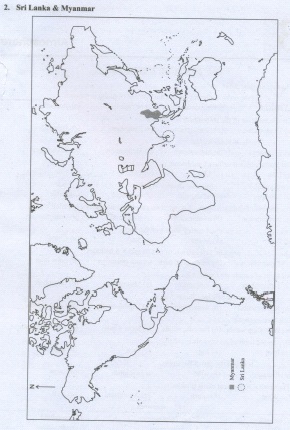
53.
a)
b)
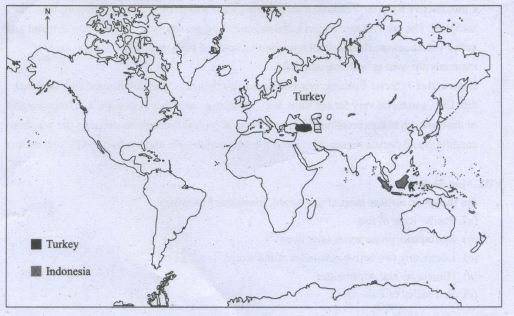
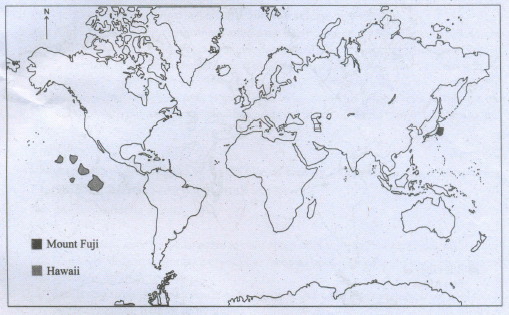
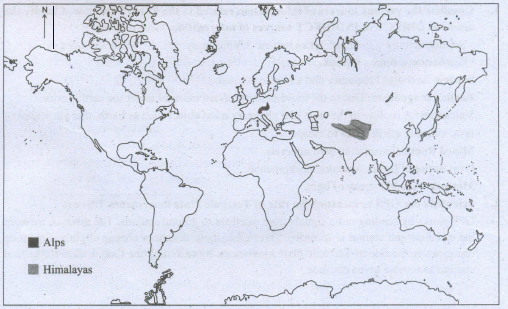
54.
a) Pacific Ring of fire: It is a major area and an arc in the basin of the Pacific ocean where many earthquakes and volcanic eruptions occur.
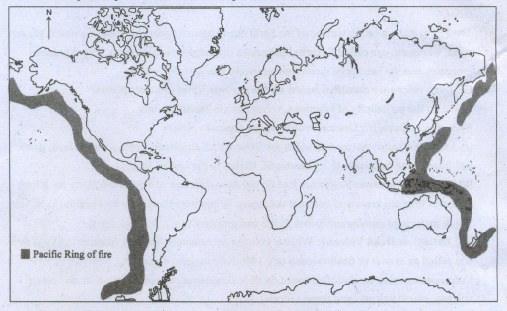
(b) Earthquake-prone zones (any two): Turkey, Indonesia
(c) Locate any two active volcanoes of the world: Hawaii, Mount Fuji
(d) Himalayas and Alps ranges
55.
a) Both A and R are correct and R explains A
56.
(a) Both (A) and (R) are true and (R) explains (A)
57.
(a) Both (A) and (R) are true and (R) explains (A)
58.
(d) Both A and R are incorrect
59.
(d)
both a and b
60.
(c)
Madras
61.
(c)
food grain production
62.
(b)
Rajasthan
63.
(d)
Pink
64.
(b)
Literacy rate
65.
(b)
Portugal
66.
(b)
civilise
67.
(b)
Germany
68.
(b)
112
69.
(a)
de Wendel
70.
(a)
Voltaire
71.
(a)
121 crore
72.
(c)
October – December
73.
(b)
Finished goods
74.
(c)
(iii) is correct
75.
(d)
Eratosthenes
76.
(c)
1498
77.
(c)
Greek
78.
(d)
Biosphere
79.
(a)
1917
80.
(c)
Sung
81.
(d)
all of the above
82.
(b)
Fram basin
83.
(b)
Right to information
84.
(a)
Saline and sandy
85.
(c)
John Calvin
86.
(b)
Hellenes
87.
(c)
(i) & (iU) are right
88.
(c)
Wind energy
89.
(b)
Easterly winds
90.
(a)
Iron
91.
(d)
2004
92.
(a)
crust
93.
(c)
Mullai
94.
(a)
Iron Age
95.
(b)
Confucius
96.
(a)
Agriculture
97.
(c)
Non-Renewable
98.
(c)
Article 324
99.
(c)
Right to vote
100.
(a)
Buddha
101.
(a)
Alto-cumulus
102.
(a)
weathering
103.
De-merits of unitary form of government
(i) It is not suitable for big countries.
(ii) The central government will have to tackle so many complex problems that lead to administrative delay.
(iii) The central government will not concentrate on local problems; local interest and initiative.
(iv) The concentration of powers may pave way for the despotism of the central government.
104.
(i) You should continue using a Weather Radio or staying tuned to a Coast Guard emergency frequency station or a local radio or television station for updated emergency information.
(ii) Check yourself for injuries and get first aid if necessary before helping injured or trapped persons.
(iii) If someone needs to be rescued, call professionals with the right equipment to help.
(iv) Help people who require special assistance Infants, elderly people, those without transportation, large families who may need additional help in an emergency situation, people with disabilities, and the people who care for them.
(v) Stay out of a building if water remains around it. Tsunami water, like floodwater, can undermine foundations, causing buildings to sink, floors to crack, or walls to collapse.
(vi) Check for gas leaks. If you smell gas or hear a blowing or hissing noise, open a window and get everyone outside quickly.
105.
The merits of federal government are
(a) Reconciliation of local autonomy with national unity.
(b) Division power between centre and states leads to administrative efficiency.
(c) It gives rise to big states.
d) Distribution powers checks the despotism of central government.
(e) More suitable for bigger countries
(f) It is good for economic and cultural progress.
106.
(i) NNP - Net National Product
(ii) PCI - Per Capita Income
107.
(i) The Net National Product (NNP) is considered as a true measure of national output. It is also known as national income.
(ii) A rise in per capita income means an increase in aggregate real output. Hence, this is a better indicator than national income for measuring development.
(iii) For measuring a country's development, its income is considered to be one of the most important factors. Countries with higher income are considered to be more developed than those with lesser income.
(iv) So, income itself is considered to be one of the indicators of economic development.
108.
(i) There term 'pressure group' originated in the USA
(ii) A pressure group is a group of people who are organised actively for promoting and defending their common interest.
(iii) It is so catted as it attempts to bring a change in the public policy by exerting pressure on the government.
(iv) They are different from the political parties i.e they neither: contest elections nor try to capture political power.
109.
110.
Rules to Ensure Road Safety for chlldren
It is impportant for children to know about road safety rules and regulatioins. Here are a few
basic road safety rules for children.
i) Know Your Signals
ii) Stop, Look and Cross
iii) Pay Attention - Listen
iv) Don't Run on Roads
v) Always Use Sidewalks
vi) Never Stick Hands outside the Vehicle
vii) Never cross Road at Bends
viii) Don't Rush.
111.
The different factors contribute to road accident are,
i) Drivers: Over speeding, rash driving, violation of rules, failure to understand signs, fatigue, alcohol.
ii) Pedestrians: Carelessness, illiteracy, crossing at wrong places, jaywalkers.
iii) Passengers: Projecting their body parts outside vehicles, talking to drivers, alighting and boarding vehicles from the wrong side, travelling on footboards, catching a running bus etc.,
iv) Vehicles: Failure of brakes or steering, tyre burst, insufficient headlights, overloading.
v) Road Conditions: Potholes, damaged roads, eroded roads merging of rural roads with highways and illegal speed breakers.
vi) Weather conditions: Fog, snow, heavy rainfall, wind storms, hail storms.
112.
Parliamentary form of Government
(i) The parliamentary system of government is the one in which the executive is responsible to the legislature for its policies and acts.
(ii) It is also known as cabinet government or responsible government or Westminster model of government and is prevalent in Britain, Japan, Canada, India among others.
Features of Parliamentary form of government
(i) Nominal and Real Executives.
(ii) Majority Party Rule
(iii) Collective Responsibility
(iv) Double Membership
(v) Leadership of the Prime Minister
Merill of the parliamentary form of government
(i) Harmony between Legislature and Executive.
(ii) Responsible Government
(iii) Prevents Dictatorship.
(iv) Wide Representation.
Demerits of the parliamentary form of government
(i) Unstable Government.
(ii) No Continuity of Policies.
(iii) Dictatorship of the Cabinet.
(iv) Against Separation of Powers.
113.
(i) "Red Tea" is a very well known novel written by Paul Harris Daniel.
(ii) The novel portraits the slavery life of plantation workers in Valparai.
(iii) This novel depicts the blood stained history of the workers that is hidden behind the green cover of the hills.
(iv) This novel has been translated in Tamil by R. Murugavel in the name "Eriyum Panikkaadu" (எரியும் பனிக்காடு)
(v) The story starts with Karupan migrating to the hills with his wife in search of survival.
(vi) The narrator of this story is Dr. Daniel, who comes there to treat the plantation employees.
114.
a) Ripon
(i) Lord Ripon was the one who introduced the Local Self Government in 1882.
(ii) He was advocating for the decentralization of administration.
(iii) He tried to remove obstacles in the sphere of Local Self government by his resolution of 1882.
(iv) Under him a large number of Tahsildars had quasi - judicial powers in their sub - districts, along with revenue collection.
b) Munroe
(i) He was all for administration in the local language.
(ii) He was against the practice of appointing to administrative posts and the judiciary those who were not fluent with the local lexicon (language).
(iii) He felt that Indians ought to be allowed to dispense justice by themselves.
115.
(i) The term virtual water was introduced by Tony Allen in 1990.
(ii) The water consumed in the production process of an agriculture or industrial product has been called the virtual water.
(iii) It is a hidden flow of water when food or other commodities are traded from one place to another.
(iv) For instance it takes 1340 cubic meters of water to produce one metric ton of wheat.
(v) That is, if one metric ton of wheat is exported to another country, then, it means that 1340 cubic metre of water used to cultivate this amount of wheat is also being exported.
(vi) India is the largest global freshwater user .
(vii) India has been the fifth largest exporter of virtual water in the world.
116.
(i) In the 2151 century, GNSS has become a part of our lives to promote the safety and convenience of transport.
(ii) Global Navigation Satellite System (GNSS) is a satellite system connected with a small electronic receiver or tracker to locate, monitor and track a user's vehicle wherever in the world.
(iii) It can also set up instant alerts when a driver of a vehicle speeds or deviates from a particular area.
(iv) GNSS applications are used in tracking or mapping vehicles, ships and aircraft.
(v) A group of satellites (Space Segment) working with a network of ground stations (Control Segment) provide location data.
(vi) The receiver (User Segment) converts satellite signals into location, speed and time data.
(vii) Examples of GNSS:
(a) Europe's Galileo
(b) USA's NAVSTAR Global Positioning System (GPS)
(c) Russia's Global'naya Navigatsionnaya Sputnikovaya Sistema (GLONASS)
(d) China's BeiDou Navigation Satellite System
(e) India's NAVIC satellite system
117.
(i) Deforestation results in many effects like floods and droughts, loss of soil fertility, air pollution, extinction of species, global warming, spread of deserts, depletion of water resource, melting of ice caps and glaciers, rise in sea level and depletion of ozone layer.
(ii) The United Nations Conference on Environment and Development (UNCED) by name Earth Summit Conference held at Rio de Janeiro, Brazil, on June 1992 concluded that all member countries should reduce their emission of carbon dioxide, methane and other green house gases thought to be responsible for global warming.
118.
(i) The policy of free trade and the forcible collection of land revenue resulted in the out break of famines.
(ii) The Odisha famine of 1866-67 was a severe and terrible event.
(iii) The famines of 1876-78 known as the Great famine of 1876-78 caused a large migration of agricultural labourers and artisans from Southern India to British colonies.
(iv) Here they worked as indentured labourers on plantations.
(v) In the Madras Presidency, the famine of 1876- 78 was preceded by droughts.
(vi) The situation was made worse because of the colonial government's policy of laissez faire in the trade of food grains.
(vii) Two of the worst famine-afflicted areas in the Madras Presidency were the district of Ganjam and Vizagapatnam. They continued to export grains throughout the famine.
(viii)These famines were typically followed by various infectious diseases.
(ix) The memory of this famine is still preserved in various folk songs and ballads.
(x) The Bengal famine of 1770 as well as 1943 of British India took a heavy toll of human lives.
119.
(i) In 1733 John Kay invented the 'Flying Shuttle' increasing the speed of the weaving of cloth. In 1767 James Hargreaves invented 'the spinning jenny' which spun eight threads at one and the same time.
(ii) Richard Arkwright invented the 'waterframe' which used water power in the place of manpower.
(iii) In 1779 Samuel Crompton invented his 'spinning mule' which included a combination of both the 'spinningjenny' and the 'water frame'. It spun hundreds of threads simultaneously.
(iv) Eli Whitney invented the cotton gin in 1793. Removing the seed from the cotton increased the productivity manifold.
(v) Textile manufacture was at the heart of the Industrial Revolution. Over a span of fifty years, the textile manufacturing industry in Britain witnessed a transformation in the method of production from handmade to machine-made goods.
(vi) The newly invented machines enabled factories to produce textile goods in large quantities.
(vii) Derbyshire, Lancashire, Cheshire, Staffordshire, Nottinghamshire, and Yorkshire became the major factory centres.
(viii) The most notable was Manchester which had more than 50 mills in 1802.
120.
(i) The French Revolution had may lasting results.
(ii) It marked the end of the system of absolute monarchy in France.
(iii) All feudal privileges were abolished and the power of clergy was curbed.
(iv) The Revolution united the people of different sections and paved the way for the enhanced power of the state.
(v) It also led to the growth of feelings of nationalism and the emergence of an assertive middle class.
(vi) Revolution up held the theory of people's sovereignty and laid the foundation for the birth of liberal constitutional governments in Europe.
(vii) Liberty, equality, and fraternity became the watchwords of freedom loving people all over the world.
(viii) It inspired many later day political movements for the establishment of liberal democracy in Europe and elsewhere.
121.
(i) A settlement pattern refers to the way that buildings and houses are distributed in a rural settlement.
(ii) Settlement patterns are of interest to geographers, historians and anthropologists for the insight they offer in how a community has developed over time.
Linear : In a linear settlement pattern, the buildings are arranged in lines. These lines often follow the route of a road or body of water.
Dispersed : In a dispersed settlement pattern, the buildings are scattered over a wide area. Dispersed settlement patterns are often associated with agricultural activity and are frequently surrounded by farmland.
Nucleated: In a nucleated settlement pattern, the buildings are grouped around a central core. Nucleated settlement patterns are usually associated with patterns of agriculture in which the settlement is surrounded two or three fields, and each field divided into strips that were formed b individual farmers.
122.
(i) The ancient Greeks created the world's first democracy. Athens started on with a monarchy and then advanced to an oligarchy until it finally reached a democracy.
(ii) The Greek Alphabet was the first alphabet in the western sense of the word, featuring distinct letters for vowels and consonants.
(iii) The first library in the world, the library of Alexandria was actually built in Egypt.
(iv) The Olympic games started in ancient Greece specially in the city of Olympia.
(v) Science and Mathematics - Eratosthenes was the first mathematician to calculate the circumference of the Earth. Aristarchus, Archimedes and Hipparchus were great mathematicians and scientists.
(vi) One of the common examples of Greek Architecture in the modular world is the Column in Pillar.
(vii) Greek mythology has pervaded nearly every form of popular culture imaginable. Many Greek myths have been adapted into modem novels, movies, TV, shows etc.
(viii) The first lighthouse in the world was located in the Greek controlled Egyptian Kingdom of Alexandria.
(ix) The democratic people of ancient Greece, especially Athens, were the first to employ trial by jury as we know it today.
123.
Hampi:
(i)There are group of monuments in Hampi.
(ii)It is a UNESCO World Heritage site located in east central Karnataka.
(iii) It became the centre of the Hindu Vijayanagara Empire capital in the 14th century.
(iv) Located in Kamataka near the modem-era city of Hosapete, Hampi's rains are spread over 4,100 hectares.
(v) Hampi continues to be an important religious centre, housing the Virupaksha temple, an active Adhi Sankara linked monastery and various monuments belonging to the old city.
124.
(i) The Italian city-states were centres of cultural activities since the fourteenth century.
(ii) With the coming of the scholars and artists from Constantinople, there was a surge of enthusiasm and interest in studying classical literature and art of Greeks and Romans.
(iii) This creative upsurge was reflected in their writings, art, architecture and music.
(iv) This cultural florescence is known as the renaissance.
(v) The origin of the word renaissance is from the Italian word 'renascita' meaning rebirth.
(vi) It is called renaissance because there was a rebirth or revival of classical Greek and Latin literature.
(vii) Many scholars in Italy went in search of manuscripts of classical literature.
(viii) Greek scholar Manuel Chrysoloras who taught Greek classics in Italy, Guarino and Giovanni Aurispa, to name just a few, visited Constantinople several times to collect Greek manuscripts.
(ix) Later they printed what they collected.
(x) This provided stimulus to the flowering of renaissance.
125.
(i) In 1925, the British government established a government press at Nasik in Maharashtra.
(ii) Currencies were printed three years later.
(iii) In 1974, a press was started in Dewas, Madhya Pradesh.
(iv) In the 1990's two more presses were started in Mysuru, Karnataka and Salboni in West Bengal to print bank notes.
(v) The Reserve Bank of India has the authority to decide the value of currency to be printed and how the amount should reach its destination safely.
(vi) Though the RBI has the power to print up to ten thousand rupee notes, at present a maximum of upto rupees two thousand is printed.
126.
(i) Democracy has an important role to play in promoting sustainable development.
(ii) Free and fair elections, independent media, accountable government as well as other basic democratic principles are all critical components of an environment and conducive to growth.
(iii) In a direct democracy the people decide on the policy initiatives directly.
(iv) Democracy is very much responsible and important over the development of a nation.
(v) In a democratic country the citizens are force to express their views and opinions on decisions taken by government.
(vi) This makes the government take more responsible decisions and they go with majority people.
(vii) All these actions can be carried on with the help of the fundamental rights generated by the constitution of India with legal background.
127.
(i) Mongols' remarkable leader was Chengiz Khan.
(ii) He was a great military genius.
(iii) His religion was Shamanism, a worship of the "Everlasting Blue Sky".
(iv) Mongols' hold over Russia for about 300 years made Russia technologically backward from the rest of Europe until the end of Middle Ages.
128.
This picture depicts Water Cycle.
The three major processes involved in the water cycle area)
Evaporation,
b) Condensation
c) Precipitation.
Evaporation is the process by which water is converted from its liquid state to the gaseous state, usually as a result of the sun's warming rays.
Condensation occurs as the vapour rises into the atmosphere, creating clouds and fog. Once clouds are formed, advection (the movement of water in its various states) through thatmosphere. Without advection, the water would evaporate and precipitate at the same place only.
Precipitation occurs when the vapour that condensed comes back out of the sky as rain, snow, sleet, hail. Most of it comes back to the ground or body of water. Thus water moves across land and is stored in lakes or reservoirs for human uses.
129.
a) Continental Rise
(i) At the base of the continental slope is a gently sloping layer of sediments which merge into the deep-sea floor.
(ii) This underwater feature found between continental slope and abyssal plains is called the continental rise.
(iii) It consists of submarine fans which are similar to the alluvial fans found on land.
b) Oceanic Ridge
(i) Oceanic ridge is a continuous submarine mountain chain.
(ii) They are made of young basaltic rock formed when two tectonic plates moves apart.
(iii) The mid-ocean ridge is probably the most extensive single feature of the earth's topography.
(iv) Two of the most well known mid- ocean ridges are the Mid-Atlantic Ridge and the East Pacific Ridge.
(v) The Mid-Atlantic Ridge is the largest unbroken oceanic ridge.
130.
(i) An ecosystem consists of three basic components, namely
a) Abiotic components,
b) Biotic components and,
c) Energy components
a) Abiotic Components
Abiotic components include the non-living, inorganic, physical and chemical factors in the environment. Eg. Land, Air ,Water, Calcium, Iron etc.
b) Biotic Components
(i) Biotic components include plants, animals and micro organisms.
(ii) Biotic components can be classified into three categories: (1) Producers, (2) Consumers and (3) Decomposers.
(iii) Producers are self nourishing components of the ecosystem. Hence they are called Autotrophs.
(iv) They are found both on land and water. Eg. Plants, Algae, Bacteria etc.
(v) Consumers are those that depend on producers, directly or indirectly. Hence they are called Heterotrophs.
(vi) Decomposers are some organisms that are incapable of preparing its own food. They live on dead and decaying plants and animals. Hence they are called Saprotrophs.
c) Energy Components
(i) All organisms in the biosphere use energy to work and convert one form of energy into another.
(ii) The Sun is the ultimate source of energy for the biosphere as a whole.
(iii) The producers, consumers and the decomposers contribute a lot to the energy flow in an ecosystem.
131.
Some of the erosional landforms of sea waves are sea cliff, sea cave, arch, stack, beach, bar and spit and wave cut platform.
Sea Cave: Prolonged wave attack on the base of a cliff erodes rock materials, which result in the formation of caves.
Sea Arch: When two caves approach one another from either side of a headland and unite, they form an arch. e.g., Neil Island, Andaman and Nicobar.
Sea Stack: Further erosion by waves ultimately leads to the total collapse of the arch. The seaward portion of the headland will remain as a pillar of rock known as stack. Eg the Old man of Hoy in Scotland.
Sea Cliffs: Sea cliffs are steep rock faces formed when sea waves dash against them. The rocks get eroded to form steep vertical walls.
Wave Cut Platforms: Flat surface found at the foot of sea cliffs are called as wave-cut platforms. Wave cut platform is also referred as beach, shelf, terrace and plain.
132.
Sustainable economic development is taken to mean development without damaging the environment and not compromising with the needs of the future generation. The consequences of environmental degradation do not respect national or state boundaries. Sustainability of development is comparatively a new area of knowledge in which scientists, economists, philosophers and other social scientists are working together. Natural resources can be divided into renewable resources and non-renewable resources. Groundwater is an example of a renewable resource. The question arises as to how sustainable development is possible if the resources are over-used rather than getting replenished. Nonrenewable resources get exhausted after certain number of years of extracting and using them and they cannot be replenished. To achieve real sustainability, we need to balance economic, social and environmental sustainability in equal harmony. In general, the question of development or progress is continuous. At all times, as a member of society and as individuals, we need to ask where we want to go, what we wish to become and what our goals are.
133.
(i) Tertiary sector in the service sector. The basic characteristics of this sector is offering the knowledge instea of producing products.
(ii) Service sector in the key factor for the social, economic growth of a country.
(iii) It controls the work pattern and output of the primary and secondary sectors. So tertiary sector is in top position in the world now.
134.
Mobilising people towards socially productive activities that lead to the overall betterment of people's lives is essential. Sometimes earthquakes, tsunamis, floods and other such natural disasters on a massive scale occur and people's immediate mobilisation for evacuation and emergency relief becomes most essential.
Democratic Participation: Democracy can succeed only when smaller local groups and, in fact, every citizen can take action that supports the tax and revenue collection systems, observance of national norms in environmental protection, cleanliness, health and hygiene, sanitary drives and immunisation programmes like pulse polio. However, we must keep in mind that there is no better form of government than Democratic government. To create a better society and nation, the people of India along with the union and state governments should come together to fight against the miseries of human life.
135.
Though democracy in India has been appreciated worldwide for its working, there is still a lot of scope for improvement. The above-mentioned steps must be taken to ensure smooth functioning of democracy in the country.
Indian democracy can be successful and vibrant only when its citizens imbibe and reflect in their behavior the basic democratic values like equality, freedom, social justice, accountability and respect for all. Their mindset, thinking and behavior are expected to be in tune with the essential conditions of democracy. They have to appreciate the opportunities for their desired roles like participation, making the system accountable, fulfilling obligations, and playing proactive roles to actualize the goals of democracy.
136.
(i) The cause of human unhappiness in the world is human selfishness. Selfishness creates unlimited human desires, which can never be satisfied.
(ii) In nature, all the things act in a natural way. The law of human conduct must correspond with nature.
(iii) Humans live a life under the regulation of someone. This is because they have acquired knowledge and have not remained innocent. On the basis of their acquired knowledge, they have built up an urban civilisation and have made themselves unhappy.
137.
The word 'Tsunami' is a Japanese term, meaning harbour waves. It is adapted to describe large seismically generated sea waves caused by Earthquakes, submarine explosions and landslides. These waves travel at a great speed (more than 500 km per hour) and the length of the waves exceeds 600 km. These waves reach to a height of more than 15 m near the sea shore and are capable of causing destruction along the coastal area.
The 2004 Indian Ocean Earthquake that caused tsunami is.the sixth-deadliest natural disaster which travelled at a speed of 6.00km per hour with an estimated death toll of 2,80,000. The Earthquake which occurred near Indonesia at 00.58 hours took nearly 7 hours to reach Chennai.
138.
(i) Archaeological excavation refers to systematically digging a site to recover material evidence for exploring and interpreting societies of the past.
(ii) Archaeological excavations at the early historic sites are the source of evidence of the activities of the Sangam Age people.
(iii) Excavations at Arikkamedu, Azhagankulam, Uraiyur, Kanchipuram, Kaveripoom pattinam, Korkai, Vasavasamudram, Keezhadi, Kodumanal in Tamil Nadu, and. Pattanam in Kerala provide the evidence we have of this period.
(iv) Arikkamedu, near Puducherry, is a Sangam Age port, excavated by the Archaeological Survey of India (ASI). British archaeologist, Robert Eric Mortimer Wheeler, French Archaeologist, J.M. Casal, and Indian archaeologists, A. Ghosh and Krishna Deva, excavated this site. They found evidence of a planned town, warehouse, streets, tanks and ring wells.
139.
(i) The culture that domesticated animals and cultivated crops is called Neolithic.
(ii) It is known as the New Stone Age. The Neolithic people used polished stone axes called celts.
(iii) Cattle rearing was their main occupation. They lived in small villages with houses made of thatched roof and walls plastered with clay.
(iv) Evidence of Neolithic village is found at Payyampalli in Vellore district and a few sites in the Dharmapuri region.
(v) Payyampalli is a village in Vellore district of Tamil Nadu. The earliest evidence for the domestication of animals and cultivation of plants is found at this site, which was excavated by the Archaeological Survey of India.
(vi) Evidence for pottery making and cultivation of horse gram and green gram has been found in this village.
(vii) These Neolithic sites were part of the Southern Neolithic Culture of India. They are mainly concentrated in the Andhra Pradesh and Karnataka regions.
(viii) The Neolithic people used stone axes fitted on a wooden handle .
(ix) These polished stone axes are worshipped in many village temples of Tamil Nadu even today.
140.
(i) The Egyptians excelled in art and architecture. Their writing is also a form of art.
(ii) Numerous sculptures, painting and carvings attest to the artistic skills of Egyptians.
(iii) The pyramids are massive monuments built as tombs of mourning to the Pharaohs.
(iv) The great pyramids near Cairo are known as the Giza Pyramids.
(v) Pyramids are considered to be one of the wonders of the world, and they were built between 2575 and 2465 BCE.
(vi) These monuments display the engineering, architectural and human resource management skills of the Egyptians.
(vii) The Great Sphinx of Giza is a massive limestone image of a lion with a human head.
(viii) It is dated to the time of Pharaoh Khafre. It is one of the largest sculptures of the world and measures seventy three metres in length and twenty metres in height.
141.
The structure of employment denotes the number of workers engaged in different sectors of the economy.
Primary Sector: Agriculture, forestry, animal husbandry, poultry, dairy farming, fishing, etc.
Secondary Section: Manufacturing, small and large scale industries and constructional activities.
Tertiary Sector: Transport insurance banking, trade, communication, real estate, government and non-government services.
In developing countries like India that a large work force will be engaged in Primary Sector, while a small proportion in Secondary and Tertiary sectors.

9th Standard Syllabus & Materials
9th Standard
TN 9th Tamil உள்ளத்தின் சீர் - திருக்குறள் Important Questions And Answers Study Material - QB365 Set A
NEW9th Standard
TN 9th Tamil உள்ளத்தின் சீர் - மணிமேகலை Important Questions And Answers Study Material - QB365 Set A
NEW9th Standard
TN 9th Tamil உள்ளத்தின் சீர் - ஏறு தழுவுதல் Important Questions And Answers Study Material - QB365 Set A
NEW9th Standard
TN 9th Tamil உயிருக்கு வேர் - தண்ணீர் Important Questions And Answers Study Material - QB365 Set A



Tamilnadu Stateboard 9th Standard Subjects
Tamilnadu Stateboard Standards




