
 100% FREE ACCESS
9th Standard Syllabus & Materials
9th Standard
TN 9th Tamil உள்ளத்தின் சீர் -கற்கண்டு (இலக்கணம்) - தொடர் இலக்கணம், ஆகுபெயர் Important Questions And Answers Study Material - QB365 Set A
NEW9th Standard
TN 9th Tamil உள்ளத்தின் சீர் -விரிவானம் (துணைப்பாடம்) - தாய்மைக்கு வறட்சி இல்லை! Important Questions And Answers Study Material - QB365 Set A
NEW9th Standard
TN 9th Tamil உள்ளத்தின் சீர் -கவிதை பேழை (செய்யுள்) - மார்கழி பெருவிழா Important Questions And Answers Study Material - QB365 Set A
NEW9th Standard
TN 9th Tamil உயிருக்கு வேர்-இலக்கணம் - பகுபத உறுப்பிலக்கணம் Important Questions And Answers Study Material - QB365 Set A
NEW9th Standard
TN 9th Tamil அமுதென்று பேர் - இலக்கணம்-எழுத்து -அளபெடை Important Questions And Answers Study Material - QB365 Set A
NEW9th Standard
TN 9th Tamil அமுதென்று பேர்-துணைப்பாடம் - ஆறாம்திணை Important Questions And Answers Study Material - QB365 Set A

Published on: 12/02/2020
9th Standard Social Science All Chapter Questions-I-2020
Download Tamil Nadu 9th Standard Social Science question papers, model tests, one-mark questions, important questions, and public exam papers in PDF format. Free study materials and answer keys for TN State Board students.
Questions + Answers key
Take MCQ Social Science Test
1.
What are the preventive measures for accidents?
2.
Write a note river Cauvery.
3.
What is National Increase of population?
4.
Highlight any two important results of Industrial Revolution.
5.
Mention the important functions of the Village Panchayat.
6.
What are the major factors responsible for female migrants in India?
7.
Democracy in Nepal
8.
What is natural money?
9.
What is an ecosystem?
10.
What do you mean by the term Hydrosphere?
11.
Write about the military expeditions of Malik Kafur.
12.
What do the internal processes generate?
13.
What is Ptolemy's Geography?
14.
Discuss when the earth was formed
15.
The Egyptians excelled in art and architecture Illustrate.
16.
In Tamil Nadu, migrants account for ___________ percent in rural areas.
38
41
28
50
17.
The Communlty Development Programme was introduced in the year_________.
1950
1952
1953
1954
18.
The North-East monsoon period in Tamilnadu
August – October
September – November
October – December
November – January
19.
All external influences and factors that affect the growth and development of living organisms is ___________.
Environment
Ecosystem
Biotic factors
Abiotic factors
20.
The name Cape of Good Hope was given by___________
Bartholomew Diaz
King John II
Henry the Navigator
Vasco da Gama
21.
Barter system involved exchange of________
Goods
Money
22.
After conquering Egypt, the Ottomans assumed the title of___________
King
Caliph
Emperor
Raja
23.
The Deccan Sultanates were conquered by_________
Ala-ud-din Khilji
Ala-ud-din Bahman- shah
Aurangzeb
Malik Kafur
24.
____________was the Roman Governor responsible for the crucifixion of Jesus.
Innocent I
Hildebrand
Leo I
Pontius Pilate
25.
The Sri Lankan chronicle composed in the Pali language mentioning about merchants and horse traders from Tamil Nadu
Deepa vamsa
Arthasastra
Mahavamsa
Indica
26.
Mention the rules to ensure Road Safety for children.
27.
Write a note on Micro Irrigation
28.
Explain the classification of Environment.
(a) Natural Environment
(b) Human Environment
(c) Man made Environment
29.
Enumerate the causes for the Second Industrialization in the USA.
30.
Reason out why should you stay away from buildings with glass panes during an earthquake.
31.
Write in details about the salient features of the 73rd & 74th Constitutional Amendment Act (1992).
32.
Elucidate about some of the interesting findings on migration in Tamil Nadu.
33.
Write about the presidential form of government and what is the difference between presidential and parliamentary forms of government.
34.
How is currency printed in India?
35.
How did Japan get its name?
36.
Examine the outcome of the geographical discoveries.
37.
Underground water is more common in limestone areas than surface run off. Why?
38.
Give an account of Mobilisation and Democratic Participation.
39.
Domestication of Animals and plants. A milestone in Human History. Explain
40.
What is your opinion about democracy in India?
41.
Consider the following statements.
Assertions (A): Rights and duties are the two sides of the same coin.
Reason (R): We have a right to freedom of religions. We have to promote harmony and the spirit of the people of other religions.
a) Both A and R are correct and R explains A
b) Both A and R are correct but R does not explain A
c) A is correct but R is false
d) A is false but R is correct
both A and R are correct and R explains A
both A and R are correct but R does not explain A
A is correct but R is false
A is false but R is correct
42.
Assertion (A): Parties shape public opinion.
Reason (R): They raise and highlight issues of importance.
(a) Both (A) and (R) are true and (R) explains (A)
(b) Both (A) and (R) are true and (R) does not explain (A)
(c) (A) is correct and (R) is false
(d) (A) is false and (R) is true
Both (A) and (R) are true and (R) explains (A)
Both (A) and (R) are true and (R) does not explain (A)
(A) is correct and (R) is false
(A) is false and (R) is true
43.
What are the Federal features of Indian Constitution?
44.
What do you do if you are indoors during an earthquake?
1.
Preventive measures for accidents are,
i) Education and awareness about road safety.
ii) Strict enforcement of law
iii) Engineering: a) Vehicle design b) Road infrastructure.
2.
(i) River Cauvery is the third largest river in India. Its length is 765 km.
(ii) Cauvery passes Thiruchirapalli, Tanjavur, Srirangapattinam, Kumbakonnam.
(iii) The dams constructed across Cauvery in Tamil Nadu are Mettur Dam, Kallanai.
3.
National increase of population is the difference between the birth rate and death rate.
4.
(i) Expansion of trade.
(ii) The Production of more food.
(iii) Emergence of factory workers as a new class.
(iv) Development in transport and communication.
5.
Important functions of the Village Panchayat are
(i) Supply of drinking water
(ii) Maintenance of street lights
(iii) Maintenance of Road
(iv) Maintenance of village libraries
(v) Maintenance of small bridges
(vi) Maintenance of drainage
(vii) Maintenance of burial grounds
(viii) Granting permission to housing plots
(ix) Construction of group houses
(x) Cleaning of streets
(xi) Maintenance of common lavatory facilities
6.
(i) Among female migrants, 70 % in India and 51 % in Tamil Nadu report marriage as their reason for migration, in 2011.
(ii) Marriage and the movement associated with marriage appear to be a major factor responsible for women's mobility in India and in Tamil Nadu.
7.
April Revolution and democracy in Nepal.
i) On April 2006, the leaders of Nepal vibrant pre-democracy civil society movement "Seven Party Alliance" (SPA) called for a million strong demonstration.
ii) It was stage at seven different points along the Ring road encircling the capital Kathmandu.
iii) People demanded end to the autocratic rule of monarchy and restoration of total democracy.
iv) The king Gyanendra stepped down paving the way for democracy in Nepal.
8.
(i) The metals such as silver and gold gained importance gradually all over the world.
(ii) So, these metals were used as standard value in the exchange of goods.
(iii) This was called as natural money
9.
(i) An ecosystem is a community, where all living organisms live and interact with one another and also with their non-living environment such as land, soil, air, water etc.
(ii) Ecosystems range in size from the smallest units (Eg: bark of a tree) that can sustain life to the global ecosystem or ecosphere. (Eg: Cropland, Pond ecosystem, Forest ecosystem, Desert ecosystem etc.).
(iii) Biosphere harbours all ecosystems on the earth and sustains life forms including mankind.
10.
Hydrosphere consists of water in various forms found on the earth. It is held on land as glaciers, ice caps, ground water, river, lakes and also as the water vapour in air.
11.
The first ten years of the 1300 AD(CE) Alauddin Khalji's slave and commander Malik Kafur was sent on military expedition to south India.
12.
(i) The internal processes generate heat and eject materials from deep below the Earth's crust.
(ii) Internal radioactivity in the principal source of power for this process.
13.
Ptolemy's Geography is a Gazetteer and atlas of Roman times providing geographical details of the Roman Empire in the Second Century CE.
14.
(i) The earth was formed approximately 4.54 billion years ago.
(ii) Gradually, conditions emerged for the growth of organisms.
(iii) Then plants and animals came into being and thereby foundation was laid for the evolution of humans.
(iv) The long span of time in earth's history is divided into eras periods and epochs by the geologists.
15.
1. The Numerous sculpture, paintings and carvings attest to the artistic skills of Egyptians.
2. Their writing is also a form of art.
3. Giza pyramids are considered to be one of the wonders of the world.
4. These monuments display the engineering, architectural and human resource management skills of the Egyptians.
16.
(b)
41
17.
(b)
1952
18.
(c)
October – December
19.
(a)
Environment
20.
(b)
King John II
21.
(a)
Goods
22.
(b)
Caliph
23.
(c)
Aurangzeb
24.
(d)
Pontius Pilate
25.
(c)
Mahavamsa
26.
Rules to Ensure Road Safety for chlldren
It is impportant for children to know about road safety rules and regulatioins. Here are a few
basic road safety rules for children.
i) Know Your Signals
ii) Stop, Look and Cross
iii) Pay Attention - Listen
iv) Don't Run on Roads
v) Always Use Sidewalks
vi) Never Stick Hands outside the Vehicle
vii) Never cross Road at Bends
viii) Don't Rush.
27.
(i) Micro irrigation technology is a very good remedial to tackle shortage in irrigational water.
(ii) This irrigation technology helps to have a higher yield when compared to the traditional irrigational methods.
(iii) As only required amount of water is supplied at regular intervals, it increases the ability of water usage and productivity of the crop resulting in reduction of labour expenses and weed growth in the field.
(iv) The government has taken many measures to implement micro irrigation for proper distribution of water to crops that require more water.
28.
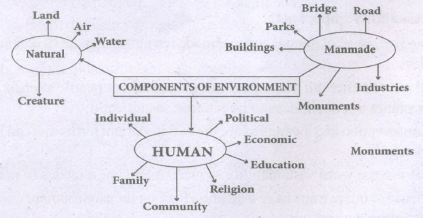
(a) Natural Environment:
Natural components of environment such as Lithosphere, atmosphere, hydrosphere and biosphere.
(b) Human Environment:
This is the interaction between man as an individual, with his family, occupation and society. It is also related to various cultural aspects such as education, religion, economics and politics.
(c) Man made Environment:
(i) This has been created by man himself for the purpose of fulfilling his needs and to make his life more convenient and easy.
(ii) For example, building, transport, park, industries, monument, etc.
(iii) To bring an equilibrium between man and the environment, man has to study the distribution of population, availability of resources, development in technology etc.
29.
1. A shift from manual labour based to more technical and machine based manufacturing industry marked the industrial revolution in the United States.
2. Samuel Slater, a citizen of England having worked at a cotton mill from the age of 10 had gained enough experience to operate a mill.
3. On learning that Americans were interested in the new techniques, Slater departed for New York in 1789 illegally. Slater offered his service to Moses Brown, who had earlier made an unsuccessful attempt to operate a mill.
4. Brown agreed and in consequence the mill became operational in 1793 being the first water-powered roller spinning textile mill in America.
5. By 1800, Slater's mill had been duplicated by many other entrepreneurs as Slater grew wealthier and his techniques became more and more popular.
6. Andrew Jackson, the U.S. President hailed him as Father of the American Industrial revolution.
7. In the Nineteenth Century America began to show technological innovation.
8. Robert Fulton established the steamboat service on the Hudson River.
9. Samuel E. B. Morse invented the telegraph and Elias Howe invented the sewing machine. This was the main cause for the industrialisation.
10. In 1869 the first transcontinental railroad was completed to transport people, raw materials and products.
11. The invention of electric bulb of Thomas Alva Edison and telephone by Alexander Graham Bell changed the world beyond recognition.
30.
31.
Salient features of the 73rd and 74th Constitutional Amendment Acts (1992)
(i) Panchayats and Municipalities will be "Institutions of Self Government".
(ii) Basic Units of Democratic System - Grama Sabhas (Villages) and Ward Committees (Municipalities) comprising all the adult members registered.
(iii) Three tier system of panchayats at village, intermediate block/taluk/mandal and district levels. Smaller states with population below 2 million only two tiers.
(iv) Seats at all levels filled by direct election.
(v) Seats reserved for SCs and STs at all levels in proportion to their population.
(vi) One third of the total number of seats-reserved for women. One third of the seats reserved for SCs and STs also reserved for women. One third of offices of Chairpersons at all levels reserved for women.
(vii) Uniform five year term and election to constitute new bodies to be completed before the expiry of the term. In the event of dissolution, elections compulsorily within six months.
32.
(i) Change in population occurs due to births, deaths and migration.
(ii) Almost everyone keeps moving most of the time, it is not easy to define which of these moves have to be classified as migratory moves.
(iii) According to the census of 2011 the population was 7.2 crore in Tamil Nadu.
(iv) 3.13 crore people were counted as migrants.
(v) The mobility of population in rural areas is greater than in urban areas.
(vi) Mobility is usually associated with male rather than female.
(vii) The poorer sections of the people migrate for survival but migrations from better off sections is to improve their living standards
(viii) Of the International migrants 15% are women while 85% are men.
33.
Presidential form of government
(i) The American President is both the head of the state and the head of government. As the head of state, he occupies a ceremonial position.
(ii) The president is elected by an electoral college for a fixed tenure of four years.
(iii) He governs with the help of a cabinet or a smaller body called' Kitchen Cabinet' . It is only an advisory body.
(iv) The President and his secretaries are not responsible to the Congress for their acts.
(v) The legislative, executive and judicial powers of the government are separated.
(vi) It is also known as non-responsible or non-parliamentary or fixed executive system of government.
Difference between Presidential and Parliamentary form of government
| No. | Presidential Form of Government | Parliamentary form of Government |
|---|---|---|
| 1 | President is directly elected by the people. | Prime Minister is the leader of majority party. |
| 2 | President is supreme | Central Legislature is supreme |
| 3 | Separation of Powers | Absence of Separation Powers Centralisation |
| 4 | Independent branches | Independent branches with Overlapping functions |
| 5 | President-head of the Government | Prime Minister-head of the Government |
| 6 | Separation of Powers | Centralisation |
| 7 | Independent branches | Independent branches with Overlapping functions |
| 8 | Individual Leadership | Collective leadership |
| 9 | President is not accountable to Congress | Collective and Individual Responsibility. |
34.
(i) In 1925, the British government established a government press at Nasik in Maharashtra.
(ii) Currencies were printed three years later.
(iii) In 1974, a press was started in Dewas, Madhya Pradesh.
(iv) In the 1990s two more presses were started in Mysuru, Karnataka and Salboni in West Bengal to print banknotes.
(v) The Reserve Bank of India has the authority to decide the value of currency to be printed and how the amount should reach its destination safely.
(vi) Though the RBI has the power to print up to ten-thousand-rupee notes, at present a maximum of up to rupees two thousand is printed.
35.
(i) Japan's name was given by a Chinese Emperor.
(ii) In a message sent by the Chinese Emperor, the Emperor of Japan was addressed as Tai-Nyih-Pung-Kok, meaning Great Sun-Rise-Kingdom.
(iii) The Japanese thought that this sounded better than Yamato.
(iv) So they began calling their country "Dai Nippon"- the land of the Rising Sun.
(v) Nippon became Japan.
36.
1. As a result of the discovery of new lands and new sea routes, the economic centre of Europe shifted from the Italian city states to spain and Portugal.
2. They brutally killed the natives in their conquest and the remaining were employed under harsh conditions in gold and silver mines, and in plantations.
3. Many natives also died because of epidemic diseases brought by the colonizers.
4. The native people faced the dangers of deadly diseases.
5. The natives had to encounter from these deadly diseases.
6. The introduction of sugarcane led to the establishment of sugarcane plantations in the Caribbean islands and South America.
7. The mass extinction of the native population led to the import of slaves from Africa. Africa became the centres of slave trade.
8. Geographical discoveries led to commercial revolution.
9. The seventeenth century witnessed the emergence of various East India companies.
10. They are English East India Company the Dutch East India Company and the French East India Company.
11. The Portuguese enforced its monopoly on the spice trade of East Indies.
12. The Spaniards established monopoly over the mining and transportation of gold and silver in its colonies in the New World.
13. The English East India Company had monopoly trade in India and amassed huge wealth.
14. Thus, the chief feature of mercantilism was exploitation of the resources of the colonies for the benefit of the colonisers.
15. It represented an important stage in the development of modern capitalism.
37.
(i) Limestone is made up of Calcium Carbonate.
(ii) It dissolves in water easily.
(iii) So during rainfall the water at the joints and fractures of the limestone seeps easily underground.
(iv) So the underground water is more common than the surface run off.
38.
Mobilising people towards socially productive activities that lead to the overall betterment of people's lives is essential. Sometimes earthquakes, tsunamis, floods and other such natural disasters on a massive scale occur and people's immediate mobilisation for evacuation and emergency relief becomes most essential.
Democratic Participation: Democracy can succeed only when smaller local groups and, in fact, every citizen can take action that supports the tax and revenue collection systems, observance of national norms in environmental protection, cleanliness, health and hygiene, sanitary drives and immunisation programmes like pulse polio. However, we must keep in mind that there is no better form of government than Democratic government. To create a better society and nation, the people of India along with the union and state governments should come together to fight against the miseries of human life.
39.
(i) Rice was probably cultivated in India and China around 7000 BCE or even earlier.
(ii) Wheat and barley were cultivated at Mehrgarh in northwestern part of the Indian subcontinent (Pakistan) before 6000 BCE.
(iii) Animal domestication developed as part of symbiotic life.
(iv) Dogs may have been domesticated first. Friendly animals were gradually domesticated. Sheep and goat were domesticated around 10,000 BCE in Southwest Asia.
(v) Oxen were used in Sumerian civilisation for tilling the land. Mehrgarh in Pakistan has evidence of sheep, goat and cattle domestication in the Neolithic period.
40.
(i) India has a Parliamentary form of democracy.
(ii) The Indian Parliament comprises the elected representatives of people.
(iii) It makes the laws for the country.
(iv) The participation of people in the decision making and the consent of citizens are the two important elements of Parliamentary form of government in India.
(v) India is the largest democratic country in the world.
(vi) Democracy in India works on five basic principles.
(vii) These are sovereign, socialist, secular, democratic and republic.
(viii) Every citizen of India who is not less than 18 years of age can exercise their right to vote in India.
(ix) There is no discrimination based on a person's caste, creed, religion, gender and education when it comes to providing the right to vote.
41.
a) Both A and R are correct and R explains A
42.
(a) Both (A) and (R) are true and (R) explains (A)
43.
Federal features of Indian Constitution are,
(1) Dual Government
(2) Written constitution
(3) Division of Powers
(4) Supremacy of the Constitution
(5) The constitution is the supreme law of the land. The laws enacted by the Centre and the states must confirm to its provisions.
(6) Rigid Constitution
(7) Independent Judiciary
(8) Bicameralism
44.
During earthquake if you are indoor:
(i) DROP to the ground; take COVER by getting under a sturdy table or other piece of furniture and HOLD ON until the shaking stops. If there is no table or desk near you, cover your face and head with your arms and crouch in an inside corner of the building.
(ii) Protect yourself by staying under the lintel of an inner door, in the corner of a room, under a table or even under a bed.
(iii) Stay away from glass windows, outside doors and walls, and anything that could fall, (such as lighting fixtures or furniture).
(iv) Stay inside until the shaking stops and afterwards it is safe to go outside.

9th Standard Syllabus & Materials
9th Standard
TN 9th Tamil உள்ளத்தின் சீர் - திருக்குறள் Important Questions And Answers Study Material - QB365 Set A
NEW9th Standard
TN 9th Tamil உள்ளத்தின் சீர் - மணிமேகலை Important Questions And Answers Study Material - QB365 Set A
NEW9th Standard
TN 9th Tamil உள்ளத்தின் சீர் - ஏறு தழுவுதல் Important Questions And Answers Study Material - QB365 Set A
NEW9th Standard
TN 9th Tamil உயிருக்கு வேர் - தண்ணீர் Important Questions And Answers Study Material - QB365 Set A



Tamilnadu Stateboard 9th Standard Subjects
Tamilnadu Stateboard Standards




