
 100% FREE ACCESS
9th Standard Syllabus & Materials
9th Standard
TN 9th Tamil உள்ளத்தின் சீர் -கற்கண்டு (இலக்கணம்) - தொடர் இலக்கணம், ஆகுபெயர் Important Questions And Answers Study Material - QB365 Set A
NEW9th Standard
TN 9th Tamil உள்ளத்தின் சீர் -விரிவானம் (துணைப்பாடம்) - தாய்மைக்கு வறட்சி இல்லை! Important Questions And Answers Study Material - QB365 Set A
NEW9th Standard
TN 9th Tamil உள்ளத்தின் சீர் -கவிதை பேழை (செய்யுள்) - மார்கழி பெருவிழா Important Questions And Answers Study Material - QB365 Set A
NEW9th Standard
TN 9th Tamil உயிருக்கு வேர்-இலக்கணம் - பகுபத உறுப்பிலக்கணம் Important Questions And Answers Study Material - QB365 Set A
NEW9th Standard
TN 9th Tamil அமுதென்று பேர் - இலக்கணம்-எழுத்து -அளபெடை Important Questions And Answers Study Material - QB365 Set A
NEW9th Standard
TN 9th Tamil அமுதென்று பேர்-துணைப்பாடம் - ஆறாம்திணை Important Questions And Answers Study Material - QB365 Set A

Published on: 12/02/2020
9th Standard Social Science All Chapter Questions-II-2019-2020
Download Tamil Nadu 9th Standard Social Science question papers, model tests, one-mark questions, important questions, and public exam papers in PDF format. Free study materials and answer keys for TN State Board students.
Questions + Answers key
Take MCQ Social Science Test
1.
In Tamil Nadu, migrants account for ___________ percent in rural areas.
38
41
28
50
2.
Panchayats are constituted wherever the population of the village is
2000
200
500
1000
3.
Irrigated land surface out of cultivable land is
27%
57%
28%
49%
4.
Gradual increase of the earth's temperature by the Greenhouse gases in the atmosphere is called ________.
Acid rain
thermal pollution
Global warming
Deforestation
5.
King Ferdinand and Queen Isabella of Spain supported________
Amerigo Vespucci
Henry
Columbus
Ptolemy
6.
One rupee and two rupee notes were first printed in India in the year_______
1917
1927
7.
Trade and industry flourished during the reign of________dynasty.
Shogun
Yuan
Sung
Tang
8.
Which of the following statements are true?
i) The state Human Rights commission was established in 1993.
ii) It has the power of a civil court.
iii) It's power extend beyond the state.
iv) It can also recommend compensation to victims.
i and ii are true
i and iii are true
i, ii and iii are true
i, ii and iv are true
9.
The establishment of __________ empire changed the administrative and institutional structures of South India.
Bahmani
Vijayanagar
Mughal
Nayak
10.
____________was the Roman Governor responsible for the crucifixion of Jesus.
Innocent I
Hildebrand
Leo I
Pontius Pilate
11.
India is the_______________________ democracy in the world.
largest
smallest
strongest
None of the above
12.
Kudavolai system was followed by
Cheras
Pandyas
Cholas
Kalabhras
13.
The name of the script used in the Sangam Age
English
Devanagari
Tamil-Brahmi
Grantha
14.
Sir Robert Bruce Foote, a geologist from England first discovered the ______ tools at Pallavaram near Chennai.
Stone Age
Palaeolithic
Mesolithic
Neolithic
15.
Mention the direct consequences of accidents?
16.
Write a note on Krishi Karman award to TamiINadu
17.
Classify the Environment.
18.
Highlight any two important results of Industrial Revolution.
19.
Give the two important recommendations of L.M. Singhvi Committee (1986).
20.
What are the major factors responsible for female migrants in India?
21.
Democracy in Nepal
22.
Narrate the given food web of Arctic Tundra in your own words.
23.
Why was money invented?
24.
What are the factors that generate the ocean currents?
25.
Mention the two natural advantages that India had in cotton weaving.
26.
What do you know about the Active Volcano?
27.
What is an Urban centre?
28.
Discuss when the earth was formed
29.
Write a note on the Great Wall of China.
30.
Mention the rules to ensure Road Safety for children.
31.
Write about ammaalvari journey towards Organic farming?
32.
Explain the term density of population.
33.
Enumerate the causes for the Second Industrialization in the USA.
34.
Reason out why should you stay away from buildings with glass panes during an earthquake.
35.
Describe the major problems & challenges faced by the local self governments.
36.
Analyse the educational qualification of migrants from Tamil Nadu in 2015.
37.
Write about the merits of unitary form of government.
38.
How is currency printed in India?
39.
Write about Feudalism.
40.
Examine the outcome of the geographical discoveries.
41.
Is wind the only gradational agent in the desert?
42.
Give an account of Mobilisation and Democratic Participation.
43.
Discuss the Neolithic culture in Tamil Nadu
44.
What are the challenges to Indian democracy? explain
45.
What are the de-merits of federal form government?
46.
Write a short note on Tsunami
1.
(b)
41
2.
(c)
500
3.
(a)
27%
4.
(c)
Global warming
5.
(b)
Henry
6.
(a)
1917
7.
(c)
Sung
8.
(d)
i, ii and iv are true
9.
(b)
Vijayanagar
10.
(d)
Pontius Pilate
11.
(a)
largest
12.
(c)
Cholas
13.
(c)
Tamil-Brahmi
14.
(b)
Palaeolithic
15.
The direct consequences of Accidents are
i) Fatality (Death) ii) Injury iii) Damage to Property
16.
(i) Tamil Nadu has the highest GDP in India according to 2017
(ii) Tamil Nadu tops in food grain production in 2015 - 2016 Prime Minister presented the Krishi Karman award to Tamil Nadu.
(iii) Mettur dam has the highest storage of water in Tamilnadu for agricultural Purpose.
17.
Environment can be classified as
(a) Natural Environment
(b) Human Environment and
(c) Man Made Environment
18.
(i) Expansion of trade.
(ii) The Production of more food.
(iii) Emergence of factory workers as a new class.
(iv) Development in transport and communication.
19.
(i) Rajiv Gandhi government in 1986 appointed a committee on "Revitalisation of Panchayati Raj institutions for Democracy and Development".
(ii) It was under the Chairmanship of L.M. Singhvi.
(iii) Its recommendations were
1. Constitutional recognition to the Panchayati Raj institutions.
2. A new chapter should be added in the constitution of India.
3. Nyaya Panchayats should be created for a cluster of villages.
20.
(i) Among female migrants, 70 % in India and 51 % in Tamil Nadu report marriage as their reason for migration, in 2011.
(ii) Marriage and the movement associated with marriage appear to be a major factor responsible for women's mobility in India and in Tamil Nadu.
21.
April Revolution and democracy in Nepal.
i) On April 2006, the leaders of Nepal vibrant pre-democracy civil society movement "Seven Party Alliance" (SPA) called for a million strong demonstration.
ii) It was stage at seven different points along the Ring road encircling the capital Kathmandu.
iii) People demanded end to the autocratic rule of monarchy and restoration of total democracy.
iv) The king Gyanendra stepped down paving the way for democracy in Nepal.
22.
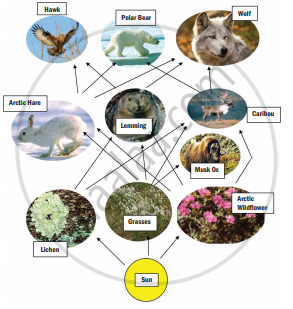
It is a well-balanced food web. This region gets slanting sunrays means very little sunlight in which lichens, grasses, and wildflowers grow and form the first trophic level as a producer. In the second trophic level herbivores who depend on the producers for survival like Arctic Hare, Musk ox, Lemming is the primary consumers. Carnivores who eat the herbivore are-Hawk, Polar Bear and Wolf. They are above the herbivores in a food pyramid. They are secondary consumers.
23.
(i) The barter system flourished wherever civilizations thrived.
(ii) This system was active not only within a civilization, but also among civilizations.
(iii) As years went by, there were issues found in barter system.
(iv) To solve these issues, they fixed a common item with a standard value, for the effective exchange of goods.
(v) It was usually in the form of some metal.
(vi) Hence, the metals can be termed as the first form of money.
24.
The factors that generate ocean currents are:
(i) Earth's rotation
(ii) Prevailing winds and
(iii) Differences in temperature and salinity of ocean water
25.
(i) The first was that cotton grew in almost all parts of India, so that the basic raw material was easily available.
(ii) Second, the technology of producing a permanent colour on cotton using vegetable dyes was known from very early times in India.
(iii) Indigo was the most important dye crop that was grown in India.
26.
Active volcanoes are those which constantly eject volcanic lava, gases and fragmented materials. e.g., Mount St. Helens in the United States.
27.
A planned town with brick architecture and, a proper layout. Urban centres have a larger population involved in non-agrarian, commercial and political occupations. Various industrial activities are seen in these towns.
28.
(i) The earth was formed approximately 4.54 billion years ago.
(ii) Gradually, conditions emerged for the growth of organisms.
(iii) Then plants and animals came into being and thereby foundation was laid for the evolution of humans.
(iv) The long span of time in earth's history is divided into eras periods and epochs by the geologists.
29.
(i) The Great Wall of China, one of the wonders of the world, was a massive effort undertaken for the protection of China from the Mongols.
(ii) In 220 BCE, under Qin Shi Huang, earlier fortifications were connected by walls as a form of defence against invasions.
(iii) It was built from third century BCE until 17th century CE.
(iv) It ran for over 20,000 kilometres covering the hills and plains, from the border of Korea in the east to the Ordos Desert in the west.
30.
Rules to Ensure Road Safety for chlldren
It is impportant for children to know about road safety rules and regulatioins. Here are a few
basic road safety rules for children.
i) Know Your Signals
ii) Stop, Look and Cross
iii) Pay Attention - Listen
iv) Don't Run on Roads
v) Always Use Sidewalks
vi) Never Stick Hands outside the Vehicle
vii) Never cross Road at Bends
viii) Don't Rush.
31.
(i) When Green Revolution was spreading throughout the nation, Nammalvar started his life journey towards organic farming.
(ii) He resigned his regional Agricultural Developmental Officer post for this purpose.
(iii) He believed in the youth the future generation of India.
(iv) Nearly 6000 youth had completed training in organic farming in his Vanagam Farm.
(v) He spent most of his days in struggles for organic farming and travels campaigning for the same.
(vi) He used only public transport.
(vii) He felt that this was his small role in reducing environmental pollution.
32.
(i) Density of population refers to the number of people living per sq. km. An area is said to be sparsely populated when it has a large area with less number of people. Similarly, smaller the area with a large number of people, it is said to be densely populated.
(ii) Population Density = \(\frac{ Total Population}{Total land area}\)
The world's population density is divided into three main groups.
(a) Areas of high density (above 50 people per sq.km) - East Asia, South Asia, North West Europe & Eastern North America.
(b) Areas of moderate density (10 to 50 people per sq.km) - The sub tropical regions like Angola, Congo, Nigeria and Zambia in Africa.
(c) Areas of low density (less than 10 people per sq.km) - Central Africa, Western Australia, Northern Russia, Canada, etc
33.
1. A shift from manual labour based to more technical and machine based manufacturing industry marked the industrial revolution in the United States.
2. Samuel Slater, a citizen of England having worked at a cotton mill from the age of 10 had gained enough experience to operate a mill.
3. On learning that Americans were interested in the new techniques, Slater departed for New York in 1789 illegally. Slater offered his service to Moses Brown, who had earlier made an unsuccessful attempt to operate a mill.
4. Brown agreed and in consequence the mill became operational in 1793 being the first water-powered roller spinning textile mill in America.
5. By 1800, Slater's mill had been duplicated by many other entrepreneurs as Slater grew wealthier and his techniques became more and more popular.
6. Andrew Jackson, the U.S. President hailed him as Father of the American Industrial revolution.
7. In the Nineteenth Century America began to show technological innovation.
8. Robert Fulton established the steamboat service on the Hudson River.
9. Samuel E. B. Morse invented the telegraph and Elias Howe invented the sewing machine. This was the main cause for the industrialisation.
10. In 1869 the first transcontinental railroad was completed to transport people, raw materials and products.
11. The invention of electric bulb of Thomas Alva Edison and telephone by Alexander Graham Bell changed the world beyond recognition.
34.
35.
Problems and challenges facing the local self governments.
(i) Local self governments are the crucial basis for our democracy.
(ii) The Constitutional status of local self governments adds more significance to their functioning.
(iii) There are a few critical concerns in the working of local self governments in India.
(iv) Major problems and challenges may be mentioned as below.
1. Lack of clear demarcation of powers and functions of local bodies.
2. Allocation of funds and needs assessment are not matched.
3. Combined with accountability, the local self governments demand for more autonomy and economic freedom may be addressed.
4. Role of caste, class and religion in decision making at the local self governments.
5. Poor accountability of elected members and officials at the grassroots of democracy.
36.
(i) In Tamil Nadu the study reveals that in 2015 about 7% were illiterates, 30% had completed schooling ie class 10;10% had completed class 12, 15% had undergone vocational training. 11% were graduates, 12% were professionally qualified and 11% were postgraduates.
(ii) The study clearly reveals various occupation undertaken by migrants which refers to highly skilled occupation on the one hand and low skilled occupation on the other with large number of semi-skilled occupations in between.
37.
Merits of unitary form of government
(i) Suitable for small countries.
(ii) There is no conflict of authority and responsibility.
(iii) A unitary government will make prompt decisions and take speedy action.
(iv) A unitary government is less expensive.
(v) Amendments to the constitution are easy.
(vi) There is unity, uniformity of law, policy and administration.
38.
(i) In 1925, the British government established a government press at Nasik in Maharashtra.
(ii) Currencies were printed three years later.
(iii) In 1974, a press was started in Dewas, Madhya Pradesh.
(iv) In the 1990s two more presses were started in Mysuru, Karnataka and Salboni in West Bengal to print banknotes.
(v) The Reserve Bank of India has the authority to decide the value of currency to be printed and how the amount should reach its destination safely.
(vi) Though the RBI has the power to print up to ten-thousand-rupee notes, at present a maximum of up to rupees two thousand is printed.
39.
(i) Feudalism was born out of chaos and disorder in the society.
(ii) Under Feudalism the king was the head of the feudal regime.
(iii) Immediately after him were the great nobles, known as dukes, counts, earls.
(iv) The relationship was one of a vassal.
(v) The nobles in turn had vassals of their own, dividing and distributing their fief to lesser nobles called viscounts or barons.
(vi) Last in this order were the knights, whose fiefs cannot be divided.
(vii) At the bottom were the villeins or serfs.
(viii) In the feudal system which centred around vassalage, there was no idea of equality or freedom.
(ix) There were only rights and obligations.
(x) The Bishops, Abbots and Cardinals and the Church came under this socio-political structure.
(xi) The nobility and the clergy did not do any physical work only peasants and artisans were taxed.
(xii) The new class of traders formed guilds, became wealthy enough to defy even the nobles and the kings.
(xiii) This development led to the end of Feudalism.
40.
1. As a result of the discovery of new lands and new sea routes, the economic centre of Europe shifted from the Italian city states to spain and Portugal.
2. They brutally killed the natives in their conquest and the remaining were employed under harsh conditions in gold and silver mines, and in plantations.
3. Many natives also died because of epidemic diseases brought by the colonizers.
4. The native people faced the dangers of deadly diseases.
5. The natives had to encounter from these deadly diseases.
6. The introduction of sugarcane led to the establishment of sugarcane plantations in the Caribbean islands and South America.
7. The mass extinction of the native population led to the import of slaves from Africa. Africa became the centres of slave trade.
8. Geographical discoveries led to commercial revolution.
9. The seventeenth century witnessed the emergence of various East India companies.
10. They are English East India Company the Dutch East India Company and the French East India Company.
11. The Portuguese enforced its monopoly on the spice trade of East Indies.
12. The Spaniards established monopoly over the mining and transportation of gold and silver in its colonies in the New World.
13. The English East India Company had monopoly trade in India and amassed huge wealth.
14. Thus, the chief feature of mercantilism was exploitation of the resources of the colonies for the benefit of the colonisers.
15. It represented an important stage in the development of modern capitalism.
41.
(i) As the desert are with little or no rainfall, wind is the only gradational agent.
(ii) Mechanical weathering is the dominant activity as there are limited plants.
42.
Mobilising people towards socially productive activities that lead to the overall betterment of people's lives is essential. Sometimes earthquakes, tsunamis, floods and other such natural disasters on a massive scale occur and people's immediate mobilisation for evacuation and emergency relief becomes most essential.
Democratic Participation: Democracy can succeed only when smaller local groups and, in fact, every citizen can take action that supports the tax and revenue collection systems, observance of national norms in environmental protection, cleanliness, health and hygiene, sanitary drives and immunisation programmes like pulse polio. However, we must keep in mind that there is no better form of government than Democratic government. To create a better society and nation, the people of India along with the union and state governments should come together to fight against the miseries of human life.
43.
(i) The culture that domesticated animals and cultivated crops is called Neolithic.
(ii) It is known as the New Stone Age. The Neolithic people used polished stone axes called celts.
(iii) Cattle rearing was their main occupation. They lived in small villages with houses made of thatched roof and walls plastered with clay.
(iv) Evidence of Neolithic village is found at Payyampalli in Vellore district and a few sites in the Dharmapuri region.
(v) Payyampalli is a village in Vellore district of Tamil Nadu. The earliest evidence for the domestication of animals and cultivation of plants is found at this site, which was excavated by the Archaeological Survey of India.
(vi) Evidence for pottery making and cultivation of horse gram and green gram has been found in this village.
(vii) These Neolithic sites were part of the Southern Neolithic Culture of India. They are mainly concentrated in the Andhra Pradesh and Karnataka regions.
(viii) The Neolithic people used stone axes fitted on a wooden handle.
(ix) These polished stone axes are worshipped in many village temples of Tamil Nadu even today.
44.
Democracy is the dominant form of government in the contemporary world. It has not faced a serious challenge or a rival so far. In the last hundred years, there has been an expansion of democracy all over the world. The various aspects of democracy and its challenges are:
1. Illiteracy
2. Poverty
3.. Gender discrimination
4. Regionalism
5. Casteism, communalism and religious fundamentalism
6. Corruption
7. Criminalisation of politics.
8. Political violence
45.
De-merits of federal form of government are,
(a) Federal government in weaker when compared to the unitary government.
(b) Federal government is more expensive.
(c) Provincial tendencies are very common
(d) Lack of uniformity in Administration
(e) Threat to national unity
(f) Distribution powers between centre and states lead to conflict
(g) Double Citizenship
(h) Rigid constitution cannot be amended easily for the changing needs.
(I) The state governments sometimes place hindrances in the foreign policy.
46.
(i) A tsunami can kill or injure people and damage or destroy buildings and infrastructure as waves come in and go out.
(ii) A tsunami is a series of enormous ocean waves caused by earthquakes, underwater landslides, volcanic eruptions, or asteroids.
(iii) Tsunamis can travel 700–800 km per hour with waves 10-30 meter high.
(iv) It causes flooding and disrupts transportation, power, communications, and the water supply.

9th Standard Syllabus & Materials
9th Standard
TN 9th Tamil உள்ளத்தின் சீர் - திருக்குறள் Important Questions And Answers Study Material - QB365 Set A
NEW9th Standard
TN 9th Tamil உள்ளத்தின் சீர் - மணிமேகலை Important Questions And Answers Study Material - QB365 Set A
NEW9th Standard
TN 9th Tamil உள்ளத்தின் சீர் - ஏறு தழுவுதல் Important Questions And Answers Study Material - QB365 Set A
NEW9th Standard
TN 9th Tamil உயிருக்கு வேர் - தண்ணீர் Important Questions And Answers Study Material - QB365 Set A



Tamilnadu Stateboard 9th Standard Subjects
Tamilnadu Stateboard Standards




