
 100% FREE ACCESS
9th Standard Syllabus & Materials
9th Standard
TN 9th Tamil உள்ளத்தின் சீர் -கற்கண்டு (இலக்கணம்) - தொடர் இலக்கணம், ஆகுபெயர் Important Questions And Answers Study Material - QB365 Set A
NEW9th Standard
TN 9th Tamil உள்ளத்தின் சீர் -விரிவானம் (துணைப்பாடம்) - தாய்மைக்கு வறட்சி இல்லை! Important Questions And Answers Study Material - QB365 Set A
NEW9th Standard
TN 9th Tamil உள்ளத்தின் சீர் -கவிதை பேழை (செய்யுள்) - மார்கழி பெருவிழா Important Questions And Answers Study Material - QB365 Set A
NEW9th Standard
TN 9th Tamil உயிருக்கு வேர்-இலக்கணம் - பகுபத உறுப்பிலக்கணம் Important Questions And Answers Study Material - QB365 Set A
NEW9th Standard
TN 9th Tamil அமுதென்று பேர் - இலக்கணம்-எழுத்து -அளபெடை Important Questions And Answers Study Material - QB365 Set A
NEW9th Standard
TN 9th Tamil அமுதென்று பேர்-துணைப்பாடம் - ஆறாம்திணை Important Questions And Answers Study Material - QB365 Set A

Published on: 12/02/2020
9th Standard Social Science All Chapter Important Creative Questions-I- 2020
Download Tamil Nadu 9th Standard Social Science question papers, model tests, one-mark questions, important questions, and public exam papers in PDF format. Free study materials and answer keys for TN State Board students.
Questions + Answers key
Take MCQ Social Science Test
1.
The driving force among men to migration is
work
employment
tourism
both a and b
2.
The Village Councils functioned very well under the __________.
Mauriyan
Pallavas
Cheras
Cholas
3.
Cholam cultivation takes place in TamilNadu is.
7% land area
1% land area
12% land area
9% land area
4.
Aerial photographs were taken by Felix Nadar in __________
1858
1852
1858
1860
5.
Automobile manufacturing come under this economic activity _____________
Primary
Tertiary
Secondary
Quaternary
6.
Djakarta was called ______
Batavia
Malacca
Bantam
Manila
7.
Albuquerque belonged to_____
Spain
Portugal
Italy
England
8.
Samuel Slater was a citizen of ________
U.S.A
England
Sweden
Germany
9.
One among the following is not the first responder in case of a disaster.
police officers
firefighters
insurance agents
emergency medical technicians
10.
Who produced the first batch of automobiles in France?
Louis Renault
Armand Peugeot
Thomas Alva Edison
McAdam
11.
Candide was written by ______
Voltaire
Rousseau
Montesquieu
Danton
12.
The 73rd and 74th constitutional Amendment Acts, was enacted during the year in __________.
1992
1995
1997
1990
13.
According to the 2011 census, the total population of India was ___________
121 crore
221 crore
102 crore
100 crore
14.
The North-East monsoon period in Tamilnadu
August – October
September – November
October – December
November – January
15.
The 'World Population Day' is observed on _____________ every year.
August 11th
September 11th
July 11th
January 11th
16.
(i) Under the Magadha king the mahamatriyas functioned as secretaries to the ministers.
(ii) Accounts of Megasthanes titled Indica is a useful record about Mauryan polity and society.
(iii) Nanda's attempt to build an imperial structure was cut short by Ashoka who founded the Mauryan kingdom.
(iv) According to tradition, towards the end of his life Chandragupta became an ardent follower of Buddhism.
(i) is correct
(ii) is correct
(i) and (ii) are correct
(iii) and (iv) are correct
17.
(i) Coins as a medium of exchange were introduced for the first time in the Mesolithic Age.
(ii) Prakrit was the language used by the common people in Northern India during the Mauryan period.
(iii) Vienna Papyrus, a Roman document, mentions trade related to Muziri.
(iv) The concept of Thinai is presented in the Tamil grammar work of Pathupaattu.
(i) is correct
(ii) is correct
(ii) & (iii) is correct
(iv) incorrect
18.
In Athens, democracy survived for about ____________ years?
50
100
200
150
19.
'Nayakas' were __________officers.
Administritive
Special
Military
Police
20.
The name Cape of Good Hope was given by___________
Bartholomew Diaz
King John II
Henry the Navigator
Vasco da Gama
21.
A healthy ecosystem provides
clean water
enriched soil
raw materials
All of the above
22.
One rupee and two rupee notes were first printed in India in the year_______
1917
1927
23.
Fundamental duties were incorporated in the Indian Constitution in the year_____________
1980
1975
1976
1950
24.
Trade and industry flourished during the reign of________dynasty.
Shogun
Yuan
Sung
Tang
25.
Seljuq Turks came from_________
Central America
Central Asia
Central Australia
Central Europe
26.
Hawaii islands are located on the_____________ocean.
Pacific
Indian
Atlantic
Arctic
27.
A 10 year old boy is working in a shop. Which right can you use to recover him?
Right to equality
Right to freedom
Right against child labour exploitation
Right to freedom of Religion
28.
Nutrients are recycled in the atmosphere with the help of certain microorganisms, referred to as
Producers
Decomposers
Consumers
None of the above
29.
Which among the following plants were introduced from America to Europe?
Sugarcane
Sweet Potato
Rice
Wheat
30.
_______is the Greek city-state which resisted the Persians to the end.
Acropolis
Sparta
Athens
Rome
31.
This is also known as National Income.
NNP
GDP
PCI
PPP
32.
The redness of the red clay soil is due to the presence of_______________
iron oxide
carbon
copper
magnesium
33.
The________________ is elected by members of the Lok Sabha.
Prime Minister
President
Governor
Cabinet Minister
34.
This gas helps in protecting the earth from radiation.
Hydrogen
Nitrogen
Ozone
CO2
35.
Indian citizen above _________ years of age can exercise the right to vote in India.
16
17
18
19
36.
The discovery of _______ marked the beginning of the second phase in the history of civilisations.
Iron
Gold
Copper
Bronze
37.
Composite volcanoes are commonly found in the ______________ ocean.
Pacific
Southern
Indian
Atlantic
38.
This is the store house of rocks.
crust
core
mantle
None of the above
39.
During the Sangam Age ______ landscape followed the pastoral way of life.
Marutham
Neithal
Mullai
Palai
40.
(i) The chimpanzee is genetically the closest to humans
(ii) Hominins & their origin have been traced to Asia
(iii) The Hominins emerged around 6 to 5 million years ago
(iv) The Great Rift valley in Africa has many sites for the Prehistoric period
(i) is correct
(ii) & (iii) are correct
(i) & (iv) are correct
(iii) is correct
41.
_______ were the contemporaries of the people of Indus and Egyptian civilisation.
The Egyptians
The Sumerians
The Romans
The Indus people
42.
__________ continues to be the largest employer in Tamil Nadu
Agriculture
Manufacturing
Banking
Small Scale Industry
43.
The ________ income is also called per capita income
average
total
people
monthly
44.
India has adapted the electoral system followed in the
USA
United Kingdom
Canada
Russia
45.
The First general elections after independence in India were held in
1948-1949
1951-1952
1957-1958
1947-1948
46.
_____ clouds are called 'Sheep clouds'
Alto-cumulus
Alto-Stratus
Nimbo-stratus
Cirro-stratus
47.
______ refers to the area covering Egypt, Israel-Palestine and Iraq.
Great Rift Valley
Fertile Crescent
Solo river
Neander Valley
48.
Historic Transition in Bhutan.
49.
What do the extent and nature of the migrant streams depend?
50.
Why are meetings conducted in Gram Sabha?
51.
Write a note on Krishi Karman award to TamiINadu
52.
Write about the hardware and software functions of a GIS.
53.
What are man made pollutants?
54.
Write a note on Robert Clive.
55.
When was the new ideology socialism born in Europe?
56.
Mention the names of the prominent members of the second continental congress
57.
What do you know of Louis Renault?
58.
State the three phases in the colonisation of Indian economy.
59.
What are the components of remote sensing?
60.
List out the 12 corporations in Tamil Nadu.
61.
Migration towards cities are the main cause for the birth of slums. Justify.
62.
Tabulate the productivity of paddy from 1965 to 2015.
63.
Write about the reign of Alexander, the Great
64.
What happened under Oligarchy in Greece?
65.
Why did Oligarchy start in Greece?
66.
What were Karkhanas?
67.
How did Akbar consolidated the Mughal empire?
68.
Fall of Constantinople
Who captured Constantinople?
69.
What about the origin of the word Renaissance?
70.
Mention about the human settlement in the Tropical Forest Biomes.
71.
How is the major portion of the savings in banks used?
72.
What is NHRC?
73.
Mention the four spheres of the earth.
74.
What is spice route? Why was it called so?
75.
What are the Child Rights define by the UNO?
76.
Mention the various terrestrial biomes.
77.
What are the factors that generate the ocean currents?
78.
Mention the various relief features of ocean floor.
79.
Contribution of Arabs to Science and Technology
80.
Pacific Ring of Fire - Most seismically and volcanically active. Why?
81.
What are wave cut Platforms?
82.
For comparing the development of various countries, total income is not an useful measure. How?
83.
Cuddalore and Nagapattinam are always affected by cyclones. Why?
84.
Who are called employees?
85.
Is weathering a pre-requisite in the formation of soil
86.
Mention the merits and demerits of Indirect elections.
87.
What do you mean by "Republic"?
88.
What kind of life Mahavira and Buddha live?
89.
What do you know about the Active Volcano?
90.
Discuss about the Tamil Traders and Sailors.
91.
Write a short note on "Prehistoric cultures"
92.
The term civilization is used to distinguish the Urban society from early forms of societies. Why?
93.
Elaborate the term “Tri-ratnas”.
94.
The Tamil rulers were independent of Mauryan authority. What explanation would you offer.
95.
Mention the various features formed by wind erosion
96.
What are ox-bow lakes?
97.
What do you mean by biological weathering?
98.
Hammurabi Code is an important legal document. Explain.
99.
List out the features of Megalithic Burial types.
100.
Locate the following on the world outline map.
1. Prairies
2. Downs
3. Tundra Biomes
4. Equatorial Biomes
101.
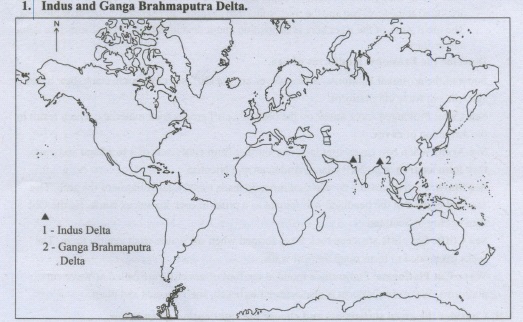
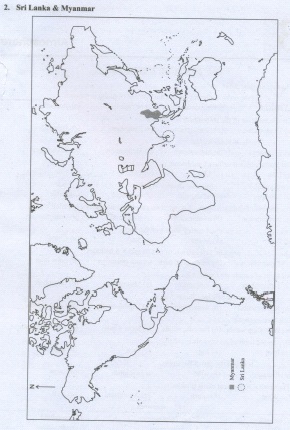
Indus and Ganga Brahmaputra Delta
102.
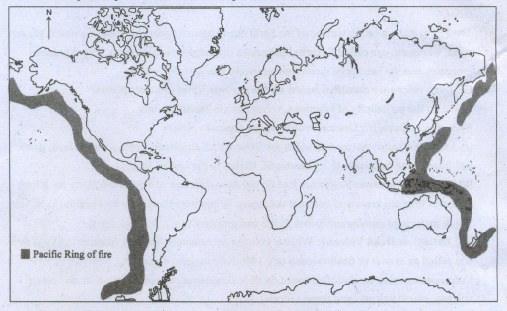
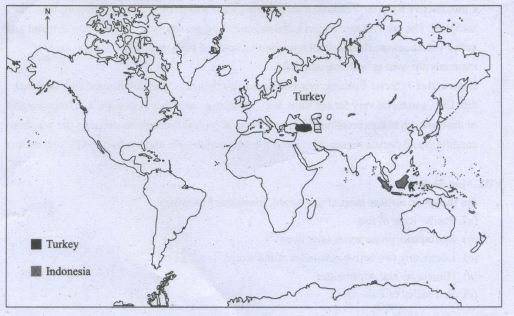
On the given outline map of the world, mark the following:
a. Pacific Ring of fire
b. Earthquake prone zones (any two)
c. Locate any two active volcanoes of the world.
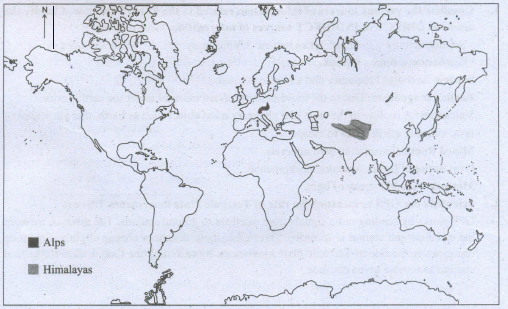
d. Himalayas and Alps ranges
e. Rift valley of East Africa.
103.
Assertion (A): Assyrians of Mesopotamian civilisation were contemporaries of Indus civilisation.
Reason (R): The Documents of an Assyrian ruler refer to the ships from Meluha
(a) A and R are correct and A explains R
(b) A and R are correct but A doesn’t explain R
(c) A is incorrect but R is correct
(d) Both A and R are incorrect
A and R are correct and A explains R
A and R are correct but A doesn’t explain R
A is incorrect but R is correct
Both A and R are incorrect
104.
What are the Federal features of Indian Constitution?
105.
What is meant by Disaster Response?
106.
Write down the differences between unitary form of government and federal form of government.
107.
What are the three sectors of an economy?
108.
Expand the following:
1. NNP
2. PCI
109.
Why NNP is not considered as an useful measure to compare a country’s development with other countries?
110.
Distinguish between direct and indirect democracy.
111.
Write about the hidden treasure of Indus civilization.
112.
Mention the rules to ensure Road Safety for children.
113.
How different factors contribute to road accidents?
114.
Write note the Parliamentary form of Government.
115.
Write a short note on "Red Tea".
116.
Write about the Gandhi's Concept of Gram Swaraj.
117.
Explain the term Virtual water.
118.
Explain the types of map.
119.
What are Urban Settlements? and explain its types.
120.
Write a note on the famines which occurred in British India.
121.
Mention the main attributes of the Industrial Revolution.
122.
How did the American war of Independence end in the declaration of independence?
123.
Highlight the contribution of Greece to World Civilization
124.
Write a note on the following:
Persian wheel
125.
Explain the term Renaissance.
126.
Explain the relationship between Money and Price.
127.
Democracy- Development - Fundamental Rights - establish a positive link among these three factors.
128.
What is mentioned by Nehru about Baghdad in his "Glimpses of World History"?
129.
Explain the terms a) Continental Rise b) Oceanic ridge
130.
Write a note on Fresh Water
131.
Explain about the aquatic biomes on Earth.
132.
"Elections are considered essential for any representative democracy". Why?
133.
Describe the Erosional landforms of Sea
134.
Describe sustainability of Development.
135.
Give an account of Mobilisation and Democratic Participation.
136.
Though democracy in India has been appreciated worldwide for its working there is still a lot of scope for improvement - Discuss.
137.
Explain the teachings of Lao-Tse (Taoism).
138.
Give an account of 'Tsunami'
139.
Give an account of "Emergence of towns and ports".
140.
Discuss the Neolithic culture in Tamil Nadu
141.
Compare the employment conditions prevailing in the organised and unorganised sectors.
1.
(d)
both a and b
2.
(d)
Cholas
3.
(a)
7% land area
4.
(c)
1858
5.
(c)
Secondary
6.
(a)
Batavia
7.
(b)
Portugal
8.
(b)
England
9.
(c)
insurance agents
10.
(b)
Armand Peugeot
11.
(a)
Voltaire
12.
(a)
1992
13.
(a)
121 crore
14.
(c)
October – December
15.
(c)
July 11th
16.
(b)
(ii) is correct
17.
(c)
(ii) & (iii) is correct
18.
(c)
200
19.
(c)
Military
20.
(b)
King John II
21.
(d)
All of the above
22.
(a)
1917
23.
(c)
1976
24.
(c)
Sung
25.
(b)
Central Asia
26.
(a)
Pacific
27.
(c)
Right against child labour exploitation
28.
(d)
None of the above
29.
(b)
Sweet Potato
30.
(c)
Athens
31.
(a)
NNP
32.
(a)
iron oxide
33.
(a)
Prime Minister
34.
(c)
Ozone
35.
(c)
18
36.
(a)
Iron
37.
(a)
Pacific
38.
(a)
crust
39.
(c)
Mullai
40.
(c)
(i) & (iv) are correct
41.
(b)
The Sumerians
42.
(a)
Agriculture
43.
(a)
average
44.
(b)
United Kingdom
45.
(b)
1951-1952
46.
(a)
Alto-cumulus
47.
(b)
Fertile Crescent
48.
(a) The fourth king of Bhutan Jigme Singye Wangchuck travelled to all the 20 districts of the tiny kingdom.
(b) The purpose of the travel is to explain the importance of historic transition to the people of Bhutan.
(c) Transition from the hereditary monarchy to the Parliamentary Democracy.
(d) In 2006 the king as abdicated the throne 34 years after ascending it. Now Bhutan is a Parliamentary Democracy and King Jigme a constitutional monarch.
49.
The extent and nature of these migrant streams would essentially depend on:
(i) Pressures and aspirations experienced by people at the origin of migration.
(ii) Constraints imposed on mobility at the origin of migration.
(iii) Opportunities at the destination and availability of information regarding these opportunities.
(iv) The cost of migration.
50.
(i) In each and every village, the people living within its jurisdiction will be the members of Panchayat.
(ii) The President of the Panchayat will preside over its meetings.
(iii) In the meetings of the Gram Sabha, the income and expenditure and the beneficiary of the schemes in the village are discussed.
51.
(i) Tamil Nadu has the highest GDP in India according to 2017
(ii) Tamil Nadu tops in food grain production in 2015 - 2016 Prime Minister presented the Krishi Karman award to Tamil Nadu.
(iii) Mettur dam has the highest storage of water in Tamilnadu for agricultural Purpose.
52.
The hardware and software functions of a GIS are
(i) Data input and verification
(ii) Compilation
(iii) Storage
(iv) Updating and changing
(v) Management and exchange
(vi) Manipulation
(vii) Retrieval and presentation
(viii) Analysis and combination
53.
Man made pollutants refer to vehicular emission, industrial wastes, smoke from thermal power plants and refineries badly affects the environment.
54.
(i) In 1750s and the early 1760s, Robert Clive gained control of the wealthiest part of the old Mughal Empire.
(ii) The company availed concessions such as exemption of company goods from transit duties, which even Indian merchants had to pay.
(iii) After the Battle of Plassey (1757), the company got 1.2 million pounds out of which Clive himself took 31,500 pounds besides a jagir which provided an annual income of 27,000 pounds.
(iv) After the Battle of Buxar (1764) the Murshidabad treasury was looted. The company acquired the Diwani right in 1765.
55.
(i) While the peasants were pauperized and the working class suffered, the middle class became wealthy by investing capital in trade and industry.
(ii) The governments of the day were influenced by them.
(iii) All legislations safeguarded their interests.
(iv) Labourers were not permitted to form trade unions.
(v) It was under these circumstances that Socialism as a new ideology was born in Europe.
56.
(i) The Second Continental Congress met on 10 May 1775 at Philadelphia.
(ii) John Adams, Sam Adams, Richard Henry Lee and Thomas Jefferson were some of prominent members of the Congress.
(iii) It organized the army gathered around Boston as the Continental Army.
(iv) It was placed under the command of George Washington
57.
(i) By the end of the nineteenth century, France had become prominent for its automobiles.
(ii) In 1898 Louis Renault built the quadricycle. He began to produce in large quantities under his company the Societe Renault Freres (Company Renault Brothers).
58.
We can divide the process of the colonialisation of India into three phases.
(i) Phase I Mercantilist Capitalism.
(ii) Phase II Industrial Capitalism.
(iii) Phase III Financial Capitalism.
59.
Components of remote sensing are
(i) Energy source
(ii) Transmission path
(iii) Target
(iv) Sensor
60.
In Tamil Nadu there are 12 Corporations. They are,
a) Chennai
b) Kovai
c) Madurai
d) Trichy
e) Tirunelveli
f) Salem
g) Erode
h) Vellore
i) Tuticorin
j) Tirupur
k) Tanjore
l) Dindigul.
61.
(i) Many people move to urban areas primarily because cities promise more jobs better schools for poor's children and diverse income opportunities than subsistence farming in rural areas.
(ii) Urbanization drives economic growth and causes people to seek working and investment opportunities in urban areas.
(iii) Local governments are unable to manage urbanisation and migrant workers without an affordable place to live in, dwell in slums.
(iv) The UN-Habitat reports that 43% of urban population in developing countries and 78% of those in the least developed countries are slum dwellers.
(v) Lack of affordable low cost housing and poor planning encourages the supply side of slums.
(vi) Some of the slums in today's world are a product of urbanisation brought by colonialism.
(vii) Urban poverty, encourages the formation and demand for slums.
(viii) Major natural disasters in poor nations often lead to migration of disaster affected from their to unaffiliated areas, the creation of temporary tent cities and slums.
62.
The productivity of rice - 1965 - 66 - 1409 kgs per hectare.
1975 - 76 - 2372 kgs per hectare.
1985 - 86 - 2712 kgs per hectare
2014 - 15 - 4429 kgs per hectare
In the past 50 years, the productivity of paddy has increased more than three times.
63.
(i) Under Alexander the Great, the Greeks were able to establish a kingdom in Macedonia.
(ii) This kingdom succeeded in annexing two historic empires of Egypt and the Middle East.
(iii) But the entire period of Alexander's reign was spent on wars.
(iv) The Greek school of Science, Mathematics and Philosophy reached its peak in the Greek-Egyptian city of Alexandria.
64.
(i) Under Oligarchy, the new rich exploited the smaller landholders.
(ii) So this republic was soon replaced by some ambitious men who administered tyrannically
65.
(I) When the Greek City-States first emerged, they still carried the legacy of the past.
(ii) The rulers came from lines of traditional chieftains.
(iii) Those who grew rich from the expansion of trade, resented the privileges enjoyed by the old ruling families.
(iv) The outcome was the overthrow of the kings and the establishment of "oligarchies" in many city-states.
66.
(i) Larger manufacturing units, employing many craftsmen, are called Karkhanas.
(ii) Karkhanas were set up under Mughal State.
67.
(i) He reversed the policy of discriminatory measures against the Hindus.
(ii) He employed Hindu administrators like Todar Mal in key positions of authority.
(iii) These initiatives earned the emperor the loyalty and trust of the majority community.
(iv) The entire region was brought under a uniform administrative structure.
(v) The political stability increased the economy and trade
68.
In 1453 A.D. Constantinople, the capital of the Byzantine Empire, was captured by the Ottoman Turks.
69.
(i) The origin of the word Renaissance is from the Italian word renascita meaning rebirth.
(ii) It is called Renaissance because there was a rebirth or revival of classical Greek and Latin literature
70.
(i) The Tropical Forest Biomes have very dense forests.
(ii) So human settlements are found scattered here.
(iii) They sustain their livelihood through food gathering, fishing, lumbering and shifting cultivation.
71.
A major portion of the savings in banks are used for the development of industries, economic growth and various development schemes for the welfare of the poor
72.
(i) The National Human Rights Commission (NHRC) is an autonomous body constituted on 12th October 1993 under the protection of Human Rights Act, 1993.
(ii) It consists of a chairman and few other members.
(iii) NHRC is responsible for the protection and promotion of human rights in India.
(iv) The Act defines the right relating to life, liberty, equality and dignity of the individual guaranteed by the Constitution or embodied in the international covenants.
73.
(i) The earth consists of four spheres
(ii) They are a) Lithosphere,
b) Atmosphere,
c) Hydrosphere and
d) Biosphere
74.
(i) Pepper, spices, pearls, gems, rubies and muslin clothes were exported from the eastern sea of Tamil Nadu. Pepper and spices took a major share of the exports.
(ii) Thus this route came to be called as the spice route.
75.
The UNO adopted the Rights of the child on 20th November, 1989. They are
(i) Right to life
(ii) Right to family environment
(iii) Right to Education
(iv) Right to benefit from Social security
(v) Right against sexual exploitation
(vi) Right against sale or trafficking
(vii) Right against other forms of exploitation like Child labour.
76.
(i) Terrestrial biomes is a group of living organisms that live and interact with one another on land.
(ii) They are mainly determined by temperature and rainfall.
(iii) Some of the major terrestrial biomes of the world are
a. Tropical Forest Biomes
b. Tropical Savanna Biomes
c. Desert Biomes
d. Temperate Grassland Biomes and
e. Tundra Biomes
77.
The factors that generate ocean currents are:
(i) Earth's rotation
(ii) Prevailing winds and
(iii) Differences in temperature and salinity of ocean water
78.
The ocean basins are characterised by the following major relief features:
(i) Continental shelf
(ii) Continental slope
(iii) Continental rise
(iv) Deep sea plain or Abyssal plain
(v) Oceanic deep
(vi) Oceanic ridge
79.
(i) Arabs were more interested in scholarly pursuits.
(ii) They had a scientific spirit of inquiry.
(iii) In some subjects like medicine and mathematics, they learnt much from India.
(iv) Many Arab students went to Takshashila, which was still a great university for specialized medicine.
(v) Sanskrit books on medicine and other subjects were translated into Arabic.
(vi) In medicine and surgery, Arab physicians and surgeons earned a great reputation.
80.
The Ring of Fire is a ring of volcanoes around the Pacific Ocean. These volcanoes result from subduction of oceanic plates beneath lighter continental plates, A subduction zone is a place where one plate of oceanic lithosphere is shoved under another plate. As it is shoved into the hotter mantle the plate heats up. The addition of volatiles such as water to the hot overlying mantle causes partial melting and the production of magma. This magma rises up through the over-lying plate to erupt at the surface. Hence, the Pacific Ring of Fire is most seismically and volcanically active.
81.
Flat surface found at the foot of the sea cliffs are called as wave cut platform. It is also referred as Beach, shelf, terrace. and plain.
82.
Since the countries have different populations comparing total income will not be suggestive of what an average person is likely to earn. So, for comparing the development of various countries total income is not an useful measure.
83.
(i) Coastal zone is exposed to natural forces including cyclones and Tsunamis.
(ii) Cuddalore and Nagapattinam are situated on the Sea-Shore.
(iii) Cuddalore and Nagapattinam are vulnerable to storms.
(iv) During Summer Bay of Bengal subject to intense heat cause to raise the humid and unstable air masses that produce cyclone.
84.
Those who are engaged in economic activities, in whatever capacity -high (or) low are called employees.
85.
(i) Yes, weathering a pre-requisite in the formation of soil.
(ii) The rock materials in due course of time are weathered further to form soil.
(iii) Soil is a mixture of disintegrated rock material.
86.
Merits:
(i) Indirect elections are less expensive.
(ii) It is more suited to elections in large countries.
Demerits:
(i) If the number of voters is very small, there exists the possibility of corruption, bribery, horse trading and other unfair activities.
(ii) It is less democratic because people do not have a direct opportunity to elect, but they instead do it through their representatives. So, this may not reflect the true will of the people.
87.
A state in which supreme power is held by the people and their elected representatives and which has an elected (or) nominated President rather than a Monarch.
e.g., India, Australia.
88.
Mahavira and Buddha lived a life of purity and exemplified simplicity and self-denial.
89.
Active volcanoes are those which constantly eject volcanic lava, gases and fragmented materials. e.g., Mount St. Helens in the United States.
90.
As seafaring people, Tamil traders and sailors established commercial and cultural links across the seas and merchants from foreign territories also visited the Tamil region.
91.
While the fossil bones are classified as various species such as Homo habilis, Homo erectus and Neanderthalensis, based on the lithic tools, cultures are assigned names such as Earliest Lithic, Assemblages, Oldowan Technology, Lower, Middle and Upper Palaeolithic and Mesolithic cultures.
92.
(i) The Urban society practised crafts, engaged in trade and exchange, adopted science and technology and formed political organisation.
(ii) Hence the term civilisation is used to distinguish them from the early forms of societies.
93.
The three principles of Jainism are known as Tri-ratnas. They are Right faith, Right knowledge, Right action.
94.
(i) The Tamil rulers were independent of Mauryan authority because Ashokan inscriptions found in present day Odisha, Karnataka, Telangana and Andhra Pradesh are not seen in Tamil Nadu and Kerala.
(ii) So we can conclude the status of Tamil rulers.
95.
The erosional landforms of wind: Mushroom rocks, Inselbergs and Yardangs
The Depositional Landforms of wind: Sand dunes, Barchans and loess.
96.
(i) Meanders in due course of time become almost a complete circle with narrow necks
(ii) This in turn gets abandoned and forms a lake. This is called an Ox-bow lake
97.
Biological weathering occurs due to the penetration and expansion of plant roots, earthworms, burrowing animals (rabbits, rats) and some human activities.
98.
(i) Hammurabi Code is an important legal document that specifies the laws related to various crimes.
(ii) It has 282 provisions specifying cases related to family rights, trade, slavery, taxes and wages.
(iii) It is carved on a stone, which portrays Hammurabi as receiving the code from the Sun god Shamash.
(iv) It was a compilation of old laws based on retributive principles.
(v) The 'eye for eye' and 'tooth for tooth' form of justice is used in the Hammurabi Code.
99.
1. In Megalithic period people buried the dead bodies with grave goods in the cists.
2. Urns or pottery jars were used for burning the dead and also they used sarcophagi made of terracotta.
3. Dolmens, table like stone structures were erected as funerary monuments. Menhirs pillar are like stones erected as part of the burials or memorials.
4. Port holes are holes found in the cists and dolmens on one side.
100.

101.
a)
b)
102.
a) Pacific Ring of fire: It is a major area and an arc in the basin of the Pacific ocean where many earthquakes and volcanic eruptions occur.
(b) Earthquake-prone zones (any two): Turkey, Indonesia
(c) Locate any two active volcanoes of the world: Hawaii, Mount Fuji
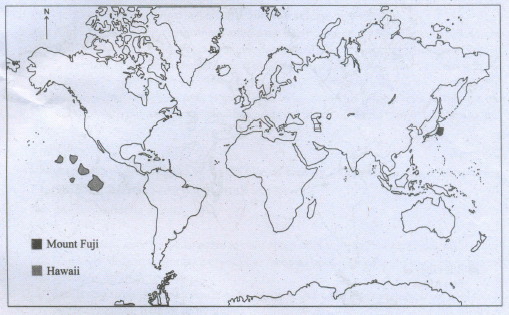
(d) Himalayas and Alps ranges
103.
(d) Both A and R are incorrect
104.
Federal features of Indian Constitution are,
(1) Dual Government
(2) Written constitution
(3) Division of Powers
(4) Supremacy of the Constitution
(5) The constitution is the supreme law of the land. The laws enacted by the Centre and the states must confirm to its provisions.
(6) Rigid Constitution
(7) Independent Judiciary
(8) Bicameralism
105.
(i) Disaster response entails restoring physical facilities, rehabilitation of affected populations, restoration of lost livelihoods and reconstruction efforts to restore the infrastructure lost or damaged
(ii) The Response Phase focuses primarily on emergency relief: saving lives, providing first aid, restoring damaged systems (communications and transportation), meeting the basic life requirements of those impacted by disaster (food, water, and shelter), and providing mental health and spiritual support and care.
106.
| S.No. | Unitary form of government | Federal form of government |
|---|---|---|
| 1 | This government is a sovereign state governed as a single entity. |
The classification of governments into unitary and federal is based on the nature of relations between the national government and the regional governments. |
| 2 | The central government is supreme and the administrative divisions exercise only powers that the central government has delegated to them. |
Powers are divided. |
| 3 | Suitable for small countries. | More suitable for bigger countries. |
| 4 | There is no conflict of authority and responsibility. It will make prompt decisions and take speedy action. |
It is good for economic and cultural progress. |
107.
The economy is classified into three sectors.
1. Primary (or) Agriculture sector,
2. Secondary (or) Industrial sector
3. Tertiary (or) Service sector.
108.
(i) NNP - Net National Product
(ii) PCI - Per Capita Income
109.
(i) The Net National Product (NNP) is considered as a true measure of national output. It is also known as national income.
(ii) A rise in per capita income means an increase in aggregate real output. Hence, this is a better indicator than national income for measuring development.
(iii) For measuring a country's development, its income is considered to be one of the most important factors. Countries with higher income are considered to be more developed than those with lesser income.
(iv) So, income itself is considered to be one of the indicators of economic development.
110.
| Direct democracy | Indirect democracy |
|---|---|
| When the people themselves directly express their will on public affairs, the type of government is called pure or direct democracy. e.g., Ancient Greek city-states, Switzerland | When the people express their will on public affairs, through their elected representatives, the type of government is called indirect or representative democracy. e.g., The prevailing system of democracy in India, USA and UK |
111.
1. The Indus civilisation and its urban features started declining from about 1900 BC.
2. Charges in climate, decline of the trade with Mesopotamia and drying up or flooding of the river Indus. foreign invasion were some of the reasons attributed to the collapse of this civilisation and for the migration of people on the southern and eastern directions.
3. It did not completely disappear.
4. It continued as rural culture.
112.
Rules to Ensure Road Safety for chlldren
It is impportant for children to know about road safety rules and regulatioins. Here are a few
basic road safety rules for children.
i) Know Your Signals
ii) Stop, Look and Cross
iii) Pay Attention - Listen
iv) Don't Run on Roads
v) Always Use Sidewalks
vi) Never Stick Hands outside the Vehicle
vii) Never cross Road at Bends
viii) Don't Rush.
113.
The different factors contribute to road accident are,
i) Drivers: Over speeding, rash driving, violation of rules, failure to understand signs, fatigue, alcohol.
ii) Pedestrians: Carelessness, illiteracy, crossing at wrong places, jaywalkers.
iii) Passengers: Projecting their body parts outside vehicles, talking to drivers, alighting and boarding vehicles from the wrong side, travelling on footboards, catching a running bus etc.,
iv) Vehicles: Failure of brakes or steering, tyre burst, insufficient headlights, overloading.
v) Road Conditions: Potholes, damaged roads, eroded roads merging of rural roads with highways and illegal speed breakers.
vi) Weather conditions: Fog, snow, heavy rainfall, wind storms, hail storms.
114.
Parliamentary form of Government
(i) The parliamentary system of government is the one in which the executive is responsible to the legislature for its policies and acts.
(ii) It is also known as cabinet government or responsible government or Westminster model of government and is prevalent in Britain, Japan, Canada, India among others.
Features of Parliamentary form of government
(i) Nominal and Real Executives.
(ii) Majority Party Rule
(iii) Collective Responsibility
(iv) Double Membership
(v) Leadership of the Prime Minister
Merill of the parliamentary form of government
(i) Harmony between Legislature and Executive.
(ii) Responsible Government
(iii) Prevents Dictatorship.
(iv) Wide Representation.
Demerits of the parliamentary form of government
(i) Unstable Government.
(ii) No Continuity of Policies.
(iii) Dictatorship of the Cabinet.
(iv) Against Separation of Powers.
115.
(i) "Red Tea" is a very well known novel written by Paul Harris Daniel.
(ii) The novel portraits the slavery life of plantation workers in Valparai.
(iii) This novel depicts the blood stained history of the workers that is hidden behind the green cover of the hills.
(iv) This novel has been translated in Tamil by R. Murugavel in the name "Eriyum Panikkaadu" (எரியும் பனிக்காடு)
(v) The story starts with Karupan migrating to the hills with his wife in search of survival.
(vi) The narrator of this story is Dr. Daniel, who comes there to treat the plantation employees.
116.
(i) Gandhi really wanted 'Swaraj', The self rule by the people of India who represent the rural mass.
(ii) He observed "India's soul lives in the village".
(iii) He dreamt of village republics in term of Panchayat in the free India.
(iv) Mahatma Gandhi advocated Panchayat Raj, a decentralized form of government where each village is responsible for its own affairs.
(v) Gandhi's ideal village should be basically self-reliant, making provision for all necessities of life, food clothing, clean water, sanitation, housing, education and other requirements, including government and self-defense.
(vi) According to Gandhi Gram Swaraj should be a complete republic, independent of its neighbor.
(vii) Every village should be a democracy in which they will not depend even on neighbor for major needs.
117.
(i) The term virtual water was introduced by Tony Allen in 1990.
(ii) The water consumed in the production process of an agriculture or industrial product has been called the virtual water.
(iii) It is a hidden flow of water when food or other commodities are traded from one place to another.
(iv) For instance it takes 1340 cubic meters of water to produce one metric ton of wheat.
(v) That is, if one metric ton of wheat is exported to another country, then, it means that 1340 cubic metre of water used to cultivate this amount of wheat is also being exported.
(vi) India is the largest global freshwater user .
(vii) India has been the fifth largest exporter of virtual water in the world.
118.
(a) On the basis of scale, maps can be classified into:
(i) Large scale maps: Large amount of detail; can only show a small area.
(ii) Small scale map: Small amount of detail; can show a large area.
b) On the basis of utility and purpose, they are classified as:
(i) General maps / Topographic Maps (physical and political maps)
(ii) Thematic map (spatial variations of single phenomena)
(iii) Special purpose maps (Braille maps for blind people, maps for neo-literates, military maps, navigational charts, etc).
119.
(i) Urban is the term related to cities and towns where people are primarily engaged in non-agricultural activities.
(ii) The factors responsible for urbanization are better employment opportunities, suitable conditions for business, education, transport, etc.
(iii) Urban centres are classified as towns, cities, metropolitan cities, mega cities, conurbation, etc., depending on the size and services available and functions rendered to it.
(a) Town: A town is generally larger than a village, but smaller than a city. It has a population of less than 1 lakh. E.g: Arakkonam.
(b) City: Cities are much larger than towns and have a greater number of economic functions. The population in cities are estimated to be more than 1 lakh. E.g: Coimbatore
(c) Metropolitan Cities: Cities accommodating population between 10 lakhs and 50 lakhs are metropolitan cities. E.g: Madurai
(d) Mega cities: Cities with more than 50 lakh population are called Megacities. E.g: Chennai
(e) Conurbation: A conurbation is a region comprising of a number of cities, large towns and other urban areas. E.g: Delhi
120.
(i) The policy of free trade and the forcible collection of land revenue resulted in the outbreak of famines.
(ii) The Odisha famine of 1866-67 was a severe and terrible event.
(iii) The famines of 1876-78 known as the Great famine of 1876-78 caused a large migration of agricultural labourers and artisans from Southern India to British colonies.
(iv) Here they worked as indentured labourers on plantations.
(v) In the Madras Presidency, the famine of 1876-78 was preceded by droughts.
(vi) The situation was made worse because of the colonial government's policy of laissez-faire in the trade of food grains.
(vii) Two of the worst famine-afflicted areas in the Madras Presidency were the district of Ganjam and Vizagapatnam. They continued to export grains throughout the famine.
(viii) These famines were typically followed by various infectious diseases.
(ix) The memory of this famine is still preserved in various folk songs and ballads.
(x) The Bengal famine of 1770 as well as 1943 of British India took a heavy toll of human lives.
121.
The main attributes of the Industrial Revolution were technological, socio-economic and cultural.
(i) Use of new basic materials: iron and steel
(ii) Use of new energy sources: coal, electricity, petroleum
(iii) Invention of new machines such as the spinning jenny and the power loom that increased the production with a minimum expenditure of human energy
(iv) Emergence of a new organization known as the factory system, which entailed increased division of labour and specialisation of work
(v) Development in transportation and communication
(vi) Increasing application of science to industry
(vii) The use of new technology
122.
(i) Initially the colonies did not begin fighting for the sake of independence. Their grievances were taxation and restrictions on trade.
(ii) George Washington was the Commander-in-Chief of the colonies and their battle cry was 'No Taxation without Representation'.
(iii) On 5 September 1774, the first Continental Congress met in Philadelphia. The Congress adopted a Declaration of American Rights.
(iv) The Battle of Bunker Hill signaled the outbreak of the American war of Independence.
(v) The second Continental Congress met on 10 May 1775 at Philadelphia. It organised the army gathered around Boston as the continental army and placed it under the command of George Washington.
(vi) As the war progressed, the Continental Congress assumed the functions of government. A committee was formed to explore the possibility of foreign aid.
(vii) On 17 June 1775 the Battle of Bunker Hill, the first major battle was fought in Massachusetts. Soon the British forces retreated from Boston.
(viii) On June 7, 1776 Richard Henry Lee of Virginia moved a resolution for independence.
(ix) After much debate the Declaration of Independence, drafted by Thomas Jefferson, was adopted by the Congress on July 4, 1776. This day is celebrated by the Americans as Independence Day.
123.
(i) The ancient Greeks created the world's first democracy. Athens started on with a monarchy and then advanced to an oligarchy until it finally reached a democracy.
(ii) The Greek Alphabet was the first alphabet in the western sense of the word, featuring distinct letters for vowels and consonants.
(iii) The first library in the world, the library of Alexandria was actually built in Egypt.
(iv) The Olympic games started in ancient Greece specially in the city of Olympia.
(v) Science and Mathematics - Eratosthenes was the first mathematician to calculate the circumference of the Earth. Aristarchus, Archimedes and Hipparchus were great mathematicians and scientists.
(vi) One of the common examples of Greek Architecture in the modern world is the Column or Pillar.
(vii) Greek mythology has pervaded nearly every form of popular culture imaginable. Many Greek myths have been adapted into modern novels, movies, TV, shows etc.
(viii) The first lighthouse in the world was located in the Greek controlled Egyptian Kingdom of Alexandria.
(ix) The democratic people of ancient Greece, especially Athens, were the first to employ trial by jury as we know it today.
124.
Persian wheel:
(i) The Persian wheel is a mechanical water lifting device.
(ii) It is usually operated by draught animals like bullocks, buffaloes or camels.
(iii) It is used to lift water from water sources typically open wells.
(iv) Since it was used in Persia, it got the name Persian wheel.
125.
(i) The Italian city-states were centres of cultural activities since the fourteenth century.
(ii) With the coming of the scholars and artists from Constantinople, there was a surge of enthusiasm and interest in studying classical literature and art of Greeks and Romans.
(iii) This creative upsurge was reflected in their writings, art, architecture and music.
(iv) This cultural florescence is known as the renaissance.
(v) The origin of the word renaissance is from the Italian word 'renascita' meaning rebirth.
(vi) It is called renaissance because there was a rebirth or revival of classical Greek and Latin literature.
(vii) Many scholars in Italy went in search of manuscripts of classical literature.
(viii) Greek scholar Manuel Chrysoloras who taught Greek classics in Italy, Guarino and Giovanni Aurispa, to name just a few, visited Constantinople several times to collect Greek manuscripts.
(ix) Later they printed what they collected.
(x) This provided stimulus to the flowering of renaissance.
126.
(i) The relationship between money and price is connected with the Monetary policy.
(ii) There is a close relationship between the growth of money supply and inflation.
(iii) Price controls play a very important role in a country's economic stability.
(iv) This role is played by RBI.
(v) Currency is the medium of exchange in a country.
(vi) The Indian currency is called the Indian Rupee (INR).
(vii) In a country the foreign currency is called foreign exchange.
(viii) Purchasing capacity of all currencies in the world are compared using the US dollar as the standard currency.
(ix) This value differs from country to country.
(x) Most of the international trade transactions are carried out in US dollar
127.
(i) Democracy has an important role to play in promoting sustainable development.
(ii) Free and fair elections, independent media, accountable government as well as other basic democratic principles are all critical components of an environment conducive to growth.
(iii) In a direct democracy the people decide on the policy initiatives directly.
(iv) Democracy is very much responsible and important over the development of a nation.
(v) In a democratic country the citizens are forced to express their views and opinions on decisions taken by government.
(vi) This makes the government take more responsible decisions and they go with majority people.
(vii) All these actions can be carried on with the help of the fundamental rights generated by the constitution of India with legal background.
128.
(i) Baghdad- a city known as the city of Arabian Nights, was a vast city of palaces and public offices and schools and colleges, and great shops and parks and gardens.
(ii) The merchants carried on a vast trade with the East and West.
(iii) Visitors came to Baghdad from all over the world especially learned men and students and artists
129.
a) Continental Rise
(i) At the base of the continental slope is a gently sloping layer of sediments which merge into the deep-sea floor.
(ii) This underwater feature found between continental slope and abyssal plains is called the continental rise.
(iii) It consists of submarine fans which are similar to the alluvial fans found on land.
b) Oceanic Ridge
(i) Oceanic ridge is a continuous submarine mountain chain.
(ii) They are made of young basaltic rock formed when two tectonic plates move apart.
(iii) The mid-ocean ridge is probably the most extensive single feature of the earth's topography.
(iv) Two of the most well known mid-ocean ridges are the Mid-Atlantic Ridge and the East Pacific Ridge.
(v) The Mid-Atlantic Ridge is the largest unbroken oceanic ridge.
130.
(i) Rain water is considered to be the purest form of water, as it contains very less proportion of salts when compared to the oceans and seas.
(ii) Hence it is called fresh water.
(iii) A major part of fresh water is found in the frozen state in the form of ice caps and glaciers.
(iv) Around 0.5 to 1% of it, is found in the liquid state as rivers, streams, lakes, ponds etc.
(v) Surface water may also penetrate through porous rocks and gets collected beneath the Earth's surface.
(vi) This is called groundwater
131.
Aquatic biome is a group of living organisms that live and interact with one another and its aquatic environment for nutrients and shelter. It is broadly classified as fresh water biomes and marine biomes.
A. Fresh water Biomes:
(i) Fresh water biomes comprises lakes, ponds, rivers, streams, wetlands etc.
(ii) It is influenced by various abiotic components such as the volume of water, water flow, composition of oxygen, temperature, etc.
(iii) Humans rely on freshwater biomes for drinking water, crop irrigation, sanitation and industry.
(iv) Water lily, lotus, duckweeds etc. are the common plants found here.
(v) Trout, salmon, turtles, crocodiles etc. are the animals found here.
B. Marine Biomes:
(i) They are the largest aquatic biomes on earth.
(ii) They are continuous bodies of salt water and provide a wide range of habitats for marine plants and animals.
(ii) Coral reefs are a second kind of marine biomes within the ocean.
(iv) Estuaries, coastal areas where salt water and fresh water mix, form a third unique marine biome.
(v) As water provides maximum mobility to marine organisms, nutrients are circulated more quickly and efficiently here than the terrestrial biomes.
(vi) Apart from animals, plants such as kelp, algae, phytoplankton etc. also grow in water.
(vii) Some of the threats and issues to aquatic biomes are overfishing, pollution and rise in sea level.
132.
(i) Democracy is a government of the people by the people and for the people.
(ii) To select a leader of people's choice we should have elections.
(iii) The representatives elected by the people can elect a suitable leader to rule the country.
133.
Some of the erosional landforms of sea waves are sea cliff, sea cave, arch, stack, beach, bar and spit and wave cut platform.
Sea Cave: Prolonged wave attack on the base of a cliff erodes rock materials, which result in the formation of caves.
Sea Arch: When two caves approach one another from either side of a headland and unite, they form an arch. e.g., Neil Island, Andaman and Nicobar.
Sea Stack: Further erosion by waves ultimately leads to the total collapse of the arch. The seaward portion of the headland will remain as a pillar of rock known as stack. Eg the Old man of Hoy in Scotland.
Sea Cliffs: Sea cliffs are steep rock faces formed when sea waves dash against them. The rocks get eroded to form steep vertical walls.
Wave Cut Platforms: Flat surface found at the foot of sea cliffs are called as wave-cut platforms. Wave cut platform is also referred as beach, shelf, terrace and plain.
134.
Sustainable economic development is taken to mean development without damaging the environment and not compromising with the needs of the future generation. The consequences of environmental degradation do not respect national or state boundaries. Sustainability of development is comparatively a new area of knowledge in which scientists, economists, philosophers and other social scientists are working together. Natural resources can be divided into renewable resources and non-renewable resources. Groundwater is an example of a renewable resource. The question arises as to how sustainable development is possible if the resources are over-used rather than getting replenished. Nonrenewable resources get exhausted after certain number of years of extracting and using them and they cannot be replenished. To achieve real sustainability, we need to balance economic, social and environmental sustainability in equal harmony. In general, the question of development or progress is continuous. At all times, as a member of society and as individuals, we need to ask where we want to go, what we wish to become and what our goals are.
135.
Mobilising people towards socially productive activities that lead to the overall betterment of people's lives is essential. Sometimes earthquakes, tsunamis, floods and other such natural disasters on a massive scale occur and people's immediate mobilisation for evacuation and emergency relief becomes most essential.
Democratic Participation: Democracy can succeed only when smaller local groups and, in fact, every citizen can take action that supports the tax and revenue collection systems, observance of national norms in environmental protection, cleanliness, health and hygiene, sanitary drives and immunisation programmes like pulse polio. However, we must keep in mind that there is no better form of government than Democratic government. To create a better society and nation, the people of India along with the union and state governments should come together to fight against the miseries of human life.
136.
Though democracy in India has been appreciated worldwide for its working, there is still a lot of scope for improvement. The above-mentioned steps must be taken to ensure smooth functioning of democracy in the country.
Indian democracy can be successful and vibrant only when its citizens imbibe and reflect in their behavior the basic democratic values like equality, freedom, social justice, accountability and respect for all. Their mindset, thinking and behavior are expected to be in tune with the essential conditions of democracy. They have to appreciate the opportunities for their desired roles like participation, making the system accountable, fulfilling obligations, and playing proactive roles to actualize the goals of democracy.
137.
(i) The cause of human unhappiness in the world is human selfishness. Selfishness creates unlimited human desires, which can never be satisfied.
(ii) In nature, all the things act in a natural way. The law of human conduct must correspond with nature.
(iii) Humans live a life under the regulation of someone. This is because they have acquired knowledge and have not remained innocent. On the basis of their acquired knowledge, they have built up an urban civilisation and have made themselves unhappy.
138.
The word 'Tsunami' is a Japanese term, meaning harbour waves. It is adapted to describe large seismically generated sea waves caused by Earthquakes, submarine explosions and landslides. These waves travel at a great speed (more than 500 km per hour) and the length of the waves exceeds 600 km. These waves reach to a height of more than 15 m near the sea shore and are capable of causing destruction along the coastal area.
The 2004 Indian Ocean Earthquake that caused tsunami is the sixth-deadliest natural disaster which travelled at a speed of 6.00 km per hour with an estimated death toll of 2,80,000. The Earthquake which occurred near Indonesia at 00.58 hours took nearly 7 hours to reach Chennai.
139.
(i) The Sangam Age saw the first urbanization in Tamilagam.
(ii) Cities developed and they had brick buildings, roof tiles, ring wells and planned towns, streets, and store houses.
(iii) The towns worked as ports and artisanal centres. Arikkamedu, Kaveripoompattinam, Azhagankulam and Korkai on the east coast and Pattanam in Kerala were port centres. Kanchipuram, Uraiyur, Karur, Madurai and Kodumanal were inland trade centres.
(iv) Many goods and commodities were produced in these centres and were exported to various regions.
(v) Though few in number, large towns appeared in the Sangam Age.
(vi) Small villages however were found in many areas. Bronze vessels, beads, shell bangles, glass beads, pottery with names of people written in Tamil-Brahmi script were found at these sites.
140.
(i) The culture that domesticated animals and cultivated crops is called Neolithic.
(ii) It is known as the New Stone Age. The Neolithic people used polished stone axes called celts.
(iii) Cattle rearing was their main occupation. They lived in small villages with houses made of thatched roof and walls plastered with clay.
(iv) Evidence of Neolithic village is found at Payyampalli in Vellore district and a few sites in the Dharmapuri region.
(v) Payyampalli is a village in Vellore district of Tamil Nadu. The earliest evidence for the domestication of animals and cultivation of plants is found at this site, which was excavated by the Archaeological Survey of India.
(vi) Evidence for pottery making and cultivation of horse gram and green gram has been found in this village.
(vii) These Neolithic sites were part of the Southern Neolithic Culture of India. They are mainly concentrated in the Andhra Pradesh and Karnataka regions.
(viii) The Neolithic people used stone axes fitted on a wooden handle.
(ix) These polished stone axes are worshipped in many village temples of Tamil Nadu even today.
141.
| S.No | Organised Sector | Unorganised Sector |
| 1 | The organised sector is one that is incorporated with the appropriate authority or government and follows its rules and regulations |
In the unorganised sector the employment terms are not fixed and regular. |
| 2 | Banks, railways insurance, industry and so on are called as organised sector. |
Household manufacturing activity, and small scale industry small jobs such as selling on the street, doing repair work. |
| 3 | The employees in this sector are provided with job security. |
Employment is not secure. |
| 4 | It gives good salary fixed working hours, paid holidays medical allowances and insurance. |
They do not have paid leave, holiday due to sickness, jobs here are low paid and often not regular. |

9th Standard Syllabus & Materials
9th Standard
TN 9th Tamil உள்ளத்தின் சீர் - திருக்குறள் Important Questions And Answers Study Material - QB365 Set A
NEW9th Standard
TN 9th Tamil உள்ளத்தின் சீர் - மணிமேகலை Important Questions And Answers Study Material - QB365 Set A
NEW9th Standard
TN 9th Tamil உள்ளத்தின் சீர் - ஏறு தழுவுதல் Important Questions And Answers Study Material - QB365 Set A
NEW9th Standard
TN 9th Tamil உயிருக்கு வேர் - தண்ணீர் Important Questions And Answers Study Material - QB365 Set A



Tamilnadu Stateboard 9th Standard Subjects
Tamilnadu Stateboard Standards




