
 100% FREE ACCESS
9th Standard Syllabus & Materials
9th Standard
TN 9th Tamil உள்ளத்தின் சீர் -கற்கண்டு (இலக்கணம்) - தொடர் இலக்கணம், ஆகுபெயர் Important Questions And Answers Study Material - QB365 Set A
NEW9th Standard
TN 9th Tamil உள்ளத்தின் சீர் -விரிவானம் (துணைப்பாடம்) - தாய்மைக்கு வறட்சி இல்லை! Important Questions And Answers Study Material - QB365 Set A
NEW9th Standard
TN 9th Tamil உள்ளத்தின் சீர் -கவிதை பேழை (செய்யுள்) - மார்கழி பெருவிழா Important Questions And Answers Study Material - QB365 Set A
NEW9th Standard
TN 9th Tamil உயிருக்கு வேர்-இலக்கணம் - பகுபத உறுப்பிலக்கணம் Important Questions And Answers Study Material - QB365 Set A
NEW9th Standard
TN 9th Tamil அமுதென்று பேர் - இலக்கணம்-எழுத்து -அளபெடை Important Questions And Answers Study Material - QB365 Set A
NEW9th Standard
TN 9th Tamil அமுதென்று பேர்-துணைப்பாடம் - ஆறாம்திணை Important Questions And Answers Study Material - QB365 Set A

Published on: 12/02/2020
9th Standard Social Science All Chapter Important Creative Questions-II-2020
Download Tamil Nadu 9th Standard Social Science question papers, model tests, one-mark questions, important questions, and public exam papers in PDF format. Free study materials and answer keys for TN State Board students.
Questions + Answers key
Take MCQ Social Science Test
1.
Dictatorship and Monarality
2.
Mention the percentage of migrants in India as well as in Tamil Nadu.
3.
What does the Article 40 of Indian Constitution
4.
Write a note on Farmer Producer Organizations (FPOs) in Tamil Nadu.
5.
Who is a cartographer?
6.
Mention any three ways to conserve Water.
7.
Explain the term commercialisation of crops.
8.
Write about the Great Railroad strike of 1877.
9.
What is meant by the term 'Reign of Terror'?
10.
What was the condition of labourer's houses during Industrial Revolution?
11.
Write a note on Zulu tribe.
12.
What are the components of remote sensing?
13.
Name the taxes levied by the Village Panchayat.
14.
Migration towards cities are the main cause for the birth of slums. Justify.
15.
On what factors does crop cultivation depends? List out the factors on which crop cultivation depends.
16.
Who were Patricians and Plebeians?
17.
Write about the reign of Alexander, the Great
18.
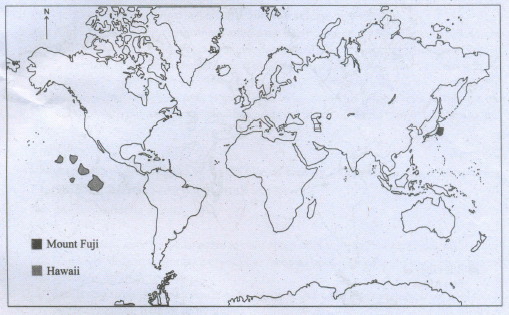
Write a note on Socrates
19.
Why was the Great Magna Carta signed by King John?
20.
How did Akbar consolidated the Mughal empire?
21.
Fall of Constantinople
What was the result?
22.
Bring out the main features of India at the dawn of Modern Age in Europe.
23.
What is considered a hotspot?
24.
How is the major portion of the savings in banks used?
25.
What is SHRC?
26.
Explain the term a) Water Table b) Aquifers
27.
Write about the Right against exploitation.
28.
What is natural money?
29.
Mention the various terrestrial biomes.
30.
Write a brief note on sea waves.
31.
What are the factors that generate the ocean currents?
32.
Impact of Crusades.
33.
Pacific Ring of Fire - Most seismically and volcanically active. Why?
34.
What are "Pot Holes"?
35.
For comparing the development of various countries, total income is not an useful measure. How?
36.
Cuddalore and Nagapattinam are always affected by cyclones. Why?
37.
What does structure of employment denote?
38.
Classify pressure groups in India.
39.
What do you mean by "Republic"?
40.
What do you know about Nanda dynasty?
41.
What is Hydrosphere?
42.
What does the third section of the Tholkappiyam describe?
43.
The Great Rift valley in Africa has evidence for the Prehistoric period. Discuss
44.
Mention the contributions of the Mesopotamian civilisation.
45.
Elaborate the term “Tri-ratnas”.
46.
Overseas interactions brought glory to ancient Tamilagam. Give examples in support.
47.
What are wave cut platforms?
48.
Define :
a) Moraine
b) Drumlin
c) Esker
49.
What do you mean by a hanging valley?
50.
Hammurabi Code is an important legal document. Explain.
51.
Discuss how the age of speculation made humans become conscious and knowledgeable.
52.
Locate the following on the world outline map.
1. Prairies
2. Downs
3. Tundra Biomes
4. Equatorial Biomes
53.
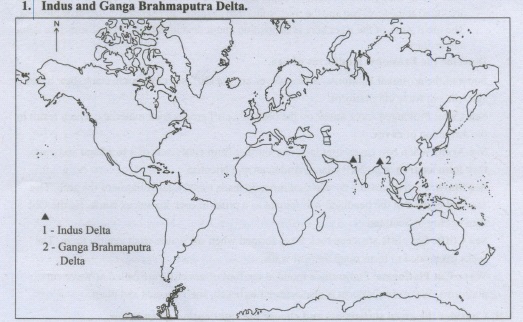
Indus and Ganga Brahmaputra Delta
54.
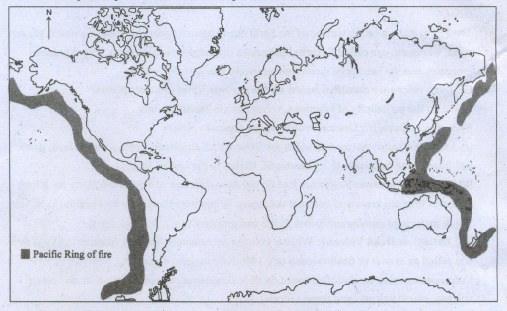
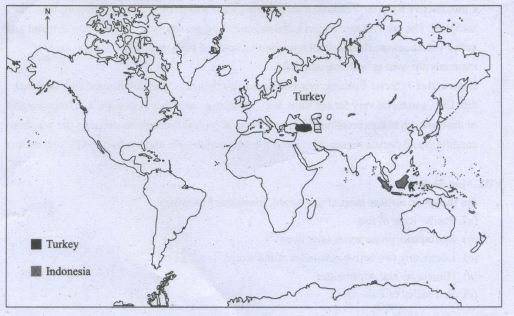
On the given outline map of the world, mark the following:
a. Pacific Ring of fire
b. Earthquake prone zones (any two)
c. Locate any two active volcanoes of the world.
d. Himalayas and Alps ranges
e. Rift valley of East Africa.
55.
Consider the following statements
Assertion (A): Child marriages should be avoided.
Reason (R): When girls get married early, they lose many privileges thereby affecting the society as a whole.
a) Both A and R are correct and R explains A
b) Both A and R are correct but R does not explain A
c) A is correct but R is false
d) A is false but R is correct
Both (A) and (R) are correct and (R) explains (A)
Both (A) and (R) are correct but (R) does not explain (A)
(A) is correct and (R) is false
(A) is false and (R) is correct.
56.
Consider the following statements.
Assertions (A): Rights and duties are the two sides of the same coin.
Reason (R): We have a right to freedom of religions. We have to promote harmony and the spirit of the people of other religions.
a) Both A and R are correct and R explains A
b) Both A and R are correct but R does not explain A
c) A is correct but R is false
d) A is false but R is correct
both A and R are correct and R explains A
both A and R are correct but R does not explain A
A is correct but R is false
A is false but R is correct
57.
Assertion (A): Assyrians of Mesopotamian civilisation were contemporaries of Indus civilisation.
Reason (R): The Documents of an Assyrian ruler refer to the ships from Meluha
(a) A and R are correct and A explains R
(b) A and R are correct but A doesn’t explain R
(c) A is incorrect but R is correct
(d) Both A and R are incorrect
A and R are correct and A explains R
A and R are correct but A doesn’t explain R
A is incorrect but R is correct
Both A and R are incorrect
58.
In Tamil Nadu, migrants account for ___________ percent in rural areas.
38
41
28
50
59.
Panchayats are constituted wherever the population of the village is
2000
200
500
1000
60.
In 2011, nearly __________ of the women were involved in agriculture
35%
55%
25%
45%
61.
According to GVK Rao Committee post of to___________ be created acting as the Chieft Executive Officer of the Zilla Parishad,
District Development Commissioner
Chairman of Panchayat Raj
Grama Munisif
Councillors
62.
A synoptic chart means ________
Weather map
Travelogue
Thematic map
General maps
63.
The percentage of people in a given population who can read and write a language refer to _____________
Infant mortality
Literacy rate
Sex ratio
Population density
64.
In 1898, Philippines became the colony of_______
England
America
Portugal
France
65.
Rudyard Kipling was a______
Ruler
Colonist
Writer
Soldier
66.
Zollverein Customs Union allowed for trade among _________
Countries
Colonies
provinces
people
67.
One among the following is not the first responder in case of a disaster.
police officers
firefighters
insurance agents
emergency medical technicians
68.
Who produced the first batch of automobiles in France?
Louis Renault
Armand Peugeot
Thomas Alva Edison
McAdam
69.
The pioneer of French Revolution who fought on the side of Washington against the British was ________
Mirabeau
Lafayette
Napoleon
Danton
70.
The poorer sections of the population migrate _____________
as a survival strategy
to improve their living standards
as a service
to get experience
71.
The North-East monsoon period in Tamilnadu
August – October
September – November
October – December
November – January
72.
The 'World Population Day' is observed on _____________ every year.
August 11th
September 11th
July 11th
January 11th
73.
The Roman Republic was governed by the ________
Plebeians
Patricians
Lawyers
Philosophers
74.
The Kakatiyas ruled from___________
Devagiri
Belur
Warangal
Bijapur
75.
A mathematical model of revolution of the earth was presented by
Galileo
Copernicus
Ptolemy
Euclid
76.
Abiotic components include
Non-living things
Living things
only plants
only animals
77.
Security Printing and Minting Corporation of India Ltd., was started in _________.
Mumbai
Dewas
78.
The theory of sacraments increased the power of the___________
Commoners
Emperor
Nobles
Clergy
79.
After conquering Egypt, the Ottomans assumed the title of___________
King
Caliph
Emperor
Raja
80.
Consider the following statements.
1. There are four major processes involved in the water cycle.
2. The ground water gets collected below the earth's surface
3. The Northern hemisphere holds 81% of land
4. The ocean floor is flat
1 and 2 are correct
2 and 3 are correct
2 is correct
2, 3 and 4 are correct
81.
Nutrients are recycled in the atmosphere with the help of certain microorganisms, referred to as
Producers
Decomposers
Consumers
None of the above
82.
Which among the following plants were introduced from America to Europe?
Sugarcane
Sweet Potato
Rice
Wheat
83.
____________was the Roman Governor responsible for the crucifixion of Jesus.
Innocent I
Hildebrand
Leo I
Pontius Pilate
84.
The enrolment for higher education in the highest in _______ in India.
Kerala
Tamil Nadu
West Bengal
Maharashtra
85.
The redness of the red clay soil is due to the presence of_______________
iron oxide
carbon
copper
magnesium
86.
This is one of the most feared weather phenomenon.
Snow
Hailstones
Sleet
Hails
87.
India is the_______________________ democracy in the world.
largest
smallest
strongest
None of the above
88.
This is the dominant form of government in the contemporary world.
Oligarchy
Monarchy
Theocracy
Democracy
89.
The discovery of _______ marked the beginning of the second phase in the history of civilisations.
Iron
Gold
Copper
Bronze
90.
The sixth deadliest natural disaster due to Tsunami caused in the year_____________.
1996
1998
2000
2004
91.
The presence of large quantities of ________________ in the core is responsible for the Earth's Gravitational force.
Aluminium
Magnesium
Iron
Silica
92.
________is an ornament made in precious stone where images are carved on the surface.
Cameo
Intaglio
Chronicle
Papyrus
93.
______ are stone artefacts of small size
Microliths
Bifaces
Acheulian
core
94.
The yellow river is known as the sorrow of _______ .
Egypt
Rome
China
Iraq
95.
Which one of the following sectors is the largest employer in India.
Primary Sector
Secondary Sector
Tertiary Sector
Public sector
96.
Inter-generational equality is ensured under the process of
Industrial progress
Economic development
Sustainable development
Economic growth
97.
The Election Commission of India is a / an
Independent body
Statutory body
Private body
Public corporation
98.
The meaning of Franchise is
Right to elect
Right to vote for the poor
Right to vote
Right to vote for the rich
99.
Tri-ratnas are the three principles taught by
Buddha
Mahavira
Lao-tze
Confucius
100.
The ______ pressure belt extends from 5°N and 5°S latitudes.
Equatorial low
Subtropical high
sub-polar low
polar high
101.
The Sri Lankan chronicle composed in the Pali language mentioning about merchants and horse traders from Tamil Nadu
Deepa vamsa
Arthasastra
Mahavamsa
Indica
102.
The disintegration or decomposition of rocks is generally called as
weathering
erosion
transportation
deposition
103.
What are the de-merits of federal form government?
104.
What is meant by Disaster Response?
105.
What are the merits of a federal government?
106.
What is labour force of the economy?
107.
Expand the following:
1. PPP
2. HDI
108.
What do you mean by development?
109.
Distinguish between two-party system and the multi-party system.
110.
Give Abraham Lincoln’s definition for democracy.
111.
Mention the rules to ensure Road Safety for children.
112.
How different factors contribute to road accidents?
113.
Write note the Parliamentary form of Government.
114.
Explain the concept of migration.
115.
Mention the Role of Ripon and Munroe in Madras Presidency.
116.
What are Farmer Producer Organisations (FPOs)?
117.
What are the colour codes used with map symbols.
118.
What are Urban Settlements? and explain its types.
119.
Explain the term 'Indentured Labour'.
120.
The Industrial Revolution began in England first. Why?
121.
State the results of the American war of Independence
122.
Highlight the contribution of Greece to World Civilization
123.
Write a note on the following:
Darasuram Temple
124.
Explain the term Renaissance.
125.
Explain the relationship between Money and Price.
126.
Democracy- Development - Fundamental Rights - establish a positive link among these three factors.
127.
Iron and Steel industries became highly organised in China - Prove.
128.
Explain the terms a) Continental Rise b) Oceanic ridge
129.
Explain about the aquatic biomes on Earth.
130.
Explain the origin of the river and its course.
131.
Describe sustainability of Development.
132.
The river channels in the lower course are wider than the upper course
133.
Give an account of Mobilisation and Democratic Participation.
134.
Though democracy in India has been appreciated worldwide for its working there is still a lot of scope for improvement - Discuss.
135.
Explain the teachings of Lao-Tse (Taoism).
136.
Give an account of 'Tsunami'
137.
Explain the "Archaeological sites".
138.
Domestication of Animals and plants. A milestone in Human History. Explain
139.
How did the Egyptians excel in art and architecture? Explain.
140.
Distinguish between the Public sector and the Private sector.
141.
Pacific ocean and Atlantic ocean
1.
| S.No. | Dictatorship | Monarchy |
|---|---|---|
| 1 | Dictatorship is an office that has been taken through force. | Monarchy is resign that passed from one generation to another. |
| 2 | A Dictatorship is termed as a government rule by one person or commands who is know as the Dictator. E.g. Uganda, Zimbawe, | Monarchy is the rule of the king or green as an emperor. E.g.Britan, Australia. |
2.
(i) The percentage of migrants was 37 percent in the country.
(ii) It was at a much higher rate in Tamil Nadu at 43 percent.
3.
Article 40 was incorporated in the Constitution, which read as: "the state should take steps to organise panchayats and endow them with such powers and authority as may be necessary to enable them to function as the units of self governments."
4.
(i) Small and marginal farmers in Tamil Nadu will be benefited from FPOs.
(ii) Each of the producers' groups have been given an investment grant of Rs. 5 lakh to purchase farm equipment.
(iii) Apart from using the equipment within the group, these can also be rented out to other farmers.
(iv) The government also has a contract farming policy.
5.
A cartographer is one who measures, analyzes and interprets geographical information to create maps and charts for political, cultural and educational purposes.
6.
(i) To conserve water do not dump in or around rivers. Clean up rivers that have a lot of trash in and around them.
(ii) Never dispose of cooking fats and oils by pouring them down the sink.
(iii) Turn off water while brushing teeth, washing, gardening and showering.
7.
(i) The colonial state pursued a policy of commercialisation of agriculture.
(ii) Commercial crops like cotton, jute, groundnuts, oilseeds, sugarcane, tobacco, etc., depending on the market demands fetched better prices than food grains.
(iii) In order to clear the debt the peasants began to raise crops for the markets, instead of home consumption.
8.
(i) After the Civil War, workers organized strikes in U.S.A. One major strike was the Great Railroad Strike of 1877.
(ii) Wage cuts in the railroad industry, in the context of a prolonged economic depression, led to the strike.
(iii) It began in West Virginia and spread to three additional states over a period of 45 days.
(iv) It was crushed by a combination of vigilantes, National Guardsmen, and Federal Army.
9.
(i) There was a struggle for power between the various groups, chiefly between the Girondins and the Jacobins.
(ii) The Convention, dominated by the Jacobins, appointed two committees the Committees of Public Welfare and Public Safety with wide powers.
(iii) In September 1793, the Convention passed the Law of Suspects, and under that law, after a month later twenty two Girondins were tried by the Revolutionary Tribunal and sentenced to death.
(iv) 'Reign of Terror' began with this incident.
10.
(i) The houses were tiny, dirty and sickly for the labouring class.
(ii) Workers had no time to clean or change their own atmosphere even if they wished to, led to the outbreak of typhoid, cholera and small pox.
11.
(i) The Zulu tribe was known for its strong fighting spirit.
(ii) They were represented by renowned warriors like Shaka Zulu.
(iii) Shaka Zulu played a prominent role in building the largest Zulu nation in South-Eastern Africa.
(iv) British troops invaded Zulu territory and divided it into thirteen chiefdoms.
(v) The Zulus never regained their independence and they had to fight against deeply entrenched racism in South Africa for about a century.
12.
Components of remote sensing are
(i) Energy source
(ii) Transmission path
(iii) Target
(iv) Sensor
13.
The village panchayats levy the following taxes such as, Property tax, Professional tax, House tax, Taxes on connecting drinking water, Land tax and Taxes levied on shops.
14.
(i) Many people move to urban areas primarily because cities promise more jobs better schools for poor's children and diverse income opportunities than subsistence farming in rural areas.
(ii) Urbanization drives economic growth and causes people to seek working and investment opportunities in urban areas.
(iii) Local governments are unable to manage urbanisation and migrant workers without an affordable place to live in, dwell in slums.
(iv) The UN-Habitat reports that 43% of urban population in developing countries and 78% of those in the least developed countries are slum dwellers.
(v) Lack of affordable low cost housing and poor planning encourages the supply side of slums.
(vi) Some of the slums in today's world are a product of urbanisation brought by colonialism.
(vii) Urban poverty, encourages the formation and demand for slums.
(viii) Major natural disasters in poor nations often lead to migration of disaster affected from their to unaffiliated areas, the creation of temporary tent cities and slums.
15.
The crop cultivation depends on the amount of land being cultivated, productivity of crops, source of water weather, rainfall etc.
16.
(i) Patricians were Aristocrats in the Roman Society. Senators and Consuls protected the interests of Patricians.
(ii) Plebeians were chronically in debt and had to eventually lose their land to the Patricians.
17.
(i) Under Alexander the Great, the Greeks were able to establish a kingdom in Macedonia.
(ii) This kingdom succeeded in annexing two historic empires of Egypt and the Middle East.
(iii) But the entire period of Alexander's reign was spent on wars.
(iv) The Greek school of Science, Mathematics and Philosophy reached its peak in the Greek-Egyptian city of Alexandria.
18.
(i) Socrates was a great thinker of the Pericles Era.
(ii) The Athenian government, after Pericles, did not like Socrates' way of finding truth.
(iii) He was accused of corrupting the youth.
(iv) The jury found Socrates guilty and sentenced him to die by drinking hemlock (a poison).
19.
(i) The nobles in England forced King John to sign a Charter of Liberty in 1215 A.D. It is Magna Carta or the Great Charter.
(ii) This Charter contained a promise that the king would respect certain liberties of the nobles and the people of England.
(iii) The theory of the supremacy of the ruler which prevailed in the Holy Roman Empire was not accepted in England.
(iv) King John of England was a contemporary of Sultan Iltutmish in India.
20.
(i) He reversed the policy of discriminatory measures against the Hindus.
(ii) He employed Hindu administrators like Todar Mal in key positions of authority.
(iii) These initiatives earned the emperor the loyalty and trust of the majority community.
(iv) The entire region was brought under a uniform administrative structure.
(v) The political stability increased the economy and trade
21.
This acted as a catalyst for the birth of Renaissance. It also led to the discovery of new land routes.
22.
(i) The Mughal rule started in 1526 A.D.
(ii) Vijayanagar state, founded in 1336, rose to a great power under Krishnadeva Raya.
(iii) Portuguese established their empire in the East with headquarters at Goa.
(iv) In Tamilnadu, in Madurai, Nayak rule began dividing the Pandya kingdom into seventy two palayams.
(v) The arrival of Jesuit Missions and the work of St. Francis Xavier, as a member of Society of Jesus, led to conversion of fishing community to Christianity (Catholicism) in Thoothukudi region.
23.
An ecological region that has lost more than 70% of its original habitat is considered a hotspot.
24.
A major portion of the savings in banks are used for the development of industries, economic growth and various development schemes for the welfare of the poor
25.
(i) SHRC refers State Human Rights Commission.
(ii) Every state in India has a State Human Rights Commission established in accordance with the power conferred on the state under section 21 of the Protection of Human Rights Act, 1993.
(iii) The protection and promotion of human rights constitute the principal concern of the Commission.
26.
(a) Water table is a level below the ground, where water is found collected beneath the Earth's surface.
(b) Aquifers are porous rock strata filled with water, found below the earth's surface.
27.
(i) It is against the law to employ children below 14 years of age in mines, factories or other occupations.
(ii) Neither contractor nor an employer can force a worker to do a job against their will.
28.
(i) The metals such as silver and gold gained importance gradually all over the world.
(ii) So, these metals were used as standard value in the exchange of goods.
(iii) This was called as natural money
29.
(i) Terrestrial biomes is a group of living organisms that live and interact with one another on land.
(ii) They are mainly determined by temperature and rainfall.
(iii) Some of the major terrestrial biomes of the world are
a. Tropical Forest Biomes
b. Tropical Savanna Biomes
c. Desert Biomes
d. Temperate Grassland Biomes and
e. Tundra Biomes
30.
(i) Of all the movements of the oceans, sea waves are considered to be the strongest.
(ii) Sea waves are ripples on water caused when winds blow over the sea.
(iii) The height of these waves depends on the speed of wind, its duration and the direction from which they blow.
(iv) Sometimes waves are also caused by tremors felt on the ocean floor.
(v) Such waves are quite destructive and called Tsunami
31.
The factors that generate ocean currents are:
(i) Earth's rotation
(ii) Prevailing winds and
(iii) Differences in temperature and salinity of ocean water
32.
(i) Crusades ended the feudal relations.
(ii) Many of the nobles who went to East to take part in the Crusades either stayed too long a period or did not return.
(iii) The serfs took advantage of their absence to break away from their bondage to the soil.
(iv) Increasing demand for products of the east led to expansion of trade.
(v) Venice, Genoa, and Pisa emerged as important commercial centres in the mediterranean region.
(vi) Constantinople ceased to be the middleman in the trade between the East and the West.
(vii) The elimination of powerful nobles had its influence in strengthening the monarchy in France and England. One notable outcome of Crusades was the loss of prestige suffered by Pope and Papacy.
33.
The Ring of Fire is a ring of volcanoes around the Pacific Ocean. These volcanoes result from subduction of oceanic plates beneath lighter continental plates, A subduction zone is a place where one plate of oceanic lithosphere is shoved under another plate. As it is shoved into the hotter mantle the plate heats up. The addition of volatiles such as water to the hot overlying mantle causes partial melting and the production of magma. This magma rises up through the over-lying plate to erupt at the surface. Hence, the Pacific Ring of Fire is most seismically and volcanically active.
34.
Due to the river action, cylindrical holes are drilled vertically in the river bed with varying depth and diametre.
35.
Since the countries have different populations comparing total income will not be suggestive of what an average person is likely to earn. So, for comparing the development of various countries total income is not an useful measure.
36.
(i) Coastal zone is exposed to natural forces including cyclones and Tsunamis.
(ii) Cuddalore and Nagapattinam are situated on the Sea-Shore.
(iii) Cuddalore and Nagapattinam are vulnerable to storms.
(iv) During Summer Bay of Bengal subject to intense heat cause to raise the humid and unstable air masses that produce cyclone.
37.
Structure of employment denotes number of workers engaged in different sectors of the economy.
38.
The pressure groups in India can be broadly classified into the following categories:
1. Business groups
2. Trade unions
3. Agrarian groups
4. Professional associations
5. Student organisations
6. Religious organisations
7. Tribal organisations
8. Linguistic groups
9. Ideology-based groups
10. Environmental protection groups.
39.
A state in which supreme power is held by the people and their elected representatives and which has an elected (or) nominated President rather than a Monarch.
e.g., India, Australia.
40.
(i) Mahapadma Nanda founded the Nanda dynasty.
(ii) The Nandas were the first of non-Kshatriya dynasties to rule in North India.
(iii) Nandas gave importance to irrigation with the canals, they built touching even the Kalinga kingdom.
41.
The Hydrosphere is the watery part of the Earth's surface including oceans, rivers, lakes and water vapour.
42.
The third section of Tholkappiyam describes poetic conventions that provide information on Tamil social life.
43.
(i) The Great Rift valley in Africa has many sites that have evidence for the prehistoric period.
(ii) The Great Rift valley is a valley-like formation that runs for about 6,400 km from the Northern part of Syria to Central Mozambique in East Africa.
(iii) This geographical feature is visible even from the space, and many prehistoric sites are found in Africa
44.
(i) The invention of the potter's wheel is credited to the Sumerians.
(ii) They developed the calendar system of 360 days and divided a circle into 360 units.
(iii) The Cuneiform system of writing was their contribution.
(iv) The Hammurabi's law code was another legacy of the Mesopotamians.
45.
The three principles of Jainism are known as Tri-ratnas. They are Right faith, Right knowledge, Right action.
46.
(i) Tamil country had connections with countries overseas both in the east and west.
(ii) Roman ships used monsoon winds to cross the Western Sea or the Arabian Sea to connect Tamilagam with the Western world.
(iii) Spices including pepper, ivory, and precious stones were exported.
(iv) Metal including gold, silver and copper and precious stones were imported.
47.
Flat surface found at the foot of the sea cliffs are called as wave cut platforms, wave cut platform is also referred as beach, shelf, terrace and plain.
48.
Moraine:
(i) Landforms formed by the glacial deposits of valley (or) continental glaciers are termed as moraines.
(ii) They are of various shapes and sizes, like ground, terminal and lateral moraines, etc.
Drumlin: Drumlins are deposits of glacial moraines that resemble giant inverted teaspoons (or) half cut eggs.
Esker: Long narrow ridges composed of boulders gravel and sand deposited by streams of melting water which run parallel to a glacier are called eskers.
49.
These are valleys eroded by tributary glacier and that hangs over the main valley
50.
(i) Hammurabi Code is an important legal document that specifies the laws related to various crimes.
(ii) It has 282 provisions specifying cases related to family rights, trade, slavery, taxes and wages.
(iii) It is carved on a stone, which portrays Hammurabi as receiving the code from the Sun god Shamash.
(iv) It was a compilation of old laws based on retributive principles.
(v) The 'eye for eye' and 'tooth for tooth' form of justice is used in the Hammurabi Code.
51.
1. In the course of evolution, humans became conscious and knowledgeable.
2. They turned curious and began to think and ask questions.
3. At first, they considered nature as God.
4. They worshipped sun, moon and various natural forces about which they developed their own understanding.
52.

53.
a)
b)
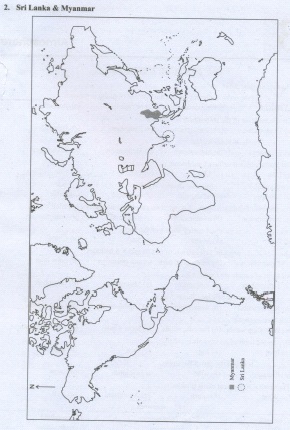
54.
a) Pacific Ring of fire: It is a major area and an arc in the basin of the Pacific ocean where many earthquakes and volcanic eruptions occur.
(b) Earthquake-prone zones (any two): Turkey, Indonesia
(c) Locate any two active volcanoes of the world: Hawaii, Mount Fuji
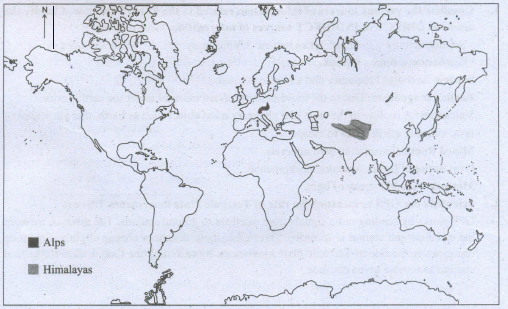
(d) Himalayas and Alps ranges
55.
a) Both A and R are correct and R explains A
56.
a) Both A and R are correct and R explains A
57.
(d) Both A and R are incorrect
58.
(b)
41
59.
(c)
500
60.
(b)
55%
61.
(a)
District Development Commissioner
62.
(a)
Weather map
63.
(b)
Literacy rate
64.
(b)
America
65.
(c)
Writer
66.
(c)
provinces
67.
(c)
insurance agents
68.
(b)
Armand Peugeot
69.
(b)
Lafayette
70.
(a)
as a survival strategy
71.
(c)
October – December
72.
(c)
July 11th
73.
(b)
Patricians
74.
(c)
Warangal
75.
(b)
Copernicus
76.
(a)
Non-living things
77.
(b)
Dewas
78.
(d)
Clergy
79.
(b)
Caliph
80.
(c)
2 is correct
81.
(d)
None of the above
82.
(b)
Sweet Potato
83.
(d)
Pontius Pilate
84.
(b)
Tamil Nadu
85.
(a)
iron oxide
86.
(b)
Hailstones
87.
(a)
largest
88.
(d)
Democracy
89.
(a)
Iron
90.
(d)
2004
91.
(c)
Iron
92.
(a)
Cameo
93.
(a)
Microliths
94.
(c)
China
95.
(a)
Primary Sector
96.
(d)
Economic growth
97.
(a)
Independent body
98.
(c)
Right to vote
99.
(b)
Mahavira
100.
(a)
Equatorial low
101.
(c)
Mahavamsa
102.
(a)
weathering
103.
De-merits of federal form of government are,
(a) Federal government in weaker when compared to the unitary government.
(b) Federal government is more expensive.
(c) Provincial tendencies are very common
(d) Lack of uniformity in Administration
(e) Threat to national unity
(f) Distribution powers between centre and states lead to conflict
(g) Double Citizenship
(h) Rigid constitution cannot be amended easily for the changing needs.
(I) The state governments sometimes place hindrances in the foreign policy.
104.
(i) Disaster response entails restoring physical facilities, rehabilitation of affected populations, restoration of lost livelihoods and reconstruction efforts to restore the infrastructure lost or damaged
(ii) The Response Phase focuses primarily on emergency relief: saving lives, providing first aid, restoring damaged systems (communications and transportation), meeting the basic life requirements of those impacted by disaster (food, water, and shelter), and providing mental health and spiritual support and care.
105.
The merits of federal government are
(a) Reconciliation of local autonomy with national unity.
(b) Division of power between centre and states leads to administrative efficiency.
(c) It gives rise to big states.
(d) Distribution of powers checks the despotism of central government.
(e) More suitable for bigger countries
(f) It is good for economic and cultural progress.
106.
(i) Labour force of the economy is the number of people in the country who work and are also capable of working.
(ii) We take the age group of 15-60 years for the computation of workforce.
107.
(i) PPP - Purchasing Power Parity
(ii) HDI - Human Development Index.
108.
(i) Development refers to the progress of a particular field or a particular person.
(ii) The economic progress of a country is known as economic development.
(iii) Development refers to the improvement in quality of life such as higher income, better education, better health and nutrition less poverty and more equal opportunity.
109.
| Two party system | Multi-party system |
|---|---|
| Two party system in which only two major parties exist, for example, USA, UK. | Multi-party system in which there are more than two political parties, for example India, Sri Lanka, France and Italy. |
110.
Abraham Lincoln defines democracy as a government of the people, by the people and for the people
111.
Rules to Ensure Road Safety for chlldren
It is impportant for children to know about road safety rules and regulatioins. Here are a few
basic road safety rules for children.
i) Know Your Signals
ii) Stop, Look and Cross
iii) Pay Attention - Listen
iv) Don't Run on Roads
v) Always Use Sidewalks
vi) Never Stick Hands outside the Vehicle
vii) Never cross Road at Bends
viii) Don't Rush.
112.
The different factors contribute to road accident are,
i) Drivers: Over speeding, rash driving, violation of rules, failure to understand signs, fatigue, alcohol.
ii) Pedestrians: Carelessness, illiteracy, crossing at wrong places, jaywalkers.
iii) Passengers: Projecting their body parts outside vehicles, talking to drivers, alighting and boarding vehicles from the wrong side, travelling on footboards, catching a running bus etc.,
iv) Vehicles: Failure of brakes or steering, tyre burst, insufficient headlights, overloading.
v) Road Conditions: Potholes, damaged roads, eroded roads merging of rural roads with highways and illegal speed breakers.
vi) Weather conditions: Fog, snow, heavy rainfall, wind storms, hail storms.
113.
Parliamentary form of Government
(i) The parliamentary system of government is the one in which the executive is responsible to the legislature for its policies and acts.
(ii) It is also known as cabinet government or responsible government or Westminster model of government and is prevalent in Britain, Japan, Canada, India among others.
Features of Parliamentary form of government
(i) Nominal and Real Executives.
(ii) Majority Party Rule
(iii) Collective Responsibility
(iv) Double Membership
(v) Leadership of the Prime Minister
Merill of the parliamentary form of government
(i) Harmony between Legislature and Executive.
(ii) Responsible Government
(iii) Prevents Dictatorship.
(iv) Wide Representation.
Demerits of the parliamentary form of government
(i) Unstable Government.
(ii) No Continuity of Policies.
(iii) Dictatorship of the Cabinet.
(iv) Against Separation of Powers.
114.
(i) In any settlement-village or town change in population occurs due to birth, death and migration.
(ii) Of these three components of population change, birth and death is clearly identifiable events while migration poses the maximum amount of problem with regards to its definition and measurement.
(iii) As almost everyone keeps moving most of the time, it is not easy to define which of these moves have to be classified as migratory moves.
(iv) In the Census of lndia, migration is enumerated on two bases - Place of birth and Place of residence.
115.
a) Ripon
(i) Lord Ripon was the one who introduced the Local Self Government in 1882.
(ii) He was advocating for the decentralization of administration.
(iii) He tried to remove obstacles in the sphere of Local Self government by his resolution of 1882.
(iv) Under him a large number of Tahsildars had quasi - judicial powers in their sub - districts, along with revenue collection.
b) Munroe
(i) He was all for administration in the local language.
(ii) He was against the practice of appointing to administrative posts and the judiciary those who were not fluent with the local lexicon (language).
(iii) He felt that Indians ought to be allowed to dispense justice by themselves.
116.
(i) In April 2013, the Government of India issued a National Policy and Process Guidelines on formation of FPOs.
(ii) The year 2014 was observed as the "Year of Farmer Producer Organisations" by the Government of India.
(iii) Its main idea of promoting and strengthening member based institutions of farmers.
(iv) It aimed at engaging the farmer companies to procure agricultural products and sell them.
(v) Supply of inputs such as seed, fertilizer and machinery, market linkages, training & networking and financial and technical advice are also among the major activities of FPO.
117.
(i) Brown: land or earth features - contour lines, eroded areas, prominent rock outcrops, sand areas and dunes, secondary or gravel roads
(ii) Light Blue: water features - canals, coastlines, dams, lakes, marshes, swamps and levees, ponds, rivers and water towers.
(iii) Dark Blue: national waterways
(iv) Green: vegetation features - cultivated fields, golf courses, nature and game reserve boundaries, orchards and vineyards, recreation grounds, woodland
(v) Black: construction features - roads, tracks, railways, buildings, bridges, cemeteries, communication towers, dam walls, excavations and mine dumps, telephone lines, power lines, windpumps, boundaries
(vi) Red: construction features - national, arterial and main roads, lighthouses and marine lights
(vii) Pink: international boundaries
118.
(i) Urban is the term related to cities and towns where people are primarily engaged in non-agricultural activities.
(ii) The factors responsible for urbanization are better employment opportunities, suitable conditions for business, education, transport, etc.
(iii) Urban centres are classified as towns, cities, metropolitan cities, mega cities, conurbation, etc., depending on the size and services available and functions rendered to it.
(a) Town: A town is generally larger than a village, but smaller than a city. It has a population of less than 1 lakh. E.g: Arakkonam.
(b) City: Cities are much larger than towns and have a greater number of economic functions. The population in cities are estimated to be more than 1 lakh. E.g: Coimbatore
(c) Metropolitan Cities: Cities accommodating population between 10 lakhs and 50 lakhs are metropolitan cities. E.g: Madurai
(d) Mega cities: Cities with more than 50 lakh population are called Megacities. E.g: Chennai
(e) Conurbation: A conurbation is a region comprising of a number of cities, large towns and other urban areas. E.g: Delhi
119.
(i) The Indentured Labour System was a form of debt bondage.
(ii) By this system 3.5 million Indians were transported to various British colonies to provide labour for the plantations (mainly sugar).
(iii) It started from 1843, the year of abolition of slavery in India and continued until 1920.
(iv) This resulted in the development of a large Indian diaspora, which spread from the Indian Ocean (Reunion and Mauritius) to the Pacific Ocean (Fiji), as well as contributing to the growth of Indo-Caribbean and Indo-African population.
(v) The Indenture system was a penal contract system.
(vi) The contract made punishable the refusal of an indentured labourer to work or his abstention from work, or his defiance of the orders of his master or absconding.
120.
The Industrial Revolution began in England first because, it had certain objective conditions. They were:
(i) England had abundant resources and possessed colonies, with India being "the brightest jewel in the British Crown".
(ii) Access to coal, iron and raw cotton from the colonies.
(iii) England possessed the required infrastructure for textiles, developed by immigrant artisans from the Netherlands.
(iv) England had a developed banking system, a growing entrepreneurial class, and potential investors.
(v) Encouragement of the Royal Society of England for scientific discoveries and inventions.
(vi) Political stability of England to bestow its full attention to industrial growth.
121.
(i) For the first time a colonial power was overthrown by the colonies, leading to the establishment of a republican government in the United States.
(ii) The Declaration of Independence of 1776 stated that, "all men are born equal." But in reality America had to fight a bitter civil war in the succeeding century to abolish slavery.
(iii) By 1777 nearly all the colonies had a written constitution. These constitutions protected individual rights, freedom of press and freedom of religion. The church and the state were separated
(iv) The intellectuals of the time believed that the republican state was the only political structure in which individuals could preserve their basic freedom including property and political rights.
(v) The conception of people's right to a government of their choice encouraged the Latin American revolutionaries to strive for the overthrow of the Spanish empire in South America.
(vi) Mirabeau quoted the Declaration of Independence with enthusiasm during the French Revolution.
(vii) Lafayette, who fought the British on Washington's side through to the conclusive battle at Yorktown in 1781, later during the French Revolution served the French National Guard as its Commander
122.
(i) The ancient Greeks created the world's first democracy. Athens started on with a monarchy and then advanced to an oligarchy until it finally reached a democracy.
(ii) The Greek Alphabet was the first alphabet in the western sense of the word, featuring distinct letters for vowels and consonants.
(iii) The first library in the world, the library of Alexandria was actually built in Egypt.
(iv) The Olympic games started in ancient Greece specially in the city of Olympia.
(v) Science and Mathematics - Eratosthenes was the first mathematician to calculate the circumference of the Earth. Aristarchus, Archimedes and Hipparchus were great mathematicians and scientists.
(vi) One of the common examples of Greek Architecture in the modern world is the Column or Pillar.
(vii) Greek mythology has pervaded nearly every form of popular culture imaginable. Many Greek myths have been adapted into modern novels, movies, TV, shows etc.
(viii) The first lighthouse in the world was located in the Greek controlled Egyptian Kingdom of Alexandria.
(ix) The democratic people of ancient Greece, especially Athens, were the first to employ trial by jury as we know it today.
123.
Darasuram Temple:
(i) Darasuram is a Panchayat town, located 3 kilometres from Kumbakonam in Thanjavur District, Tamil Nadu.
(ii) The town is known for the Airavateswara Temple constructed by Raja Raja Chola II in the 12th century A.D.
(iii) The temple is recognised as a UNESCO World Heritage Monument.
(iv) Darasuram Temple is a storehouse of art and architecture.
(v) The vimana is 85 feet high.
(vi) With heavily ornamented pillars accurate in detail and richly sculpted walls, the Airavateswara at Darasuram is a classic example of Chola art and architecture
124.
(i) The Italian city-states were centres of cultural activities since the fourteenth century.
(ii) With the coming of the scholars and artists from Constantinople, there was a surge of enthusiasm and interest in studying classical literature and art of Greeks and Romans.
(iii) This creative upsurge was reflected in their writings, art, architecture and music.
(iv) This cultural florescence is known as the renaissance.
(v) The origin of the word renaissance is from the Italian word 'renascita' meaning rebirth.
(vi) It is called renaissance because there was a rebirth or revival of classical Greek and Latin literature.
(vii) Many scholars in Italy went in search of manuscripts of classical literature.
(viii) Greek scholar Manuel Chrysoloras who taught Greek classics in Italy, Guarino and Giovanni Aurispa, to name just a few, visited Constantinople several times to collect Greek manuscripts.
(ix) Later they printed what they collected.
(x) This provided stimulus to the flowering of renaissance.
125.
(i) The relationship between money and price is connected with the Monetary policy.
(ii) There is a close relationship between the growth of money supply and inflation.
(iii) Price controls play a very important role in a country's economic stability.
(iv) This role is played by RBI.
(v) Currency is the medium of exchange in a country.
(vi) The Indian currency is called the Indian Rupee (INR).
(vii) In a country the foreign currency is called foreign exchange.
(viii) Purchasing capacity of all currencies in the world are compared using the US dollar as the standard currency.
(ix) This value differs from country to country.
(x) Most of the international trade transactions are carried out in US dollar
126.
(i) Democracy has an important role to play in promoting sustainable development.
(ii) Free and fair elections, independent media, accountable government as well as other basic democratic principles are all critical components of an environment conducive to growth.
(iii) In a direct democracy the people decide on the policy initiatives directly.
(iv) Democracy is very much responsible and important over the development of a nation.
(v) In a democratic country the citizens are forced to express their views and opinions on decisions taken by government.
(vi) This makes the government take more responsible decisions and they go with majority people.
(vii) All these actions can be carried on with the help of the fundamental rights generated by the constitution of India with legal background.
127.
(i) Iron and Steel industries became highly organised.
(ii) The quantity of iron China produced in 1078 A.D. exceeded 114,000 tons (England produced only 68,000 tons even in 1788).
(iii) China excelled in ceramics and porcelain-making.
(iv) This technique was not known to Europe for another 700 years.
(v) Gunpowder was in use by 1044.
128.
a) Continental Rise
(i) At the base of the continental slope is a gently sloping layer of sediments which merge into the deep-sea floor.
(ii) This underwater feature found between continental slope and abyssal plains is called the continental rise.
(iii) It consists of submarine fans which are similar to the alluvial fans found on land.
b) Oceanic Ridge
(i) Oceanic ridge is a continuous submarine mountain chain.
(ii) They are made of young basaltic rock formed when two tectonic plates move apart.
(iii) The mid-ocean ridge is probably the most extensive single feature of the earth's topography.
(iv) Two of the most well known mid-ocean ridges are the Mid-Atlantic Ridge and the East Pacific Ridge.
(v) The Mid-Atlantic Ridge is the largest unbroken oceanic ridge.
129.
Aquatic biome is a group of living organisms that live and interact with one another and its aquatic environment for nutrients and shelter. It is broadly classified as fresh water biomes and marine biomes.
A. Fresh water Biomes:
(i) Fresh water biomes comprises lakes, ponds, rivers, streams, wetlands etc.
(ii) It is influenced by various abiotic components such as the volume of water, water flow, composition of oxygen, temperature, etc.
(iii) Humans rely on freshwater biomes for drinking water, crop irrigation, sanitation and industry.
(iv) Water lily, lotus, duckweeds etc. are the common plants found here.
(v) Trout, salmon, turtles, crocodiles etc. are the animals found here.
B. Marine Biomes:
(i) They are the largest aquatic biomes on earth.
(ii) They are continuous bodies of salt water and provide a wide range of habitats for marine plants and animals.
(ii) Coral reefs are a second kind of marine biomes within the ocean.
(iv) Estuaries, coastal areas where salt water and fresh water mix, form a third unique marine biome.
(v) As water provides maximum mobility to marine organisms, nutrients are circulated more quickly and efficiently here than the terrestrial biomes.
(vi) Apart from animals, plants such as kelp, algae, phytoplankton etc. also grow in water.
(vii) Some of the threats and issues to aquatic biomes are overfishing, pollution and rise in sea level.
130.
Rivers generally originate from mountains and end in a sea or lake. The whole path that a river
flows through is called its course. The course of a river is divided into:
(i) The upper course
(ii) The middle course and
(iii) The lower course
(i) The Upper Course: Erosion is the most dominant action of river in the upper course. In this course, a river usually tumbles down the steep mountain slopes. The steep gradient increases the velocity and the river channel performs erosion with great force to widen and deepen its valley; The land features carved by a river in its upper course are V-shaped valleys, gorges, canyons, rapids, potholes, spurs, and waterfalls.
(ii) The Middle Course: The river enters the plain in its middle course. The volume of water increases with the confluence of many tributaries and thus increases the load of the river. Thus, the predominant action of a river is transportation. Deposition also occurs due to the sudden decrease in velocity. The river in the middle course develops some typical landforms like alluvial fans, flood plains, meanders, ox-bow lakes etc.,
(iii) The Lower course: The river, moving downstream across a broad, level plain is loaded with debris, brought down from its upper and middle courses. Large deposits of sediments are found at the level bed and the river, splits into a number of channels called distributaries. The main work of the river here is deposition and it develops typical landforms like delta and estuary.
131.
Sustainable economic development is taken to mean development without damaging the environment and not compromising with the needs of the future generation. The consequences of environmental degradation do not respect national or state boundaries. Sustainability of development is comparatively a new area of knowledge in which scientists, economists, philosophers and other social scientists are working together. Natural resources can be divided into renewable resources and non-renewable resources. Groundwater is an example of a renewable resource. The question arises as to how sustainable development is possible if the resources are over-used rather than getting replenished. Nonrenewable resources get exhausted after certain number of years of extracting and using them and they cannot be replenished. To achieve real sustainability, we need to balance economic, social and environmental sustainability in equal harmony. In general, the question of development or progress is continuous. At all times, as a member of society and as individuals, we need to ask where we want to go, what we wish to become and what our goals are.
132.
(i) The river channels of the upper course has more energy gradient then the channels of lower course.
(ii) As the river flows in the lower course it corrodes sideways and makes it wider.
133.
Mobilising people towards socially productive activities that lead to the overall betterment of people's lives is essential. Sometimes earthquakes, tsunamis, floods and other such natural disasters on a massive scale occur and people's immediate mobilisation for evacuation and emergency relief becomes most essential.
Democratic Participation: Democracy can succeed only when smaller local groups and, in fact, every citizen can take action that supports the tax and revenue collection systems, observance of national norms in environmental protection, cleanliness, health and hygiene, sanitary drives and immunisation programmes like pulse polio. However, we must keep in mind that there is no better form of government than Democratic government. To create a better society and nation, the people of India along with the union and state governments should come together to fight against the miseries of human life.
134.
Though democracy in India has been appreciated worldwide for its working, there is still a lot of scope for improvement. The above-mentioned steps must be taken to ensure smooth functioning of democracy in the country.
Indian democracy can be successful and vibrant only when its citizens imbibe and reflect in their behavior the basic democratic values like equality, freedom, social justice, accountability and respect for all. Their mindset, thinking and behavior are expected to be in tune with the essential conditions of democracy. They have to appreciate the opportunities for their desired roles like participation, making the system accountable, fulfilling obligations, and playing proactive roles to actualize the goals of democracy.
135.
(i) The cause of human unhappiness in the world is human selfishness. Selfishness creates unlimited human desires, which can never be satisfied.
(ii) In nature, all the things act in a natural way. The law of human conduct must correspond with nature.
(iii) Humans live a life under the regulation of someone. This is because they have acquired knowledge and have not remained innocent. On the basis of their acquired knowledge, they have built up an urban civilisation and have made themselves unhappy.
136.
The word 'Tsunami' is a Japanese term, meaning harbour waves. It is adapted to describe large seismically generated sea waves caused by Earthquakes, submarine explosions and landslides. These waves travel at a great speed (more than 500 km per hour) and the length of the waves exceeds 600 km. These waves reach to a height of more than 15 m near the sea shore and are capable of causing destruction along the coastal area.
The 2004 Indian Ocean Earthquake that caused tsunami is the sixth-deadliest natural disaster which travelled at a speed of 6.00 km per hour with an estimated death toll of 2,80,000. The Earthquake which occurred near Indonesia at 00.58 hours took nearly 7 hours to reach Chennai.
137.
(i) Archaeological excavation refers to systematically digging a site to recover material evidence for exploring and interpreting societies of the past.
(ii) Archaeological excavations at the early historic sites are the source of evidence of the activities of the Sangam Age people.
(iii) Excavations at Arikkamedu, Azhagankulam, Uraiyur, Kanchipuram, Kaveripoompattinam, Korkai, Vasavasamudram, Keezhadi, Kodumanal in Tamil Nadu, and. Pattanam in Kerala provide the evidence we have of this period.
(iv) Arikkamedu, near Puducherry, is a Sangam Age port, excavated by the Archaeological Survey of India (ASI). British archaeologist, Robert Eric Mortimer Wheeler, French Archaeologist, J.M. Casal, and Indian archaeologists, A. Ghosh and Krishna Deva, excavated this site. They found evidence of a planned town, warehouse, streets, tanks and ring wells.
138.
(i) Rice was probably cultivated in India and China around 7000 BCE or even earlier.
(ii) Wheat and barley were cultivated at Mehrgarh in northwestern part of the Indian subcontinent (Pakistan) before 6000 BCE.
(iii) Animal domestication developed as part of symbiotic life.
(iv) Dogs may have been domesticated first. Friendly animals were gradually domesticated. Sheep and goat were domesticated around 10,000 BCE in Southwest Asia.
(v) Oxen were used in Sumerian civilisation for tilling the land. Mehrgarh in Pakistan has evidence of sheep, goat and cattle domestication in the Neolithic period.
139.
(i) The Egyptians excelled in art and architecture. Their writing is also a form of art.
(ii) Numerous sculptures, painting and carvings attest to the artistic skills of Egyptians.
(iii) The pyramids are massive monuments built as tombs of mourning to the Pharaohs.
(iv) The great pyramids near Cairo are known as the Giza Pyramids.
(v) Pyramids are considered to be one of the wonders of the world, and they were built between 2575 and 2465 BCE.
(vi) These monuments display the engineering, architectural and human resource management skills of the Egyptians.
(vii) The Great Sphinx of Giza is a massive limestone image of a lion with a human head.
(viii) It is dated to the time of Pharaoh Khafre. It is one of the largest sculptures of the world and measures seventy three metres in length and twenty metres in height.
140.
| S.No | Public Sector | Private Sector |
| 1 | Service motive | Profit motive |
| 2 | Government owns the assets | Private individuals own the assets |
| 3 | Wages are paid by the government | Wages are paid by the owner of private enterprises. |
| 4. | NIC, SAIL, BSNL. | TVS motors, Ashok Leyland, TATA Steel. |
141.
| S. No. | Pacific ocean | Atlantic ocean |
| (i) | Pacific ocean is spread between the western coast of America to the far east coast (China) | Atlantic ocean is spread between Europe and eastern coast of America |
| (ii) | It has less sea traffic | It has served as an important sea route for trade in the earlier countries and has contributed to the discovery of America |
| (iii) | It is larger in Size | It has stronger ocean currents |
| (iv) | Deepest point - Mariana Trench (10,924 m) | Deepest point - Puerto Rico Trench (8,605 m) |

9th Standard Syllabus & Materials
9th Standard
TN 9th Tamil உள்ளத்தின் சீர் - திருக்குறள் Important Questions And Answers Study Material - QB365 Set A
NEW9th Standard
TN 9th Tamil உள்ளத்தின் சீர் - மணிமேகலை Important Questions And Answers Study Material - QB365 Set A
NEW9th Standard
TN 9th Tamil உள்ளத்தின் சீர் - ஏறு தழுவுதல் Important Questions And Answers Study Material - QB365 Set A
NEW9th Standard
TN 9th Tamil உயிருக்கு வேர் - தண்ணீர் Important Questions And Answers Study Material - QB365 Set A



Tamilnadu Stateboard 9th Standard Subjects
Tamilnadu Stateboard Standards




