
 100% FREE ACCESS
9th Standard Syllabus & Materials
9th Standard
TN 9th Tamil உள்ளத்தின் சீர் -கற்கண்டு (இலக்கணம்) - தொடர் இலக்கணம், ஆகுபெயர் Important Questions And Answers Study Material - QB365 Set A
NEW9th Standard
TN 9th Tamil உள்ளத்தின் சீர் -விரிவானம் (துணைப்பாடம்) - தாய்மைக்கு வறட்சி இல்லை! Important Questions And Answers Study Material - QB365 Set A
NEW9th Standard
TN 9th Tamil உள்ளத்தின் சீர் -கவிதை பேழை (செய்யுள்) - மார்கழி பெருவிழா Important Questions And Answers Study Material - QB365 Set A
NEW9th Standard
TN 9th Tamil உயிருக்கு வேர்-இலக்கணம் - பகுபத உறுப்பிலக்கணம் Important Questions And Answers Study Material - QB365 Set A
NEW9th Standard
TN 9th Tamil அமுதென்று பேர் - இலக்கணம்-எழுத்து -அளபெடை Important Questions And Answers Study Material - QB365 Set A
NEW9th Standard
TN 9th Tamil அமுதென்று பேர்-துணைப்பாடம் - ஆறாம்திணை Important Questions And Answers Study Material - QB365 Set A

Published on: 12/02/2020
9th Standard Social science Important Question model
Download Tamil Nadu 9th Standard Social Science question papers, model tests, one-mark questions, important questions, and public exam papers in PDF format. Free study materials and answer keys for TN State Board students.
Questions + Answers key
Take MCQ Social Science Test
1.
Of the international migrants ___________ percent are women.
85
25
15
20
2.
The Community Development Programme was introduced in the year_________.
1950
1952
1953
1954
3.
The productivity of paddy during the year 2014-2015
3,039 kg
4,429 kg
2,775 kg
3,519 kg
4.
The 'World Population Day' is observed on _____________ every year.
August 11th
September 11th
July 11th
January 11th
5.
Decline of_________ helped to move towards urbanisation.
Trade
Feudalism
Freedom
Population
6.
The Chinese made coins out of___________
Bronze
Copper
7.
Hideyoshi was a_________
Noble
Trader
Peasant
Warrior
8.
A 10 year old boy is working in a shop. Which right can you use to recover him?
Right to equality
Right to freedom
Right against child labour exploitation
Right to freedom of Religion
9.
________was the second stronghold of Ala-ud-din Khalji's expanding Kingdom
Daulatabad
Delhi
Madurai
Bidar
10.
____________was the Roman Governor responsible for the crucifixion of Jesus.
Innocent I
Hildebrand
Leo I
Pontius Pilate
11.
Direct ancestor of modern man was ______.
Homo habilis
Homo erectus
Homo sapiens
Neanderthal man
12.
Mention the direct consequences of accidents?
13.
What is National Ayush Movement?
14.
Mention the problems of Urbanisation.
15.
What was the condition of labourer's houses during Industrial Revolution?
16.
List out the salient features of Tamil Nadu Panchayat Raj Act 1994.
17.
Enlist the reasons for migration.
18.
Parliamentary and presidential forms of government.
19.
Why were coins of low value printed in large quantities?
20.
Mention the various terrestrial biomes.
21.
What is hydrological cycle?
22.
Who founded the Vijayanagar Kingdom? Mention the dynasties that ruled over the kingdom.
23.
Glaciers do not form deep narrow valleys. Why?
24.
What do the internal processes generate?
25.
What is Ptolemy's Geography?
26.
Why were the Levalloisian tools called so?
27.
State the salient features of the Ziggurats.
28.
Mention the rules to ensure Road Safety for children.
29.
Explain the term Virtual water.
30.
Write short note on (a) Green House Effect (b) Acid Rain
31.
Enumerate the causes for the Second Industrialization in the USA.
32.
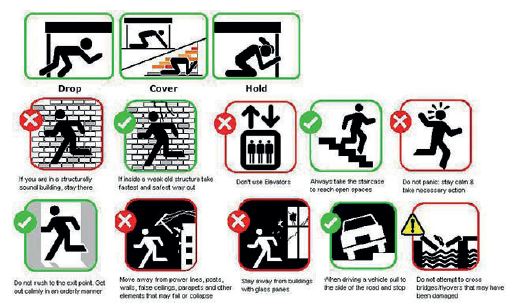
1. Why do you think you should cover your head with one hand and hold the table with the other during an earthquake?
2. During an earthquake, why should we exit through staircase and not use elevators?
3. Suppose you are in a room of a strong building without any furniture when an earthquake occurs. What would you do to protect yourself from the earthquake?
4. Reason out why should you stay away from buildings with glass panes during an earthquake.
33.
Describe the major problems & challenges faced by the local self governments.
34.
Elucidate about some of the interesting findings on migration in Tamil Nadu.
35.
Write about the merits of unitary form of government.
36.
What are educational loans?
37.
Write about Chengiz Khan.
38.
Examine the outcome of the geographical discoveries.
39.
Give an account of Mobilisation and Democratic Participation.
40.
Discuss the Neolithic culture in Tamil Nadu
41.
Explain the conditions necessary for the success of democracy in India
42.
Assertion (A): Parties shape public opinion.
Reason (R): They raise and highlight issues of importance.
(a) Both (A) and (R) are true and (R) explains (A)
(b) Both (A) and (R) are true and (R) does not explain (A)
(c) (A) is correct and (R) is false
(d) (A) is false and (R) is true
Both (A) and (R) are true and (R) explains (A)
Both (A) and (R) are true and (R) does not explain (A)
(A) is correct and (R) is false
(A) is false and (R) is true
43.
Mention about the Unitary feature of Indian constitution.
44.
What should you do if you are trapped in a car during a civil unrest?
1.
(c)
15
2.
(b)
1952
3.
(b)
4,429 kg
4.
(c)
July 11th
5.
(b)
Feudalism
6.
(a)
Bronze
7.
(c)
Peasant
8.
(c)
Right against child labour exploitation
9.
(a)
Daulatabad
10.
(d)
Pontius Pilate
11.
(c)
Homo sapiens
12.
The direct consequences of Accidents are
i) Fatality (Death) ii) Injury iii) Damage to Property
13.
(i) The National Ayush Movement scheme is implemented by the central government.
(ii) Its main aim is to save and extend the life of many medicinal herbs that grow only in the forest.
(iii) This scheme is carried out with 60:40 shares from the central and state governments
14.
(i) As the town expands, it mounts more pressure on transport system, water supplies, sewage and profuse disposal.
(ii) The overall development creates problems like air pollution, water pollution, traffic congestion and noise pollution etc.,
(iii) This disturbed environment affects the human beings as mental illness, heart troubles, breathing problems etc.
15.
(i) The houses were tiny, dirty and sickly for the labouring class.
(ii) Workers had no time to clean or change their own atmosphere even if they wished to, led to the outbreak of typhoid, cholera and small pox.
16.
The salient features of the Tamil Nadu Panchayat Raj Act of 1994-
(i) A three tier system,
(ii) Gram Sabha
(iii) Establishment of Election Commission
(iv) Constitution of Finance Commission
(v) Reservation of Seats for SS/ST's proportionate to their population.
(vi) One third reservation of seats for women and
(vii) Constitution of District Planning Committees.
17.
(i) Job
(ii) Employment
(iii) Education
(iv) Trade
(v) Business
18.
| S.No | Parliamentary form of government | Presidential form of government |
|---|---|---|
| 1 | Prime Minister is the leader of the majority party. | President is directly elected by the people. |
| 2 | Central Legislature is supreme E.g. Canada, India, Japan | President is supreme E.g. Russia, Brazil, U.S.A |
| 3 | Absence of Separation powers Centralisation. | Separation powers |
| 4 | Independent branches with overlapping functions. |
Independent branches |
| 5 | President - head of the state. | President - head of the state. |
| 6 | Prime - Minister - head of the Government | President head of the Government |
| 7 | Centralisation | Independent branches |
| 8 | Collective leadership | Individual leadership. |
| 9 | Collective and Individual Responsibility | President is not accountable to Congress |
19.
(i) As days went by, issues arose while trade prospered, there were insufficient reserves of gold and silver.
(ii) Mines also had a limited reserve of these metals.
(iii) An alternative was found and coins were made using metals with lesser value.
(iv) These were used to buy and sell goods of lesser value.
20.
(i) Terrestrial biomes is a group of living organisms that live and interact with one another on land.
(ii) They are mainly determined by temperature and rainfall.
(iii) Some of the major terrestrial biomes of the world are
a. Tropical Forest Biomes
b. Tropical Savanna Biomes
c. Desert Biomes
d. Temperate Grassland Biomes and
e. Tundra Biomes
21.
(i) The Earth's water is not static.
(ii) It is always in motion.
(iii) This continuous movement of water on, above and below the earth's surface is called the Hydrological Cycle.
(iv) The three major processes involved in the water cycle are evaporation, condensation and precipitation.
22.
(i) Vijayanagar kingdom was established by - Harihara and Bukka (the two brothers).
(ii) This empire was ruled by Sangama dynasty, Saluva dynasty and the Tuluva dynasty.
23.
(i) A valley is made deeper by a stream of water (or) a river as it flows from the high land.
(ii) The valleys are either 'U' shaped or 'V' shaped.
(iii) The glacier debris get deposited in the low lying areas. So glaciers do not form deep narrow valleys.
24.
(i) The internal processes generate heat and eject materials from deep below the Earth's crust.
(ii) Internal radioactivity in the principal source of power for this process.
25.
Ptolemy's Geography is a Gazetteer and atlas of Roman times providing geographical details of the Roman Empire in the Second Century CE.
26.
(i) The lithic tool - making tradition of the Levalloisian belonged to this period.
(ii) Levalloisian tools are the implements made after preparing the core.
(iii) These tools are found in Europe and Central and Western Asia.
(iv) The Levalloisian tools are the implements made after preparing the core. It was named after the town of Levallois in France.
27.
1. The Ziggurats were at the city centre on a platform and appeared like steep pyramids, with staircases leading to the top.
2. Around this temple were complexes of ceremonial courtyards, shrines, burial chambers for the priests and priestesses, ceremonial banquet halls, along with workshops, granaries storehouses and administrative buildings.
28.
Rules to Ensure Road Safety for children
It is important for children to know about road safety rules and regulations. Here are a few
basic road safety rules for children.
i) Know Your Signals
ii) Stop, Look and Cross
iii) Pay Attention - Listen
iv) Don't Run on Roads
v) Always Use Sidewalks
vi) Never Stick Hands outside the Vehicle
vii) Never cross Road at Bends
viii) Don't Rush.
29.
(i) The term virtual water was introduced by Tony Allen in 1990.
(ii) The water consumed in the production process of an agriculture or industrial product has been called the virtual water.
(iii) It is a hidden flow of water when food or other commodities are traded from one place to another.
(iv) For instance it takes 1340 cubic meters of water to produce one metric ton of wheat.
(v) That is, if one metric ton of wheat is exported to another country, then, it means that 1340 cubic meters of water used to cultivate this amount of wheat is also being exported.
(vi) India is the largest global freshwater user .
(vii) India has been the fifth largest exporter of virtual water in the world.
30.
(a) Green house:
(i) Global warming is caused by the increase of green house gases such as carbon dioxide, methane, water vapour and Chlorofluorocarbons(CFC), carbon monoxide, photochemical oxidants and hydrocarbons.
(ii) They are responsible for the heat retention ability of the atmosphere
(iii) Global warming causes climatic change, ozone layer depletion, rise in sea level and drowning of coastal inhabited land, melting of ice, etc.,
(iv) They are posing an even greater threat to human existence and so, man must start thinking of protecting the environment from pollution.
(b) Acid Rain :
(i) When pollutants combine with water vapour in the presence of sunlight and oxygen, they form dilute sulphuric and nitric acids in the atmosphere.
(ii) When this mixture precipitates from the atmosphere, it is called acid rain.
(iii) The gases that cause acid rain are sulphur-di-oxide, nitrogen oxides, carbon-di-oxide and other minute bio-products, caused by the burning of fossil fuels.
31.
1. A shift from manual labour based to more technical and machine based manufacturing industry marked the industrial revolution in the United States.
2. Samuel Slater, a citizen of England having worked at a cotton mill from the age of 10 had gained enough experience to operate a mill.
3. On learning that Americans were interested in the new techniques, Slater departed for New York in 1789 illegally. Slater offered his service to Moses Brown, who had earlier made an unsuccessful attempt to operate a mill.
4. Brown agreed and in consequence the mill became operational in 1793 being the first water-powered roller spinning textile mill in America.
5. By 1800, Slater's mill had been duplicated by many other entrepreneurs as Slater grew wealthier and his techniques became more and more popular.
6. Andrew Jackson, the U.S. President hailed him as Father of the American Industrial revolution.
7. In the Nineteenth Century America began to show technological innovation.
8. Robert Fulton established the steamboat service on the Hudson River.
9. Samuel E. B. Morse invented the telegraph and Elias Howe invented the sewing machine. This was the main cause for the industrialisation.
10. In 1869 the first transcontinental railroad was completed to transport people, raw materials and products.
11. The invention of electric bulb of Thomas Alva Edison and telephone by Alexander Graham Bell changed the world beyond recognition.
32.
1. It is mainly to protect the head and neck from gently damaged.
2. Because the earthquake likely to knock out electrical power, the elevator machinery will not work.
3. If doors are opened, stand under a door way or in a comer inside the room. Cover your face and head with your arms.
4. At jolting of the earthquake bursting and breaking of wall, glass panes may happen. So it is better to be away from it.
33.
Problems and challenges facing the local self governments.
(i) Local self governments are the crucial basis for our democracy.
(ii) The Constitutional status of local self governments adds more significance to their functioning.
(iii) There are a few critical concerns in the working of local self governments in India.
(iv) Major problems and challenges may be mentioned as below.
1. Lack of clear demarcation of powers and functions of local bodies.
2. Allocation of funds and needs assessment are not matched.
3. Combined with accountability, the local self governments demand for more autonomy and economic freedom may be addressed.
4. Role of caste, class and religion in decision making at the local self governments.
5. Poor accountability of elected members and officials at the grassroots of democracy.
34.
(i) Change in population occurs due to births, deaths and migration.
(ii) Almost everyone keeps moving most of the time, it is not easy to define which of these moves have to be classified as migratory moves.
(iii) According to the census of 2011 the population was 7.2 crore in Tamil Nadu.
(iv) 3.13 crore people were counted as migrants.
(v) The mobility of population in rural areas is greater than in urban areas.
(vi) Mobility is usually associated with male rather than female.
(vii) The poorer sections of the people migrate for survival but migrations from better off sections is to improve their living standards
(viii) Of the International migrants 15% are women while 85% are men.
35.
Merits of unitary form of government
(i) Suitable for small countries.
(ii) There is no conflict of authority and responsibility.
(iii) A unitary government will make prompt decisions and take speedy action.
(iv) A unitary government is less expensive.
(v) Amendments to the constitution are easy.
(vi) There is unity, uniformity of law, policy and administration.
36.
(i) Educational loan attempts to meet the educational aspirations of the society.
(ii) A student is the main borrower.
(iii) A parent, spouse or sibling can be the co-applicant.
(iv) It is offered to students who want to pursue higher education in India or overseas.
(v) It can be taken for a full time, part-time or vocational course and Graduation or Post Graduation.
(vi) There is no security required for the loan amount up to 4 lakhs.
(vii) The loan is repaid by the student generally after the employment.
(viii) Students can apply through "Vidya Lakshmi Portal Education Loan Scheme.
37.
(i) Mongols' remarkable leader was Chengiz Khan.
(ii) He was a great military genius.
(iii) His religion was Shamanism, a worship of the "Everlasting Blue Sky".
(iv) Mongols' hold over Russia for about 300 years made Russia technologically backward from the rest of Europe until the end of Middle Ages.
38.
1. As a result of the discovery of new lands and new sea routes, the economic centre of Europe shifted from the Italian city states to spain and Portugal.
2. They brutally killed the natives in their conquest and the remaining were employed under harsh conditions in gold and silver mines, and in plantations.
3. Many natives also died because of epidemic diseases brought by the colonizers.
4. The native people faced the dangers of deadly diseases.
5. The natives had to encounter from these deadly diseases.
6. The introduction of sugarcane led to the establishment of sugarcane plantations in the Caribbean islands and South America.
7. The mass extinction of the native population led to the import of slaves from Africa. Africa became the centres of slave trade.
8. Geographical discoveries led to commercial revolution.
9. The seventeenth century witnessed the emergence of various East India companies.
10. They are English East India Company the Dutch East India Company and the French East India Company.
11. The Portuguese enforced its monopoly on the spice trade of East Indies.
12. The Spaniards established monopoly over the mining and transportation of gold and silver in its colonies in the New World.
13. The English East India Company had monopoly trade in India and amassed huge wealth.
14. Thus, the chief feature of mercantilism was exploitation of the resources of the colonies for the benefit of the colonisers.
15. It represented an important stage in the development of modern capitalism.
39.
Mobilising people towards socially productive activities that lead to the overall betterment of people's lives is essential. Sometimes earthquakes, tsunamis, floods and other such natural disasters on a massive scale occur and people's immediate mobilisation for evacuation and emergency relief becomes most essential.
Democratic Participation: Democracy can succeed only when smaller local groups and, in fact, every citizen can take action that supports the tax and revenue collection systems, observance of national norms in environmental protection, cleanliness, health and hygiene, sanitary drives and immunisation programmes like pulse polio. However, we must keep in mind that there is no better form of government than Democratic government. To create a better society and nation, the people of India along with the union and state governments should come together to fight against the miseries of human life.
40.
(i) The culture that domesticated animals and cultivated crops is called Neolithic.
(ii) It is known as the New Stone Age. The Neolithic people used polished stone axes called celts.
(iii) Cattle rearing was their main occupation. They lived in small villages with houses made of thatched roof and walls plastered with clay.
(iv) Evidence of Neolithic village is found at Payyampalli in Vellore district and a few sites in the Dharmapuri region.
(v) Payyampalli is a village in Vellore district of Tamil Nadu. The earliest evidence for the domestication of animals and cultivation of plants is found at this site, which was excavated by the Archaeological Survey of India.
(vi) Evidence for pottery making and cultivation of horse gram and green gram has been found in this village.
(vii) These Neolithic sites were part of the Southern Neolithic Culture of India. They are mainly concentrated in the Andhra Pradesh and Karnataka regions.
(viii) The Neolithic people used stone axes fitted on a wooden handle.
(ix) These polished stone axes are worshipped in many village temples of Tamil Nadu even today.
41.
(i) Empowerment of the poor and illiterates to enjoy the goodness of democracy.
(ii) Willingness among the elected people not to misuse their powerful position and public wealth.
(iii) Eradication of social evils and dangers from which democracy suffers.
(iv) An impartial and efficient press to form public opinion.
(v) Presence of strong public opinion.
(vi) Feeling of tolerance and communal harmony among the people.
(vii) Awareness among the people of the fundamental rights that they are entitled to enjoy.
(viii) Conscious check and vigilance on the working of the elected representatives.
(ix) Powerful and responsible opposition
42.
(a) Both (A) and (R) are true and (R) explains (A)
43.
Unitary features of Indian constitution are
(1) Strong Centre
(2) Central Government's control over state territory
(3) Single Constitution.
(4) Flexibility of the Constitution
(5) Unequal representation of states
(6) Emergency Provisions
(7) Single citizenship
(8) Single Integrated Judiciary
(9) All India Services
(10) Appointment of Governor by the central government.
44.
(i) Never drive through a crowd.
(ii) If you find yourself in the path of a crowd, turn down the nearest side road, reverse or turn around and drive away calmly.
(iii) If you cannot drive away, park the car, lock it and leave it, taking shelter in a side street or doorway.
(iv) If you do not have time for this, stop and turn the engine off. Lock the doors and remain calm. Be sure not to show hostility or anger.

9th Standard Syllabus & Materials
9th Standard
TN 9th Tamil உள்ளத்தின் சீர் - திருக்குறள் Important Questions And Answers Study Material - QB365 Set A
NEW9th Standard
TN 9th Tamil உள்ளத்தின் சீர் - மணிமேகலை Important Questions And Answers Study Material - QB365 Set A
NEW9th Standard
TN 9th Tamil உள்ளத்தின் சீர் - ஏறு தழுவுதல் Important Questions And Answers Study Material - QB365 Set A
NEW9th Standard
TN 9th Tamil உயிருக்கு வேர் - தண்ணீர் Important Questions And Answers Study Material - QB365 Set A



Tamilnadu Stateboard 9th Standard Subjects
Tamilnadu Stateboard Standards




