
 100% FREE ACCESS
9th Standard Syllabus & Materials
9th Standard
TN 9th Tamil உள்ளத்தின் சீர் -கற்கண்டு (இலக்கணம்) - தொடர் இலக்கணம், ஆகுபெயர் Important Questions And Answers Study Material - QB365 Set A
NEW9th Standard
TN 9th Tamil உள்ளத்தின் சீர் -விரிவானம் (துணைப்பாடம்) - தாய்மைக்கு வறட்சி இல்லை! Important Questions And Answers Study Material - QB365 Set A
NEW9th Standard
TN 9th Tamil உள்ளத்தின் சீர் -கவிதை பேழை (செய்யுள்) - மார்கழி பெருவிழா Important Questions And Answers Study Material - QB365 Set A
NEW9th Standard
TN 9th Tamil உயிருக்கு வேர்-இலக்கணம் - பகுபத உறுப்பிலக்கணம் Important Questions And Answers Study Material - QB365 Set A
NEW9th Standard
TN 9th Tamil அமுதென்று பேர் - இலக்கணம்-எழுத்து -அளபெடை Important Questions And Answers Study Material - QB365 Set A
NEW9th Standard
TN 9th Tamil அமுதென்று பேர்-துணைப்பாடம் - ஆறாம்திணை Important Questions And Answers Study Material - QB365 Set A

Published on: 16/03/2020
9th Standard Social Science English Medium All Chapter Book Back and Creative Five Marks Questions 2020
Download Tamil Nadu 9th Standard Social Science question papers, model tests, one-mark questions, important questions, and public exam papers in PDF format. Free study materials and answer keys for TN State Board students.
Questions + Answers key
Take MCQ Social Science Test
1.
(i) Barter was the primary mode of exchange.
(ii) Spices including pepper and precious stones were exported.
(iii) The Sangam Age saw the first urbanization in Tamilagam.
(iv) People in the Sangam Age had no faith in religion.
(i) is correct
(i) is correct (ii) incorrect
(i) is correct (iv) incorrect
(i), (ii), (iii) correct (iv) incorrect
2.
This is an Epic________.
Silappathikaaram
Pattinappalai
Mullai pathu
Madurai Kanchi
3.
______ are tools used for scraping the surfaces
Lunates
Triangles
Scrapers
Cists
4.
______ are stone artefacts of small size
Microliths
Bifaces
Acheulian
core
5.
The yellow river is known as the sorrow of _______ .
Egypt
Rome
China
Iraq
6.
_____ did not give much attention to the life after death.
The Sumerians
The Babylonians
The Egyptians
The Chinese
7.
The name of the script used in the Sangam Age
English
Devanagari
Tamil-Brahmi
Grantha
8.
The Sumerian system of writing
Pictographic
Hieroglyphic
Sonogram
Cuneiform
9.
______ inscriptions datable to third century BCE refer to the Cheras, Cholas and Pandyas in ancient Tamilagam.
Pulakesin
Ashoka
Chandragupta
Dhanananda
10.
Direct ancestor of modern man was ______.
Homo habilis
Homo erectus
Homo sapiens
Neanderthal man
11.
Write about the hidden treasure of Indus civilization.
12.
How different factors contribute to road accidents?
13.
Write note the Parliamentary form of Government.
14.
Write a short note on "Red Tea".
15.
Write about the Gandhi's Concept of Gram Swaraj.
16.
Explain the term Virtual water.
17.
Write a note on Google Earth.
18.
Explain the classification of Environment.
(a) Natural Environment
(b) Human Environment
(c) Man made Environment
19.
Write a note on the famines which occurred in British India.
20.
The Coal production in England increased from 4.7 million tonnes in 1750 to 250 million tonnes in 1900. Give reasons.
21.
State the results of the American war of Independence
22.
Enumerate the causes for the Second Industrialization in the USA.
23.
Discuss the economic impact of British Rule in India.
24.
“Taxation without Representation” led to the outbreak of American War of Independence – Explain
25.
During and earthquake, why should we exit through staircase and not use elevators?
26.
What do you mean by the term 'scale of the map'? Explain its classification.
27.
Write in details about the salient features of the 73rd & 74th Constitutional Amendment Act (1992).
28.
Discuss the patterns of migration
29.
Describe the patterns of rural settlement with neat diagrams.
30.
Write about the presidential form of government and what is the difference between presidential and parliamentary forms of government.
31.
What are the problems faced by using ground water for agriculture?
32.
Highlight the contribution of Greece to World Civilization
33.
Write a note on the following:
Darasuram Temple
34.
Explain the term Renaissance.
35.
How is currency printed in India?
36.
Explain Child Rights.
37.
During the later Middle Ages what developments did Christianity undergo?
38.
Why is the salinity at the equator less even though it experiences high temperature?
39.
Write a note on Fresh Water
40.
Explain the various components of ecosystem
41.
Explain in detail about the role of RBI in the country.
42.
What are the benefits for workers provided by labour law?
43.
Discuss how Renaissance, Reformation and Geographical discoveries heralded the modern age?
44.
Discuss the political changes during 1526 -1707 A.D. (C.E.).
45.
Who were the Mongols? How did they rule China?
46.
Highlight the contributions of Rome to World Civilization
47.
Describe the Erosional landforms of Sea
48.
Describe sustainability of Development.
49.
How is the Orographic rainfall caused?
50.
Give an account of Mobilisation and Democratic Participation.
51.
Though democracy in India has been appreciated worldwide for its working there is still a lot of scope for improvement - Discuss.
52.
Give reasons for the decline of Buddhism.
53.
Give an account of 'Tsunami'
54.
Explain the "Archaeological sites".
55.
Indicate how the industries and crafts of the Sangam Age contribute to their economy.
56.
Domestication of Animals and plants. A milestone in Human History. Explain
57.
Explain the employment structure of India.
58.
Differentiate between renewable and non-renewable resources
59.
What are the function of Pressure groups in India?
60.
Write a paragraph about the structure of the atmosphere.
61.
What are the challenges to Indian democracy? explain
62.
To what extent is the Chinese influence reflected in the fields of philosophy and literature?
63.
Compare and contrast the principles of Jainism and Buddhism.
64.
Give a detailed account on the three orders of landforms
65.
Describe the structure of the Earth
66.
The developments in the fields of agriculture, pottery and metal tools are considered a landmark in the life of Megalithic period-Substantiate.
67.
Assertion (A): Assyrians of Mesopotamian civilisation were contemporaries of Indus civilisation.
Reason (R): The Documents of an Assyrian ruler refer to the ships from Meluha
(a) A and R are correct and A explains R
(b) A and R are correct but A doesn’t explain R
(c) A is incorrect but R is correct
(d) Both A and R are incorrect
A and R are correct and A explains R
A and R are correct but A doesn’t explain R
A is incorrect but R is correct
Both A and R are incorrect
1.
(d)
(i), (ii), (iii) correct (iv) incorrect
2.
(a)
Silappathikaaram
3.
(c)
Scrapers
4.
(a)
Microliths
5.
(c)
China
6.
(a)
The Sumerians
7.
(c)
Tamil-Brahmi
8.
(d)
Cuneiform
9.
(b)
Ashoka
10.
(c)
Homo sapiens
11.
1. The Indus civilisation and its urban features started declining from about 1900 BC.
2. Charges in climate, decline of the trade with Mesopotamia and drying up or flooding of the river Indus. foreign invasion were some of the reasons attributed to the collapse of this civilisation and for the migration of people on the southern and eastern directions.
3. It did not completely disappear.
4. It continued as rural culture.
12.
The different factors contribute to road accident are,
i) Drivers: Over speeding, rash driving, violation of rules, failure to understand signs, fatigue, alcohol.
ii) Pedestrians: Carelessness, illiteracy, crossing at wrong places, jaywalkers.
iii) Passengers: Projecting their body parts outside vehicles, talking to drivers, alighting and boarding vehicles from the wrong side, travelling on footboards, catching a running bus etc.,
iv) Vehicles: Failure of brakes or steering, tyre burst, insufficient headlights, overloading.
v) Road Conditions: Potholes, damaged roads, eroded roads merging of rural roads with highways and illegal speed breakers.
vi) Weather conditions: Fog, snow, heavy rainfall, wind storms, hail storms.
13.
Parliamentary form of Government
(i) The parliamentary system of government is the one in which the executive is responsible to the legislature for its policies and acts.
(ii) It is also known as cabinet government or responsible government or Westminster model of government and is prevalent in Britain, Japan, Canada, India among others.
Features of Parliamentary form of government
(i) Nominal and Real Executives.
(ii) Majority Party Rule
(iii) Collective Responsibility
(iv) Double Membership
(v) Leadership of the Prime Minister
Merill of the parliamentary form of government
(i) Harmony between Legislature and Executive.
(ii) Responsible Government
(iii) Prevents Dictatorship.
(iv) Wide Representation.
Demerits of the parliamentary form of government
(i) Unstable Government.
(ii) No Continuity of Policies.
(iii) Dictatorship of the Cabinet.
(iv) Against Separation of Powers.
14.
(i) "Red Tea" is a very well known novel written by Paul Harris Daniel.
(ii) The novel portraits the slavery life of plantation workers in Valparai.
(iii) This novel depicts the blood stained history of the workers that is hidden behind the green cover of the hills.
(iv) This novel has been translated in Tamil by R. Murugavel in the name "Eriyum Panikkaadu" (எரியும் பனிக்காடு)
(v) The story starts with Karupan migrating to the hills with his wife in search of survival.
(vi) The narrator of this story is Dr. Daniel, who comes there to treat the plantation employees.
15.
(i) Gandhi really wanted 'Swaraj', The self rule by the people of India who represent the rural mass.
(ii) He observed "India's soul lives in the village".
(iii) He dreamt of village republics in term of Panchayat in the free India.
(iv) Mahatma Gandhi advocated Panchayat Raj, a decentralized form of government where each village is responsible for its own affairs.
(v) Gandhi's ideal village should be basically self-reliant, making provision for all necessities of life, food clothing, clean water, sanitation, housing, education and other requirements, including government and self-defense.
(vi) According to Gandhi Gram Swaraj should be a complete republic, independent of its neighbor.
(vii) Every village should be a democracy in which they will not depend even on neighbor for major needs.
16.
(i) The term virtual water was introduced by Tony Allen in 1990.
(ii) The water consumed in the production process of an agriculture or industrial product has been called the virtual water.
(iii) It is a hidden flow of water when food or other commodities are traded from one place to another.
(iv) For instance it takes 1340 cubic meters of water to produce one metric ton of wheat.
(v) That is, if one metric ton of wheat is exported to another country, then, it means that 1340 cubic metre of water used to cultivate this amount of wheat is also being exported.
(vi) India is the largest global freshwater user .
(vii) India has been the fifth largest exporter of virtual water in the world.
17.
(i) Google Earth is a web based computer application.
(ii) Google Earth is a virtual globe that renders a 3D representation of the Earth.
(iii) It combines the power of Google Search with maps, satellite imageries, aerial photographs, GIS data and 3D buildings to visualize the world.
(iv) Google Earth allows users to see cities and buildings looking perpendicularly down or at a tilted angle.
(v) Google Earth allows users to search for addresses of some countries, enter coordinates or simply use the mouse to browse a location.
(vi) Google Earth also has Digital Elevation Model (DEM) data for many major cities.
(vii) This means one can view Mount Everest or buildings in three dimensions, instead of 2D.
18.
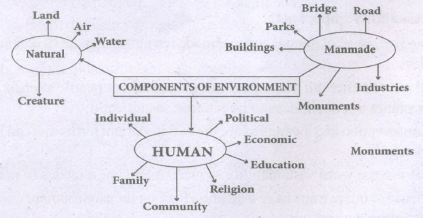
(a) Natural Environment:
Natural components of environment such as Lithosphere, atmosphere, hydrosphere and biosphere.
(b) Human Environment:
This is the interaction between man as an individual, with his family, occupation and society. It is also related to various cultural aspects such as education, religion, economics and politics.
(c) Man made Environment:
(i) This has been created by man himself for the purpose of fulfilling his needs and to make his life more convenient and easy.
(ii) For example, building, transport, park, industries, monument, etc.
(iii) To bring an equilibrium betweenman and the environment, man has to study the distribution of population, availability of resources, development in technology etc.
19.
(i) The policy of free trade and the forcible collection of land revenue resulted in the out break of famines.
(ii) The Odisha famine of 1866-67 was a severe and terrible event.
(iii) The famines of 1876-78 known as the Great famine of 1876-78 caused a large migration of agricultural labourers and artisans from Southern India to British colonies.
(iv) Here they worked as indentured labourers on plantations.
(v) In the Madras Presidency, the famine of 1876- 78 was preceded by droughts.
(vi) The situation was made worse because of the colonial government's policy of laissez faire in the trade of food grains.
(vii) Two of the worst famine-afflicted areas in the Madras Presidency were the district of Ganjam and Vizagapatnam. They continued to export grains throughout the famine.
(viii)These famines were typically followed by various infectious diseases.
(ix) The memory of this famine is still preserved in various folk songs and ballads.
(x) The Bengal famine of 1770 as well as 1943 of British India took a heavy toll of human lives.
20.
(i) Industrial Revolution required fuel.
(ii) Coal was needed in vast quantities.
(iii) Before the Industrial Revolution, two types of mines existed: drift mines and bell pits.
(iv) Both were small scale coal mines and the extracted coal was used in homes and local work spots.
(v) As industrialisation gained pace, more and more coal was needed to fuel steam engines and furnaces.
(vi) The development of factories by Arkwright and the improvement of the steam engine by James Watt further increased demand for coal.
(vii) As a result, coal mines became deeper and deeper, making it more and more dangerous.
(viii) As miners used oil lamps in the mines the risk of explosion was high leading to the death of miners.
(ix) This was reduced by the invention of a safety lamp by Sir Humphrey Davy in 1815.
21.
(i) For the first time a colonial power was overthrown by the colonies, leading to the establishment of a republican government in the United States.
(ii) The Declaration of Independence of 1776 stated that, "all men are born equal." But in reality America had to fight a bitter civil war in the succeeding century to abolish slavery.
(iii) By 1777 nearly all the colonies had a written constitution. These constitutions protected individual rights, freedom of press and freedom of religion. The church and the state were separated
(iv) The intellectuals of the time believed that the republican state was the only political structure in which individuals could preserve their basic freedom including property and political rights.
(v) The conception of people's right to a government of their choice encouraged the Latin American revolutionaries to strive for the overthrow of the Spanish empire in South America.
(vi) Mirabeau quoted the Declaration of Independence with enthusiasm during the French Revolution.
(vii) Lafayette, who fought the British on Washington's side through to the conclusive battle at Yorktown in 1781, later during the French Revolution served the French National Guard as its Commander
22.
1. A shift from manual labour based to more technical and machine based manufacturing industry marked the industrial revolution in the United States.
2. Samuel Slater a citizen of England having worked at a cotton mill from the age of 10 had gained enough experience to operate a mill.
3. On learning that Americans were interested in the new techniques, Slater departed for New York in 1789 illegally Slater offered his service to Moses Brown, who had earlier made an unsuccessful attempt to operate a mill.
4. Brown agreed and in consequence the mill became operational in 1793 being the first water-powered roller spinning textile mill in America.
5. By 1800, Slater's mill had been duplicated by many other intrepreneurs as Slater grew wealthier and his techniques became more and more popular.
6. Andrew Jackson the U.S. President hailed him as Father of the American Industrial revolution.
7. In the Nineteenth Century America began to show technological innovation.
8. Robert Fulton established the steam boat service on the Hudsen river.
9. Samuel E.B Morses invented the telegraph and Elias Howe inverted the sewing machine. This was the main cause for the industrialisation.
10. In 1869 the first transcontinental rail road was completed to transport people, raw materials and products.
11. The invention of electric bulb of Thomas Alva Edison and telephone by Alexander Graham Bell changed the world beyond recognition.
23.
(i) Lord Cornwallis created Zaminders and Landlords for the first time in India and collected revenue. This settlement made with the zaminders was called as the permanent settlement.
(ii) The Ryotwari system was a different revenue system introduced in south India.
(iii) Under this system the peasant was the proprietor and paid tax on land. The government deal with him directly. He was entitled to remain in possession of land acquired by him, so long as he paid the land revenue.
(iv) As no credit facilities were provided by the state they had to depend on money lenders to borrow money.
(v) The colonial state pursued a policy of commercialization of agriculture.
(vi) The peasant's bid to clear his debt and to pay up the revenue dues to the state instead of producing for home consumption, the peasants began to raise crop for the market.
(vi) Even than the money earmarked for irrigation was meagre, but due to the initiative of some well meaning British officials and engineers irrigation became possible in certain areas, but they collected more taxes.
(vii) The policy of free trade and the forcible collection of land revenue resulted in the out break of famines.
(viii) The Indentured labour system was a form of debt bondage, by which many Indians were transported to various British colonies.
24.
(i) The Seven years war of 1756 - 63 between Britain and France had center on the control of colonies especially in North America.
(ii) Britain defeated France and took control of Canada.
(iii) But the war cost the English heavily.
(iv The British ministers proposed that the American colonists pay some of the cost of the war.
(v) So a series of taxes were imposed on the colonists.
| 1764 | Sugar Act |
| 1765 | Stamp Act |
| 1767 | Townshend Act |
| 1764 | Currency Act |
| 1766 | Declaratory Act |
(vi) The American colonists protested against all the above taxes.
(vii) The British Parliament did not give representation to the colonists.
(viii) The colonies did not begin fighting for the sake of independence.
(ix) Their grievances were taxation and restrictions on trade.
(x) They challenged the right of the British parliament to tax them against their will.
(xi) George Washington became the commander-in-cheif of the colonists army.
(xii) "No taxation without representation" was their famous battle cry.
25.
26.
(i) Scale is one of the components of map.
(ii) Scale makes it possible to reduce the size of the whole earth to show it on a piece of paper.
(iii) A scale is a ratio between the actual distance on the map to the actual distance on the ground.
(iv) Scales can be represented in three methods.
(v) They are the
(a) Statement,
(b) Representative Fraction (R.F) and
(c) Linear or Graphical scale methods.
(a) Statement Scale:
The statement scale describes the relationship of map distance to ground distance in words, such as one centimetre to ten kilometres. It is expressed as 1cm = 10 km.
What do you mean by the term
(i) It describes the proportion or ratio of the map distance to ground distance. It is usually abbreviated as R.F. It is stated as 1/100000 or 1:100000
(ii) This means that one unit on the map represents 100,000 of the same unit on the ground.
(iii) This unit may be an inch or a centimetre or any other linear measurement unit.
(b) Representative Fraction (R.F.) = \(\frac{Distance \ on \ the \ map}{Distance \ on \ the \ Ground}\)
(c) Linear (or) Graphical cale: In geography, a linear scale is represented by a straight line divided into equal parts (Primary and secondary) to show what these markings represent on the actual ground. This scale helps in the direct measurement of distance on the map.
27.
Salient features of the 73m and 74th Constitutional Amendment Act (1992)
(i) Panchayats and Municipalities will be "Institutions of Self Government".
(ii) Basic Units of Democratic System - Grama Sabhas (Villages) and Ward Committees (Municipalities) comprising all the adult members registered.
(iii) Three tier system of panchayats at village, intermediate block/taluk/mandal and district levels. Smaller states with population below 2 million only two tiers.
(iv) Seats at all levels filled by direct election.
(v) Seats reserved for SCs and STs at all levels in proportionon to their population.
(vi) One third of the total number of seats-reserved for women. One third of the seats reserved for SCs and STs also reserved for women. One third officers of Chair persons at all levels reserved for women.
(vii) Uniform five year term and election to constitute new bodies to be completed before the expiry of the term. In the event of dissolution, elections compulsorily within six months.
28.
Suresh: What is the reason for population change?
Subash: Change in population occurs due to birth, death and migration.
Suresh: What is migration?
Subash: Birds, Animals and Man move from one place to another.
Suresh: Why do people migrate?
Subash: To search for Job, Education, Marriage, etc.
Suresh: How can migrants be calculated?
Subash: By place of birth and place of residence.
Suresh: How is it calculated in Tamil Nadu?
Subash: According to the census of 2011, there was 7.2 crore people in Tamil Nadu of these 3.13 crore people were counted as migrants.
29.
Patterns of rural settlements:
| (i) Rectangular pattern: Rectangular pattern of settlements are found in plain areas or valleys. The roads are rectangular and cut each other at right angles. |
 |
| (ii) Linear pattern : In a linear pattern, the houses are located along a road, railway line and along the edge of the river valley. |
.JPG) |
| (iii) Circular or Semicircular pattern : The pattern of settlement that is found around the lakes, ponds and sea coasts are called circular or semicircular pattern. |
.JPG) |
| (iv) Star like pattern: Where several metalled or unmetalled roads converge, star shaped settlements develop. |
.JPG) |
| (v) Triangular pattern: Triangular patterns of rural settlement generally develop at the confluence of rivers |
.JPG) |
| (vi) T-Shaped, V-Shaped, Cross-Shaped or Cruciform settlements: T-shaped settlements develop at tri-junctions of the roads (T) while V-shaped where two roads converge with the third one and Cruciform settlements develop on the cross-roads which extend in all your directions. |
.JPG) |
| (vii) Nebular pattern: The arrangement of roads is almost circular which ends at the central location or nucleus of the settlement around the house of the main landlord of the village or around a mosque, temple or church. |
.JPG) |
30.
Presidential form of government
(i) The American President is both the head of the state and the head of government. As the head of state, he occupies a ceremonial position.
(ii) The president is elected by an electoral college for a fixed tenure of four years.
(iii) He governs with the help of a cabinet or a smaller body called' Kitchen Cabinet' . It is only an advisory body.
(iv) The President and his secretaries are not responsible to the Congress for their acts.
(v) The legislative, executive and judicial powers of the government are separated.
(vi) It is also known as non-responsible or non-parliamentary or fixed executive system of government.
Difference between Presidential and Parliamentary form of government
| No. | Presidentail Form of Government | Parliamentary form of Government |
|---|---|---|
| 1 | President is directly elected by the people. | Prime Minister is the leader of majority party. |
| 2 | President is supreme | Central Legislature is supreme |
| 3 | Separation of Powers | Absence of Separation Powers Centralisation |
| 4 | Independent branches | Independent branches with Overlapping functions |
| 5 | President-head of the Government | Prime Minister-head of the Government |
| 6 | Separation of Powers | Centralisation |
| 7 | Independent branches | Independent branches with Overlapping functions |
| 8 | Individual Leadership | Collective leadership |
| 9 | President is not accountable to Congress | Collective and Individual Responsibility. |
31.
(i) Agriculture in Tamil Nadu is dependent on ground water.
(ii) Use of ground water for agriculture creates many hardships too.
(iii) The Union Water Board is constantly monitoring the level and nature of ground water.
(iv) This continuous monitoring has categorized the panchayat union in terms of the amount of groundwater used.
(v) 139 blocks are identified as excessive users of ground water.
(vi) Only 136 blocks have enough quantity and quality water for usage.
(vii) It is very urgent and necessary to regulate the usage of underground water.
32.
(i) The ancient Greeks created the world's first democracy. Athens started on with a monarchy and then advanced to an oligarchy until it finally reached a democracy.
(ii) The Greek Alphabet was the first alphabet in the western sense of the word, featuring distinct letters for vowels and consonants.
(iii) The first library in the world, the library of Alexandria was actually built in Egypt.
(iv) The Olympic games started in ancient Greece specially in the city of Olympia.
(v) Science and Mathematics - Eratosthenes was the first mathematician to calculate the circumference of the Earth. Aristarchus, Archimedes and Hipparchus were great mathematicians and scientists.
(vi) One of the common examples of Greek Architecture in the modular world is the Column in Pillar.
(vii) Greek mythology has pervaded nearly every form of popular culture imaginable. Many Greek myths have been adapted into modem novels, movies, TV, shows etc.
(viii) The first lighthouse in the world was located in the Greek controlled Egyptian Kingdom of Alexandria.
(ix) The democratic people of ancient Greece, especially Athens, were the first to employ trial by jury as we know it today.
33.
Darasuram Temple:
(i) Darasuram is a panchayat town, located 3 kilometres from Kumbakonam in Thanjavur District, Tamilnadu.
(ii) The town is known for the Airavateswara temple constructed by Raja Raja Chola II in the 12th century A.D.
(iii) The temple is recognised UNESCO World Heritage Monument.
(iv) Darasuram temple is a storehouse of art and architecture.
(v) The vimana is 85 feet high.
(vi) With heavily ornamented pillars accurate in detail and richly sculpted walls, the Airavateswara at Darasuram is a classic example of Chola art and architecture
34.
(i) The Italian city-states were centres of cultural activities since the fourteenth century.
(ii) With the coming of the scholars and artists from Constantinople, there was a surge of enthusiasm and interest in studying classical literature and art of Greeks and Romans.
(iii) This creative upsurge was reflected in their writings, art, architecture and music.
(iv) This cultural florescence is known as the renaissance.
(v) The origin of the word renaissance is from the Italian word 'renascita' meaning rebirth.
(vi) It is called renaissance because there was a rebirth or revival of classical Greek and Latin literature.
(vii) Many scholars in Italy went in search of manuscripts of classical literature.
(viii) Greek scholar Manuel Chrysoloras who taught Greek classics in Italy, Guarino and Giovanni Aurispa, to name just a few, visited Constantinople several times to collect Greek manuscripts.
(ix) Later they printed what they collected.
(x) This provided stimulus to the flowering of renaissance.
35.
(i) In 1925, the British government established a government press at Nasik in Maharashtra.
(ii) Currencies were printed three years later.
(iii) In 1974, a press was started in Dewas, Madhya Pradesh.
(iv) In the 1990's two more presses were started in Mysuru, Karnataka and Salboni in West Bengal to print bank notes.
(v) The Reserve Bank of India has the authority to decide the value of currency to be printed and how the amount should reach its destination safely.
(vi) Though the RBI has the power to print up to ten thousand rupee notes, at present a maximum of upto rupees two thousand is printed.
36.
Child Rights are
(a) Right to life:
(i) A child has the right to survive even before its birth.
(ii) The right to survival also includes the right to be born, the right to basic needs of food, shelter and clothing and a dignified living.
(b) Right to Family environment:
(i) A child has the right to live a normal childhood in a family environment.
(ii) Children who have been left destitute, abandoned or orphaned also have the right to live.
(iii) These children can be given for adoption to caring families.
(c) Right to benefit from Social security:
Children should get financial support from the country when their parents or guardians are unable to provide them with a good standard of living by themselves, due to any illness, disability or old age.
(d) Right to Education:
Right to Education Act is an Act of the Parliament of India enacted in 2009 for free and compulsory education for children from 6 to 14 years of age as under Article 21A of the Constitution.
(e) Right to sale or trafficking:
(i) Children should be treated as individuals with fundamental human rights.
(ii) They are subjected to sale or trafficking for various reasons like economic exploitation, sexual exploitation, sexual abuse, drug trafficking and child labour
(f) Right to sexual exploitation:
(i) The state should protect children from sexual exploitation and abuse.
(ii) This is done through POCSO Act - Protection of Children from Sexual Offences Act in 2012.
(g) Right against other forms of exploitation like Child labour:
(i) Children are often employed in several industries.
(ii) These children are deprived of their childhood, health and education.
(h) Child Rights in the Indian Constitution:
(i) Article 24 - No child below the age of 14 must be employed in hazardous employment.
(ii) Article 45 - Free and compulsory education for all children until they attain the age of 14 years.
37.
(i) Christianity underwent many significant developments during the later Middle Ages.
(ii) The most important were in matters of doctrine and religious practices.
(iii) New elements were included in Christian theology like theory of priesthood and the theory of sacraments.
(iv) Excommunication and Interdict were the two instruments used against those who defied the Church.
38.
(i) Near the equator, the tropics receive the most rain on a consistent basis.
(ii) As a result, the fresh water falling into the ocean helps decrease the salinity of the surface water in that region, even though high temperature is experienced there
39.
(i) Rain water is considered to be the purest form of water, as it contains very less proportion of salts when compared to the oceans and seas.
(ii) Hence it is called fresh water.
(iii) A major part of fresh water is found in the frozen state in the form of ice caps and glaciers.
(iv) Around 0.5 to 1% of it, is found in the liquid state as rivers, streams, lakes, ponds etc.
(v) Surface water may also penetrate through porous rocks and gets collected beneath the Earth's surface.
(vi) This is called groundwater
40.
(i) An ecosystem consists of three basic components, namely
a) Abiotic components,
b) Biotic components and,
c) Energy components
a) Abiotic Components
Abiotic components include the non-living, inorganic, physical and chemical factors in the environment. Eg. Land, Air, Water, Calcium, Iron etc.
b) Biotic Components
(i) Biotic components include plants, animals and microorganisms.
(ii) Biotic components can be classified into three categories: (1) Producers, (2) Consumers and (3) Decomposers.
(iii) Producers are self-nourishing components of the ecosystem. Hence they are called Autotrophs.
(iv) They are found both on land and water. Eg. Plants, Algae, Bacteria etc.
(v) Consumers are those that depend on producers, directly or indirectly. Hence they are called Heterotrophs.
(vi) Decomposers are some organisms that are incapable of preparing its own food. They live on dead and decaying plants and animals. Hence they are called Saprotrophs.
c) Energy Components
(i) All organisms in the biosphere use energy to work and convert one form of energy into another.
(ii) The Sun is the ultimate source of energy for the biosphere as a whole.
(iii) The producers, consumers and the decomposers contribute a lot to the energy flow in an ecosystem.
41.
(i) A government has the responsibility to regulate money supply and oversee the monetary policy.
(ii) Hoarding of money must be avoided at all costs in a country's economy.
(iii) Only then money can be saved in banks.
(iv) Dr. B.R. Ambedkar's Ph.D. thesis on 'The Problem of the Rupee - Its origin and solution' was the reference tool and provided guidelines for the Reserve Bank of India Act of 1934.
(v) All the major and important banks were nationalised (1969) in India.
(vi) The Reserve Bank of India (RBI) regulates the circulation of currency in India.
(vii) The Reserve Bank of India started its operations on 1st April 1935.
(viii) It was permanently moved to Mumbai from the year 1937.
(ix) RBI was nationalised in 1949. 85% of the printed currency is let for circulation. According to the statistics available as on August 2018, currency worth of 19 lakh crore are in circulation.
42.
1. Right to equality.
2. Equality of opportunity in public employment.
3. Right to form associations and unions.
4. Right to livelihood.
5. Prohibits trafficking, forced labour and child labour.
6. Article 39(d) ensures equal wages to male and female workers for equal work.
7. Reduction in Factory working Hours.
8. Compulsory Recognition of Trade Unions.
9. Employment Exchange in India.
10. Employees State Insurance.
11. Minimum wages.
12. Coal and Mica Mines provident fund.
43.
(i) The Italian humanist Petrarch's Canzoniere, German theologian Martin Luther's Ninety-five theses and Portugal Prince Henry's Navigation School heralded the dawn of the modern era.
(ii) The Holy Roman Empire and the Roman Church became weak and discredited.
(iii) In their place nation states, new Churches that emphasized individual faith, and a commercial revolution based on mercantilism emerged.
(iv) The modern era was characterized by freedom of thought, individualism, rationalism, and economic and scientific progress.
(v) The changes ushered in were the Renaissance, Reformation and Geographical Discoveries.
44.
(i) The Mughal empire was founded by Babur in 1526 A.D. (C.E.) after he defeated Ibrahim Lodi at Panipat.
(ii) The first six Mughal Emperors are referred to as the 'Great Mughals'.
(iii) Aurangzeb was the last of the great Mughals.
(iv) Akbar consolidated the Mughal Empire through conquest and through a policy of conciliation with the Religious based kingdoms of Rajasthan.
(v) Though the Mughal empire began to disintegrate after Aurangzeb, it continued to exist nominally till 1857 A.D. (C.E.) when the British finally ended the virtually non-existent empire.
(vi) A new power centre rose in Maharashtra in the seventeenth century, and the Marathas under the leadership of Shivaji seriously undermined the authority of the Mughals in western India.
(vii) At its height, the empire stretched over most of the Indian sub-continent.
(viii) Only the south-western region of Kerala and southern Tamil Nadu were not directly under Mughal rule.
45.
MONGOLS:
1. Mongols were nomads. They came into Europe from the Steppes of Asiatic Russia.
2. They were herdsmen.
3. The Mongols were experts in warfare and produced a remarkable chief, Chengiz Khan.
MONGOLS RULE IN CHINA:
1. After the end of Sung dynasty the Mongols established their rule in the name of Yuan dynasty
2. The Mongols, who overran Persia and the whole of Central Asia, did not spare China either.
3. Mangu Khan became the Great Khan in 1252 who appointed Kublai Khan the Governor of China.
4. The Mongol presence from one end of Eurasia to the other played a key role in spreading Chinese technological advances to the less developed societies in the west.
5. Though the Mongol court in Beijing impressed a foreigner like Marco polo, the poverty of peasantry continued.
6. Finally, the leader of "Red Turbans" Chu Yuan Chang took the Mongol capital Beijing and proclaimed himself emperor in 1369.
46.
(i) Romans followed new arch techniques which allowed the construction of aqueducts, Colosseums, basilicas and amphitheatres. Not only have many of these structures lasted for thousands of years, but the techniques are still in use today.
(ii) The system of Republic followed by Romans served as a model for others.
(iii) The Romans were also skilled at making solid long-lasting forms of concrete.
(iv) The Romans enjoyed entertainment such as chariot races, gladiator battles, plays at the theatre etc., some of them are enjoyed even today.
(v) Their roads were well engineered, designed to last and allowed for fast travel across the empire.
(vi) The Roman Emperor Augustus started the first courier service.
(vii) Romans law included all facets of life in the ancient empire. The Romans helped shape best practice in the legal system.
(viii) Roman Emperors like Trajan established social welfare schemes.
(ix) They had a very good knowledge about medical tools.
(x) The Romans were greatly admired for their city planning.
(xi) The Romans culture was the foundation of western culture and linguistics which on its turn was spread all around the world.
47.
Some of the erosional landforms of sea waves are sea cliff, sea cave, arch, stack, beach, bar and spit and wave cut platform.
Sea Cave: Prolonged wave attack on the base of a cliff erodes rock materials, which result in the formation of caves.
Sea Arch: When two caves approach one another from either side of a headland and unite, they form an arch. e.g., Neil Island, Andaman and Nicobar.
Sea Stack: Further erosion by waves ultimately leads to the total collapse of the arch. The seaward portion of the headland will remain as a pillar of rock known as stack. Eg the Old man of Hoy in Scotland.
Sea Cliffs: Sea cliffs are steep rock faces formed when sea waves dash against them. The rocks get eroded to form steep vertical walls.
Wave Cut Platforms: Flat surface found at the foot of sea cliffs are called as wave-cut platforms. Wave cut platform is also referred as beach, shelf, terrace and plain.
48.
Sustainable economic development is taken to mean development without damaging the environment and not compromising with the needs of the future generation. The consequences of environmental degradation do not respect national or state boundaries. Sustainability of development is comparatively a new area of knowledge in which scientists, economists, philosophers and other social scientists are working together. Natural resources can be divided into renewable resources and non-renewable resources. Groundwater is an example of a renewable resource. The question arises as to how sustainable development is possible if the resources are over-used rather than getting replenished. Nonrenewable resources get exhausted after certain number of years of extracting and using them and they cannot be replenished. To achieve real sustainability, we need to balance economic, social and environmental sustainability in equal harmony. In general, the question of development or progress is continuous. At all times, as a member of society and as individuals, we need to ask where we want to go, what we wish to become and what our goals are.
49.
Orographic rainfall, 'also called relief rainfall" is caused when air is forced to rise against a high mountain. The mountain barriers lying across the direction of air flow, force the moisture laden air rise along the mountain slope. This results in the cooling of the air, which leads to the formation of clouds and rain. This rainfall is called Orographic rainfall. The side of the mountain facing the wind is called the windward side and receives heavy rainfall. It is called the rainfed region. The other side of the mountain that does not face the wind is called the leeward side and receives less rainfall becomes rain shadow region.
50.
Mobilising people towards socially productive activities that lead to the overall betterment of people's lives is essential. Sometimes earthquakes, tsunamis, floods and other such natural disasters on a massive scale occur and people's immediate mobilisation for evacuation and emergency relief becomes most essential.
Democratic Participation: Democracy can succeed only when smaller local groups and, in fact, every citizen can take action that supports the tax and revenue collection systems, observance of national norms in environmental protection, cleanliness, health and hygiene, sanitary drives and immunisation programmes like pulse polio. However, we must keep in mind that there is no better form of government than Democratic government. To create a better society and nation, the people of India along with the union and state governments should come together to fight against the miseries of human life.
51.
Though democracy in India has been appreciated worldwide for its working, there is still a lot of scope for improvement. The above-mentioned steps must be taken to ensure smooth functioning of democracy in the country.
Indian democracy can be successful and vibrant only when its citizens imbibe and reflect in their behavior the basic democratic values like equality, freedom, social justice, accountability and respect for all. Their mindset, thinking and behavior are expected to be in tune with the essential conditions of democracy. They have to appreciate the opportunities for their desired roles like participation, making the system accountable, fulfilling obligations, and playing proactive roles to actualize the goals of democracy.
52.
Buddhism declined in India due to the following reasons:
1. Buddhism was popular in the beginning because it was preached in people's language (Pali). The later texts were written in Sanskrit, which was difficult for the common people to understand.
2. The split in Buddhism into Hinayana and Mahayana was another vital reason. Image worship in Mahayana made no difference between Hinduism and Buddhism.
3. Buddhism lost its royal patronage during the reign of Guptas.
4. Further, the invasions of Huns and Turks almost wiped out Buddhism.
53.
The word 'Tsunami' is a Japanese term, meaning harbour waves. It is adapted to describe large seismically generated sea waves caused by Earthquakes, submarine explosions and landslides. These waves travel at a great speed (more than 500 km per hour) and the length of the waves exceeds 600 km. These waves reach to a height of more than 15 m near the sea shore and are capable of causing destruction along the coastal area.
The 2004 Indian Ocean Earthquake that caused tsunami is the sixth-deadliest natural disaster which travelled at a speed of 6.00 km per hour with an estimated death toll of 2,80,000. The Earthquake which occurred near Indonesia at 00.58 hours took nearly 7 hours to reach Chennai.
54.
(i) Archaeological excavation refers to systematically digging a site to recover material evidence for exploring and interpreting societies of the past.
(ii) Archaeological excavations at the early historic sites are the source of evidence of the activities of the Sangam Age people.
(iii) Excavations at Arikkamedu, Azhagankulam, Uraiyur, Kanchipuram, Kaveripoompattinam, Korkai, Vasavasamudram, Keezhadi, Kodumanal in Tamil Nadu, and. Pattanam in Kerala provide the evidence we have of this period.
(iv) Arikkamedu, near Puducherry, is a Sangam Age port, excavated by the Archaeological Survey of India (ASI). British archaeologist, Robert Eric Mortimer Wheeler, French Archaeologist, J.M. Casal, and Indian archaeologists, A. Ghosh and Krishna Deva, excavated this site. They found evidence of a planned town, warehouse, streets, tanks and ring wells.
55.
1. Craft production and craft specialization were important aspects of urbanization.
2. In the Sangam Age there were professional groups that produced various commodities.
3. The system of production of commodities is called industry.
4. Pottery was practised in many settlements. People used pottery produced by kalam ceyks in their daily activities and so they were made in large numbers.
5. Black ware, russet-coated painted ware, black and red ware potteries were the different types of pottery used.
6. Iron manufacturing was an important artisanal activity. Iron smelting was undertaken in traditional furnaces.
7. Furnaces and raw ore have been found in many archaeological sites.
8. Sangam Age literature mentioned about the Iron manufacturing.
9. They produced Iron implements required for agriculture and warfare (sword, daggers and spears).
56.
(i) Rice was probably cultivated in India and China around 7000 BCE or even earlier.
(ii) Wheat and barley were cultivated at Mehrgarh in northwestern part of the Indian subcontinent (Pakistan) before 6000 BCE.
(iii) Animal domestication developed as part of symbiotic life.
(iv) Dogs may have been domesticated first. Friendly animals were gradually domesticated. Sheep and goat were domesticated around 10,000 BCE in Southwest Asia.
(v) Oxen were used in Sumerian civilisation for tilling the land. Mehrgarh in Pakistan has evidence of sheep, goat and cattle domestication in the Neolithic period.
57.
(i) The nature of employment in India is multi-dimensional. Some get employment throughout the year; some others get employed for only a few months in a year.
(ii) The economy is classified into three sectors: primary or agriculture sector, secondary or industrial sector and tertiary or service sector.
(iii) The structure of employment denotes the number of workers engaged in different sectors of the economy.
(iv) Though the occupational pattern varies from one country to another, one can find in developing countries like India that a large workforce will be engaged in primary sector, while a small proportion in secondary and tertiary sectors.
(v) Whereas, in well-developed countries, the proportion of workforce engaged in agriculture will be very small and a majority of labour force will be in the industrial and tertiary sectors.
(vi) Employment has always featured as an important element of development policy in India.
(vii) Employment growth has increased at an average rate of 2% during the past four decades since 1972-73.
58.
| Renewable resources | Non-renewable resources |
| Renewable resources are pollution free and environment friendly. These resources take a short time for renewal. Example: Solar energy, wind energy, water, wood, paper. |
Non-renewable resources pollute and damage the environment. Million of years are needed for the formation of these resources. Example: Metals, glass, fossil fuels (coal, petroleum, natural gas, diesel) |
59.
(i) Pressure groups are the interest groups that work to secure certain interest by influencing the public policy
(ii) They are non-aligned with any other party.
(iii) They work as an indirect yet powerful group to influence the policy decisions.
(iv) They support through activities such as petitions, marches, demonstrations and other forms of political protest.
(v) It comments on government policy and using high profile academics, scientists and even celebrities to get their views across with an emphasis to cultivate expert authority.
(vi) Many pressure groups are vital sources of information and render advice to the government.
(vii) They are regularly consulted in the process of policy formulation.
60.
Atmosphere:
The blanket of air that surrounds the Earth is called the atmosphere. The five atmospheric layers are Troposphere, Stratosphere, Mesosphere, Thermosphere and Exosphere.
Troposphere: The lowest layer of the atmosphere is the troposphere. The Greek word 'tropos' means 'turn' or change. The layer extends up to 8 kms at the poles and up to 18 kms at the Equator. The temperature decreases with increasing height. Almost all weather phenomenon take place in this layer. Hence it is called weather making layer. The upper limit of the troposphere is called as tropopause.
Stratosphere: Stratosphere lies above the troposphere. It extends to a height of about 50 km above earth surface. Since this layer is a concentration of ozone molecules, it is also referred as ozonosphere. The temperature increases with increase in height in this layer, Large jet planes normally fly here. The upper limit of the stratosphere is called as stratopause.
Mesosphere: Mesosphere extends between 50km and 80km. The temperature increases with increasing height. Radio waves transmitted from earth are reflected back to earth from this layer: Most of the meteors nearing the earth, get burned here. The uppermost limit of the mesosphere is the mesopause.
Thermosphere: Thermosphere exists above the mesosphere. It extends to about 600 km. The composition of gases in the lower thermosphere is more or less uniform, hence it is called "Homosphere". The upper portion of the thermosphere has uneven composition of gases and hence it is referred as "Heterosphere". Here the temperature increases with increasing height. Ionosphere is a layer of the thermosphere that contains Ions. and free electrons.
Exosphere: The uppermost layer of the atmosphere is called exosphere. This layer is extremely rarefied with gases and gradually merges with the outer space. This zone is characterized by aurora Australis and aurora borealis
61.
Democracy is the dominant form of government in the contemporary world. It has not faced a serious challenge or a rival so far. In the last hundred years, there has been an expansion of democracy all over the world. The various aspects of democracy and its challenges are:
1. Illiteracy
2. Poverty
3.. Gender discrimination
4. Regionalism
5. Casteism, communalism and religious fundamentalism
6. Corruption
7. Criminalisation of politics.
8. Political violence
62.
Philosophy:
1. Lao Tze was the master archive keeper of Chou state. He was the founder of Taoism.
2. He argued that desire is the root cause of all evils.
Confucius:
1. Confucius was famous among the Chinese philosophers and a political reformer.
2. He insisted on cultivation of one's own personal life.
3. He said, "If personal life is cultivated, family life is regulated and once family life is regulated, national life is regulated."
Mencius:
1. Mencius was another well-known Chinese philosopher.
2. He travelled throughout China and offered his counsel to the rulers.
Literature:
1. Chinese poets and philosophers contributed to the development of Chinese civilisation.
2. Sun-Tzu, a military strategist, wrote the work called Art of War.
3. The Spring and Autumn Annals is the official chronicle of the state at the time.
4. The Yellow Emperor's Canon of Medicine is considered China's earliest written book on medicine.
5. It was codified during the time of Han Dynasty.
63.
UNITY:
(i) Mahavira and Gautama Buddha were princes in their early life.
(ii) Both of them left the house at the age of 30 and wandered from place to place subjecting themselves to severe penance and got wisdom and enlightenment.
(iii) Both religion preached their teachings in the people's language.
(iv) These two religions denied blood sacrifice and animal sacrifice.
(v) Ahimsa is the basic faith followed by these two religions.
(vi) The two religions insist disciplined life, Right faith, and Right knowledge.
(vii) Later on these two religion split into two.
DIVERSITIES:
(i) Jainism believed that all the things had soul. But Buddhism did not accept it.
(ii) Mahavira's teachings are known as Triratnas and Buddha's teachings are known as eight fold path.
(iii) Jain texts are written in Sanskrit and Prakrit language But Buddhist text are written in Pali language.
(iv) Buddhism was patronised by the kings Ashoka and Kanishka. Jainism was not patronised by any king.
(v) Buddhism spread all over the world but Jainism did not spread to other countries.
64.
Major landforms:
(i) First order landforms : Continents & Oceans
(ii) Second order landforms : Mountains, Plateaus, and plains minor land forests
(iii) Third order landforms : Deltas, Fjords coasts, Sand dunes, Beaches, Valleys, Cirques, Mushroom rocks, Limestone rocks.
First order landforms:
Continents:
(i) It is a very large area of land.
(ii) One of the seven large land masses on the earth's surface, surrounded by sea. Asia, Africa, Europe, North America, South America, Australia and Antarctica.
Oceans: A very large expanse of sea, Atlantic ocean, Arctic ocean, Pacific ocean, Indian ocean and Antarctic ocean.
Second order landforms: Mountains, Plateaus and Plains.
Mountains: A large natural elevation of the earth's surface, rising abruptly from the surrounding level. e.g., Himalayas.
Plateaus: An area of fairly level high ground. e.g., Tibetan plateau.
Plains: A large area of flat land. e.g., Coastal plains.
Third order landforms: Deltas, Fjords, Sand dunes, Beaches, Valleys, Cirques, Mushroom rocks; Limestone rocks.
Deltas: A triangular shaped low lying area formed by the river at its mouth is called Delta.
Fjords: These are glacial valleys that are partly submerged in the sea.
Sand Dunes: In deserts, huge amount of sand gets deposited. These mounds (or) hills of sand are called sand dunes.
Beaches: Sand and gravel are moved and deposited by waves along the shore to form Beaches.
Valleys: A low area of land between hills (or) mountains typically with a river (or) stream flowing through it.
Cirques: The glacier erodes the steep side walls of the mountain and forms bowl shaped arm chair. It is termed as cirque.
Mushroom rocks: By the constant wearing down action of wind the bottom of the rock gets eroded away to form a mushroom like structure. This is called Mushroom rock (or) Pedestal rock.
Limestone rocks: The underground water creates distinct landforms in limestone regions called Karst Topography. It consists of calcite, aragonite.
65.
The outer surface and inner core of the Earth are totally different in their nature and structure. The structure of the Earth's interior is divided into three layers namely the crust, the mantle and the core.
Crust: Crust is the outer layer of the Earth, where we live. It is the skin of our Earth, which ranges between 5 to 30 km. It is the solid and rigid layer of the Earth. The thickness of the crust is greater below the continents than the ocean floor. The crust is classified as continental crust and oceanic crust. The major elements of crust are Silica (Si) and Aluminium (Al) and thus, it is termed as SIAL.
Mantle: The interior part beneath the crust is called mantle, which is about 2,900 km thick. The major elements of the mantle are Silica (Si) and Magnesium (Mg) and hence it is also termed as SIMA. In the upper part of the mantle. the rock remains solid, whereas, in the lower part of the mantle, rocks are in molten form. This molten rock inside the Earth is called 'magma'.
Core: The core is the innermost and hottest layer of the Earth which lies below the mantle. It is composed mainly of Nickel (Ni) and Iron (Fe). Hence it is called NIFE.
The core is divided into Solid inner core and Liquid outer core. The presence of large quantities of iron in the core is responsible for the Earth's gravitational force. As the Earth rotates on its axis, the liquid outer core spins over the solid inner core and generates the Earth's magnetic field. This is responsible for the functioning of the magnetic compass. Due to high pressure, the materials in the inner core are unable to move and hence remain solid.
66.
AGRICULTURE:
1. The people in megalithic practiced agriculture, domesticated cattle and sheep.
2. Megalithic sites are found nearby rivers and tanks. In the deltaic regions.
3. Irrigation as a technology had developed.
4. Irrigation management developed in this period.
5. Millets and rice were cultivated.
POTTERY:
1. Pottery was made with hand or wheels.
2. people used the black and red colour to make black ware and red ware pottery.
3. The black and red ware pottery has a black inside and a red outside, with lustrous surfaces.
4. Potteries were used for cooking, storage and dining purposes.
METAL TOOLS:
1. The Megalithic burials have abundant iron objects placed in the burials as grave goods.
2. Weapons such as swords and daggers, axes, chisels, lamps and tripod stands are also found.
3. The Iron tools were used for agriculture, hunting, gathering and in battles.
4. Bronze bowls, bronze mirrors and bell have been found.
67.
(d) Both A and R are incorrect

9th Standard Syllabus & Materials
9th Standard
TN 9th Tamil உள்ளத்தின் சீர் - திருக்குறள் Important Questions And Answers Study Material - QB365 Set A
NEW9th Standard
TN 9th Tamil உள்ளத்தின் சீர் - மணிமேகலை Important Questions And Answers Study Material - QB365 Set A
NEW9th Standard
TN 9th Tamil உள்ளத்தின் சீர் - ஏறு தழுவுதல் Important Questions And Answers Study Material - QB365 Set A
NEW9th Standard
TN 9th Tamil உயிருக்கு வேர் - தண்ணீர் Important Questions And Answers Study Material - QB365 Set A



Tamilnadu Stateboard 9th Standard Subjects
Tamilnadu Stateboard Standards




