
 100% FREE ACCESS
9th Standard Syllabus & Materials
9th Standard
TN 9th Tamil உள்ளத்தின் சீர் -கற்கண்டு (இலக்கணம்) - தொடர் இலக்கணம், ஆகுபெயர் Important Questions And Answers Study Material - QB365 Set A
NEW9th Standard
TN 9th Tamil உள்ளத்தின் சீர் -விரிவானம் (துணைப்பாடம்) - தாய்மைக்கு வறட்சி இல்லை! Important Questions And Answers Study Material - QB365 Set A
NEW9th Standard
TN 9th Tamil உள்ளத்தின் சீர் -கவிதை பேழை (செய்யுள்) - மார்கழி பெருவிழா Important Questions And Answers Study Material - QB365 Set A
NEW9th Standard
TN 9th Tamil உயிருக்கு வேர்-இலக்கணம் - பகுபத உறுப்பிலக்கணம் Important Questions And Answers Study Material - QB365 Set A
NEW9th Standard
TN 9th Tamil அமுதென்று பேர் - இலக்கணம்-எழுத்து -அளபெடை Important Questions And Answers Study Material - QB365 Set A
NEW9th Standard
TN 9th Tamil அமுதென்று பேர்-துணைப்பாடம் - ஆறாம்திணை Important Questions And Answers Study Material - QB365 Set A

Published on: 20/02/2019
3rd Term Complete Study Material
Download Tamil Nadu 9th Standard Social Science question papers, model tests, one-mark questions, important questions, and public exam papers in PDF format. Free study materials and answer keys for TN State Board students.
Questions + Answers key
Take MCQ Social Science Test
1.
The Discovery of gold in the __________ led to a large number of British miners settled in and around Johannesburg.
Transvaal
Orange Free State
Cape Colony
Rhodesia
2.
Which of the following statements is untrue?
'Stop, Drop, Roll’ is for fire.
‘Drop, Cover, Hold’ is for an earthquake
‘If seawater recedes back, run to higher places’ is for flood.
‘If gunshots are heard, drop to the ground and cover the head with hand’ is for riot.
3.
Which of the following is observed to commemorate the Haymarket Massacre?
Independence Day
Farmers Day
Labour Day
Martyrs Day
4.
The moderate liberals who wanted to retain Louis XVI as a limited monarchy were called ________
Girondins
Jacobins
Emigres
Royalists
5.
The Uthiramerur stone inscription show evidences of prevalent local self government during the ____________ period in Tamil Nadu.
Chola
Chera
Pandiya
Pallava
6.
The North-East monsoon period in Tamilnadu
August – October
September – November
October – December
November – January
7.
The extraction of valuable minerals and other geological minerals from the earth, is ___________.
Fishing
Lumbering
Mining
Agriculture
8.
Menelik
9.
Seven years war
10.
The art and science of mapping
11.
Migration policy
12.
Loudspeaker
13.
Non-food crops
14.
Write a note on Zulu tribe.
15.
Point out the significance of “the Boston Tea Party”.
16.
Name the Urban local governments.
17.
What are the factors responsible for the poorer sections and better-off sections to migrate?
18.
Write any two ways of how the locals and the government restored Palk Bay.
19.
Democracy in Nepal
20.
Give two examples for each food crop and non-food crops
21.
Explain the process of colonisation in Africa
22.
“Taxation without Representation” led to the outbreak of American War of Independence – Explain
23.
Suppose you are in a room of a strong building without any furniture when and earthquake occurs. What would you do to protect yourself from the earthquake?
24.
What do you mean by the term 'scale of the map'? Explain its classification.
25.
Write about the presidential form of government and what is the difference between presidential and parliamentary forms of government.
26.
What are the problems faced by using groundwater for agriculture?
27.
Web cartography is one of the modern mapping techniques.
28.
Population growth has to be brought under control.
29.
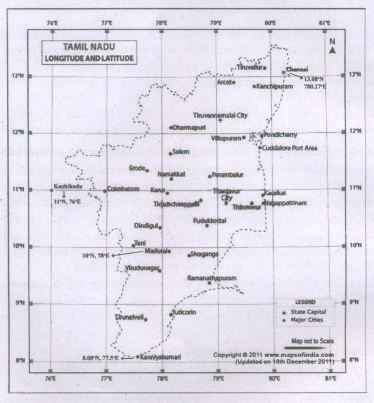
With the help of an atlas, mark the following on the outline map of Tamil Nadu.
a) The latitude and longitude of Chennai.
b) Mark the city located at 100N, 780E.
c) Locate the city approximately on 110N and 760E.
d) Find the latitude and longitude of Kanyakumari and mark it.
30.
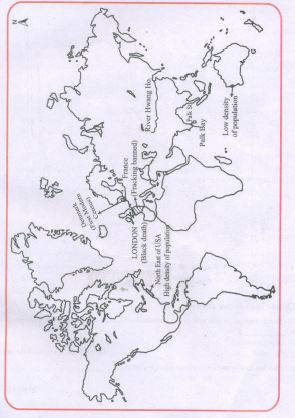
On the outline map of the world mark the following.
1. England - A country affected by 'black death'.
2. Denmark - First country where the modern census was conducted.
3. River Hwang Ho.
31.
Large scale map and small scale map
32.
Social life in France
a) What was the tax collected by the Church in France?
b) Who was Danton?
c) Who were the Encyclopaedists of eighteenth century France?
d) Who provided free labour for the construction of public roads?
1.
(a)
Transvaal
2.
(a)
'Stop, Drop, Roll’ is for fire.
3.
(c)
Labour Day
4.
(a)
Girondins
5.
(a)
Chola
6.
(c)
October – December
7.
(c)
Mining
8.
Ethiopia
9.
Britain and France
10.
Cartography
11.
to reduce the volume of migration
12.
noise pollution
13.
Coconut, Channa
14.
(i) The Zulu tribe was known for its strong fighting spirit.
(ii) They were represented by renowned warriors like Shaka Zulu.
(iii) Shaka Zulu played a prominent role in building the largest Zulu nation in South-Eastern Africa.
(iv) British troops invaded Zulu territory and divided it into thirteen chiefdoms.
(v) The Zulus never regained their independence and they had to fight against deeply entrenched racism in South Africa for about a century.
15.
(i) The British Parliament repealed the Townshend Acts. But it retained the tax on tea.
(ii) This harmed the local tea trade and so it was decided to boycott this tea. In many places the colonists obstructed the import of tea.
(iii) In New York and Philadelphia ships carrying tea were blocked.
(iv) In December 1773, a group of men disguised themselves as Native Americans boarded the Cargo vessels and threw the tea overboard which was hailed as the Boston Tea party.
(v) It was a challenge which led to war between the rebellious colonies and England.
16.
(i) Urban local governments are Corporation, Municipality and Town Panchayat
(ii) The area where more than 10,000 people are living is called a Town Panchayat
(iii) Municipalities were constituted in India for the first time in Chennai in 1688
(iv) Municipal Corporation are established in big cities.
17.
The poorer sections of the people migrate for survival but migrants from better off sections migrate to improve their living standards.
18.
(i) Saplings of native species of plants and trees are being grown, planted and cared for
(ii) Live colonies of coral from the Gulf of Mannar Biosphere Reserve are being transplanted to Palk Bay. The existing mangroves and the region are being mapped and the way land is used around the mangrove is being studied.
(iii) Along with awareness programmes, the communities are also being provided with livelihood training, so they can earn an income in more ways than just fishing.
19.
April Revolution and democracy in Nepal.
i) On April 2006, the leaders of Nepal vibrant pre-democracy civil society movement "Seven Party Alliance" (SPA) called for a million strong demonstration.
ii) It was stage at seven different points along the Ring road encircling the capital Kathmandu.
iii) People demanded end to the autocratic rule of monarchy and restoration of total democracy.
iv) The king Gyanendra stepped down paving the way for democracy in Nepal.
20.
(i) Food crops: Paddy, Maize, Ragi, Cumbu
(iii) Non-food crops: Coconut, Cotton, Coffee, Tea, Sugar cane.
21.
(i) Until the last quarter of the nineteenth century Africa, South of the Sahara was almost unknown to the outside world.
(ii) The interior of Africa was unexplored.
(iii) After 1875 European penetration and colonisation began on a large scale.
(iv) European colonisation of Africa was thus accomplished smoothly without any outbreak of war against major European powers.
(v) This invasion, occupation, colonisation and annexation of African territories by European powers between 1881 and 1914, the era of Imperialism is called the scramble for Africa.
or the partition of Africa.
22.
(i) The Seven years war of 1756 - 63 between Britain and France had center on the control of colonies especially in North America.
(ii) Britain defeated France and took control of Canada.
(iii) But the war cost the English heavily.
(iv) The British ministers proposed that the American colonists pay some of the cost of the war.
(v) So a series of taxes were imposed on the colonists.
| 1764 | Sugar Act |
| 1765 | Stamp Act |
| 1767 | Townshend Act |
| 1764 | Currency Act |
| 1766 | Declaratory Act |
(vi) The American colonists protested against all the above taxes.
(vii) The British Parliament did not give representation to the colonists.
(viii) The colonies did not begin fighting for the sake of independence.
(ix) Their grievances were taxation and restrictions on trade.
(x) They challenged the right of the British parliament to tax them against their will.
(xi) George Washington became the commander-in-chief of the colonists army.
(xii) "No taxation without representation" was their famous battle cry.
23.
24.
(i) Scale is one of the components of map.
(ii) Scale makes it possible to reduce the size of the whole earth to show it on a piece of paper.
(iii) A scale is a ratio between the actual distance on the map to the actual distance on the ground.
(iv) Scales can be represented in three methods.
(v) They are the
(a) Statement,
(b) Representative Fraction (R.F) and
(c) Linear or Graphical scale methods.
(a) Statement Scale:
The statement scale describes the relationship of map distance to ground distance in words, such as one centimetre to ten kilometres. It is expressed as 1 cm = 10 km.
What do you mean by the term
(i) It describes the proportion or ratio of the map distance to ground distance. It is usually abbreviated as R.F. It is stated as 1/100000 or 1:100000
(ii) This means that one unit on the map represents 100,000 of the same unit on the ground.
(iii) This unit may be an inch or a centimetre or any other linear measurement unit.
(b) Representative Fraction (R.F.) = \(\frac{Distance \ on \ the \ map}{Distance \ on \ the \ Ground}\)
(c) Linear (or) Graphical scale: In geography, a linear scale is represented by a straight line divided into equal parts (Primary and secondary) to show what these markings represent on the actual ground. This scale helps in the direct measurement of distance on the map.
25.
Presidential form of government
(i) The American President is both the head of the state and the head of government. As the head of state, he occupies a ceremonial position.
(ii) The president is elected by an electoral college for a fixed tenure of four years.
(iii) He governs with the help of a cabinet or a smaller body called' Kitchen Cabinet' . It is only an advisory body.
(iv) The President and his secretaries are not responsible to the Congress for their acts.
(v) The legislative, executive and judicial powers of the government are separated.
(vi) It is also known as non-responsible or non-parliamentary or fixed executive system of government.
Difference between Presidential and Parliamentary form of government
| No. | Presidential Form of Government | Parliamentary form of Government |
|---|---|---|
| 1 | President is directly elected by the people. | Prime Minister is the leader of majority party. |
| 2 | President is supreme | Central Legislature is supreme |
| 3 | Separation of Powers | Absence of Separation Powers Centralisation |
| 4 | Independent branches | Independent branches with Overlapping functions |
| 5 | President-head of the Government | Prime Minister-head of the Government |
| 6 | Separation of Powers | Centralisation |
| 7 | Independent branches | Independent branches with Overlapping functions |
| 8 | Individual Leadership | Collective leadership |
| 9 | President is not accountable to Congress | Collective and Individual Responsibility. |
26.
(i) Agriculture in Tamil Nadu is dependent on ground water.
(ii) Use of ground water for agriculture creates many hardships too.
(iii) The Union Water Board is constantly monitoring the level and nature of ground water.
(iv) This continuous monitoring has categorized the panchayat union in terms of the amount of groundwater used.
(v) 139 blocks are identified as excessive users of ground water.
(vi) Only 136 blocks have enough quantity and quality water for usage.
(vii) It is very urgent and necessary to regulate the usage of underground water.
27.
(i) Web mapping is the process of using the maps delivered by geographic information systems.
(ii) The advent of web mapping can be regarded as major new trend in cartography.
(iii) Until recently cartography was restricted to a few companies, institutes, mapping agencies.
(iv) Web mapping has brought many geographical data sets.
28.
(i) The population growth increases when there are more births and immigration.
(ii) Unemployment, Social defence, Deforestation and Urbanisation are the mandate of population growth.
29.
30.
31.
| Large Scale Map | Small Scale Map | |
| (i) | It shows only small area. | It shows a large area. |
| (ii) | But it shows in great detail. | But it shows in less detail |
32.
a) The clergy collected tithe (one tenth of the annual produce or earnings) from the common people
b) Danton, a great leader of the Revolution, addressed the assembled crowds and threw an open challenge to other European kings. He along with Herbert and Robespierre emerged as the main leaders of the National Convention
c) Diderot and Jean d' Alembert were the two Encyclopaedists of the eighteenth century of France.
d) The Peasants provided free labour for the construction of public roads.

9th Standard Syllabus & Materials
9th Standard
TN 9th Tamil உள்ளத்தின் சீர் - திருக்குறள் Important Questions And Answers Study Material - QB365 Set A
NEW9th Standard
TN 9th Tamil உள்ளத்தின் சீர் - மணிமேகலை Important Questions And Answers Study Material - QB365 Set A
NEW9th Standard
TN 9th Tamil உள்ளத்தின் சீர் - ஏறு தழுவுதல் Important Questions And Answers Study Material - QB365 Set A
NEW9th Standard
TN 9th Tamil உயிருக்கு வேர் - தண்ணீர் Important Questions And Answers Study Material - QB365 Set A



Tamilnadu Stateboard 9th Standard Subjects
Tamilnadu Stateboard Standards




