
 100% FREE ACCESS
9th Standard Syllabus & Materials
9th Standard
TN 9th Tamil உள்ளத்தின் சீர் -கற்கண்டு (இலக்கணம்) - தொடர் இலக்கணம், ஆகுபெயர் Important Questions And Answers Study Material - QB365 Set A
NEW9th Standard
TN 9th Tamil உள்ளத்தின் சீர் -விரிவானம் (துணைப்பாடம்) - தாய்மைக்கு வறட்சி இல்லை! Important Questions And Answers Study Material - QB365 Set A
NEW9th Standard
TN 9th Tamil உள்ளத்தின் சீர் -கவிதை பேழை (செய்யுள்) - மார்கழி பெருவிழா Important Questions And Answers Study Material - QB365 Set A
NEW9th Standard
TN 9th Tamil உயிருக்கு வேர்-இலக்கணம் - பகுபத உறுப்பிலக்கணம் Important Questions And Answers Study Material - QB365 Set A
NEW9th Standard
TN 9th Tamil அமுதென்று பேர் - இலக்கணம்-எழுத்து -அளபெடை Important Questions And Answers Study Material - QB365 Set A
NEW9th Standard
TN 9th Tamil அமுதென்று பேர்-துணைப்பாடம் - ஆறாம்திணை Important Questions And Answers Study Material - QB365 Set A

Published on: 12/02/2020
9th Standard Social science Annual Question Model
Download Tamil Nadu 9th Standard Social Science question papers, model tests, one-mark questions, important questions, and public exam papers in PDF format. Free study materials and answer keys for TN State Board students.
Questions + Answers key
Take MCQ Social Science Test
1.
In Tamil Nadu, migrants account for ___________ percent in rural areas.
38
41
28
50
2.
James Munroe was the Governor of _________ Presidency.
Calcutta
Bombay
Madras
None of the above
3.
The productivity of paddy during the year 2014-2015
3,039 kg
4,429 kg
2,775 kg
3,519 kg
4.
The statistical study of human population is ___________.
Demography
Morphology
Etymology
Seismography
5.
Zwingli worked from_______
Zurich
Genoa
Rome
Spain
6.
One rupee and two rupee notes were first printed in India in the year_______
1917
1927
7.
Seljuq Turks came from_________
Central America
Central Asia
Central Australia
Central Europe
8.
The guild known as "the five hundred" (ainnurruvar) had its headquarters in_______
Nagapattinam
Ajanta
Calicut
Aihole
9.
_______is the Greek city-state which resisted the Persians to the end.
Acropolis
Sparta
Athens
Rome
10.
India is the______________________ th country in the world to introduce NOTA.
10
12
14
16
11.
In democracy the final authority rests with
The Parliament
The People
The council of Ministers
The President
12.
Sir Robert Bruce Foote, a geologist from England first discovered the ______ tools at Pallavaram near Chennai.
Stone Age
Palaeolithic
Mesolithic
Neolithic
13.
Mention the major rea one of Road accidents
14.
Write a note on Farmer Producer Organizations (FPOs) in Tamil Nadu.
15.
What are natural pollutants?
16.
Highlight any two important results of Industrial Revolution.
17.
List out the salient features of Tamil Nadu Panchayat Raj Act 1994.
18.
What are the factors responsible for the poorer sections and better-off sections to migrate?
19.
Unitary form of government
20.
Narrate the given food web of Arctic Tundra in your own words.
21.
What were the items used as barter during olden days?
22.
What are the factors that generate the ocean currents?
23.
What is sericulture?
24.
What is Geology?
25.
What does the third section of the Tholkappiyam describe?
26.
What was the main factor for the development of early civilisations?
27.
Write a note on the Great Wall of China.
28.
Mention the rules to ensure Road Safety for children.
29.
Write about ammaalvari journey towards Organic farming?
30.
What is 'Migration'? and explain its types.
31.
Enumerate the causes for the Second Industrialization in the USA.
32.
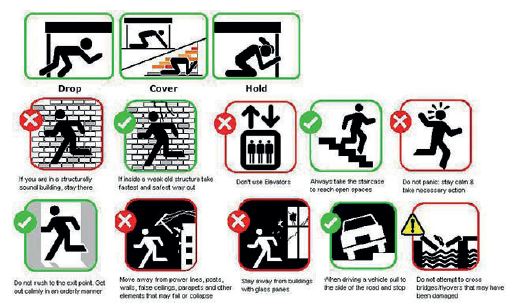
1. Why do you think you should cover your head with one hand and hold the table with the other during an earthquake?
2. During an earthquake, why should we exit through staircase and not use elevators?
3. Suppose you are in a room of a strong building without any furniture when an earthquake occurs. What would you do to protect yourself from the earthquake?
4. Reason out why should you stay away from buildings with glass panes during an earthquake.
33.
Describe the major problems & challenges faced by the local self governments.
34.
Elucidate about some of the interesting findings on migration in Tamil Nadu.
35.
Write about the merits of unitary form of government.
36.
Explain the relationship between Money and Price.
37.
During the later Middle Ages what developments did Christianity undergo?
38.
Discuss how Renaissance, Reformation and Geographical discoveries heralded the modern age?
39.
Is wind the only gradational agent in the desert?
40.
Give an account of Mobilisation and Democratic Participation.
41.
Discuss the Neolithic culture in Tamil Nadu
42.
Explain the conditions necessary for the success of democracy in India
43.
Consider the following statements.
Assertions (A): Rights and duties are the two sides of the same coin.
Reason (R): We have a right to freedom of religions. We have to promote harmony and the spirit of the people of other religions.
a) Both A and R are correct and R explains A
b) Both A and R are correct but R does not explain A
c) A is correct but R is false
d) A is false but R is correct
both A and R are correct and R explains A
both A and R are correct but R does not explain A
A is correct but R is false
A is false but R is correct
44.
What are the de-merits of federal form government?
45.
What do you do if you are indoors during an earthquake?
1.
(b)
41
2.
(c)
Madras
3.
(b)
4,429 kg
4.
(a)
Demography
5.
(a)
Zurich
6.
(a)
1917
7.
(b)
Central Asia
8.
(d)
Aihole
9.
(c)
Athens
10.
(c)
14
11.
(a)
The Parliament
12.
(b)
Palaeolithic
13.
The major reasons of road accident are
i) Negligence in driving
ii) Drunk and drive
iii) Overlooking the other vehicles
iv) High speed
v) Improper driving training and
vi) Non-stop long driving
14.
(i) Small and marginal farmers in Tamil Nadu will be benefited from FPOs.
(ii) Each of the producers' groups have been given an investment grant of Rs. 5 lakh to purchase farm equipment.
(iii) Apart from using the equipment within the group, these can also be rented out to other farmers.
(iv) The government also has a contract farming policy.
15.
The natural pollutants are volcanic eruptions, wind erosion, pollen disposal, evaporation of organic compounds and radioactive elements etc.,
16.
(i) Expansion of trade.
(ii) The Production of more food.
(iii) Emergence of factory workers as a new class.
(iv) Development in transport and communication.
17.
The salient features of the Tamil Nadu Panchayat Raj Act of 1994-
(i) A three tier system,
(ii) Gram Sabha
(iii) Establishment of Election Commission
(iv) Constitution of Finance Commission
(v) Reservation of Seats for SS/ST's proportionate to their population.
(vi) One third reservation of seats for women and
(vii) Constitution of District Planning Committees.
18.
The poorer sections of the people migrate for survival but migrants from better off sections migrate to improve their living standards.
19.
(i) A unitary system of government, or unitary state is a sovereign state governed as a single entity.
(ii) The central Government is supreme, and the administrative divisions exercise only powers that the Central Government has delegated to them.
(iii) Suitable for small countries.
(iv) A unitary government is less expensive.
(v) In this form of Government amendments to the constitution are easy.
20.
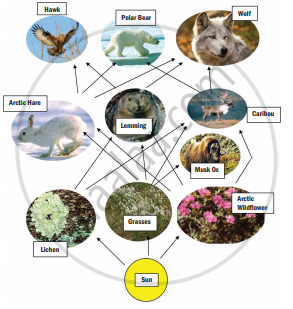
It is a well-balanced food web. This region gets slanting sunrays means very little sunlight in which lichens, grasses, and wildflowers grow and form the first trophic level as a producer. In the second trophic level herbivores who depend on the producers for survival like Arctic Hare, Musk ox, Lemming is the primary consumers. Carnivores who eat the herbivore are-Hawk, Polar Bear and Wolf. They are above the herbivores in a food pyramid. They are secondary consumers.
21.
Leather, beads, shells, tobacco, salt, corn, cattle and even slaves were exchanged as barter.
22.
The factors that generate ocean currents are:
(i) Earth's rotation
(ii) Prevailing winds and
(iii) Differences in temperature and salinity of ocean water
23.
(i) Sericulture the silk production by breeding the mulberry silkworm was introduced in the fourteenth and fifteenth centuries.
(ii) By the seventeenth century, Bengal had become one of the largest silk-producing regions in the world.
(iii) In addition, other varieties of silk (like tassar) were also produced.
24.
The science that deals with the physical structure and substances of the earth their history and the processes which act on them.
25.
The third section of Tholkappiyam describes poetic conventions that provide information on Tamil social life.
26.
(i) As a result of domestication and cultivating plants, there was an excess food production.
(ii) The surplus food production was a main factor for the development of early civilisations.
27.
(i) The Great Wall of China, one of the wonders of the world, was a massive effort undertaken for the protection of China from the Mongols.
(ii) In 220 BCE, under Qin Shi Huang, earlier fortifications were connected by walls as a form of defence against invasions.
(iii) It was built from third century BCE until 17th century CE.
(iv) It ran for over 20,000 kilometres covering the hills and plains, from the border of Korea in the east to the Ordos Desert in the west.
28.
Rules to Ensure Road Safety for chlldren
It is impportant for children to know about road safety rules and regulatioins. Here are a few
basic road safety rules for children.
i) Know Your Signals
ii) Stop, Look and Cross
iii) Pay Attention - Listen
iv) Don't Run on Roads
v) Always Use Sidewalks
vi) Never Stick Hands outside the Vehicle
vii) Never cross Road at Bends
viii) Don't Rush.
29.
(i) When Green Revolution was spreading throughout the nation, Nammalvar started his life journey towards organic farming.
(ii) He resigned his regional Agricultural Developmental Officer post for this purpose.
(iii) He believed in the youth the future generation of India.
(iv) Nearly 6000 youth had completed training in organic farming in his Vanagam Farm.
(v) He spent most of his days in struggles for organic farming and travels campaigning for the same.
(vi) He used only public transport.
(vii) He felt that this was his small role in reducing environmental pollution.
30.
(i) Migration is defined as the permanent or semi-permanent change of home of an individual or a group of people over a significant distance from their place of birth.
(ii) The causes of migration may be physical (climate, drought, flood, earthquake, volcanic eruption, epidemics etc.), social inequalities, economic opportunities, technology, education, cultural clashes, war or political issues.
(iii) There are two types of migration:
(a) Internal Migration
The movement of people within a country i.e. between states, districts, villages, etc is called as Internal migration.
(b) International Migration
The movement of people from one country to another, across international borders is called as International migration.
31.
1. A shift from manual labour based to more technical and machine based manufacturing industry marked the industrial revolution in the United States.
2. Samuel Slater, a citizen of England having worked at a cotton mill from the age of 10 had gained enough experience to operate a mill.
3. On learning that Americans were interested in the new techniques, Slater departed for New York in 1789 illegally. Slater offered his service to Moses Brown, who had earlier made an unsuccessful attempt to operate a mill.
4. Brown agreed and in consequence the mill became operational in 1793 being the first water-powered roller spinning textile mill in America.
5. By 1800, Slater's mill had been duplicated by many other entrepreneurs as Slater grew wealthier and his techniques became more and more popular.
6. Andrew Jackson, the U.S. President hailed him as Father of the American Industrial revolution.
7. In the Nineteenth Century America began to show technological innovation.
8. Robert Fulton established the steamboat service on the Hudson River.
9. Samuel E. B. Morse invented the telegraph and Elias Howe invented the sewing machine. This was the main cause for the industrialisation.
10. In 1869 the first transcontinental railroad was completed to transport people, raw materials and products.
11. The invention of electric bulb of Thomas Alva Edison and telephone by Alexander Graham Bell changed the world beyond recognition.
32.
1. It is mainly to protect the head and neck from gently damaged.
2. Because the earthquake likely to knock out electrical power, the elevator machinery will not work.
3. If doors are opened, stand under a door way or in a comer inside the room. Cover your face and head with your arms.
4. At jolting of the earthquake bursting and breaking of wall, glass panes may happen. So it is better to be away from it.
33.
Problems and challenges facing the local self governments.
(i) Local self governments are the crucial basis for our democracy.
(ii) The Constitutional status of local self governments adds more significance to their functioning.
(iii) There are a few critical concerns in the working of local self governments in India.
(iv) Major problems and challenges may be mentioned as below.
1. Lack of clear demarcation of powers and functions of local bodies.
2. Allocation of funds and needs assessment are not matched.
3. Combined with accountability, the local self governments demand for more autonomy and economic freedom may be addressed.
4. Role of caste, class and religion in decision making at the local self governments.
5. Poor accountability of elected members and officials at the grassroots of democracy.
34.
(i) Change in population occurs due to births, deaths and migration.
(ii) Almost everyone keeps moving most of the time, it is not easy to define which of these moves have to be classified as migratory moves.
(iii) According to the census of 2011 the population was 7.2 crore in Tamil Nadu.
(iv) 3.13 crore people were counted as migrants.
(v) The mobility of population in rural areas is greater than in urban areas.
(vi) Mobility is usually associated with male rather than female.
(vii) The poorer sections of the people migrate for survival but migrations from better off sections is to improve their living standards
(viii) Of the International migrants 15% are women while 85% are men.
35.
Merits of unitary form of government
(i) Suitable for small countries.
(ii) There is no conflict of authority and responsibility.
(iii) A unitary government will make prompt decisions and take speedy action.
(iv) A unitary government is less expensive.
(v) Amendments to the constitution are easy.
(vi) There is unity, uniformity of law, policy and administration.
36.
(i) The relationship between money and price is connected with the Monetary policy.
(ii) There is a close relationship between the growth of money supply and inflation.
(iii) Price controls play a very important role in a country's economic stability.
(iv) This role is played by RBI.
(v) Currency is the medium of exchange in a country.
(vi) The Indian currency is called the Indian Rupee (INR).
(vii) In a country the foreign currency is called foreign exchange.
(viii) Purchasing capacity of all currencies in the world are compared using the US dollar as the standard currency.
(ix) This value differs from country to country.
(x) Most of the international trade transactions are carried out in US dollar
37.
(i) Christianity underwent many significant developments during the later Middle Ages.
(ii) The most important were in matters of doctrine and religious practices.
(iii) New elements were included in Christian theology like theory of priesthood and the theory of sacraments.
(iv) Excommunication and Interdict were the two instruments used against those who defied the Church.
38.
(i) The Italian humanist Petrarch's Canzoniere, German theologian Martin Luther's Ninety-five theses and Portugal Prince Henry's Navigation School heralded the dawn of the modern era.
(ii) The Holy Roman Empire and the Roman Church became weak and discredited.
(iii) In their place nation states, new Churches that emphasized individual faith, and a commercial revolution based on mercantilism emerged.
(iv) The modern era was characterized by freedom of thought, individualism, rationalism, and economic and scientific progress.
(v) The changes ushered in were the Renaissance, Reformation and Geographical Discoveries.
39.
(i) As the desert are with little or no rainfall, wind is the only gradational agent.
(ii) Mechanical weathering is the dominant activity as there are limited plants.
40.
Mobilising people towards socially productive activities that lead to the overall betterment of people's lives is essential. Sometimes earthquakes, tsunamis, floods and other such natural disasters on a massive scale occur and people's immediate mobilisation for evacuation and emergency relief becomes most essential.
Democratic Participation: Democracy can succeed only when smaller local groups and, in fact, every citizen can take action that supports the tax and revenue collection systems, observance of national norms in environmental protection, cleanliness, health and hygiene, sanitary drives and immunisation programmes like pulse polio. However, we must keep in mind that there is no better form of government than Democratic government. To create a better society and nation, the people of India along with the union and state governments should come together to fight against the miseries of human life.
41.
(i) The culture that domesticated animals and cultivated crops is called Neolithic.
(ii) It is known as the New Stone Age. The Neolithic people used polished stone axes called celts.
(iii) Cattle rearing was their main occupation. They lived in small villages with houses made of thatched roof and walls plastered with clay.
(iv) Evidence of Neolithic village is found at Payyampalli in Vellore district and a few sites in the Dharmapuri region.
(v) Payyampalli is a village in Vellore district of Tamil Nadu. The earliest evidence for the domestication of animals and cultivation of plants is found at this site, which was excavated by the Archaeological Survey of India.
(vi) Evidence for pottery making and cultivation of horse gram and green gram has been found in this village.
(vii) These Neolithic sites were part of the Southern Neolithic Culture of India. They are mainly concentrated in the Andhra Pradesh and Karnataka regions.
(viii) The Neolithic people used stone axes fitted on a wooden handle.
(ix) These polished stone axes are worshipped in many village temples of Tamil Nadu even today.
42.
(i) Empowerment of the poor and illiterates to enjoy the goodness of democracy.
(ii) Willingness among the elected people not to misuse their powerful position and public wealth.
(iii) Eradication of social evils and dangers from which democracy suffers.
(iv) An impartial and efficient press to form public opinion.
(v) Presence of strong public opinion.
(vi) Feeling of tolerance and communal harmony among the people.
(vii) Awareness among the people of the fundamental rights that they are entitled to enjoy.
(viii) Conscious check and vigilance on the working of the elected representatives.
(ix) Powerful and responsible opposition
43.
a) Both A and R are correct and R explains A
44.
De-merits of federal form of government are,
(a) Federal government in weaker when compared to the unitary government.
(b) Federal government is more expensive.
(c) Provincial tendencies are very common
(d) Lack of uniformity in Administration
(e) Threat to national unity
(f) Distribution powers between centre and states lead to conflict
(g) Double Citizenship
(h) Rigid constitution cannot be amended easily for the changing needs.
(I) The state governments sometimes place hindrances in the foreign policy.
45.
During earthquake if you are indoor:
(i) DROP to the ground; take COVER by getting under a sturdy table or other piece of furniture and HOLD ON until the shaking stops. If there is no table or desk near you, cover your face and head with your arms and crouch in an inside corner of the building.
(ii) Protect yourself by staying under the lintel of an inner door, in the corner of a room, under a table or even under a bed.
(iii) Stay away from glass windows, outside doors and walls, and anything that could fall, (such as lighting fixtures or furniture).
(iv) Stay inside until the shaking stops and afterwards it is safe to go outside.

9th Standard Syllabus & Materials
9th Standard
TN 9th Tamil உள்ளத்தின் சீர் - திருக்குறள் Important Questions And Answers Study Material - QB365 Set A
NEW9th Standard
TN 9th Tamil உள்ளத்தின் சீர் - மணிமேகலை Important Questions And Answers Study Material - QB365 Set A
NEW9th Standard
TN 9th Tamil உள்ளத்தின் சீர் - ஏறு தழுவுதல் Important Questions And Answers Study Material - QB365 Set A
NEW9th Standard
TN 9th Tamil உயிருக்கு வேர் - தண்ணீர் Important Questions And Answers Study Material - QB365 Set A



Tamilnadu Stateboard 9th Standard Subjects
Tamilnadu Stateboard Standards




