
 100% FREE ACCESS
9th Standard Syllabus & Materials
9th Standard
TN 9th Tamil உள்ளத்தின் சீர் -கற்கண்டு (இலக்கணம்) - தொடர் இலக்கணம், ஆகுபெயர் Important Questions And Answers Study Material - QB365 Set A
NEW9th Standard
TN 9th Tamil உள்ளத்தின் சீர் -விரிவானம் (துணைப்பாடம்) - தாய்மைக்கு வறட்சி இல்லை! Important Questions And Answers Study Material - QB365 Set A
NEW9th Standard
TN 9th Tamil உள்ளத்தின் சீர் -கவிதை பேழை (செய்யுள்) - மார்கழி பெருவிழா Important Questions And Answers Study Material - QB365 Set A
NEW9th Standard
TN 9th Tamil உயிருக்கு வேர்-இலக்கணம் - பகுபத உறுப்பிலக்கணம் Important Questions And Answers Study Material - QB365 Set A
NEW9th Standard
TN 9th Tamil அமுதென்று பேர் - இலக்கணம்-எழுத்து -அளபெடை Important Questions And Answers Study Material - QB365 Set A
NEW9th Standard
TN 9th Tamil அமுதென்று பேர்-துணைப்பாடம் - ஆறாம்திணை Important Questions And Answers Study Material - QB365 Set A

Published on: 20/02/2019
Term 3 SA Mock Test 2019
Download Tamil Nadu 9th Standard Maths question papers, model tests, one-mark questions, important questions, and public exam papers in PDF format. Free study materials and answer keys for TN State Board students.
Questions + Answers key
Take MCQ Maths Test1.
What is the probability of drawing a King or a Queen or a Jack from a deck of cards?
2.
You are walking along a street. If you just choose a stranger crossing you, what is the probability that his next birthday will fall on a Sunday?
3.
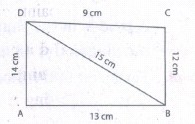
Find the area of a quadrilateral ABCD whose sides are AB = 13cm, BC = 12cm, CD = 9cm, AD = 14cm and diagonal BD = 15cm.
4.
Draw the graph of the equations x= 3, x = 5 and 2x – y – 4 = 0. Also find the area of the quadrilateral formed by these lines and the x-axis.
5.
Using Heron’s formula, find the area of a triangle whose sides are
(i) 10 cm, 24 cm, 26 cm
(ii) 1.8 m, 8 m, 8.2 m
6.
Verify 3 cos A = 4 cos3 A - 3 cosA , when A = 300
7.
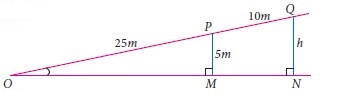
A boy standing at a point O finds his kite flying at a point P with distance OP = 25 m. It is at a height of 5m from the ground. When the thread is extended by 10 m from P, it reaches a point Q. What will be the height QN of the kite from the ground? (use trigonometric ratios)
8.
Find the coordinates of the point which divides the line segment joining the points A(4,−3) and B(9,7) in the ratio 3:2.
9.
The points A(−3, 6), B(0, 7) and C(1, 9) are the mid-points of the sides DE, EF and FD of a triangle DEF. Show that the quadrilateral ABCD is a parallelogram.
10.
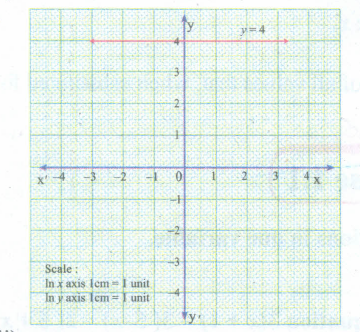
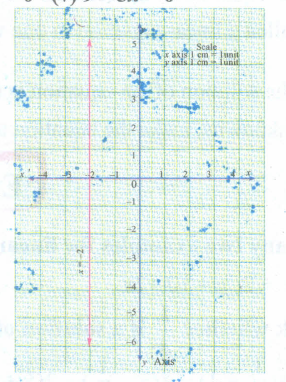
Draw the graph for the following linear equations
(i) y = 4
(ii) x = -2
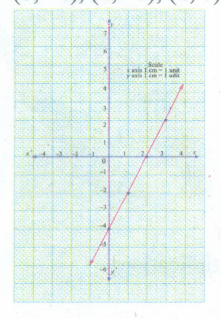
(iii) 2x - 4 =0
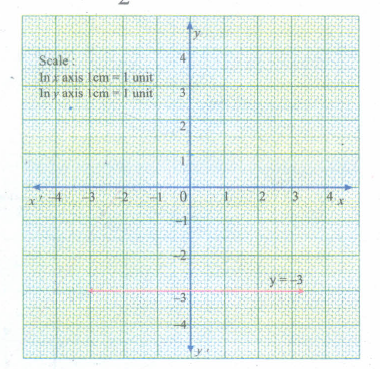
(iv) 6 + 2y = 0
(v) 9 – 3x = 0
11.
The length, breadth and height of a cuboid are in the ratio 7: 5: 2. Its volume is 35840 cm3. Find its dimensions.
12.
In an office, where 42 staff members work, 7 staff members use cars, 20 staff members use two-wheelers and the remaining 15 staff members use cycles. Find the relative frequencies.
13.
When a dice is rolled, find the probability to get the number greater than 4?
14.
The length, breadth and height of a hall are 25 m, 15 m and 5 m respectively. Find the cost of renovating its floor and four walls at the rate of Rs. 80 per m2.
15.
Find the TSA and LSA of a cuboid whose length, breadth and height are 7.5 m, 3 m and 5 m respectively.
16.
Find the value of cos19059'
17.
Check the value of k for which the given system of equations kx + 2y = 3; 2x − 3y = 1 has a unique solution.
18.
(i) If cosec A = sec 340, then find A
(ii) If tan B = cot 470, then find B.
19.
If the centroid of a triangle is at (−2, 1) and two of its vertices are (1, −6) and (−5, 2), then find the third vertex of the triangle.
20.
Check whether (5, −1) is a solution of the simultaneous equations x – 2y = 7 and 2x + 3y = 7.
21.
If sec \(\theta\) = \(\frac { 13 }{ 5 } \), then show that \(\frac { 2sin\theta -3cos\theta }{ 4sin\theta -9cos\theta } \) = 3
22.
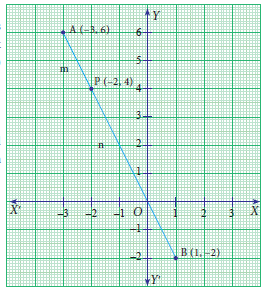
In what ratio does the point P(–2, 4) divide the line segment joining the points A(–3, 6) and B(1, –2) internally?
23.
The perimeter of a rectangle is 36 metres and the length is 2 metres more than three times the width. Find the dimension of rectangle by using the method of graph.
24.
The volume of a cuboid is 660 cm3 and the area of the base is 33 cm2. Its height is _______.
10 cm
12 cm
20 cm
22 cm
25.
If the lateral surface area of a cube is 600 cm2, then the total surface area is _______.
150 cm2
400 cm2
900 cm2
1350 cm2
26.
A letter is chosen at random from the word “STATISTICS”. The probability of getting a vowel is
\(\frac { 1 }{ 10 } \)
\(\frac { 2 }{ 10 } \)
\(\frac { 3 }{ 10 } \)
\(\frac { 4 }{ 10 } \)
27.
A particular result of an experiment is called _______.
Trial
Simple event
Compound event
Outcome
28.
The value of 2tan30° tan60° is
1
2
\(2\sqrt { 3 } \)
6
29.
If sin \(\alpha\) = \(\frac { 1 }{ 2 } \) and \(\alpha\) is acute, then (3 cos\(\alpha\) - 4cos3 \(\alpha\)) is equal to
0
\(\frac { 1 }{ 2 } \)
\(\frac { 1 }{ 6 } \)
-1
30.
Which condition does not satisfy the linear equation ax + by + c = 0.
a \(\neq \) 0 , b = 0
a = 0 , b \(\neq \) 0
a = 0 , b = 0 , c \(\neq \) 0
a \(\neq \)0, b \(\neq \) 0
31.
Which of the following is a solution of the equation 2x − y = 6.
(2,4)
(4,2)
(3, −1)
(0,6)
32.
The centroid of the triangle with vertices (−1, −6), (−2, 12) and (9, 3) is
(3, 2)
(2, 3)
(4, 3)
(3, 4)
33.
The coordinates of the point C dividing the line segment joining the points P(2, 4) and Q(5, 7) internally in the ratio 2:1 is______.
\((\frac{7}{2},\frac{11}{2})\)
(3, 5)
(4, 4)
(4, 6)
1.
Number of cards n(S) = 52
No. of King cards n(A) = 4
No. of Queen cards n(B) = 4
No. of Jack cards n(C) = 4
Probability of drawing a King card
\(\frac { n(A) }{ n(S) } =\frac { 4 }{ 52 } \)
Probability of drawing a Queen card
=\(\frac { n(B) }{ n(S) } =\frac { 4 }{ 52 } \)
Probability of drawing a Jack card
=\(\frac { n(C) }{ n(S) } =\frac { 4 }{ 52 } \)
∴ The Probability of drawing a King or a Queen or a Jack from a deck of cards
= p(A) + P(B)+ P(C) =\(\frac { 4 }{ 52 } +\frac { 4 }{ 52 } +\frac { 4 }{ 52 } =\frac { 4+4+4 }{ 52 } =\frac { 12 }{ 52 } =\frac { 3 }{ 13 } \).
2.
(S) Days in a week = {Sunday, Monday, Tuesday, Wednesday, Thursday, Friday, Saturday}
n(S) = 7
∴ No. of days in week = 7
(A) Event of selecting Sunday = {Sunday}
n(A) = 1
∴ Probability of selecting Sunday = \(\frac { n(A) }{ n(S) } =\frac { 1 }{ 7 } \).
3.
Area of the quadrilateral ABCD
= Area of the Δ ABD + Area of the Δ BCD
Sides of the triangle ABD are 13 cm, 14 cm, 15 cm.
s = \(\frac { 13+14+15 }{ 2 } \)cm
= \(\frac { 42 }{ 2 } \) = 21 cm
Area =\(\sqrt { s(s-a)(s-b)(s-c) } \)
=\(\sqrt { 21(21-13)(21-14)(21-15) } \)
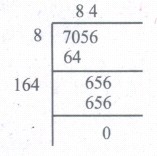
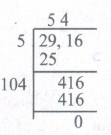
=\(\sqrt { 21\times 8\times 7\times 6 } =\sqrt { 7056 } \)=84 cm2
sides of the triangle
BCD are 12 cm, 9 cm, 15 cm
∴ s = \(\frac { 12+9+15 }{ 2 } =\frac { 36 }{ 2 } \) = 18 cm
Area =\(\sqrt { 18(18-2)(18-9)(18-15) } \)
=\(\sqrt { 18\times 6\times 9\times 3 } =\sqrt { 2916 } \) = 54 cm2
∴ Area of the quadrilateral
= 84 cm2 + 54 cm2 =138 cm2
4.
x = 3, x = 5
2x-y-4 = 0
y = 2x-4
| x | -1 | 0 | 1 | 2 | 3 | 4 |
| 2x | -2 | 0 | 2 | 4 | 6 | 10 |
| -4 | -4 | -4 | -4 | -4 | -4 | -4 |
| y=2x-4 | -6 | -4 | -2 | 0 | 2 | 6 |
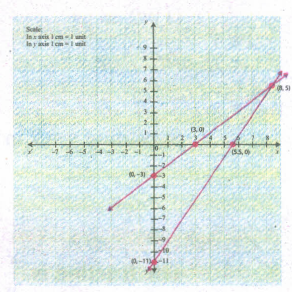
The points to be plotted
(-1, - 6), (0, - 4), (1, - 2), (2, 0), (3,2), (5, 6)
Area of the quadrilateral = \(\cfrac { 1 }{ 2 } \times h(a+b)=\cfrac { 1 }{ 2 } \times 2(2\div 6)\)
Area of the quadrilateral = 8 sq.units
5.
(i) sides: 10 cm, 24 cm, 26 cm
Using Heron's formula
Area of the triangle = \(\sqrt { s(s-a)(s-b)(s-c) } \) sq. units
s = \(\frac { a+b+c }{ 2 } =\left( \frac { 10+24+26 }{ 2 } \right) cm=\frac { 60 }{ 2 } \) = 30 cm
∴ Area =\(\sqrt { 30(30-10)(0-24)(0-26) } \)
= \(\sqrt { 30\times 20\times 6\times 4 } =\sqrt { 600\times 24 } =\sqrt { 14400 } \) = 120 cm2
(ii) Sides: 1.8 m, 8 m, 8.2 m
s = \(\\ \frac { 1.8+8+8.2 }{ 2 } =\frac { 18 }{ 2 } \) = 9
∴ Area = \(\sqrt { s(s-a)(s-b)(s-c) } \)
= \(\sqrt { 9(9-1.8)(9-8)(9-8.2) } =\sqrt { 9\times 7.2\times 0.8 } \)
= \(\sqrt { 51.84 } \) = 7.2 m2
6.
L.H.S = cos 3A= cos 3 (30°)
= cos 90°
=0 ---- (1)
R.H.S = 4 cos3 A- 3 cosA
= 4 cos3 30° - 3 cos 30°
= \(4\left( \cfrac { \sqrt { 3 } }{ 2 } \right) ^{ 3 }-3\times \cfrac { \sqrt { 3 } }{ 2 } \)

(1) = (2). Hence it is verified
7.
In the figure,
\(\triangle\)OPM, \(\triangle\)OQN are similar triangles. In similar triangles the sides are in the same proportion.
\(\cfrac { QN }{ PM } =\cfrac { QO }{ PO } \)
\(\cfrac { h }{ 5 } =\cfrac { 35 }{ 25 } \)
\(h=\cfrac { 5\times 35 }{ 25 } \)
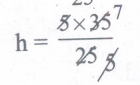
h = 7m
8.
x1 y1 x2 y2 m : n
A (4, -3), B (9, 7), 3 : 2
By section formula \(P\left( \frac { { mx }_{ 2 }+{ nx }_{ 1 } }{ m+n } ,\frac { { my }_{ 2 }+{ ny }_{ 1 } }{ m+n } \right) =P(x,y) \)

\(P(x,y)=\left( \frac { 3(9)+2(4) }{ 3+2 } ,\frac { 3(7)+2(-3) }{ 3+2 } \right) \)
\(=\left( \frac { 27+8 }{ 5 } ,\frac { 21-6 }{ 5 } \right) =\left( \frac { 35 }{ 5 } ,\frac { 15 }{ 5 } \right) =(7,3)\)
9.
In a parallelogram diagonals bisect each other and diagonals are not equal.
Mid point of DE \(=\left( \frac { { x }_{ 1 }+{ x }_{ 2 } }{ 2 } ,\frac { { y }_{ 1 }+{ y }_{ 2 } }{ 2 } \right) \)
(-3, 6)\(=\left( \frac { { x }_{ 1 }+{ x }_{ 2 } }{ 2 } ,\frac { { y }_{ 1 }+{ y }_{ 2 } }{ 2 } \right) \)
\(\frac { x_{ 1 }+{ x }_{ 2 } }{ 2 } =-3\ \ \ \ \ \frac { y_{ 1 }+y_{ 2 } }{ 2 } =6\)
x1 + x2 = -6........(1)
y1 + y2 = 12.......(2)
Mid point of EF\(\left( \frac { { x }_{ 2 }+{ x }_{ 3 } }{ 2 } ,\frac { { y }_{ 2 }+{ y }_{ 3 } }{ 2 } \right) \)
(0, 7)=\(\left( \frac { { x }_{ 2 }+{ x }_{ 3 } }{ 2 } ,\frac { { y }_{ 2 }+{ y }_{ 3 } }{ 2 } \right) \)
\(\frac { x_{ 2 }+{ x }_{ 3 } }{ 2 } =0\ \ \ \frac { y_{ 2 }+{ y }_{ 3 } }{ 2 } =7\)
x2+x3= 0..............(3)
Mid point of FD=\(\left( \frac { { x }_{ 3 }+{ x }_{ 1 } }{ 2 } ,\frac { { y }_{ 3 }+{ y }_{ 1 } }{ 2 } \right) =(-3,-2)\)
x3 + x1 = -6.......(5)
y3 + y1 = -4..........(6)
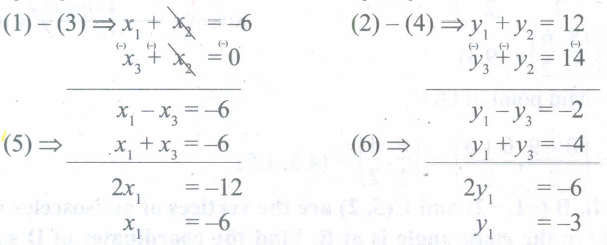
∴ D (x1, y1) = (-6, -3)
Midpoints of the diagonals are equal in parallelogram
∴ We have to prove this
Mid point of AC \(=\left( \frac { (-3)+(-3) }{ 2 } ,\frac { 6+(-2) }{ 2 } \right) =\left( \frac { -6 }{ 2 } ,\frac { 4 }{ 2 } \right) =(-3,2)\)
Mid Point of BD \(=\left( \frac { -6+0 }{ 2 } ,\frac { -3+7 }{ 2 } \right) =\left( \frac { -6 }{ 2 } ,\frac { 4 }{ 2 } \right) =(-3,2)\)
∴ Mid point of AC = Mid point of BD
∴ ABCD is a parallelogram
10.
(i)
(ii)
(iii)
| x | 0 | 1 | 2 | 3 |
| 2x | 0 | 2 | 4 | 6 |
| -4 | -4 | -4 | -4 | -4 |
| y=2x-4 | -4 | -2 | 0 | 2 |
\(\therefore\) The points to be plotted:
(0, -4), (1, -2), (2, 0), (3,2)
(iii)
2y = - 6
\(y=\cfrac { -6 }{ 2 } \Rightarrow y=3\)
(v) - 9 + 9 - 3x = 0 -9
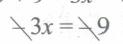
\(x=\cfrac { 9 }{ 3 } \Rightarrow x=3\\ \)
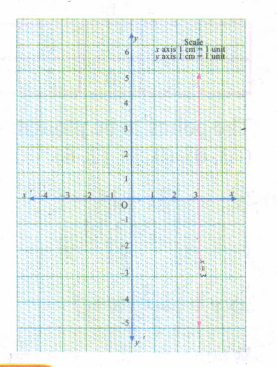
11.
Let the dimensions of the cuboid be
l = 7x, b = 5x and h = 2x.
Given that volume of cuboid = 35840 cm3
l × b × h = 35840
(7x)(5x)(2x) = 35840
70x3 = 35840
x3 = \(\frac{35840}{70}\)
x2 = 512
x =\(\sqrt [ 3 ]{ 8\times 8\times 8 } \)
x = 8 cm
Length of cuboid= 7x = 7 × 8 = 56cm
Breadth of cuboid= 5x = 5 × 8 = 40cm
Height of cuboid= 2x = 2 × 8 = 16 cm
12.
Total number of staff members = 42
The relative frequencies:
Car users \(=\frac { 7 }{ 42 } =\frac { 1 }{ 6 } \)
Two-wheeler users \(=\frac { 20 }{ 42 } =\frac { 10 }{ 21 } \)
Cycle users \(=\frac { 15 }{ 42 } =\frac { 5 }{ 14 } \)
13.
Sample space S = {1, 2, 3, 4, 5, 6}
Let E be the event of getting a number greater than 4
E = {5, 6}
\(P(E)=\frac { Number\ of\ favourable\ outcomes }{ Total\ number\ of\ outcomes } \)
\(P(E)=\frac { n(E) }{ n(S) } =\frac { 2 }{ 6 } =0.333...\)
14.
Here, length (l) = 25 m, breadth (b) = 15 m, height (h) = 5 m.
Area of four walls = LSA of cuboid
= 2(l + b) × h
= 2(25 +15) × 5
= 80 × 5 = 400 m2
Area of the floor = l × b
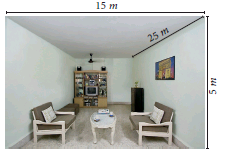
= 25 ×15
= 375 m2
Total renovating area of the hall = (Area of four walls + Area of the floor) = (400 + 375) m2 = 775 m2
Therefore, cost of renovating at the rate of Rs.80 per m2 = 80 × 775
= Rs. 62,000
15.
Given the dimensions of the cuboid;
that is length (l) = 7.5 m, breadth (b) = 3 m and height (h) = 5 m.
TSA = 2(lb + bh + lh)
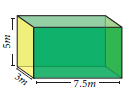
= 2[(7.5 × 3) + (3 × 5) + (7.5 × 5)]
= 2(22.5 +15 + 37.5)
= 2 × 75
= 150 m2
LSA = 2(l + b) × h
= 2(7.5 + 3) × 5
= 2 ×10.5 × 5
= 105 m2
16.
| 0' | 6' | 12' | 18' | 24' | 30' | 36' | 42' | 48' | 54' | Mean Difference | |||||
| 0.00 | 0.10 | 0.20 | 0.30 | 0.40 | 0.50 | 0.60 | 0.70 | 0.80 | 0.90 | 1 | 2 | 3 | 4 | 5 | |
| 190 | 0.9403 | 5 | |||||||||||||
write 19059' = 19054' + 5'
From the table we have, cos19054' = 0.9403

17.
Given linear equations are
kx + 2y = 3 ......(1)
2x - 3y = 1 .......(2)
\(\left[ \begin{matrix} { a }_{ 1 }x+{ b }_{ 1 }y+{ c }_{ 1 }=0 \\ { a }_{ 2 }x+{ b }_{ 2 }y+{ c }_{ 2 }=0 \end{matrix} \right] \)
Here a1 = k, b1 = 2, a2 = 2, b2 = −3 ;
For unique solution we take \(\frac { { a }_{ 1 } }{ { a }_{ 2 } } \neq \frac { { b }_{ 1 } }{ { b }_{ 2 } } \); therefore \(\frac { k }{ 2 } \neq \frac { 2 }{ -3 } \);\(k\neq \frac { 4 }{ -3 } \), that is \(k\neq -\frac { 4 }{ 3 } \)
18.
(i) We know that cosec A = sec(900 A)
sec(900 - A) sec(340)
900 - A =340
We get A = 90° − 34°
A = 560
(ii) We know that tan B = cot(900 - B)
cot(900 - B) = cot 470
900 - B = 470
We get B = 90° − 47°
B = 430
19.
Let the vertices of a triangle be A(1, −6), B(−5, 2) and C(x3, y3)
Given the centroid of a triangle as (−2, 1) we get,
\(\frac { { x }_{ 1 }+{ x }_{ 2 }+{ x }_{ 3 } }{ 3 } \) = -2
\(\frac { 1-5+{ x }_{ 3 } }{ 3 } \) = -2
−4 + x3 = −6
x3 = −2
\(\frac { { y }_{ 1 }+{ y }_{ 2 }+{ y }_{ 3 } }{ 3 } \) = 1
\(\frac { 6+2+{ y }_{ 3 } }{ 3 } \) = 1
−4 + y3 = 3
y3 = 7
Therefore, third vertex is (−2, 7).
20.
Given x – 2y = 7 …(1)
2x + 3y = 7 …(2)
When x = 5, y = −1 we get
From (1) x – 2y = 5 – 2(−1) = 5 + 2 = 7 which is RHS of (1)
From (2) 2x + 3y = 2(5) + 3(−1) = 10−3 = 7 which is RHS of (2)
Thus the values x = 5, y = −1 satisfy both (1) and (2) simultaneously. Therefore (5,−1) is a solution of the given equations.
21.
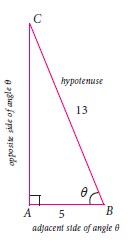
Let BC = 13 and AB = 5
sec θ = \(\frac { hypotenuse }{ adjacentside } =\frac { BC }{ AB } =\frac { 13 }{ 5 } \)
By the Pythagoras theorem,
\(AC=\sqrt { { BC }^{ 2 }-{ AB }^{ 2 } } \)
= \(\sqrt { { 13 }^{ 2 }-{ 5 }^{ 2 } } \)
= \(\sqrt { 169-25 } \) = \(\sqrt { 144 } \) = 12
Therefore, \(sin\theta =\frac { AC }{ BC } =\frac { 12 }{ 13 } \) ; \(cos\theta =\frac { AB }{ BC } =\frac { 5 }{ 13 } \)
\(LHS=\frac { 2sin\theta -3cos\theta }{ 4sin\theta -9cos\theta } =\frac { 2\times \frac { 12 }{ 13 } =3\times \frac { 5 }{ 13 } }{ 4\times \frac { 12 }{ 13 } -9\times \frac { 5 }{ 13 } } =\frac { \frac { 24-15 }{ 13 } }{ \frac { 48-45 }{ 12 } } =\frac { 9 }{ 3 } =3\) = RHS
22.
Given points are A(–3, 6) and B(1, –2), P(–2, 4) divide AB internally in the ratio m : n.
By section formula,
\(P(x, y)=P\left(\frac{m x_{2}+n x_{1}}{m+n}, \frac{m y_{2}+n y_{1}}{m+n}\right)\)
= P(−2, 4) .......(1)
Here x1 = −3, y1 = 6, x2 = 1, y2 = −2
\((1)\Rightarrow \left( \frac { m(1)+n(-3) }{ m+n } ,\frac { m(-2)+n(6) }{ m+n } \right) \)
Equating x-coordinates, we get
\(\frac{m-3 n}{m+n}=-2\) or m− 3n = −2m− 2n
3m = n
\(\frac{m}{n}=\frac{1}{3}\)
m : n = 1: 3
Hence P divides AB internally in the ratio 1 : 3.
23.
Let us form equations for the given statement.
Let us consider l and b as the length and breadth of the rectangle respectively.
Now let us frame the equation for the first statement
Perimeter of rectangle = 36
2(l+b) = 36
\(l+b=\frac { 36 }{ 2 } \)
l = 18 - b .....(1)
| b | 2 | 4 | 5 | 8 |
| 18 | 18 | 18 | 18 | 18 |
| -b | -2 | -4 | -5 | -8 |
| l =18 - b | 16 | 14 | 13 | 10 |
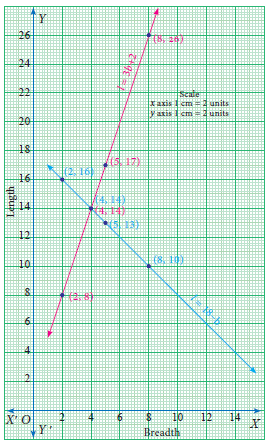
Points: (2,16), (4,14), (5,13), (8,10)
The second statement states that the length is 2 metres more than three times the width which is a straight line written as l = 3b + 2 ... (2)
Now we shall form table for the above equation (2).
| b | 2 | 4 | 5 | 8 |
| 3b | 6 | 12 | 15 | 24 |
| 2 | 2 | 2 | 2 | 2 |
| l = 3b + 2 | 8 | 14 | 17 | 26 |
Points: (2, 8), (4, 14), (5,17), (8, 26)
The solution is the point that is common to both the lines. Here we find it to be (4,14).
We can give the solution to be b = 4, l = 14.
Verification :
2(l + b) = 36 ...(1)
2(14 + 4) = 36
2 \(\times\) 18 = 36
36 = 36 true
l = 3b + 2 ...(2)
14 = 3(4) +2
14 = 12 + 2
14 = 14 true
24.
(c)
20 cm
25.
(c)
900 cm2
26.
(c)
\(\frac { 3 }{ 10 } \)
27.
(d)
Outcome
28.
(b)
2
29.
(a)
0
30.
(c)
a = 0 , b = 0 , c \(\neq \) 0
31.
(b)
(4,2)
32.
(b)
(2, 3)
33.
(d)
(4, 6)

9th Standard Syllabus & Materials
9th Standard
TN 9th Tamil உள்ளத்தின் சீர் - திருக்குறள் Important Questions And Answers Study Material - QB365 Set A
NEW9th Standard
TN 9th Tamil உள்ளத்தின் சீர் - மணிமேகலை Important Questions And Answers Study Material - QB365 Set A
NEW9th Standard
TN 9th Tamil உள்ளத்தின் சீர் - ஏறு தழுவுதல் Important Questions And Answers Study Material - QB365 Set A
NEW9th Standard
TN 9th Tamil உயிருக்கு வேர் - தண்ணீர் Important Questions And Answers Study Material - QB365 Set A



Tamilnadu Stateboard 9th Standard Subjects
Tamilnadu Stateboard Standards





