
 100% FREE ACCESS
11th Standard Syllabus & Materials
11th Standard
TN 11th Tamil இயற்கை வேளாண்மை,சுற்றுச்சூழல் -செய்யுள் - மனோன்மணீயம் Important Questions And Answers Study Material - QB365 Set A
NEW11th Standard
TN 11th Tamil என்னுயிர் என்பேன் -துணைப்பாடம் - இசைத்தமிழர் இருவர் Important Questions And Answers Study Material - QB365 Set A
NEW11th Standard
TN 11th Tamil மொழி கலை -செய்யுள் - ஒவ்வொரு புல்லையும் Important Questions And Answers Study Material - QB365 Set A
NEW11th Standard
TN 11th Tamil பீடு பெற நில் - இலக்கணம் - பகுபத உறுப்புகள் Important Questions And Answers Study Material - QB365 Set A
NEW11th Standard
TN 11th Tamil பீடு பெற நில் - துணைப்பாடம் - வாடிவாசல் Important Questions And Answers Study Material - QB365 Set A
NEW11th Standard
TN 11th Tamil பீடு பெற நில் - செய்யுள் - குறுந்தொகை Important Questions And Answers Study Material - QB365 Set A

Published on: 30/09/2018
Important 5mark -chapter 5,6
Download Tamil Nadu 11th Standard Chemistry question papers, model tests, one-mark questions, important questions, and public exam papers in PDF format. Free study materials and answer keys for TN State Board students.
Questions + Answers key
Take MCQ Chemistry Test
1.
Describe the biological importance of sodium and potassium.
2.
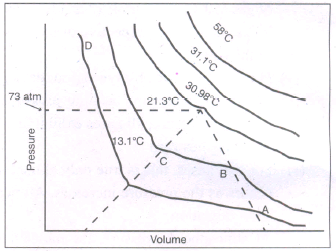
Explain about Andrew's experimental isotherms of CO2 gas.
3.
What are the observations that you get from the plot of Z vs P. (PV / RT vs P) for real gases?
4.
In an experiment of verification of Charle's law, the following are the set of readings taken by a student.
| Experiment | Volume (L) | Temperature (0C) |
|---|---|---|
| 1 | 1.54 | 20 |
| 2 | 1.65 | 40 |
| 3 | 1.95 | 100 |
| 4 | 2.07 | 120 |
What is the average value of the constant of proportionality ?
5.
What is the cause for the distinctive behaviour of lithium? Compare the properties of lithium with other elements of the group.
6.
An element A belonging to group 2 and period 2 reacts with chlorine at an elevated temperature to give compound (B) compound B combines with LiAlH4 to form compound (C). Which is an hydride identify A, B, and C?
7.
If a scuba diver takes a breath at the surface filling his lungs with 5.82 dm3 of air what volume will the air in his lungs occupy when he dives to a depth where the pressure is 1.92 atm. (assume temperature is constant and the pressure at the surface is exactly)
8.
Van der Waals' constant for gas are a = 3.67 atm lit2 mo1-2 b = 0.0408 lit mol-1. Find the critical temperature and critical pressure of the gas.
9.
Find the pressure of neon gas having density 0.9 gm lit-1 at 350 K temperature.
10.
Give a detailed account on compressibility factor
11.
Define the following terms.
12.
How is sodium hydroxide prepared commercially from brine solution?
13.
Bring out the similarities between lithium and magnesium.
14.
15.
Explain the important common features of Group 2 elements.
16.
Alkaline earth metal (A), belongs to 3rd period reacts with oxygen and nitrogen to form compound (B) and (C) respectively. It undergo metal displacement reaction with AgNO3 solution to form compound (D).
17.
Discuss briefly the similarities between beryllium and aluminium.
18.
Derive the values of critical constants in terms of van der Waals constants.
19.
Of two samples of nitrogen gas, sample A contains 1.5 moles of nitrogen in a vessel of volume of 37.6 dm3 at 298K, and the sample B is in a vessel of volume 16.5 dm3 at 298K. Calculate the number of moles in sample B.
20.
A combustible gas is stored in a metal tank at a pressure of 2.98 atm at 25°C. The tank can withstand a maximum pressure of 12 atm after which it will explode. The building in which the tank has been stored catches fire. Now predict whether the tank will blow up first or start melting? (Melting point of the metal = 1100 K).
1.
(i) Monovalent sodium and potassium ions are found in large proportions in biological fluids.
(ii) These ions perform important biological functions such as maintenance of ion balance and nerve impulse conduction.
(iii) Sodium - Potassium play an important role in transmitting nerve signals.
(iv) A typical 70 kg man has 90 g of Na and 170 g of K.
(v) Sodium ions are found on the outside of cells, being located in blood plasma and in the interstitial fluid which surrounds the cells. These ions .participate in the transmission of nerve signals, in regulating the flow of water across cell membranes and in the transport of sugars and amino acids into cells.
(vi) Potassium ions are the most abundant cations within cell fluids, where they activate many enzymes, participate in the oxidation of glucose to produce ATP and with sodium, are responsible for the transmission of nerve signals.
2.
(i) Andrew plotted isotherms of carbon dioxide at different temperatures. It is then proved that many real gases behave In a similar manner like CO2.
(ii) At a temperature of 303.98 K, CO2 remains as a gas. Below this temperature, CO2 turns into liquid CO2 at 73 atm. It is called the critical temperature of CO2.
(iii) At 303.98 K and 73 atm pressure, CO2 becomes a liquid but remains a gas at higher temperature.
(iv) Below the critical temperature, the behaviour of CO2 is different. For example, consider an isotherm of CO2 at 294.5 K, it is a gas until the point B, is reached. At B, a liquid separates along the line BC, both the liquid and gas coexist. At C, the gas is completely condensed.
(v) lf the pressure is higher. than at C, only the liquid is compressed so, a steep rise in pressure is observed. Thus, there exist a continuity of state.
(vi) A gas below the critical temperature can be liquefied by applying pressures.
3.
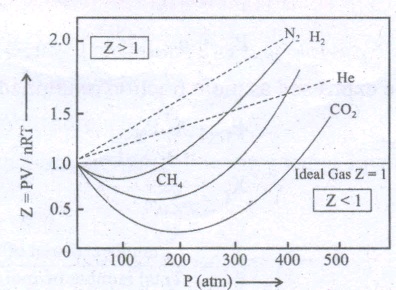
(i) For 1 mole of an ideal the plot becomes parallel to the pressure axis.
(ii) At low pressures all gases exhibit ideal behaviour.\(\frac{PV}{RT}\) values converges to 1 as P approaches to zero.
(iii) At moderate pressures, \(\frac{PV}{RT}\)becomes less than 1. This means that gases exhibit negative derivation from ideal behaviour. This is because attractive forces operate among molecules at relatively short distances.
(iv) At high pressures, \(\frac{PV}{RT}\) becomes greater than 1. This means that gases exhibit negative deviation from ideal behaviour. Intermolecular force becomes significant effect to affect the motion of the molecules.
4.
| Experiment | \(\frac{v_1}{T_1}\)=constant |
|---|---|
| 1 | \(\frac{1.54}{293}\) = 0.0053 |
| 2 | \(\frac{1.65}{313}\) = 0.0053 |
| 3 | \(\frac{1.95}{373}\) = 0.0053 |
| 4 | \(\frac{2.07}{393}\) = 0.0053 |
The average value of the constant is 0.0053.
5.
The distinctive behaviour of Li+ ion is due to its exceptionally small size, high polarising power, high hydration energy and non availability of d-orbitals.
| Lithium | Other elements of the family |
| Hard, high melting and boiling point. | Soft and lower melting and boiling point. |
| Least reactive (For example it reacts with oxygen to form normal oxide, forms peroxides with great difficulty and its higher oxides are unstable). |
More reactive. |
| Reacts with nitrogen to give Li3N (lithium nitride) | No reaction. |
| Reacts with bromine slowly. | React violently. |
| Reacts directly with carbon to form ionic carbides. eg: 2Li + 2C ⟶ Li2C2 (lithium carbide). |
Do not react with carbon directly, but can react with carbon compounds. eg: Na + C2H2 ⟶ Na2C2 |
| Compounds are sparingly soluble in water. | Compounds are highly soluble in water. |
| Lithium nitrate decomposes to give an oxide. | decompose to give nitrites. |
6.
(i) An element A belonging to II group and II period is beryllium (A)
(ii) Beryllium reacts with chlorine to form beryllium chloride (B)
Be +Cl2 \(\longrightarrow \) BeCl2
(B)
(iii) Beryllium chloride on treatment with LialH Forms beryllium hydride (c)
2BeCl2 + LiA1H4 \(\longrightarrow \) 2BeH2 + LiCl + AlCl3
(C)
| A | Be | Beryllium |
| B | Becl2 | Beryllium Chloride |
| C | BeH2 | Beryllium Hydride |
7.
Given data P1 = 1 atm V1 = 5.82 dm3
P1 = 1.92 atm V2 = ?
According to Boyles law,
P1V1 = P2V2
\({ V }_{ 2 }=\frac { { P }_{ 1 }{ V }_{ 1 } }{ { P }_{ 2 } } \)
\({ V }_{ 2 }=\frac { 1\ atm\times 5.82\ { dm }^{ 3 } }{ 1.92\ atm } \)
V2 = 3.031 dm2
8.
a = 3.67 atm lit2 mol-2
b = 0.0408 lit mol-1
R = 0.0821 atm lit K-1 mol-1
(i) \({ T }_{ c }=\frac { 8a }{ 27Rb } \)
\(=\frac { 8\times 3.67 }{ 27\times 0.082\times 0.0408 } =324.7\quad K\)
Tc = 324.7 K
(ii) \({ P }_{ c }=\frac { a }{ 27{ b }^{ 2 } } \)
\(=\frac { 3.67 }{ 27\times { (0.0408) }^{ 2 } } =81.6\)
Pc = 81.6 atm.
9.
Density (d) = 0.9 gm lit-1
T = 350 K
Mass of neon (M) = 20 gm mol-1
\(P=\frac { dRT }{ M } \quad \left( \because n=\frac { d }{ M } \right) \)
\(=\frac { 0.9\times 8.314\times 10^{ -2 }\times 350 }{ 20 } =1.309\quad bar\)
Pressure of neon = 1.309 bar
10.
(i) The deviation of real gases from ideal behaviour is measured in terms of a ratio of PV to nRT. This is termed as compression factor. Mathematically,
\(Z=\frac { PV }{ nRT } \)
For ideal gases Z=1 at all temperatures and pressures, because PV = nRT.
(ii) When a gas deviates from ideal behaviour, its Z value deviates from unity.
(iii) At high pressure these gases have Z > 1 and are difficult to compress. At intermediate pressures, Z< 1.
(iv) Above the Boyle point, Z > 1 for real gases, ie., the real gases show positive deviation.
(v) Below the Boyle point, the real gases first show a decrease for Z, reaches a minimum and then increase with the increase in pressure.
Hence, the compressibility factor Z can be rewritten as
\(Z=\frac { { PV }_{ real } }{ nRT } \)
\({ V }_{ ideal }=\frac { nRT }{ P } \)
Substituting b in a
\(Z=\frac { { V }_{ real } }{ { V }_{ ideal } } \)
(vi) Where Vreal is the molar volume of the real gas and Videal is the molar volume of it when it behaves ideally.
11.
(i) Isotherm:
At any constant temperature when pressure is increased, volume is decreased and vice versa. Such P - V curves at constant temperature are known as isotherms.
(ii) Critical Temperature: (Tc)
It is defined as the characteristic temperature of a gas above which no liquefaction occurs.
(iii) Critical Pressure: (Pc)
It is defined as the minimum pressure required to liquefy 1 mole of a gas present at its critical temperature.
(iv) Critical volume: (Vc)
The volume occupied by 1 mole of a gas at its critical pressure and at critical temperature is the critical volume of the gas
(v) Compressibility factor:
The deviation of real gases from ideal behaviour is measured in terms of a ratio of PV to nRT. This is termed as compressibility factor.
\(Z=\frac { PV }{ nRT } \)
12.
(i) Sodium hydroxide is prepared commercially by the electrolysis of brine solution in Castner-Kellner cell .
(ii) Cathode- mercury
anode - carbon
(iii) Sodium metal is discharged at the cathode and combines with mercury to form sodium amalgam.
(iv) Chlorine gas is evolved at the anode.
(v) The sodium amalgam thus obtained is treated with water to give sodium hydroxide
(vi) At cathode: Na+ + e- ⟶ Na(amalgam)
At anode : Cl- ⟶ 1/2 Cl2 ↑ + e-
2Na(amalgam) + 2H2O ⟶ 2NaOH + 2Hg + H2↑
13.
| S.No | Properties |
|---|---|
| 1 | Both lithium and magnesium are harder than other elements in the respective groups |
| 2 | Lithium and magnesium react slowely with water. Their oxides and hydroxides are much less soluble and their hydroxides decompose on heating |
| 3 | Both form a nitride, Li3N and mg3N2 , by direct combination with nitrogen |
| 4 | They do not give any superoxides and form only oxides, Li2O and MgO |
| 5 | The carbonates of lithium and magnesium decompose upon heating to form their respective oxides and CO2 |
| 6 | Lithium and magnesium do not form bicarbonates |
| 7 | Both LiCl and MgCl2 are soluble and are deliquescent |
14.
15.
1. This group contains Be, Mg, Ca, Sr, Ba & Ra.
2. Except Be all these elements are called as alkaline earth metals because their oxides and hydroxides are alkaline in nature.
3. Beryllium is the rare element and Radium is the rarest (10% rocks) ; Their Occurrence: Be- Beryl; Mg - carnallite; Dolomite Ca - Fluorapatite; Sr - Celestite Ba - Barytes.
4. Radium is radioactive.
5. The general electronic configuration is :
[Noble gas] ns2 eg. Be - [He] 2s2
6. On moving down the group the radii increase. Their atomic radii are smaller than alkali metals.
7. They exhibit +2 oxidation state.
8. The ionisation enthalpies are less than p - block elements due to large size. Down the group the ionisation enthalpy decreases.
9. The IE1 of group 2 elements are greater than group 1 elements.
10. The IE2 values are higher than that of alkali metals.
11. They are less electro Positive elements than alkali metals.
12. The hydration enthalpy decreases with increase in ionic radii.
13. MgCl2 form MgCI2 .6H2O and CaCl2 form CaCl2.6H2O
14. The electronegativity value decreases down the group.
15. With concentrated HCl They impart flame colour. Ca - Brick Red ; Sr - Crimson red and Barium - Apple Green.
16. All form metallic halides at elevated temperatures. M + X2 + MX2
17. All elements except Beryllium combine with hydrogen to form hydrides of formula MH2.
16.
(i) Alkaline earth metal (A) belonging to 3rd period is magnesium.
(ii) So A is Magnesium. Magnesium reacts with oxygen and nitrogen as follows.
\(2Mg+O_2⟶\underset{(B)}{2MgO}\)
\(3Mg+N_2⟶\underset{(C)}{Mg_3N_2}\)
So B is Magnesium oxide and C is magnesium nitride.
(iii) Magnesium undergoes metal displacement reaction with AgNO3 as follow to give D as follows :
\(Mg+2AgNO_3⟶\underset{D}{Mg(NO_3)_2}+2Ag\)
So D is Magnesium nitrate.
Result :
| Compound or Element | Symbol or Formula | Name |
|---|---|---|
| A | Mg | Magnesium |
| B | MgO | Magnesium oxide |
| C | Mg3N2 | Magnesium nitride |
| D | Mg(NO3)2 | Magnesium nitrate |
17.
| S.No | Properties |
|---|---|
| 1 | Beryllium chloride forms a dimeric structure like aluminium chloride with chloride bridges. Beryllium chloride also forms polymeric chain structure In addition to dimer. Both are soluble in organic solvents and are strong lewis acids. |
| 2 | Beryllium hydroxide dissolves in excess of alkali and gives beryllate ion and [Be(OH)2]2- and hydrogen as aluminium hydroxide which gives aluminate ion, [Al(OH)4]- |
| 3 | Beryllium and aluminum ions have strong tendency to form complexes, \(BeF_4^{2-} AIFt{_6^{3-}}\) |
| 4 | Both beryllium and aluminium hydroxides are amphoteric in nature. |
| 5 | Carbides of beryllium (Be2C) like aluminum carbide (Al4C3) give methane on hydrolysis |
| 6 | Both beryllium and aluminium are rendered passive by nitric acid. |
18.
The van der Waals equation for n moles is
\(\left( P+\frac { { an }^{ 2 } }{ { v }^{ 2 } } \right) \left( v-nb \right) =nRT\) ....(1)
For 1 mole
\(\left( P+\frac { { a }^{ 2 } }{ { v }^{ 2 } } \right) \left( v-b \right) =RT\) ...(2)
From the equation we can derive the values of critical constants Pc, Vc and Tc, in terms of a and b, the van der Waals constants, On expanding the above equation
\(pv+\frac { a }{ v } -pb-\frac { ab }{ { v }^{ 2 } } -RT=0\) ...(3)
Multiply equation (3) by V2 / P
\(\frac { { v }^{ 2 } }{ p } \left( Pv+\frac { a }{ v } -pb-\frac { ab }{ { v }^{ 2 } } -RT \right) =0\)
\({ v }^{ 3 }+\frac { av }{ p } +-{ bv }^{ 2 }-\frac { ab }{ { v }^{ 2 } } -\frac { { RTV }^{ 2 } }{ p } \) ...(4)
When the above equation is rearranged in powers of Y.
\({ v }^{ 3 }-\left[ \frac { RT }{ P } +b \right] { v }^{ 2 }+\left[ \frac { a }{ p } \right] v-\left[ \frac { ab }{ p } \right] =0\) ...(5)
The equation (5) is a cubic equation in V. On solving this equation,
we will get three solutions. At the critical point all these three solutions of V are equal to the critical volume VC. The pressure and temperature becomes Pc and Tc respectively
i.e., V = Vc
V - Vc = 0
(V - VC)3 = 0
V3 - 3VCV2 + 3Vc2V - Vc3 = 0 .....(6)
As equation (5) is identical with equation (6), we can equate the coefficients of V2, V and constant terms in (5) and (6).
\(-3{ v }_{ c }{ v }^{ 2 }=-\left[ \frac { { RT }_{ c } }{ { p }_{ c } } +b \right] { v }^{ 2 }\)
\(3{ v }_{ c }=\frac { { RT }_{ c } }{ { p }_{ c } } +b\) .....(7)
\(3{ v }_{ c }^{ 2 }=\frac { a }{ { p }_{ c } } \) ......(8)
\(3{ v }_{ c }^{ 2 }=\frac { ab }{ { p }_{ c } } \) ...(9)
Divide equation (9) by equation (8)
\(\frac { { v }_{ c }^{ 3 } }{ 3{ v }_{ c }^{ 2 } } =\frac { ab/{ p }_{ c } }{ a/{ p }_{ c } } \)
\(\frac { { V }_{ c } }{ 3 } =b\)
i.e. Vc = 3b .....(10)
when equation (10) is substituted in (8)
\(3{ v }_{ c }^{ 2 }=\frac { a }{ { p }_{ c } } \)
\({ p }_{ c }=\frac { a }{ 3{ v }_{ c }^{ 2 } } =\frac { a }{ 3\left( { 3b }^{ 2 } \right) } =\frac { a }{ { 3\times 9b }^{ 2 } } =\frac { a }{ { 27 }b^{ 2 } } \)
\({ p }_{ c }=\frac { a }{ { 27 }b^{ 2 } } \) ...(11)
substituting the values of Vc and Pc in equation (7),
\(3vc=b+\frac { { RT }_{ c } }{ p } \)
\(3\left( 3b \right) =b+\frac { { RT }_{ c } }{ \left( \frac { a }{ { 27b }^{ 2 } } \right) } \)
\(9b-b=\left( \frac { { RT }_{ c } }{ a } \right) 27{ b }^{ 2 }\)
\(8b=\frac { { t }_{ c }R{ 27b }^{ 2 } }{ a } \)
\(\therefore { T }_{ c }=\frac { 8ab }{ 27R{ b }^{ 2 } } =\frac { 8a }{ 27Rb } \)
\({ T }_{ c }=\frac { { 8 }_{ a } }{ 27Rb } \) ......(12)
The critical constants can be calculated using the values of van der Waals constant of a gas and vice versa.
\(a=3{ V }_{ C }^{ 2 }{ P }_{ C }\quad and\quad b=\frac { { V }_{ C } }{ 3 } \)
19.
nA = 1.5 mol nB = ?
VA= 37.6 dm3 VB = 16.5 dm3
(T = 298 K constant)
\(\frac { { V }_{ A } }{ { n }_{ A } } =\frac { { V }_{ B } }{ { n }_{ B } } \)
\({ n }_{ A }=\left( \frac { { n }_{ A } }{ { V }_{ A } } \right) { V }_{ B }\)

= 0.66 mol.
20.
Pressure of the gas in the tank at its melting point
T1 = 298 K; P1 = 2.98 atm; T2 = 1100 K; P2 = ?
\(\frac { { P }_{ 1 } }{ { T }_{ 1 } } =\frac { { P }_{ 2 } }{ { T }_{ 2 } } \)
\(\Rightarrow \quad { P }_{ 2 }=\frac { { P }_{ 1 } }{ { T }_{ 1 } } \times { T }_{ 2 }\)
\({ P }_{ 2 }=\frac { 2.98\quad atm }{ 298\ K } \times 1100\ K=11\ atm\)
At 1100 K the pressure of the gas inside the tank will become 11 atm. Given that tank can withstand a maximum pressure of 12 atm, the tank will start melting first.

11th Standard Syllabus & Materials
11th Standard
TN 11th Tamil பீடு பெற நில் - செய்யுள் - காவடிச்சிந்து Important Questions And Answers Study Material - QB365 Set A
NEW11th Standard
TN 11th Tamil பீடு பெற நில் - உரைநடை - மலை இடப்பெயர்கள் : ஓர் ஆய்வு Important Questions And Answers Study Material - QB365 Set A
NEW11th Standard
TN 11th Tamil மாமழை போற்றுதும் - துணைப்பாடம் - யானை டாக்டர் Important Questions And Answers Study Material - QB365 Set A
NEW11th Standard
TN 11th Tamil மாமழை போற்றுதும் - செய்யுள் - ஐங்குறுநூறு Important Questions And Answers Study Material - QB365 Set A



Tamilnadu Stateboard 11th Standard Subjects

Maths

Commerce

Economics

Biology

Business Maths and Statistics

Accountancy

Computer Science

Physics
Chemistry
Maths
Biology
Economics
Physics
Chemistry

History
Business Maths and Statistics

Computer Science
Accountancy

Computer Applications
History
Computer Technology
Commerce
Computer Applications
Computer Technology

Tamil

English

French
Tamilnadu Stateboard Standards
