
 100% FREE ACCESS
11th Standard Syllabus & Materials
11th Standard
TN 11th Tamil இயற்கை வேளாண்மை,சுற்றுச்சூழல் -செய்யுள் - மனோன்மணீயம் Important Questions And Answers Study Material - QB365 Set A
NEW11th Standard
TN 11th Tamil என்னுயிர் என்பேன் -துணைப்பாடம் - இசைத்தமிழர் இருவர் Important Questions And Answers Study Material - QB365 Set A
NEW11th Standard
TN 11th Tamil மொழி கலை -செய்யுள் - ஒவ்வொரு புல்லையும் Important Questions And Answers Study Material - QB365 Set A
NEW11th Standard
TN 11th Tamil பீடு பெற நில் - இலக்கணம் - பகுபத உறுப்புகள் Important Questions And Answers Study Material - QB365 Set A
NEW11th Standard
TN 11th Tamil பீடு பெற நில் - துணைப்பாடம் - வாடிவாசல் Important Questions And Answers Study Material - QB365 Set A
NEW11th Standard
TN 11th Tamil பீடு பெற நில் - செய்யுள் - குறுந்தொகை Important Questions And Answers Study Material - QB365 Set A

Published on: 30/09/2018
Important questions -chapter 5,6
Download Tamil Nadu 11th Standard Chemistry question papers, model tests, one-mark questions, important questions, and public exam papers in PDF format. Free study materials and answer keys for TN State Board students.
Questions + Answers key
Take MCQ Chemistry Test
1.
The value of Vander Waals constant "a" is maximum for __________.
helium
nitrogen
methane
ammonia
2.
The general electronic configuration of alkali metals is ____________
[noble gas] ns2
[noble gas] ns1
ns2 np6
ns2 (n-1)d1-10
3.
Which of the following pairs of gases will diffuse at the same time through a porus plug?
CO, NO2
NO, C2H6
NO2, CO2
NH3,PH3
4.
Statement I: At very high pressures, compressibility factor is greater than I.
Statement II: At very high pressure, 'b' can be neglected in vanderwaal's gas equation.
Both statement I and statement II are true and statement II explains statement I.
Both statement I and statement II are true but statement II does not explain statement I
Statement I is true but statement II is false.
Both the statements are false.
5.
Pick out the correct relation for 1 mole of real gas.
\(\left( P+\frac { V }{ { a }^{ 2 } } \right) (V-b)=RT\)
\(P=\frac { RT }{ (V-b) } +\frac { a }{ { V }^{ 2 } } \)
\(\left( P+\frac { a }{ { V }^{ 2 } } \right) (V-b)=RT\)
\(\left( P-\frac { a }{ { V }^{ 2 } } \right) (V+b)=\frac { 1 }{ RT } \)
6.
_____________ is the gas constant.
a
Vc
R
Tc
7.
A colourless solid substance (A) on heating evolved CO2 and also gave a white residue, soluble in water. Residue also gave CO2 when treated with dilute HCI ___________
Na2CO3
NaHCO3
CaCO3
Ca(HCO3)2
8.
Which of the following compounds will not evolve H2 gas on reaction with alkali metals ?
ethanoic acid
ethanol
phenol
none of these
9.
Equal moles of hydrogen and oxygen gases are placed in a container, with a pin-hole through which both can escape what fraction of oxygen escapes in the time required for one-half of the hydrogen to escape.
\(\frac { 3 }{ 8 } \)
\(\frac { 1 }{ 2 } \)
\(\frac { 1 }{ 8 } \)
\(\frac { 1 }{ 4 } \)
10.
When an ideal gas undergoes unrestrained expansion, no cooling occurs because the molecules _____________
are above inversion temperature
exert no attractive forces on each other
do work equal to the loss in kinetic energy
collide without loss of energy
11.
Explain Charles' law with an experimental illustration.
12.
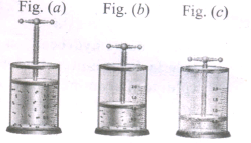
In the below figure, let us find the missing parameters [volume in (b) and pressure in (c)]
P1 = 1 atm, P2 = 2 atm, P3 = ? atm
V1 = 1dm3, V2 =? dm3, V3 = 0.25 dm3
T1 = 298 K, T2 = 298 K, T3 = 298 K.
13.
Aerosol cans carry clear warning of heating of the can. Why?
14.
Suggest why there is no hydrogen (H2) in our atmosphere. Why does the moon have no atmosphere?
15.
Beryllium halides are Covalent whereas magnesium halides are ionic why ?
16.
Mention the uses of plaster of paris
17.
75 ml of gas A effuses through a pin hole in 73 seconds the same volume of SO2 under identical conditions effuses in seconds. Calculate the molecular mass of A.
18.
Define the following terms.
19.
Alkaline earth metal (A), belongs to 3rd period reacts with oxygen and nitrogen to form compound (B) and (C) respectively. It undergo metal displacement reaction with AgNO3 solution to form compound (D).
20.
Discuss briefly the similarities between beryllium and aluminium.
21.
Which would you expect to have a higher melting point magnesium oxide or magnesium fluoride ? Explain your reasoning.
22.
Distinguish between diffusion and effusion.
23.
What are the uses of sodium hydroxides?
24.
Why sodium hydroxide is much more water soluble than chloride ?
1.
(d)
ammonia
2.
(c)
ns2 np6
3.
(b)
NO, C2H6
4.
(c)
Statement I is true but statement II is false.
5.
(c)
\(\left( P+\frac { a }{ { V }^{ 2 } } \right) (V-b)=RT\)
6.
(c)
R
7.
(b)
NaHCO3
8.
(d)
none of these
9.
(c)
\(\frac { 1 }{ 8 } \)
10.
(b)
exert no attractive forces on each other
11.
Charles' law states that for a fixed mass of a gas at constant pressure, the volume is directly proportional to temperature (K).
\(V\propto T\) (or) = \(\frac{V}{T}\) Constant
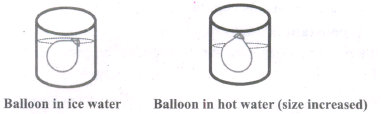
Volume vs Temperature:
If a balloon is moved from an ice water bath to a boiling water bath, the gas molecules inside move faster due to increased temperature and hence the volume increases.
12.
According to Boyle's law, at constant temperature for a given mass of gas at constant temperature,
P1VI = P2V2 = P3V3
1 atm x 1 dm3 = 2 atm x V2 = P3 x 0.25 dm3
\(\therefore\) 2 atm x V2 = 1 atm x 1 dm3
.png)
\(\boxed{V_2=0.5\ dm^3}\)
and P3 x 0.25 dm3 = 1 atm x 1 dm3
.png)
\(\boxed{P_3=4\ atm}\)
13.
On heating incineration might take place due to the increase of pressure
14.
a) Hydrogen is the lightest gas in the atmosphere. So it rises up and other gases which are heavier like O2 & N2 come down towards the surface of the earth according to Graham's law of diffusions \(\mathrm{r} \alpha \sqrt{\frac{1}{M}}\). Hydrogen diffuses very fast. Its mean speed in greater than the escape velocity from the earth. As a consequence, H2 would have escaped from the atmosphere long time ago.
b) The acceleration due to gravity 'g' on moon surface is small. The value of escape velocity is also small. The molecules of the atmospheric gases on the moon's surface have thermal velocities greater than the escape velocity.
All the molecules have escaped. So the atmosphere is so thin.
15.
This is due to the smaller size and relatively high charge as Be2+ ion. Moreover Beryllium is a non - metal. But Magnesium is a metal. In the case of beryllium the ionisation energy and electronegativity of the halides are almost similar; but there is a vast difference in IE and electronegativity between Mg and halides.
16.
The largest use of plaster of paris is in the building industry as well as plasters. It is used for immobilising the affected part of organ where there is a bone fracture or sprain. It is also employed in dentistry, in ornamental work and for making casts of statues and busts.
17.
Time taken for effusion of gas A = 73 seconds
Time taken for effusion of SO2 gas = 75 seconds
Volume of gases (A & SO2) taken = 75 ml each.
Molecular mass of SO2 =
\(\frac { Effusion\ rate\ of\ { SO }_{ 2 } }{ Effusion\ rate\ of\ A } =\sqrt { \frac { { M }_{ A } }{ { M }_{ { SO }_{ 2 } } } } \)
\(\frac { 75/75 }{ 75/73 } =\sqrt { \frac { { M }_{ A } }{ { M }_{ { SO }_{ 2 } } } } ;\frac { 1 }{ 1.027 } =\sqrt { \frac { { M }_{ A } }{ 64 } } \)
\({ (0.9737) }^{ 2 }=\frac { { M }_{ A } }{ 64 } ;{ M }_{ A }=60.67\)
\(\therefore\) Molecular mass of A is 60.67.
18.
(i) Isotherm:
At any constant temperature when pressure is increased, volume is decreased and vice versa. Such P - V curves at constant temperature are known as isotherms.
(ii) Critical Temperature: (Tc)
It is defined as the characteristic temperature of a gas above which no liquefaction occurs.
(iii) Critical Pressure: (Pc)
It is defined as the minimum pressure required to liquefy 1 mole of a gas present at its critical temperature.
(iv) Critical volume: (Vc)
The volume occupied by 1 mole of a gas at its critical pressure and at critical temperature is the critical volume of the gas
(v) Compressibility factor:
The deviation of real gases from ideal behaviour is measured in terms of a ratio of PV to nRT. This is termed as compressibility factor.
\(Z=\frac { PV }{ nRT } \)
19.
(i) Alkaline earth metal (A) belonging to 3rd period is magnesium.
(ii) So A is Magnesium. Magnesium reacts with oxygen and nitrogen as follows.
\(2Mg+O_2⟶\underset{(B)}{2MgO}\)
\(3Mg+N_2⟶\underset{(C)}{Mg_3N_2}\)
So B is Magnesium oxide and C is magnesium nitride.
(iii) Magnesium undergoes metal displacement reaction with AgNO3 as follow to give D as follows :
\(Mg+2AgNO_3⟶\underset{D}{Mg(NO_3)_2}+2Ag\)
So D is Magnesium nitrate.
Result :
| Compound or Element | Symbol or Formula | Name |
|---|---|---|
| A | Mg | Magnesium |
| B | MgO | Magnesium oxide |
| C | Mg3N2 | Magnesium nitride |
| D | Mg(NO3)2 | Magnesium nitrate |
20.
| S.No | Properties |
|---|---|
| 1 | Beryllium chloride forms a dimeric structure like aluminium chloride with chloride bridges. Beryllium chloride also forms polymeric chain structure In addition to dimer. Both are soluble in organic solvents and are strong lewis acids. |
| 2 | Beryllium hydroxide dissolves in excess of alkali and gives beryllate ion and [Be(OH)2]2- and hydrogen as aluminium hydroxide which gives aluminate ion, [Al(OH)4]- |
| 3 | Beryllium and aluminum ions have strong tendency to form complexes, \(BeF_4^{2-} AIFt{_6^{3-}}\) |
| 4 | Both beryllium and aluminium hydroxides are amphoteric in nature. |
| 5 | Carbides of beryllium (Be2C) like aluminum carbide (Al4C3) give methane on hydrolysis |
| 6 | Both beryllium and aluminium are rendered passive by nitric acid. |
21.
Magnesium oxide in having higher melting point. The lattice energy of MgO & MgF2 are 3938 and 2957 respectively.
MgO has +2, -2 charges, MgF2 has +2, -1 charges. When the two charges are multiplied together, MgO results in larger amount of lattice energy since it has a higher charge, The strong attraction cause most ionic material to be hard and brittle and have high melting points.
22.
| S.NO | diffusion | effusion |
| 1 | It is the spreading of molecules of a substance throughout a space or second substance | It is the escape of the gas molecules through a very small hole (orifice) in a membrane into an evacuated area. |
| 2 | It is typically used to describe statistical properties of a gas at length scales that are much larger than mean free path. | The diameter of the hole should be smaller than mean free path of the molecules. |
| 3 | It is the spreading of gases. | It is the pouring out of gases. |
23.
(i) Sodium hydroxide is used as laboratory reagent.
(ii) It is used in the purification of bauxite and petroleum refining.
(iii) It is used in the textile industries for mercerising cotton fabrics.
(iv) It is used in the manufacture of soap, paper, artificial silk and a number of chemicals.
24.
The solubility product of NaCl is lower than that of NaOH. The more soluble a substance is, the higher the Ksp value it has In aqueous solution NaOH gives OH- ions. It can be solvated by establishing H-bonds with water molecules. So it is more water soluble.

11th Standard Syllabus & Materials
11th Standard
TN 11th Tamil பீடு பெற நில் - செய்யுள் - காவடிச்சிந்து Important Questions And Answers Study Material - QB365 Set A
NEW11th Standard
TN 11th Tamil பீடு பெற நில் - உரைநடை - மலை இடப்பெயர்கள் : ஓர் ஆய்வு Important Questions And Answers Study Material - QB365 Set A
NEW11th Standard
TN 11th Tamil மாமழை போற்றுதும் - துணைப்பாடம் - யானை டாக்டர் Important Questions And Answers Study Material - QB365 Set A
NEW11th Standard
TN 11th Tamil மாமழை போற்றுதும் - செய்யுள் - ஐங்குறுநூறு Important Questions And Answers Study Material - QB365 Set A



Tamilnadu Stateboard 11th Standard Subjects

Maths

Commerce

Economics

Biology

Business Maths and Statistics

Accountancy

Computer Science

Physics
Chemistry
Maths
Biology
Economics
Physics
Chemistry

History
Business Maths and Statistics

Computer Science
Accountancy

Computer Applications
History
Computer Technology
Commerce
Computer Applications
Computer Technology

Tamil

English

French
Tamilnadu Stateboard Standards
