
 100% FREE ACCESS
11th Standard Syllabus & Materials
11th Standard
TN 11th Tamil இயற்கை வேளாண்மை,சுற்றுச்சூழல் -செய்யுள் - மனோன்மணீயம் Important Questions And Answers Study Material - QB365 Set A
NEW11th Standard
TN 11th Tamil என்னுயிர் என்பேன் -துணைப்பாடம் - இசைத்தமிழர் இருவர் Important Questions And Answers Study Material - QB365 Set A
NEW11th Standard
TN 11th Tamil மொழி கலை -செய்யுள் - ஒவ்வொரு புல்லையும் Important Questions And Answers Study Material - QB365 Set A
NEW11th Standard
TN 11th Tamil பீடு பெற நில் - இலக்கணம் - பகுபத உறுப்புகள் Important Questions And Answers Study Material - QB365 Set A
NEW11th Standard
TN 11th Tamil பீடு பெற நில் - துணைப்பாடம் - வாடிவாசல் Important Questions And Answers Study Material - QB365 Set A
NEW11th Standard
TN 11th Tamil பீடு பெற நில் - செய்யுள் - குறுந்தொகை Important Questions And Answers Study Material - QB365 Set A

Published on: 30/09/2018
Important 3mark -chapter 5,6
Download Tamil Nadu 11th Standard Chemistry question papers, model tests, one-mark questions, important questions, and public exam papers in PDF format. Free study materials and answer keys for TN State Board students.
Questions + Answers key
Take MCQ Chemistry Test
1.
How would you explain the following observations?
(i) BeO is almost insoluble but BeSO4 is soluble in water.
(ii) BaO is soluble but BaSO4 is insoluble in water.
(iii) LiI is more soluble than KI in ethanol.
2.
Explain Charles' law with an experimental illustration.
3.
A mixture of gases contains 4.76 mole of Ne, 0.74 mole of Ar and 2.5 mole of Xe. Calculate the partial pressure of gases, if the total pressure is 2 atm. at a fixed temperature. Solve this problem using Dalton's law.
4.
Mention the application of Dalton's law.
5.
Explain the term 'Boyle's point.' Mention is significance.
6.
A steel tank contains carbon dioxide at 300 K and a pressure of 10 atm. Calculate the internal gas pressure when the tank gas is heated to 373 K.
7.
Give the characteristics of gases.
8.
Complete and balance the following equations.
(i) Li + H2O ⟶ ...,
(ii) Na + C2H5OH ⟶ ...,
(iii) CH ≡ CH + Na ⟶ ...,
9.
Which one of the following alkaline earth metal carbonates is thermally the most stable?
(a) MgCO3
(b) CaCO3
(c) SrCO3
(d) BaCO3
10.
Give the applications of strontium with respect to nuclear chemistry.
11.
Why does lithium exhibit anomalous properties?
12.
Why alkaline earth metals are harder than alkali metals.
13.
An alkali metal (x) forms a hydrated sulphate, X2SO4 • 10 H2O. Is the metal more likely to be sodium (or) potassium.
14.
Would it be easier to drink water with a straw on the top of Mount Everest?
15.
When the driver of an automobile applies brake, the passengers are pushed toward the front of the car but a helium balloon is pushed toward back of the car. Upon forward acceleration the passengers are pushed toward the front of the car. Why?
16.
Suggest why there is no hydrogen (H2) in our atmosphere. Why does the moon have no atmosphere?
17.
What are ideal gases? In what way real gases differ from ideal gases.
18.
Write the chemical equations for the reactions involved in solvay process of preparation of sodium carbonate.
19.
Why sodium hydroxide is much more water soluble than chloride ?
20.
Which would you expect to have a higher melting point magnesium oxide or magnesium fluoride ? Explain your reasoning.
1.
(i) Lattice energy of BeO is comparatively higher than the hydration energy. Therefore, it is almost insoluble in water. Whereas BeSO4 is ionic in nature and its hydration energy dominates the lattice energy.
(ii) Both BaO and BaSO4 are ionic compounds but the hydration energy of BaO is higher than the lattice energy, therefore it is soluble in water.
(iii) Since the size of Li+ ion is very small in comparison to K+ ion, it polarises the electron cloud of I- ion to a great extent. Thus LiI dissolves in ethanol more easily than the KI.
2.
Charles' law states that for a fixed mass of a gas at constant pressure, the volume is directly proportional to temperature (K).
\(V\propto T\) (or) = \(\frac{V}{T}\) Constant
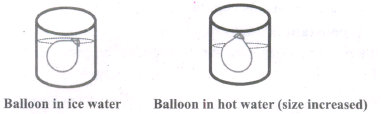
Volume vs Temperature:
If a balloon is moved from an ice water bath to a boiling water bath, the gas molecules inside move faster due to increased temperature and hence the volume increases.
3.
PNe = XNe PTotal
\(X_{Ne}=\frac{n_{Ne}}{n_{Ne}+n_{Ar}+n_{Xe}}\)
\(=\frac{4.76}{4.76+0.74+2.5}=0.595\)
\(X_{Ar}=\frac{n_{Ar}}{n_{Ne}+n_{Ar}+n_{Xe}}\)
\(=\frac{0.74}{4.76+0.74+2.5}=0.0093\)
\(X_{Xe}=\frac{n_{Xe}}{n_{Ne}+n_{Ar}+n_{Xe}}\)
\(=\frac{2.5}{4.76+0.74+2.5}=0.312\)
PNe = XNe PTotal = 0.595 x 2
= 1.19 atm.
PAr = XAr PTotal = 0.093 x 2
= 0.186 atm.
PXe = XXe PTotal = 0.312 x 2
= 0.624 atm.
4.
In a reaction involving the collection of gas by downward displacement of water, the pressure of dry vapor collected can be calculated using Dalton's law.
Pdry gas collected = PTotal - Pwater vapour
Pwater vapour is generally referred as aqueous tension and its values are available for air at various temperatures. These values are relevant in weather forecast.
5.
(i) Boyle's point is the temperature at which, real gases behave ideally over a range of low pressures.
(ii) The Boyle point varies with the nature of the gas.
(iii) Above the Boyle point, Z > 1 for real gases. i.e., they show positive deviation.
(iv) Below the Boyle point, the real gases first show a decrease for Z, reaches a minimum and then increase with increase in pressure.
6.
Given, P1 = 10 atm; P2 = ?; T1 = 300K; T2 = 373
\(\frac{P_1}{T_1}=\frac{P_2}{T_2}\)
P2 = T2 = 373
\(\frac{100}{300}=\frac{P_2}{373}\)
= 124.3 atm
7.
(i) They assume the volume and shape of their container
(ii) They are the most compressible state of matter
(iii) They mix thoroughly when confined to the same container
(iv) They have much lower densities than liquids and solids
(v) Their pressure is uniform on all sides of the. container.
8.
(i) 2Li + 2H2O ⟶ 2LiOH + H2
(Lithium hydroxide)
(ii) 2Na + 2C2H5OH ⟶ 2C2H5ONa + H2
(sodium ethoxide)
(iii) \(CH\equiv CH\overset { Na }{ \rightarrow } HC\equiv CNa\overset { Na }{ \rightarrow } \underset { (sodium\quad acetylide) }{ NaC } \equiv C-Na\).
9.
BaCO3 is thermally the most stable.
Thermal stability increases with Increase In cationic size.
The increasing order of size of cation of the alkaline earth metals is Mg < Ca < Sr < Ba.
Hence the increasing order of thermal stability of the given alkaline earth metal carbonates is
MgCO3 < CaCO3 < SrCO3 < BaCO3
10.
(I) 90Sr is used in cancer therapy.
(ii) 87Sr / 86Sr ratios are commonly used in marine investigations as well as in teeth, tracking animal migrations or in criminal forensics.
(iii) Dating of rocks.
(iv) As a radioactive tracer in determining the source of ancient archaeological materials such as timbers and coins.
11.
Reasons for anomalous behaviour of lithium,
(i) Extremely small in size
(ii) Greater polarizing power of ion
(iii) Least electropositive character
(iv) Non-availability of d-orbitals
12.
Alkali metals have one eo in their outer most shell. Alkaline earth metals have 2 eo in their outer most shell. More valence electrons and more positively charged nucleii leads to greater opportunity for metallic bonding.
13.
In Na2 SO4.10 H2O. So the metal will be Na (sodium). The salt is washing soda.
14.
It will be more difficult to drink water with a straw on the top of a Mount Everest. This is because the reduced atmospheric pressure is less effective in pushing water up into the straw, below the water surface.
The force that propels water through a straw is atmospheric pressure, which is less at high altitude.
15.
The passenger in a moving bus falls in the forward direction, when brakes are applied suddenly is in accordance with Newton's first law of motion.
When breaks are applied, the automobile comes to rest but the passenger due to inertia of motion tend to continue to move in forward direction hence fall forward.
The movement of helium balloon in the opposite direction is due to the difference in the density of surrounding air. When the car stops suddenly, the air moves forward due to inertia of motion.
As a result the air in the front of the car is more dense that at the rear of the car creating more pressure on the front side of the balloon. This causes the balloon move towards the rear of the car where air is less dense.
The body is at rest but the car is forward motion, due to inertia the passengers are pushed toward the front of the car on forward acceleration.
16.
a) Hydrogen is the lightest gas in the atmosphere. So it rises up and other gases which are heavier like O2 & N2 come down towards the surface of the earth according to Graham's law of diffusions \(\mathrm{r} \alpha \sqrt{\frac{1}{M}}\). Hydrogen diffuses very fast. Its mean speed in greater than the escape velocity from the earth. As a consequence, H2 would have escaped from the atmosphere long time ago.
b) The acceleration due to gravity 'g' on moon surface is small. The value of escape velocity is also small. The molecules of the atmospheric gases on the moon's surface have thermal velocities greater than the escape velocity.
All the molecules have escaped. So the atmosphere is so thin.
17.
Gases which obey Boyle's Law and Charle's law or ideal gas equation PV = nRT are called ideal gases.
All gases whose behaviour is consistent with the assumption of kinetic theory of gases under all condition are called ideal gases.
| Ideal Gas | Real gas | |
|---|---|---|
| (i) | Ideal gases obey all gas laws under all conditions of temperature and pressure | Real obey gas law only at low pressures and high temperature. |
| (ii) | The volume occupied by a gas molecule is negligible when compared to the total volume of the gas. | The volume occupied by a gas molecule is not negligible when compared to the total volume of the gas. |
| (iii) | The attractive forces between the molecules are negligible | The force of attraction are not negligible at all temperatures and pressures. |
| (iv) | They obey the ideal gas equation: PV = nRT | They obey the Vander waal's equation: \(\left(P+\frac{n^{2} a}{V^{2}}\right)(V-n b)=n R T\) |
| (v) | The collision between the molecules are elastic | The collision between the molecules are not elastic |
| (vi) | No energy is involved during, the collision of the molecules of ideal gas | Collision of molecules in real gas have attractive energy |
18.
2NH3 + H2O + CO2 ⟶ (NH4)2 CO3
(NH4)2 CO3 + H2O + CO2 ⟶ 2NH4 HCO3
2NH4HCO3 + NaCl ⟶ NH4Cl + NaHCO3
2NaH CO3 ⟶ Na2 CO3 + CO2 + H2O.
19.
The solubility product of NaCl is lower than that of NaOH. The more soluble a substance is, the higher the Ksp value it has In aqueous solution NaOH gives OH- ions. It can be solvated by establishing H-bonds with water molecules. So it is more water soluble.
20.
Magnesium oxide in having higher melting point. The lattice energy of MgO & MgF2 are 3938 and 2957 respectively.
MgO has +2, -2 charges, MgF2 has +2, -1 charges. When the two charges are multiplied together, MgO results in larger amount of lattice energy since it has a higher charge, The strong attraction cause most ionic material to be hard and brittle and have high melting points.

11th Standard Syllabus & Materials
11th Standard
TN 11th Tamil பீடு பெற நில் - செய்யுள் - காவடிச்சிந்து Important Questions And Answers Study Material - QB365 Set A
NEW11th Standard
TN 11th Tamil பீடு பெற நில் - உரைநடை - மலை இடப்பெயர்கள் : ஓர் ஆய்வு Important Questions And Answers Study Material - QB365 Set A
NEW11th Standard
TN 11th Tamil மாமழை போற்றுதும் - துணைப்பாடம் - யானை டாக்டர் Important Questions And Answers Study Material - QB365 Set A
NEW11th Standard
TN 11th Tamil மாமழை போற்றுதும் - செய்யுள் - ஐங்குறுநூறு Important Questions And Answers Study Material - QB365 Set A



Tamilnadu Stateboard 11th Standard Subjects

Maths

Commerce

Economics

Biology

Business Maths and Statistics

Accountancy

Computer Science

Physics
Chemistry
Maths
Biology
Economics
Physics
Chemistry

History
Business Maths and Statistics

Computer Science
Accountancy

Computer Applications
History
Computer Technology
Commerce
Computer Applications
Computer Technology

Tamil

English

French
Tamilnadu Stateboard Standards
