
 100% FREE ACCESS
11th Standard Syllabus & Materials
11th Standard
TN 11th Tamil இயற்கை வேளாண்மை,சுற்றுச்சூழல் -செய்யுள் - மனோன்மணீயம் Important Questions And Answers Study Material - QB365 Set A
NEW11th Standard
TN 11th Tamil என்னுயிர் என்பேன் -துணைப்பாடம் - இசைத்தமிழர் இருவர் Important Questions And Answers Study Material - QB365 Set A
NEW11th Standard
TN 11th Tamil மொழி கலை -செய்யுள் - ஒவ்வொரு புல்லையும் Important Questions And Answers Study Material - QB365 Set A
NEW11th Standard
TN 11th Tamil பீடு பெற நில் - இலக்கணம் - பகுபத உறுப்புகள் Important Questions And Answers Study Material - QB365 Set A
NEW11th Standard
TN 11th Tamil பீடு பெற நில் - துணைப்பாடம் - வாடிவாசல் Important Questions And Answers Study Material - QB365 Set A
NEW11th Standard
TN 11th Tamil பீடு பெற நில் - செய்யுள் - குறுந்தொகை Important Questions And Answers Study Material - QB365 Set A

Published on: 01/08/2018
Based on the chapter Basic Algebra, some of the important questions are prepared in this question paper. It covers one mark, two and five marks questions from the book back and PTA question.
Download Tamil Nadu 11th Standard Maths question papers, model tests, one-mark questions, important questions, and public exam papers in PDF format. Free study materials and answer keys for TN State Board students.
Questions + Answers key
Take MCQ Maths Test1.
Simplify the rational expression : \(\frac { { y }^{ 2 }-15y-34 }{ { 3y }^{ 2 }-12 } \)
2.
If a and b are both rational numbers, find the values of a and b if \(\frac { 3+\sqrt { 7 } }{ 3-\sqrt { 7 } } =a+b\sqrt { 7 } \)
3.
If a3+ b3= ab(8 - 3a - 3b), show that log \(\left( \frac { a+b }{ 2 } \right) =\frac { 1 }{ 3 } \) (log a + log b)
4.
Given log216 = 4. Find log162
5.
Are there two distinct irrational numbers such that their difference is a rational number? Justify.
6.
Simplify \(\left( 3^{ -6 } \right) ^{ \frac { 1 }{ 3 } }\)
7.
Simplify \((-1000)^{ \frac { -2 }{ 3 } }\)
8.
A quadratic polynomial has one of its zeros as \(1+\sqrt { 5 } \) and it satisfies p(1) = 2. Find the quadratic polynomial.
9.
Find two irrational numbers such that their sum is a rational number. Can you find two irrational numbers whose product is a rational number
10.
The largest side of a triangle is 3 times the shortest side and the third side is 2 cm shorter than the longest side. If the perimeter of the triangle is at least 61 cm, find the minimum length of the shortest side?
11.
Solve : \({{2x+5}\over{x-1}}>5\)
12.
Determine the region in the Plane determined by the inequalities \(y\ge 2x,\ -2x+3y\le 6\)
13.
Find the condition that one of the roots of ax2+ bx + c may be negative of the other.
14.
If x=\(\sqrt { 2 } +\sqrt { 3 } \) find \(\frac { { x }^{ 2 }+1 }{ { x }^{ 2 }-2 } \)
15.
Simplify \(\frac { 1 }{ 3-\sqrt { 8 } } -\frac { 1 }{ \sqrt { 8 } -\sqrt { 7 } } +\frac { 1 }{ \sqrt { 7 } -\sqrt { 6 } } -\frac { 1 }{ \sqrt { 6 } -\sqrt { 5 } } +\frac { 1 }{ \sqrt { 5 } -2 } \)
16.
The number of real solution of |2x - x2- 3| = 1 is ___________
0
2
3
4
17.
\(\sqrt [ 4 ]{ 11 } \) is equal to ___________
\(\sqrt [ 8 ]{ 11^{ 2 } } \)
\(\sqrt [ 8 ]{ 11^{ 4 } } \)
\(\sqrt [ 8 ]{ 11^{ 8 } } \)
\(\sqrt [ 8 ]{ 11^{ 6 } } \)
18.
If |x + 3| ≥ 10 then ___________
x ∊ (-13, 7]
x ∊ [-13, 7)
x ∊ (-∞, -13] \(\cup\) [7, ∞)
x ∊ (-∞, -13] \(\cup\) [7, ∞)
19.
If - 3x + 17 < -13 then ___________
x ∈ (10, ∞)
x ∈ [10, ∞)
x ∈ (-∞, 10]
x ∈ [10, 10)
20.
If x < 7, then ___________
-x < -7
- x ≤ -7
-x > -7
-x ≥ -7
21.
The value of \({ log }_{ 3 }\frac { 1 }{ 81 } \) is
-2
-8
-4
-9
22.
The value of \({ log }_{ \sqrt { 2 } }512\) is
16
18
9
12
23.
24.
The solution 5x-1<24 and 5x+1 > -24 is
(4,5)
(-5,-4)
(-5,5)
(-5,4)
25.
If \(\frac { |x-2| }{ x-2 } \ge 0\), then x belongs to
\([2,\infty]\)
\((2,\infty )\)
\((-\infty,2)\)
\((-2,\infty )\)
1.
Given rational expression is
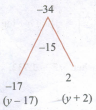
[∵a2 - b2 = (a+b)(a-b)]
\(\frac { { y }^{ 2 }-15y-34 }{ { 3y }^{ 2 }-12 } \) = \(\frac { (y-17)(y+2) }{ 3({ y }^{ 2 }-4) } \)
= \(\frac { (y-17)(y+2) }{ 3(y-2)(y+2) } \)
= \(\frac { y-17 }{ 3(y-2) } \)
2.
Given \(\frac { 3+\sqrt { 7 } }{ 3-\sqrt { 7 } } =a+b\sqrt { 7 } \)
Multiplying the numerator and denominator by the conjugate of the denominator we get
\(\frac { (3+\sqrt { 7 } )(3+\sqrt { 7 } ) }{ (3-\sqrt { 7 } )(3+\sqrt { 7 } ) } =a+b\sqrt { 7 } \)
⇒ \(\frac { 9+7+6\sqrt { 7 } }{ { 3 }^{ 2 }-(\sqrt { 7 } )^{ 2 } } =a+b\sqrt { 7 } \)
⇒ \(\frac { 16+6\sqrt { 7 } }{ 9-7 } =a+b\sqrt { 7 } \Rightarrow \frac { 2(8+3\sqrt { 9 } ) }{ 2 } =a+b\sqrt { 7 } \)
\(8+3\sqrt { 7 } =a+b\sqrt { 7 } \)
Comparing the like co-efficients both sides we get a = 8 and b = 3
3.
Given a3+b3 = ab (8-3a-3b)
⇒ a3+ b3 = 8ab - 3a2b - 3ab2
⇒ a3+b3+3a2b+3ab2=8ab
⇒ (a+b)3= 23 ab
⇒ \(\left( \frac { a+b }{ 2 } \right) ^{ 3 }\)= ab
⇒ log\(\left( \frac { a+b }{ 2 } \right) \) = log ab [Taking logarithm on both sides]
⇒ 3 log\(\left( \frac { a+b }{ 2 } \right) \) log a + log b [Using power rule and products rule]
⇒ log \(\left( \frac { a+b }{ 2 } \right) \) = \(\frac { 1 }{ 3 } \) [log a + log b]
4.
Given log216 = 4
Using \({ log }_{ b }^{ m }=\frac { { log }_{ a }^{ m } }{ { log }_{ b }^{ m } } \) we have
\({ log }_{ 16 }^{ 2 }=\frac { { log }_{ 2 }^{ 2 } }{ { log }_{ 2 }^{ 16 } } =\frac { 1 }{ { log }_{ 2 }^{ { 2 }^{ 4 } } } \) \([{ log }_{ a }^{ a }=1]\)
= \(\frac { 1 }{ 4{ log }_{ 2 }^{ 2 } } =\frac { 1 }{ 4 } \) [using power rule]
∴ \({ log }_{ 16 }^{ 2 }=\frac { 1 }{ 4 } \)
5.
Let the two distinct irrational numbers be \(\left( 2+\sqrt { 3 } \right) \) and \(\left( 4+\sqrt { 3 } \right) \).
Their difference is \(\left( 2+\sqrt { 3 } \right) -\left( 4+\sqrt { 3 } \right) =2+\sqrt { 3 } -4-\sqrt { 3 } =2-4=-2\) which is rational.
6.
= \({ 3 }^{ -6\times \frac { 1 }{ 3 } }={ 3 }^{ 2 }=\frac { 1 }{ { 3 }^{ 2 } } =\frac { 1 }{ 9 } \)
7.
= \(\left( { -10 }^{ 3\times \frac { -2 }{ 3 } } \right) =-{ 10 }^{ -2 }=\frac { -1 }{ { 10 }^{ 2 } } =\frac { -1 }{ 100 } \)
8.
Required polynomial equation is
\(\mathrm{p}(x)=a x^{2}+b x+c\)
Given one root is \(1+\sqrt{5}\)
another root is \(1-\sqrt{5}\)
Required equation is s (x- a)(x- b)
\( =(x-(1+\sqrt{5}))(x-(1-\sqrt{5})) \)
\( =(x-1-\sqrt{5})(x-1+\sqrt{5}) \)
\( =(x-1)^{2}-(\sqrt{5})^{2} \)
\( =x^{2}-2 x+1-5 \)
\( =x^{2}-2 x-4\)
9.
Let the two irrational numbers be \(5+\sqrt { 7 } \) and \(7-\sqrt { 7 } \)
Their sum = \(\left( 5+\sqrt { 7 } \right) +\left( 7-\sqrt { 7 } \right) \ = \ 5+\sqrt { 7 } +7-\sqrt { 7 } \)
= 5 + 7 = 12 which is a rational number.
Consider the two irrational numbers \(4+\sqrt { 6 } \) and \(4-\sqrt { 6 } \)
Their product = \(\left( 4+\sqrt { 6 } \right) +\left( 4-\sqrt { 6 } \right) ={ 4 }^{ 2 }-{ \left( \sqrt { 6 } \right) }^{ 2 }\)= 16 - 6 = 10 which is a rational number.
10.
Let the sides of the triangle be a cm, b cm, c cm and a>b>c.
By the given conditions,
a = 3c
b = a - 2
and a + b + c > 61
From(2), b = 3c-2
Putting the values of a and b in (3) we get, 3c + (3c + 2) + c \(\ge\) 61
\(\Rightarrow\) 7c\(\ge\) 61+2
\(\Rightarrow\) 6\(\ge{{63}\over{7}}\)
\(\Rightarrow\) c \(\ge\) 9
\(\therefore\) Minimum length of the shortest side = 9 cm.
11.
Given inequality is \({{2x+5}\over{x-1}}>5\)
\(\Rightarrow\) \({{2x+5}\over{x-1}}-5>0\)
\(\Rightarrow\) \({{2x+5-5x+5}\over{x-1}}>0\)
\(\Rightarrow\) \({{-3x+10}\over{x-1}}>0\)
Case(i) -3x + 10 > 0, x - 1 > 0
-3x < -10, x >1
3x < 10, x >1
\(x<{{10}\over{3}},x>1\)
\(1,x<{{10}\over{3}}\)
Case(ii) -3x + 10 < 0, x - 1< 0
-3x < -10, x < 1
3x<10, x <1
\(x>{{10}\over{3}},x<1\)
This is impossible
\(\therefore\) The solution is \(\left(1,{{10}\over{3}} \right)\)
12.
Suppose y = 2x
| x | 1 | -1 | 2 | -2 |
| y | 2 | -2 | 4 | -4 |
-2x + 3y = 6
-2x = 6 - 3y
\(x={6-3y\over -2}\)
| x | 0 | -3 |
| y | 2 | 0 |
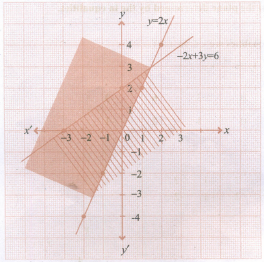
All the points above the y ≥ 2x and all the points below -2x + 3y ≤ 6 is required region. Darkly shaded area will represents the solution set of the given linear inequalities.
13.
negative of other
Given quadratic equation is ax2 + bx + c = 0
Since one root is negative of the other, let
α and -α be the roots
\(∴\ α+(α)={-b\over a}\)
\(⇒\ 0={-b\over a}=0\)
⇒ b = 0
Also α(-α) = \(c\over a\)
\(⇒\ -α^2={c\over a}\)
Hence the required condition is b = 0
14.
Given x =\(\sqrt { 2 } +\sqrt { 3 } \)
⇒ x3 = \((\sqrt { 2 } +\sqrt { 3 } )^{ 2 }=2+3+2\sqrt { 6 } =5+2\sqrt { 6 } \)
∴ \(\frac { { x }^{ 2 }+1 }{ { x }^{ 2 }-1 } =\frac { 5+2\sqrt { 6 } +1 }{ 5+2\sqrt { 6 } -2 } =\frac { 6+2\sqrt { 6 } }{ 3+2\sqrt { 6 } } \)
⇒ \(\frac { 6+2\sqrt { 6 } }{ 3+2\sqrt { 6 } } \times \frac { 3-2\sqrt { 6 } }{ 3-2\sqrt { 6 } } =\frac { (6+2\sqrt { 6 } )(3-2\sqrt { 6 } ) }{ 9-(2\sqrt { 6 } )^{ 2 } } \)
⇒ \(\frac { 18-12\sqrt { 6 } +6\sqrt { 6 } -4(\sqrt { 6 } )^{ 2 } }{ 9-24 } =\frac { 18-12\sqrt { 6 } -24 }{ -15 } \)
⇒ \(\frac { -6-6\sqrt { 3 } }{ -15 } \)
\(=\frac{2(1+\sqrt{6})}{5}=\frac{2+2 \sqrt{6}}{5}\)
15.
Given \(\frac { 1 }{ 3-\sqrt { 8 } } -\frac { 1 }{ \sqrt { 8 } -\sqrt { 7 } } +\frac { 1 }{ \sqrt { 7 } -\sqrt { 6 } } -\frac { 1 }{ \sqrt { 6 } -\sqrt { 5 } } +\frac { 1 }{ \sqrt { 5 } -2 } \) ..(1)
Multiplying each term by the conjugate of the denominator we get
\(\frac { 1 }{ 3-\sqrt { 8 } } \) = \(\frac { 1 }{ 3-\sqrt { 8 } } \times \frac { 3+\sqrt { 8 } }{ 3+\sqrt { 8 } } =\frac { 3+\sqrt { 8 } }{ { 3 }^{ 2 }-\sqrt { 8 } ^{ 2 } } =\frac { 3+\sqrt { 8 } }{ 9-8 } =3+\sqrt { 8 } \)
\(\frac { 1 }{ \sqrt { 8 } -\sqrt { 7 } } \)= \(\frac { 1 }{ \sqrt { 8 } -\sqrt { 7 } } \times \frac { \sqrt { 8 } +\sqrt { 7 } }{ \sqrt { 8 } +\sqrt { 7 } } =\frac { \sqrt { 8 } +\sqrt { 7 } }{ 8-7 } =\frac { \sqrt { 8 } +\sqrt { 7 } }{ 1 } =\sqrt { 8 } +\sqrt { 7 } \)
\(\frac { 1 }{ \sqrt { 7 } -\sqrt { 6 } } \) =\(\frac { 1 }{ \sqrt { 7 } -\sqrt { 6 } } \times \frac { \sqrt { 7 } +\sqrt { 6 } }{ \sqrt { 7 } +\sqrt { 6 } } =\frac { \sqrt { 7 } +\sqrt { 6 } }{ \sqrt { 7 } ^{ 2 }+\sqrt { 6 } ^{ 2 } } =\frac { \sqrt { 7 } +\sqrt { 6 } }{ 7-6 } =\sqrt { 7 } +\sqrt { 6 } \)
\(\frac { 1 }{ \sqrt { 6 } -\sqrt { 5 } } \) = \(\frac { 1 }{ \sqrt { 6 } -\sqrt { 5 } } \times \frac { \sqrt { 6 } +\sqrt { 5 } }{ \sqrt { 6 } +\sqrt { 5 } } =\frac { \sqrt { 6 } +\sqrt { 5 } }{ \sqrt { 6 } ^{ 2 }+\sqrt { 5 } ^{ 2 } } =\frac { \sqrt { 6 } +\sqrt { 5 } }{ 6-5 } \)
\(\frac { 1 }{ \sqrt { 5 } -2 } \) = \(\frac { 1 }{ \sqrt { 5 } -2 } \times \frac { \sqrt { 5 } +2 }{ \sqrt { 5 } +2 } =\frac { \sqrt { 5 } +2 }{ \sqrt { 5 } ^{ 2 }+2^{ 2 } } =\frac { \sqrt { 5 } +2 }{ 5-4 } =\sqrt { 5 } +2\)
Substituting all these values in (1)we get
\(\frac { 1 }{ 3-\sqrt { 8 } } -\frac { 1 }{ \sqrt { 8 } -\sqrt { 7 } } +\frac { 1 }{ \sqrt { 7 } -\sqrt { 6 } } -\frac { 1 }{ \sqrt { 6 } -\sqrt { 5 } } +\frac { 1 }{ \sqrt { 5 } -2 } \) = 5
16.
(b)
2
17.
(a)
\(\sqrt [ 8 ]{ 11^{ 2 } } \)
18.
(d)
x ∊ (-∞, -13] \(\cup\) [7, ∞)
19.
(a)
x ∈ (10, ∞)
20.
(c)
-x > -7
21.
\(\text { Let } \log _{3} \frac{1}{81}=x \Rightarrow 3^{x}=\frac{1}{81}\)
\(\Rightarrow 3^{x}=3^{-4}\)
\(\Rightarrow x=-4 \)
22.
\(\text { Let } \log _{\sqrt{2}} 512=x\)
\(\text { Then }(\sqrt{2})^{x}=2^{9}\)
\(\Rightarrow 2^{\frac{x}{2}}=2^{9} \Rightarrow x / 2=9 \Rightarrow x=18\)
23.
(b)
24.
\(5 x-1 <24 \ \ \ 5 x+1 >-24 \)
\(5 x <25 \ \ 5 x >-25\)
\(x <5 \ x >-5 \)
\(x \in(-5,5)\)
25.
\(\text { In }(-\infty, 2), \frac{|x-2|}{x-2} \text { is negative }\)
\(\operatorname{In}[2, \infty), \frac{|x-2|}{x-2} \geq 0\)

11th Standard Syllabus & Materials
11th Standard
TN 11th Tamil பீடு பெற நில் - செய்யுள் - காவடிச்சிந்து Important Questions And Answers Study Material - QB365 Set A
NEW11th Standard
TN 11th Tamil பீடு பெற நில் - உரைநடை - மலை இடப்பெயர்கள் : ஓர் ஆய்வு Important Questions And Answers Study Material - QB365 Set A
NEW11th Standard
TN 11th Tamil மாமழை போற்றுதும் - துணைப்பாடம் - யானை டாக்டர் Important Questions And Answers Study Material - QB365 Set A
NEW11th Standard
TN 11th Tamil மாமழை போற்றுதும் - செய்யுள் - ஐங்குறுநூறு Important Questions And Answers Study Material - QB365 Set A



Tamilnadu Stateboard 11th Standard Subjects
Maths

Commerce

Economics

Biology

Business Maths and Statistics

Accountancy

Computer Science

Physics

Chemistry
Maths
Biology
Economics
Physics
Chemistry

History
Business Maths and Statistics

Computer Science
Accountancy

Computer Applications
History
Computer Technology
Commerce
Computer Applications
Computer Technology

Tamil

English

French
Tamilnadu Stateboard Standards

