
 100% FREE ACCESS
11th Standard Syllabus & Materials
11th Standard
TN 11th Tamil இயற்கை வேளாண்மை,சுற்றுச்சூழல் -செய்யுள் - மனோன்மணீயம் Important Questions And Answers Study Material - QB365 Set A
NEW11th Standard
TN 11th Tamil என்னுயிர் என்பேன் -துணைப்பாடம் - இசைத்தமிழர் இருவர் Important Questions And Answers Study Material - QB365 Set A
NEW11th Standard
TN 11th Tamil மொழி கலை -செய்யுள் - ஒவ்வொரு புல்லையும் Important Questions And Answers Study Material - QB365 Set A
NEW11th Standard
TN 11th Tamil பீடு பெற நில் - இலக்கணம் - பகுபத உறுப்புகள் Important Questions And Answers Study Material - QB365 Set A
NEW11th Standard
TN 11th Tamil பீடு பெற நில் - துணைப்பாடம் - வாடிவாசல் Important Questions And Answers Study Material - QB365 Set A
NEW11th Standard
TN 11th Tamil பீடு பெற நில் - செய்யுள் - குறுந்தொகை Important Questions And Answers Study Material - QB365 Set A

Published on: 26/07/2018
In this question paper, the questions are prepared from the concept of Chemistry and Chemical Calculations.
The questions are prepared from the book back and previous year questions. Please click here, to get the answer of this question paper.
Download Tamil Nadu 11th Standard Chemistry question papers, model tests, one-mark questions, important questions, and public exam papers in PDF format. Free study materials and answer keys for TN State Board students.
Questions + Answers key
Take MCQ Chemistry Test
1.
The number of moles of H, in 2.24 litre of hydrogen gas at STP is ____________
1
0.1
0.01
0.001
2.
How many molecules of hydrogen is required to produce 4 moles of ammonia?
15 moles
20 moles
6 moles
4 moles
3.
How many equivalents of sodium sulphate is formed when sulphuric acid is completely neutralized by a base NaOH __________.
0.2
2
0.1
1
4.
The number of molecules in 16g of methane is _________
3.023 x 10²³
6.023 x 10²³
16/6.023 x 1023
6.023/3 x 1023
5.
Two elements X and Y ( atomic mass of X = 75; Y = 16) combine to give a compound having 76% of X. The formula of the compound is?
XY
X2Y
X2Y2
X2Y3
6.
How many moles of magnesium phosphate Mg3(PO4)2 Will Contain 0.25 moles of oxygen atoms?
0.02
3.125 x 10⁻²
1.25 x 10⁻²
2.5 x 10⁻²
7.
Which among the following statement(s) describe an element?
i) It is a pure substance which could be split into two or more simpler substance.
ii) It is a pure substance which cannot be split into simpler substance
iii) It's composition is not uniform
iv) All the above
only (iv)
only (ii)
(ii) and (iii)
(i) and (iii)
8.
What is the mass of precipitate formed when 50 ml of 8.5 % solution of AgNO3 is mixed with 100 ml of 1.865 % potassium chloride solution ?
3.59 g
7g
14 g
28 g
9.
Define the following:
(i) Element
(ii) Compound.
10.
Calculate the number of moles present in the following 120g of sodium hydroxide
11.
Calculate the oxidation number of underlined atoms of the following :
NO3-
12.
How much mass (in gram units) is represented by the following ?
0.2 mol of NH3
13.
Calculate the mass of the following : 1 atom of silver
14.
The density of carbon dioxide is equal to 1.965 kgm-3 at 273 K and 1 atm pressure. calculate the molar mass of CO2.
15.
\({ 2NH }_{ 3 }\left( g \right) +{ CO }_{ 2 }\left( g \right) \rightarrow \underset{Urea}{H_2N}-\overset { \underset { || }{ O } }{ C } -{ NH }_{ 2 }\left( aq \right) +{ H }_{ 2 }O(I)\)
In a process, 646 g of ammonia is allowed to react with 1.144 kg of CO2 to form urea.
(i) If the entire quantity of all the reactants is not consumed in the reaction which is the limiting reagent ?
(ii) Calculate the quantity of urea formed and unreacted quantity of the excess reagent. The balanced equation is
\(\overset { { 2NH }_{ 3 }+{ CO }_{ 2 } }{ \underset { { H }_{ 2 }NCON{ H }_{ 2 }+{ H }_{ 2 }O }{ \downarrow } } \)
16.
Balance the following equations by oxidation number method.
K2Cr2O7 + HI ⟶ KI + Crl3 + H2O + I2
17.
Balance the following equations by ion electron method.
i) \({ KMn }O_{ 4 }+{ SnCl }_{ 2 }+HCI\longrightarrow MnCI_{ 2 }+{ SnCI }_{ 4 }+{ H }_{ 2 }O+KCI\)
ii) 
iii) 
iv) 
18.
What is the empirical formula of the following?
i) Fructose (C6 H12 O6) Found in honey
ii) Caffeine (C8 H10 N4 O2) a substance found in tea and Coffee
19.
Assertion: Equal volumes of all the gases do not contain equal number of atoms
Reason: Atom is the smallest particle which takes part in chemical reactions.
Codes:
(a) Both assertion and reason are correct and reason is the correct explanation for assertion
(b) Both assertion and reason are correct but reason is not the correct explanation for assertion
(c) Assertion is true but reason is false.
(d) Both assertion and reason is false.
Both assertion and reason are correct and reason is the correct explantion for assertion
Both assertion and reason are correct but reason is not the correct explantion for assertion
Assertion is true but reason are false
Both assertion and reason are false
20.
What is meant by Plasma state? Give an example.
21.
Calculate the equivalent masses of the following - HNO3
1.
(b)
0.1
2.
(c)
6 moles
3.
(b)
2
4.
(b)
6.023 x 10²³
5.
(d)
X2Y3
6.
(b)
3.125 x 10⁻²
7.
(b)
only (ii)
8.
(a)
3.59 g
9.
(i) An element consists of only one type of atom ..An atom is the smallest electrically neutral - particle, being made up of fundamental particles, namely electrons, protons and neutrons.
(ii) Compounds are made up of molecules which contain two or more atoms of different elements. Properties of compounds are different.from those of their constituent elements. The constituents of a compound is present in a fixed ratio by weight.
10.
Molar mass of sodium hydroxide = 40
No.of moles = \(\frac { Mass }{ Molar\ mass } \)
No.of moles (n) = \(\frac { 120 }{ 40 } \)
= 3 moles
11.
NO3-
x + 3(-2) = -1
x - 6 = -1
x = -1 + 6
x = +5
Oxidation number of N in NO3- is +5
12.
Molar mass of NH3 = (1 x 14 + 3 x 1) = 17g mol-1
Mass of 0.2 mol of NH3 = 0.2 mol x 17g mol-1
= 3.4 g
13.
Molecular mass of silver (Ag) = 107.87 u
Molar mass of Ag = 107.87 g mol-1
\(\therefore\) Mass of 1 atom of Ag = \(\frac { Molar\ mass }{ Avogadro's\ number } \)
= \(\frac { 107.87g\ { mol }^{ -1 } }{ 6.023\times { 10 }^{ 23 }\ { mol }^{ -1 } } \)
= 17.91 x 10⁻²³g
Mass of 1 atom of Ag = 17.91 x 10⁻²³ g.
14.
Molar mass = density x Molar volume
= 1.965 x 2.24 x 10-2
= 4.4016 x 10⁻² kg/mol
= 4.4016 x 10-2 x 103 g/mol
= 44.016 g/mol
15.
(i) The entire quantity of ammonia is consumed in the reaction. So ammonia is the Iimiting reagent. Some quantity of CO2 remains unreacted, so CO2 is the excess reagent.
(ii) Quantity of urea formed = number of moles of urea formed x molar mass of urea
= 19 moles x 60 g mol-1
= 1140 g = 1.14 kg
Excess reagent leftover at the end of the reaction is carbon dioxide.
Amount of carbon dioxide leftover
= number of moles of CO2 left over x molar mass of CO2
= 7 moles x 44 g mol-1
= 308 g
| Reactants | Products | |||
| NH3 | CO2 | Urea | H2O | |
| Stoichiometric coefficients | 2 | 1 | 1 | 1 |
| Number of moles of reactants allowed to react \(N=\frac { Mass }{ Molar\quad mass } \) | \(\frac { 646 }{ 17 } =38\) moles | \(\frac { 1144 }{ 44 } =26\)moles | - | - |
| Actual number of moles consumed during reaction Ratio (2:1) | 38 moles | 19 moles | - | - |
| No.of moles of product thus formed | - | - | 19 moles | 19 moles |
| No.of moles of reactant left at the end of the reaction | - | 7 moles | - | - |
16.
Step - 1 : To find atoms undergoing change in O.N.
K2Cr2O7 + HI ⟶ KI + Crl3 + H2O + I2
Step - 2 : To find the total increase and decrease in O.N.
K2Cr2O7 + CrI3 (decrease of 3 unit / atom = Total decrease = 6 units / 2 atom)
HI ⟶ I2 (increase of 1 unit / atom = total increase 1 x 6 = 6)
Step - 3 : To balance the total increase and decrease in O.N, multiply HI by 6.,
K2Cr2O7 + 6 HI ⟶ KI + Crl3 + H2O + I2
Step - 4 : To balance all atoms other than '0' and 'H'
K2Cr2O7 + 6 HI ⟶ 2KI + 2Crl3 + H2O + 3I2
This makes 14 iodine atoms on RHS. (These iodide ions do not undergo any change in O.N). Hence to balance the iodine atoms add 8HI to LHS.
i.e., K2Cr2O7 + 14 HI ⟶ 2KI + 2CrI3 + H2O + 3I2
These, the oxygen atoms are balanced by making 7H2O as RHS.
K2Cr2O7 + 14 HI ⟶ 2KI + 2CrI3 + 7H2O + 3I2
The hydrogen atoms are balanced by themselves.
Hence the balanced equation is
K2Cr2O7 + 14HI ⟶ 2KI + 2Crl3 + 7H2O + 3I2
17.
Half reactions are:
\(\overset { +7 }{ M } { nO }_{ 4 }^{ - }\longrightarrow { Mn }^{ 2+ }\)
and \({ Sn }^{ 2+ }\longrightarrow { Sn }^{ 4+ }\)
(1) \(\Rightarrow \) \({ MnO }_{ 4 }^{ - }+{ 8H }^{ - }+5e^{ - }\longrightarrow { Mn }^{ 2+ }+{ 4H }_{ 2 }O\)
(2) \(\Rightarrow \) \({ Sn }^{ 2+ }\longrightarrow { Sn }^{ 4+ }+{ 2e }^{ - }\)
.png)
ii)
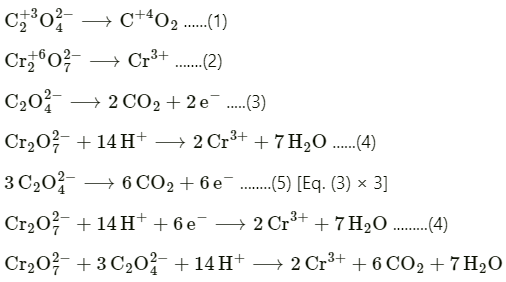
iii)
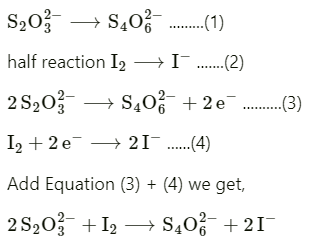
iv)
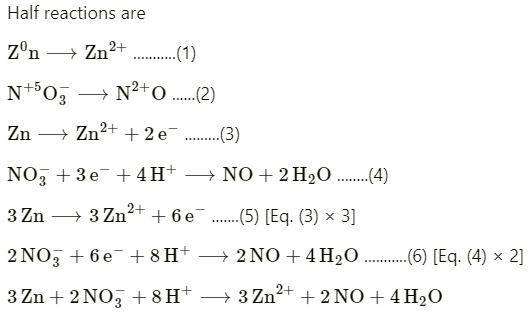
18.
| Compound | Molecular formula | Empirical Formula |
|---|---|---|
| Fructose | C6 H12O6 | C H2O |
| Caffeine | C8 H10 N4 O2 | C4 H5 N2O |
19.
(b) Both assertion and reason are correct but reason is not the correct explanation for assertion
20.
Gaseous state of matter at very high temperature containing gaseous ions and free electron is referred to as the Plasma state. e.g. Lightning.
21.
Molar mass of HNO3 = 1 + 14 + 3 x 16 = 63
Basicity of HNO3 = 1
Equivalent mass of HNO3 = \(\frac { 63 }{ 1 } =63g\) eq-1

11th Standard Syllabus & Materials
11th Standard
TN 11th Tamil பீடு பெற நில் - செய்யுள் - காவடிச்சிந்து Important Questions And Answers Study Material - QB365 Set A
NEW11th Standard
TN 11th Tamil பீடு பெற நில் - உரைநடை - மலை இடப்பெயர்கள் : ஓர் ஆய்வு Important Questions And Answers Study Material - QB365 Set A
NEW11th Standard
TN 11th Tamil மாமழை போற்றுதும் - துணைப்பாடம் - யானை டாக்டர் Important Questions And Answers Study Material - QB365 Set A
NEW11th Standard
TN 11th Tamil மாமழை போற்றுதும் - செய்யுள் - ஐங்குறுநூறு Important Questions And Answers Study Material - QB365 Set A



Tamilnadu Stateboard 11th Standard Subjects

Maths

Commerce

Economics

Biology

Business Maths and Statistics

Accountancy

Computer Science

Physics
Chemistry
Maths
Biology
Economics
Physics
Chemistry

History
Business Maths and Statistics

Computer Science
Accountancy

Computer Applications
History
Computer Technology
Commerce
Computer Applications
Computer Technology

Tamil

English

French
Tamilnadu Stateboard Standards
