
 100% FREE ACCESS
11th Standard Syllabus & Materials
11th Standard
TN 11th Tamil இயற்கை வேளாண்மை,சுற்றுச்சூழல் -செய்யுள் - மனோன்மணீயம் Important Questions And Answers Study Material - QB365 Set A
NEW11th Standard
TN 11th Tamil என்னுயிர் என்பேன் -துணைப்பாடம் - இசைத்தமிழர் இருவர் Important Questions And Answers Study Material - QB365 Set A
NEW11th Standard
TN 11th Tamil மொழி கலை -செய்யுள் - ஒவ்வொரு புல்லையும் Important Questions And Answers Study Material - QB365 Set A
NEW11th Standard
TN 11th Tamil பீடு பெற நில் - இலக்கணம் - பகுபத உறுப்புகள் Important Questions And Answers Study Material - QB365 Set A
NEW11th Standard
TN 11th Tamil பீடு பெற நில் - துணைப்பாடம் - வாடிவாசல் Important Questions And Answers Study Material - QB365 Set A
NEW11th Standard
TN 11th Tamil பீடு பெற நில் - செய்யுள் - குறுந்தொகை Important Questions And Answers Study Material - QB365 Set A

Published on: 30/09/2018
Important 5mark -chapter 1,2
Download Tamil Nadu 11th Standard Chemistry question papers, model tests, one-mark questions, important questions, and public exam papers in PDF format. Free study materials and answer keys for TN State Board students.
Questions + Answers key
Take MCQ Chemistry Test
1.
Protons can be accelerated in particle accelerators. Calculate the wavelength (in Å) of such accelerated proton moving at 2.85 x 10⁸ ms-1 (the mass of proton is 1.673 x 10⁻²⁷ Kg).
2.
Calculate the uncertainty in the position of an electron, if the uncertainty in its velocity is 5.7 x 10⁵ ms-1.
3.
\({ 2NH }_{ 3 }\left( g \right) +{ CO }_{ 2 }\left( g \right) \rightarrow \underset{Urea}{H_2N}-\overset { \underset { || }{ O } }{ C } -{ NH }_{ 2 }\left( aq \right) +{ H }_{ 2 }O(I)\)
In a process, 646 g of ammonia is allowed to react with 1.144 kg of CO2 to form urea.
(i) If the entire quantity of all the reactants is not consumed in the reaction which is the limiting reagent ?
(ii) Calculate the quantity of urea formed and unreacted quantity of the excess reagent. The balanced equation is
\(\overset { { 2NH }_{ 3 }+{ CO }_{ 2 } }{ \underset { { H }_{ 2 }NCON{ H }_{ 2 }+{ H }_{ 2 }O }{ \downarrow } } \)
4.
Calculate the percentage composition of the elements present in magnesium carbonate. How many kilogram of CO2 can be obtained by heating 1 kg of 90 % pure magnesium carbonate.
5.
The Mn3+ ion is unstable in solution and undergoes disproportionation to give Mn2+, MnO2 and H+ ion. Write a balanced ionic equation for the reaction.
6.
An insecticide has the following percentage composition by mass: 47.5% C, 2.54% H, and 50.0% Cl. Determine its empirical formula and molecular formulae. Molar mass of the substance is 354.5g mol-1
7.
Balance the following equation by ion-electron method In acidic medium.
\(Cr{(OH)}_4^-+H_2O_2\rightarrow Cr{O}_4^{2-}\)
8.
Balance the following equation by ion-electron method In acidic medium.
\(S_2O_3^{2-}+I_2\rightarrow S_2O_4^{2-}+SO_2+I^-\)
9.
Balance the following equation by oxidation number method:
Zn + HNO3 \(\rightarrow\)Zn(NO3)2 + NH4NO3 + H2O
10.
Explain the angular distribution function of 1s, 2s, 3s, 2p, 3d and 4f orbits.
1.
v = 2.85 x 10⁸ ms-1
mp = 1.673 x 10⁻²⁷Kg
\(\lambda=\frac{h}{mv}\)
\(=\frac{6.626\times10^{-34}kgm^{2}s^{-1}}{1.673\times10^{-27}kg\times\times2.85\times10^{8}ms^{-1}}\)
\(\lambda=1.389\times10^{-15}\Rightarrow\lambda=1.389\times10^{-15}A\) \([\because \mathring{A}={10}^{-10}m]\)
2.
Given \(\triangle\)v = 5.7 x 10⁵ ms-1. \(\triangle\)x = ?
According to Heisenbergs uncertainty principle \(\Delta x \cdot \Delta p \geq \frac{\mathrm{h}}{4 \pi}\)
\(
\frac{\mathrm{h}}{4 \pi}=\frac{6.626 \times 10^{-34}}{4 \times 3.14} \mathrm{kgm}^{2} \mathrm{~s}^{-1}=5.28 \times 10^{-35}
\)
\(\Delta x \cdot \Delta \mathrm{p} \geq 5.28 \times 10^{-35}
\)
\(\Delta x . \mathrm{m} \Delta \mathrm{v} \geq 5.28 \times 10^{-35}
\)
\(\Rightarrow \Delta x \geq \frac{5.28 \times 10^{-35} \mathrm{kgm}^{2} \mathrm{~s}^{-1}}{9.1 \times 10^{-31} \mathrm{~kg} \times 5.7 \times 10^{5} \mathrm{~ms}^{-1}} \Rightarrow \Delta x \geq 1.017 \times 10^{-10} \mathrm{~m}\)
3.
(i) The entire quantity of ammonia is consumed in the reaction. So ammonia is the Iimiting reagent. Some quantity of CO2 remains unreacted, so CO2 is the excess reagent.
(ii) Quantity of urea formed = number of moles of urea formed x molar mass of urea
= 19 moles x 60 g mol-1
= 1140 g = 1.14 kg
Excess reagent leftover at the end of the reaction is carbon dioxide.
Amount of carbon dioxide leftover
= number of moles of CO2 left over x molar mass of CO2
= 7 moles x 44 g mol-1
= 308 g
| Reactants | Products | |||
| NH3 | CO2 | Urea | H2O | |
| Stoichiometric coefficients | 2 | 1 | 1 | 1 |
| Number of moles of reactants allowed to react \(N=\frac { Mass }{ Molar\quad mass } \) | \(\frac { 646 }{ 17 } =38\) moles | \(\frac { 1144 }{ 44 } =26\)moles | - | - |
| Actual number of moles consumed during reaction Ratio (2:1) | 38 moles | 19 moles | - | - |
| No.of moles of product thus formed | - | - | 19 moles | 19 moles |
| No.of moles of reactant left at the end of the reaction | - | 7 moles | - | - |
4.
The balanced chemical equation is
\(\mathrm{MgCO}_{3} \stackrel{\Delta}{\longrightarrow} \mathrm{MgO}+\mathrm{CO}_{2}\)
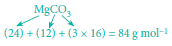
Molar mass of MgCO3 is 84 g mol–1.
84 g MgCO3 contain 24 g of Magnesium.
∴ 100 g of MgCO3 contain
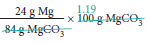
= 28.57 g Mg.
i.e. percentage of magnesium
= 28.57 %.
84 g MgCO3 contain 12 g of carbon
∴ 100 g MgCO3 contain
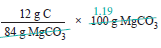
= 14.29 g of carbon.
∴ Percentage of carbon
= 14.29 %.
84 g MgCO3 contain 48 g of oxygen
∴ 100 g MgCO3 contains
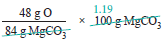
= 57.14 g of oxygen.
∴ Percentage of oxygen
= 57.14 %.
As per the stoichiometric equation,
84 g of 100 % pure MgCO3 on heating gives 44 g of CO2.
∴ 1000 g of 90 % pure MgCO3 gives
\(\frac{\text { wt. of } \mathrm{MgCO}_{3}}{84 \mathrm{~g}} \frac{\text { % Purities }}{100 \%} \frac{\text { wt.of } \mathrm{CO}_{2}}{44 \mathrm{~g}}\)
\(x=44 \times \frac{100}{84} \times \frac{90}{100}\)
= 471.43 g CO2
= 0.471 kg CO2
5.
The skeletal equation is:
\(Mn^{3+}_{aq} \rightarrow Mn_{aq}^{2+}+MnO_{2(s)}+H^+_{(aq)}\)
Oxidation half equation:
\(\overset{+3}Mn^{3+}_{(aq)}\rightarrow \overset{+4}MnO_2{s}\)
Balance O.N. by adding electrons,
\(Mn^{3+}_{(aq)}\rightarrow Mn{O}_{2{(s)}}+e^-\)
Balance charge by adding 4H+ ions,
\(\overset{3+}Mn_{(aq)}\rightarrow MnO_{2{(s)}}+4H^+_{(aq)}+e^-\)
Balance O atoms by adding 2H2O
\(\overset{ 3+}Mn_{(aq)}+2H_2O_{(1)}\rightarrow MnO_{2{(s)}}+4H^+_{(aq)}+e^-\)....(1)
Reduction half equation:
\(\overset{3+}Mn^{3+}\rightarrow\overset{2+} Mn^{2+}\)
Balance O.N. by adding electrons:
\(Mn^{3+}_{(aq)}+e^-\rightarrow Mn^{2+}_{(aq)}\).....(2)
Adding Equation (1) and (2), the balanced equation for the disproportionation reaction is
\(2M{n}^{3+}_{(aq)}+2{H}_{2}{O}_{(1)}\rightarrow Mn{O}_{2(s)}+M{n}^{2+}_{(aq)}+{4H}^{+}_{(aq)}\)
6.
| Element | Percentage | Atomic mass | Relative No. of moles | Simple ratio of atoms | Simplest whole number ratio |
| C | 47.5% | 12 | \(\frac{47.5}{12}=3.96\) | \(\frac{3.96}{1.41}=2.8\times 5\) | 14 |
| H | 2.54% | 1 | \(\frac{2.54}{1}=2.54\) | \(\frac{2.54}{1.41}=1.8\times 5\) | 9 |
| Cl | 50% | 35.5 | \(\frac{50}{35.5}=1.41\) | \(\frac{1.41}{1.41}=1\times 5\) | 5 |
\(\therefore\) The empirical formula is C14H9Cl5.
Calculation of Molecular formula:
The empirical formula mass(C14H9Cl5) = \((14\times 12)+(9\times1)+(5\times 35.5)\)
= 168 + 9 + 177.5 = 354.5
\(n=\frac{Molecular\ mass}{Empirical\ formula\ mass}=\frac{354.5}{354.5}=1\)
Molecular formula = (Empirical formula)n
= (C14H9Cl5)l
\(\therefore\) Molecular formula = C14H9Cl5
7.
\(Cr{(OH)}_4^-+H_2O_2\rightarrow Cr{O}_4^{2-}\)
Oxidation half reaction:
\(\underset{(+3)}{Cr{(OH)}_4^-}\rightarrow\underset{(+6)} {Cr{O}_4^{2-}}+3e^-\).... (1)
Reduction half reaction:
\(H_2O_2+e^-\rightarrow H_2O\)....(2)
(+2) (+1)

To balance oxygen and hydrogen atoms, OH- and H2O are added.
\(2Cr{(OH)}_4^-+3H_2O_2+2OH^-\rightarrow 2Cr{O}_4^{2-}+8H_2O\)
8.
\(S_2O_3^{2-}+I_2\rightarrow S_2O_4^{2-}+SO_2+I^-\)
Oxidation half reaction:
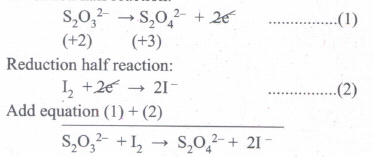
To balance, SO2 is added on RHS of the equation.
\(S_2O_3^{2-}+I_2\rightarrow S_2O_4^{2-}+2I^-+SO_2\)
To balance oxygen atom, S2O32- and SO2 is multiplied by 2.
\(2S_2O_3^{2-}+I_2\rightarrow S_2O_4^{2-}+2I^-+2SO_2\)
9.
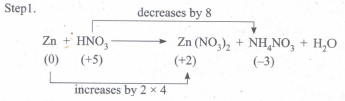
Step 2 .4Zn + HNO3 \(\rightarrow\) 4Zn(NO3)2 + NH4NO3 + H2O
Step 3 . To balance N, HNO3 is multiplied by 10
4Zn + 10HNO3 \(\rightarrow\) 4Zn(NO3)2 + NH4NO3 + H2O
Step 4. To balance oxygen, H2O is multiplied by 3
4Zn + 10HNO3 \(\rightarrow\) 4Zn(NO3)2 + NH4NO3 + 3 H2O
10.
The variation of the probability of locating the electron on a sphere with nucleus at its centre depends on the azimuthal quantum number of the orbital in which the electron is present.
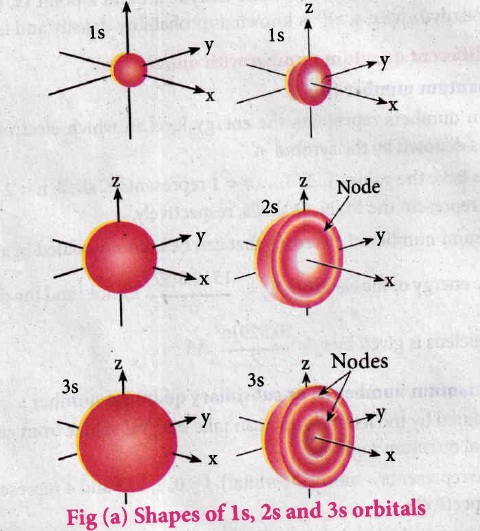
For 1s orbital, l = 0, m = 0,\(f(\theta)=\frac{1}{\sqrt 2}\)and \(g(\varphi)=\frac{1}{\sqrt 2\pi}\) Therefore, the angular distribution function is equal to \(\frac{1}{2\sqrt \pi }\)
i.e. it is independent of the angle \(\theta\) and \(\varphi\). Hence, the probability of finding the electron is independent of the direction from the nucleus. So, the shape of the s orbital is spherical.
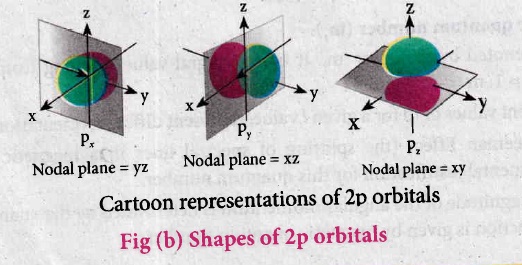
For p orbitals, l = 1 and the corresponding m values are -1, 0 and +1. The angular distribution functions are quite complex and are not discussed here, The shape of the p orbital is shown in Figure (b). The three different m values indicates that there are three different orientations possible for p orbitals. These orbitals are designated as Px, Py and Pz and the angular distribution for these orbitals shows that the lobes are along the x, y arid z axis respectively. As seen in the Figure the 2p orbitals have one nodal plane
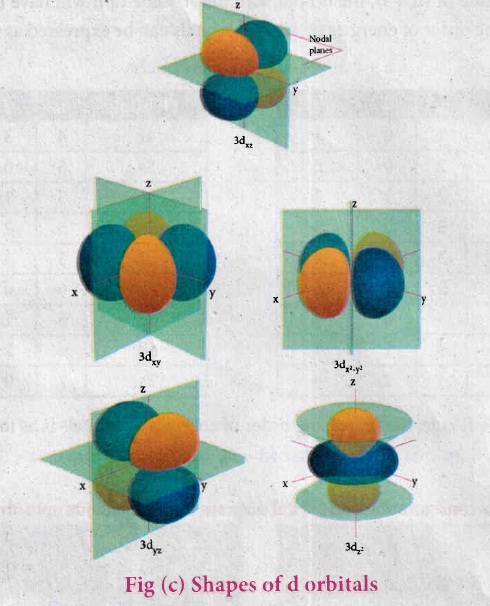
For 'd' orbital l = 2 and the corresponding m values are -2, -1, 0, +1, +2. The shape of the d orbital looks like a 'clover leaf'.
The five m values give rise to five d orbitals namely dxy, dyz, dzx, dx2-y2 and dz2. The 3d orbitals contain two nodal planes.
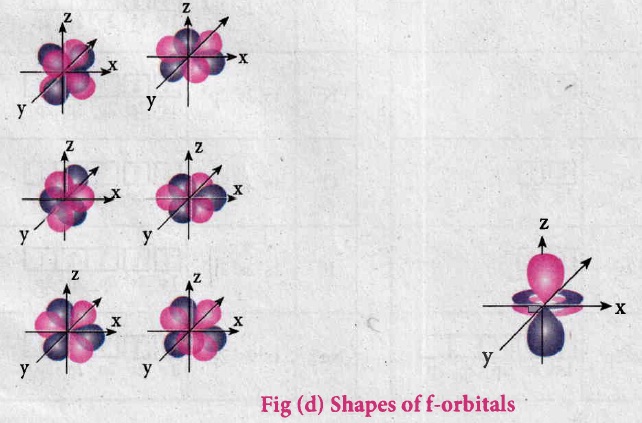
For 'f' orbital, l = 3 and the m values are -3, -2,-1,0, +1, +2, +3 corresponding to seven f orbitals. fz3, fxz2,fyz2,fxyz,fz(x2 - y2),fx(x2 - 3y2),fy(3x2 - y2) which are shown in Figure. There are 3 nodal planes in the f-orbitals.

11th Standard Syllabus & Materials
11th Standard
TN 11th Tamil பீடு பெற நில் - செய்யுள் - காவடிச்சிந்து Important Questions And Answers Study Material - QB365 Set A
NEW11th Standard
TN 11th Tamil பீடு பெற நில் - உரைநடை - மலை இடப்பெயர்கள் : ஓர் ஆய்வு Important Questions And Answers Study Material - QB365 Set A
NEW11th Standard
TN 11th Tamil மாமழை போற்றுதும் - துணைப்பாடம் - யானை டாக்டர் Important Questions And Answers Study Material - QB365 Set A
NEW11th Standard
TN 11th Tamil மாமழை போற்றுதும் - செய்யுள் - ஐங்குறுநூறு Important Questions And Answers Study Material - QB365 Set A



Tamilnadu Stateboard 11th Standard Subjects

Maths

Commerce

Economics

Biology

Business Maths and Statistics

Accountancy

Computer Science

Physics
Chemistry
Maths
Biology
Economics
Physics
Chemistry

History
Business Maths and Statistics

Computer Science
Accountancy

Computer Applications
History
Computer Technology
Commerce
Computer Applications
Computer Technology

Tamil

English

French
Tamilnadu Stateboard Standards
