
 100% FREE ACCESS
11th Standard Syllabus & Materials
11th Standard
TN 11th Tamil இயற்கை வேளாண்மை,சுற்றுச்சூழல் -செய்யுள் - மனோன்மணீயம் Important Questions And Answers Study Material - QB365 Set A
NEW11th Standard
TN 11th Tamil என்னுயிர் என்பேன் -துணைப்பாடம் - இசைத்தமிழர் இருவர் Important Questions And Answers Study Material - QB365 Set A
NEW11th Standard
TN 11th Tamil மொழி கலை -செய்யுள் - ஒவ்வொரு புல்லையும் Important Questions And Answers Study Material - QB365 Set A
NEW11th Standard
TN 11th Tamil பீடு பெற நில் - இலக்கணம் - பகுபத உறுப்புகள் Important Questions And Answers Study Material - QB365 Set A
NEW11th Standard
TN 11th Tamil பீடு பெற நில் - துணைப்பாடம் - வாடிவாசல் Important Questions And Answers Study Material - QB365 Set A
NEW11th Standard
TN 11th Tamil பீடு பெற நில் - செய்யுள் - குறுந்தொகை Important Questions And Answers Study Material - QB365 Set A

Published on: 30/09/2018
Important questions -chapter 1,2
Download Tamil Nadu 11th Standard Chemistry question papers, model tests, one-mark questions, important questions, and public exam papers in PDF format. Free study materials and answer keys for TN State Board students.
Questions + Answers key
Take MCQ Chemistry Test
1.
\({ 2NH }_{ 3 }\left( g \right) +{ CO }_{ 2 }\left( g \right) \rightarrow \underset{Urea}{H_2N}-\overset { \underset { || }{ O } }{ C } -{ NH }_{ 2 }\left( aq \right) +{ H }_{ 2 }O(I)\)
In a process, 646 g of ammonia is allowed to react with 1.144 kg of CO2 to form urea.
(i) If the entire quantity of all the reactants is not consumed in the reaction which is the limiting reagent ?
(ii) Calculate the quantity of urea formed and unreacted quantity of the excess reagent. The balanced equation is
\(\overset { { 2NH }_{ 3 }+{ CO }_{ 2 } }{ \underset { { H }_{ 2 }NCON{ H }_{ 2 }+{ H }_{ 2 }O }{ \downarrow } } \)
2.
Calculate the percentage composition of the elements present in magnesium carbonate. How many kilogram of CO2 can be obtained by heating 1 kg of 90 % pure magnesium carbonate.
3.
Balance the following equation by oxidation number method:
P + HNO3 \(\rightarrow\)H3PO4 + NO2 + H2O
4.
Balance the following equations by oxidation number method.
KMnO4 + KOH + H2O2 ⟶ K2MnO4 + O2 + H2O
5.
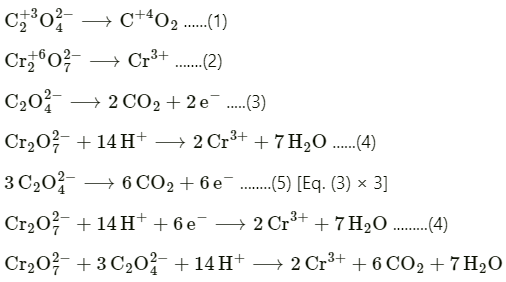
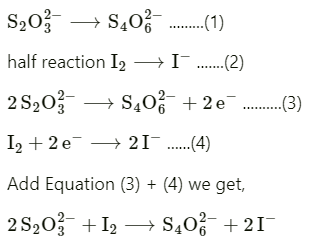
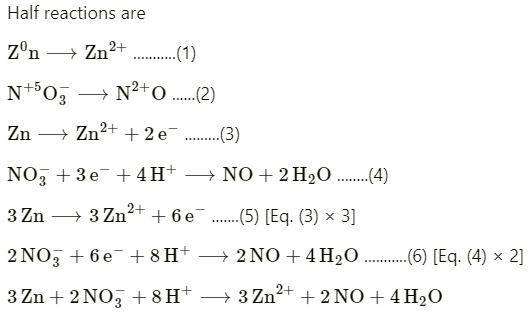
Balance the following equations by ion electron method.
i) \({ KMn }O_{ 4 }+{ SnCl }_{ 2 }+HCI\longrightarrow MnCI_{ 2 }+{ SnCI }_{ 4 }+{ H }_{ 2 }O+KCI\)
ii) 
iii) 
iv) 
6.
Calculate the uncertainty in position of a dust particle of mass 0.1 mg if the uncertainty in velocity is \(5\times { 10 }^{ -19 }{ ms }^{ -1 }\)
7.
Define orbital ? what are the n and 1 values for 3px and 4dx2-y2 electron ?
8.
By applying Bohr's postulates, arrive at the radius of nth orbit for hydrogen like atom
9.
The empirical formula of glucose is __________
CH
CH2O
CH2O2
CHO
10.
The oxidation number of fluorine in all its compounds is equal to ______________.
-1
+1
-2
+2
11.
Which of the following is the actual configuration of Cr (Z = 24)?
1s2 2s2 2p6 3s2 3p6 3d4 4s2
1s2 2s2 2p6 3s2 3p6 3d5 4s1
1s2 2s2 2p6 3s2 3p6 3d6
1s2 2s2 2p6 3s2 3p6 3d5 4s3
12.
What will be the wavelength of a ball of mass 0.1 kg moving with a velocity of 10ms-1?
6.62 \(\times\) 10-34m
6.626 \(\times\) 1034m
6.626 \(\times\) 10-34m
6.626 \(\times\) 1034m
13.
The maximum number of electrons in a sub shell is given by the expression _____________
2n2
2l + 1
4l + 2
none of these
14.
Assertion (A): Among halogens fluorine is the best oxidant.
Reason (R): Fluorine is the most electronegative atom.
Codes:
(a) both assertion and reason are true and the reason is the correct explanation of assertion
(b) both assertion and reason are true but reason is not the correct explanation of assertion
(c) assertion is true but reason is false
(d) both assertion and reason are false
Both A and R are true and R explains A
Both A and R are true but R does not explain A
A is true but R is false
Both A and R are false
15.
Calculate the de Broglie wavelength of an electron moving with 1% of the speed of light?
16.
Calculate the mass of the following atoms in a.m.u (unified atomic mass).
17.
Calculate the number of atoms/molecules present in the following 100 g of sulphur dioxide
18.
The percentage of all the elements present o in a compound is 95. What does it indicate?
19.
Show that if the measurement of the uncertainty in the location of the particle is equal to its de Broglie wavelength, the minimum uncertainty in its velocity is equal to its velocity 1/4\(\pi\) of its velocity (V).
20.
An atom having atomic mass number 13 has 7 neutrons. What is the atomic number of the atom?
21.
How many electrons can be accommodated in the main shell I,m and n?
22.
Which ion has the stable electronic configuration? Ni2+ or Fe3+.
23.
Calculate the equivalent masses of the following - Oxalic acid H2C2O4
24.
Give the relationship between the number of mole of the substance and its gram molecular mass.
25.
What is the difference between atomic mass and mass number?
1.
(i) The entire quantity of ammonia is consumed in the reaction. So ammonia is the Iimiting reagent. Some quantity of CO2 remains unreacted, so CO2 is the excess reagent.
(ii) Quantity of urea formed = number of moles of urea formed x molar mass of urea
= 19 moles x 60 g mol-1
= 1140 g = 1.14 kg
Excess reagent leftover at the end of the reaction is carbon dioxide.
Amount of carbon dioxide leftover
= number of moles of CO2 left over x molar mass of CO2
= 7 moles x 44 g mol-1
= 308 g
| Reactants | Products | |||
| NH3 | CO2 | Urea | H2O | |
| Stoichiometric coefficients | 2 | 1 | 1 | 1 |
| Number of moles of reactants allowed to react \(N=\frac { Mass }{ Molar\quad mass } \) | \(\frac { 646 }{ 17 } =38\) moles | \(\frac { 1144 }{ 44 } =26\)moles | - | - |
| Actual number of moles consumed during reaction Ratio (2:1) | 38 moles | 19 moles | - | - |
| No.of moles of product thus formed | - | - | 19 moles | 19 moles |
| No.of moles of reactant left at the end of the reaction | - | 7 moles | - | - |
2.
The balanced chemical equation is
\(\mathrm{MgCO}_{3} \stackrel{\Delta}{\longrightarrow} \mathrm{MgO}+\mathrm{CO}_{2}\)
Molar mass of MgCO3 is 84 g mol–1.
84 g MgCO3 contain 24 g of Magnesium.
∴ 100 g of MgCO3 contain
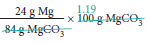
= 28.57 g Mg.
i.e. percentage of magnesium
= 28.57 %.
84 g MgCO3 contain 12 g of carbon
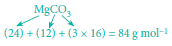
∴ 100 g MgCO3 contain
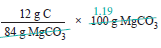
= 14.29 g of carbon.
∴ Percentage of carbon
= 14.29 %.
84 g MgCO3 contain 48 g of oxygen
∴ 100 g MgCO3 contains
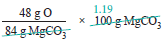
= 57.14 g of oxygen.
∴ Percentage of oxygen
= 57.14 %.
As per the stoichiometric equation,
84 g of 100 % pure MgCO3 on heating gives 44 g of CO2.
∴ 1000 g of 90 % pure MgCO3 gives
\(\frac{\text { wt. of } \mathrm{MgCO}_{3}}{84 \mathrm{~g}} \frac{\text { % Purities }}{100 \%} \frac{\text { wt.of } \mathrm{CO}_{2}}{44 \mathrm{~g}}\)
\(x=44 \times \frac{100}{84} \times \frac{90}{100}\)
= 471.43 g CO2
= 0.471 kg CO2
3.
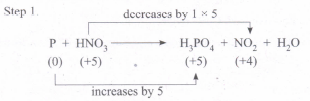
Step 2. P + 5HNO3 \(\rightarrow\)H3PO4 +5 NO2 + H2O
4.
Step - 1 : To find out atoms undergoing change in O.N.
\(\overset { +1+7-2 }{ KMnO_{ 4 } } +\overset { +1-2+1 }{ KOH } +\overset { +1-1 }{ { H }_{ 2 }{ O }_{ 2 } } \rightarrow +\overset { +1+6-2 }{ K_{ 2 }MnO_{ 4 } } +\overset { 0 }{ { O }_{ 2 } } +\overset { +1-2 }{ { H }_{ 2 }O } \)
Step - 2 : To find out total increase and decrease in O.N .
\(\overset { +7 }{ KMnO_{ 4 } } \rightarrow \overset { +6 }{ K_{ 2 }MnO_{ 4 } } \) (decrease of 1 unit per atom)
\(\overset { -1 }{ { H }_{ 2 }{ O }_{ 2 } } \rightarrow \overset { 0 }{ { O }_{ 2 } } \) (increase of 1 unit per atom or 2 units per atom)
Total increase = 2
Total decrease = 2
Step - 3 : To balance the total increase and decrease in O.N, multiply KMnO4 by 2.
2KMnO4 + KOH + H2O2 ⟶ K2MnO4 + O2 + H2O
Step - 4 : To balance all atoms other than 'H' and 'O'
2KMnO4 + 2KOH + H2O2 ⟶ 2K2MnO4 + O2 + H2O
number of oxygen atoms on LHS = 12
number of oxygen atoms on RHS = 11
Hence, multiply H2O in RHS by 2. The equation becomes,
2KMnO4 + 2KOH + H2O2 ⟶ 2K2MnO4 + O2 + H2O
Hydrogen atoms balance by themselves. The balanced equation is
2KMnO4 + 2KOH + H2O2 ⟶ 2K2MnO4 + O2 + 2H2O
5.
Half reactions are:
\(\overset { +7 }{ M } { nO }_{ 4 }^{ - }\longrightarrow { Mn }^{ 2+ }\)
and \({ Sn }^{ 2+ }\longrightarrow { Sn }^{ 4+ }\)
(1) \(\Rightarrow \) \({ MnO }_{ 4 }^{ - }+{ 8H }^{ - }+5e^{ - }\longrightarrow { Mn }^{ 2+ }+{ 4H }_{ 2 }O\)
(2) \(\Rightarrow \) \({ Sn }^{ 2+ }\longrightarrow { Sn }^{ 4+ }+{ 2e }^{ - }\)
.png)
ii)
iii)
iv)
6.
h = \(6.626\times { 10 }^{ -34 }kg{ m }^{ 2 }{ s }^{ -1 }\)
m = 0.1 mg = 1 X 10⁻⁷ kg
Δv =\(5\times { 10 }^{ -19 }{ ms }^{ -1 }\)
Uncertainty in position
\(\Delta x=\frac { h }{ 4\pi m\Delta v } \)
= \(\frac { 6.626\times { 10 }^{ -34 }kg{ m }^{ 2 }{ s }^{ -1 } }{ 4\times 3.143\times { 10 }^{ -7 }kg\times 5\times { 10 }^{ -9 }{ ms }^{ -1 } } \)
= \(1.05\times { 10 }^{ -9 }m\)
\(\boxed{\triangle x=1.05\ nm}\)
7.
The solution to Schrodinger equation gives the permitted total energy values called eigen values and the corresponding wave function represent atomic orbitals.
| Orbital | n | l |
| 3px | 3 | 1 |
| 4dx2-y2 | 4 | 2 |
8.
Applying Bohr's postulates to a hydrogen like atom (one electron species such as H, He+ and Li2+ etc...)the radius of the nth orbit and the energy of the electron revolving in the nth orbit were derived. The results are as follows:
rn = \(\frac { (0.529){ n }^{ 2 } }{ x } \mathring { A } \) ...(1)
En = \(\frac { -13.6({ z }^{ 2 }) }{ { n }^{ 2 } } ev\quad { atom }^{ -1 }\) or ... (2) or
En = \(\frac { (-1312.8){ z }^{ 2 } }{ { n }^{ 2 } } kJ\quad { mol }^{ -1 }\) .....(3)
9.
(b)
CH2O
10.
(a)
-1
11.
(b)
1s2 2s2 2p6 3s2 3p6 3d5 4s1
12.
(a)
6.62 \(\times\) 10-34m
13.
(c)
4l + 2
14.
(a) both assertion and reason are true and the reason is the correct explanation of assertion
15.
According to de Broglie equation, \(\lambda ={h\over mv}\)
Mass of electron = 9.1 x 10⁻³¹kg; Planck's constant = 6.626 x 10⁻³⁴kg m2 s-1
Velocity of electron = 1% of speed of light = 3.0 x 108 x 0.01 = 3 x 10⁶ ms-1
Wavelength of electron(\(\lambda\)) =\(h\over mv\) = \({(6.626\times 10^{-34}kg m^2s^{-1})\over (9.1\times 10^{-31}kg)\times(3\times 10^6ms^{-1})}\)
= 2.43 x 10⁻¹⁰m.
16.
(i) Oxygen: (average mass of oxygen atom = 2.656 x 1O-23g
1 a.m.u = 1.6605 x 1O-27kgor 1.6605 x 1O-24gram)
(ii) Mass of an oxygen atom = 2.656 x 1O-23g
The mass of oxygen atom In a.m.u = \({Average \ mass \ of \ oxygen \ atom \ in \ gram\over1.6605\times10^{-24}}\)
\(={2.656\times10^{-23}g\over1.6605 \times 10^{-24}g}\)
= 1.599 x10
= 15.99 a.m.u
17.
Molecular mass of SO2 = 64
64 g of sulphur dioxide contains = 6.023 \(\times\) 1023
Molecules of SO2
∴ 100g of SO2 contains = \(\frac { 100\times 6.023\times { 10 }^{ 23 } }{ 64 } \)
= 9.41
Molecules of SO2
18.
This indicates that the compound contains oxygen. Its percentage is given as 100 - 95 = 5
19.
\(\triangle x=?\)
\(\triangle v=?\)
\(\triangle x.\triangle p\ge\frac{h}{4\pi}\)
\(\lambda (m\triangle v)\ge\frac{h}{4\pi}\)
\(\triangle v\ge\frac{h}{4\pi(m\lambda)}\)
\(\triangle \ge\frac{h}{4\pi\times m \times\frac{h}{mv}}\) \(\left[ \because \lambda-={{h}\over{mv}} \right]\)
\(\triangle v \ge \frac{v}{4\pi}\)
therefore, minimum uncertainty in velocity \(=\frac{v}{4\pi}\)
20.
A = 13, A - Z = 7 (Neutrons)
Then Z= 6
(ie) Atomic number = 6
21.
| Main shell | l | m | n |
| Principal quantum number | 2 | 3 | 4 |
| Number of electrons in the main shell 2n2 | 2(2)2 = 8 | 2(3)2 = 18 | 2(4)2 = 32 |
22.
Electronic configuration of Fe3+ : 1s2 2s2 2p6 3s2 3p6 4s0 3d5
Electronic configuration of Ni2+ : 1s2 2s2 2p6 3s2 3p6 4s0 3d8
Fe3+ has stable 3d5 half filled configuration.
23.
Molar mass of oxalic acid (H2C2O4) = 2 x 1 + 2 x 12 + 4 x 16 = 90
Basicity of oxalic acid = 2
Equivalent Mass = \(\frac { 90 }{ 2 } =45g\) eq-1
24.
Number of mole =\(Weight \ of \ the \ substance \ in \ g \over gram \ atomic \ mass (or) \ gram \ molecular \ mass \)
25.
(i) Mass number is a whole number because it is the sum of number of protons and number of neutrons.
(ii) Atomic mass is fractional because it is the average relative mass of its atom as compared with mass of an atom of C-12 isotope taken as 12.

11th Standard Syllabus & Materials
11th Standard
TN 11th Tamil பீடு பெற நில் - செய்யுள் - காவடிச்சிந்து Important Questions And Answers Study Material - QB365 Set A
NEW11th Standard
TN 11th Tamil பீடு பெற நில் - உரைநடை - மலை இடப்பெயர்கள் : ஓர் ஆய்வு Important Questions And Answers Study Material - QB365 Set A
NEW11th Standard
TN 11th Tamil மாமழை போற்றுதும் - துணைப்பாடம் - யானை டாக்டர் Important Questions And Answers Study Material - QB365 Set A
NEW11th Standard
TN 11th Tamil மாமழை போற்றுதும் - செய்யுள் - ஐங்குறுநூறு Important Questions And Answers Study Material - QB365 Set A



Tamilnadu Stateboard 11th Standard Subjects

Maths

Commerce

Economics

Biology

Business Maths and Statistics

Accountancy

Computer Science

Physics
Chemistry
Maths
Biology
Economics
Physics
Chemistry

History
Business Maths and Statistics

Computer Science
Accountancy

Computer Applications
History
Computer Technology
Commerce
Computer Applications
Computer Technology

Tamil

English

French
Tamilnadu Stateboard Standards
