
 100% FREE ACCESS
11th Standard Syllabus & Materials
11th Standard
TN 11th Tamil இயற்கை வேளாண்மை,சுற்றுச்சூழல் -செய்யுள் - மனோன்மணீயம் Important Questions And Answers Study Material - QB365 Set A
NEW11th Standard
TN 11th Tamil என்னுயிர் என்பேன் -துணைப்பாடம் - இசைத்தமிழர் இருவர் Important Questions And Answers Study Material - QB365 Set A
NEW11th Standard
TN 11th Tamil மொழி கலை -செய்யுள் - ஒவ்வொரு புல்லையும் Important Questions And Answers Study Material - QB365 Set A
NEW11th Standard
TN 11th Tamil பீடு பெற நில் - இலக்கணம் - பகுபத உறுப்புகள் Important Questions And Answers Study Material - QB365 Set A
NEW11th Standard
TN 11th Tamil பீடு பெற நில் - துணைப்பாடம் - வாடிவாசல் Important Questions And Answers Study Material - QB365 Set A
NEW11th Standard
TN 11th Tamil பீடு பெற நில் - செய்யுள் - குறுந்தொகை Important Questions And Answers Study Material - QB365 Set A

Published on: 30/09/2018
Important 3mark -chapter 1,2
Download Tamil Nadu 11th Standard Chemistry question papers, model tests, one-mark questions, important questions, and public exam papers in PDF format. Free study materials and answer keys for TN State Board students.
Questions + Answers key
Take MCQ Chemistry Test
1.
State and explain pauli exclusion principle.
2.
How much volume of chlorine is required to form 11.2 L of HCI at 273 K and 1 atm pressure?
3.
What is decomposition reaction? Give two examples.
4.
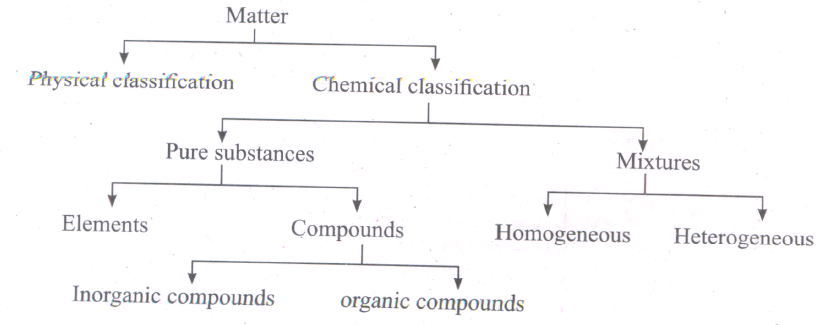
Explain about the classification of matter.
5.
How many unpaired electrons are present in the ground state of Fe3+ (z = 26), Mn2+(z = 25) and argon (z = 18)?
6.
Calculate the number of atoms / molecules present in the following 1.8 gram of water
7.
Define the following:
(i) Element
(ii) Compound.
8.
Calculate the molar volume of the following 460g of formic acid
9.
Calculate Equivalent mass of the Phosphorous acid
10.
Calculate the Formula Weights of the following compounds. NaOH
11.
Calculate the Formula Weights of the following compounds.C6H12O6 - Glucose
12.
How much mass (in gram units) is represented by the following ?
0.2 mol of NH3
13.
Explain briefly the time independent schrodinger wave equation?
14.
Which ion has the stable electronic configuration? Ni2+ or Fe3+.
15.
The quantum mechanical treatment of the hydrogen atom gives the energy value:
\({ E }_{ n }=\frac { -13.6 }{ { n }_{ 2 } } ev{ \ atom }^{ -1 }\)
(i) use this expression to find ΔE between n = 3 and n = 4
(ii) Calculate the wavelength corresponding to the above transition.
1.
Statement : "No two electrons in an atom can have the same set of values of all four quantum numbers"
Explanation : It means that, each electron must have unique values for the four quantum numbers (n, l, m and s).
For the lone electron present in hydrogen atom, the four quantum numbers are: n = 1; l = 0; m = 0 and s = +1/2. For the two electrons present in helium, one electron has the quantum numbers same as the electron of hydrogen atom, n = 1.
l = 0, m = 0 and s = +1/2. For other electron, the fourth quantum number is different i.e., n = 1, l = 0, m = 0 and s = -1/2.
As we know that the spin quantum number can have only two values +1/2 and - 1/2, only two electrons can be accommodated in a given orbital in accordance with pauli exclusion principle.
| Atom | e- | n | l | m | s |
| Helium | First | 1 | 0 | 0 | +1/2 |
| Second | 1 | 0 | 0 | +1/2 |
2.
The balanced equation for the formation of HCI is,
H2(g) + CI2(g) \(\rightarrow\) 2 HCI (g)
As per the stoichiometric equation, under given conditions,
To produce 2 moles of HCI, 1 mole of chlorine gas is required.
To produce 44.8 litres of HCI, 22.4 litres of chlorine gas are required.
\(\therefore\) To produce 11.2 litres of HCI,
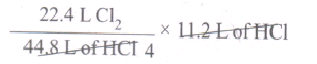
= 5.6 litres of chlorine are required.
3.
Chemical reactions in which a compound splits up into two or more simpler substances are called decomposition reaction
A B \(\rightarrow\) A + B
Example: 2KClO3 \(\rightarrow\) 2KCl + O2
PCl5 \(\rightarrow\) PCl3 +Cl2
4.
5.
Electronic configuration of Fe3+ 1s22s22p63s23p63d64s2
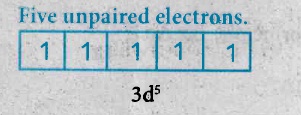
Electronic configuration of mn2+ is 1s2 2s2 2p6 3s2 3p6 4s2 3d5
Five unpaired electrons
Electronic configuration of Ar is 1s2 2s2 2p6 3s2 3p6
no unpaired electrons.
6.
Molecular mass of H20 = 18
gram molecular mass of H20 = 18g
1 mol of H20 = 18g of H20 = 6.023 x 10²³molecules of water
1.8g of H20 = \({6.023\times10^{23}\over18}\times1.8 \)
\(=6.023\times10^{22} molecules\)
7.
(i) An element consists of only one type of atom ..An atom is the smallest electrically neutral - particle, being made up of fundamental particles, namely electrons, protons and neutrons.
(ii) Compounds are made up of molecules which contain two or more atoms of different elements. Properties of compounds are different.from those of their constituent elements. The constituents of a compound is present in a fixed ratio by weight.
8.
Molar mass of formic acid = 46 g
Molar volume of 46 g (1 mole) of formic acid = 2.24 \(\times\) 10-2 m3
Molar volume of 460 g of (10 moles) of formic acid = \(\frac { 2.24\times { 10 }^{ -2 }\times 460 }{ 46 } \)
= 2.24 \(\times\) 10-2 m3
9.
Phosphorous acid (H3 P03)
equivalent mass of phosphorous acid
= \(\frac{Molar \ mass}{basicity} =\frac{82}{2}=41\)
∴ equivalent mass of H3P03 = 41
10.
1 x AW of Na = 1 x 22.99 = 22.99 amu
1 x AW of O = 1x 16 = 16.00 amu
1 x AW of H = 1 x1.008 = 1.008 amu
Formula weight of NaOH is = 39.998 amu
11.
6 x AW of C = 6x12.01 = 72.06 amu
12 x AW of H = 12x1.008 = 12.096 amu
6 x AW of O = 6 x16 = 96.0 amu
Formula weight of Glucose is = 180.156 am
12.
Molar mass of NH3 = (1 x 14 + 3 x 1) = 17g mol-1
Mass of 0.2 mol of NH3 = 0.2 mol x 17g mol-1
= 3.4 g
13.
Erwin Schrodinger expressed the wave nature of electron in terms of a differential equation. This equation determines the change of wave function in space depending on the field of force in which the electron moves. The time independent Schrodinger equation can be expressed as,
\(\overset { \wedge }{ H } \psi =E\psi \) .........(1)
Where \(\overset { \wedge }{ H } \) is called Hamiltonian operator, \(\psi \) is the wave function and is a function of position coordinates of the particle and is denoted as \(\psi \) (x, y, z) E is the energy of the system
\(\overset { \wedge }{ H } =\left[ \frac { { -h }^{ 2 } }{ 8{ \pi }^{ 2 } } \left( \frac { { \partial }^{ 2 }\psi }{ { \partial x }^{ 2 } } +\frac { { \partial }^{ 2 }\psi }{ { \partial y }^{ 2 } } +\frac { { \partial }^{ 2 }\psi }{ { \partial z }^{ 2 } } \right) +V \right] \)
can be written as
\(\left[ \frac { { -h }^{ 2 } }{ 8{ \pi }^{ 2 }m } \left( \frac { { \partial }^{ 2 }\psi }{ { \partial x }^{ 2 } } +\frac { { \partial }^{ 2 }\psi }{ { \partial y }^{ 2 } } +\frac { { \partial }^{ 2 }\psi }{ { \partial z }^{ 2 } } \right) +V\Psi \right] =E\Psi \)
Multiply by \(\frac { 8{ \pi }^{ 2 }m}{ { -h }^{ 2 } } \)and rearranging
\(\frac { { \partial }^{ 2 }\psi }{ { \partial x }^{ 2 } } +\frac { { \partial }^{ 2 }\psi }{ { \partial y }^{ 2 } } +\frac { { \partial }^{ 2 }\psi }{ { \partial z }^{ 2 } } +\frac { 8{ \pi }^{ 2 }m }{ { -h }^{ 2 } } (E-V)\Psi =0\) ........(2)
The above Schrodinger wave equation does not contain time as a variable and is referred to as time independent Schrodinger wave equation. This equation can be solved only for certain values of E, the total energy. i.e. the energy of the system is quantised. The permitted total energy values are called eigen values and corresponding wave functions represent the atomic orbitals.
14.
Electronic configuration of Fe3+ : 1s2 2s2 2p6 3s2 3p6 4s0 3d5
Electronic configuration of Ni2+ : 1s2 2s2 2p6 3s2 3p6 4s0 3d8
Fe3+ has stable 3d5 half filled configuration.
15.
\({ E }_{ n }=\frac { -13.6 }{ { n }_{ 2 } } ev{ \quad atom }^{ -1 }\)
n = 3 E3 = \(\frac { -13.6 }{ { 3 }^{ 2 } } =\frac { -13.6 }{ 9 } \)
= -1.51 ev atom-1
n = 4 E4 =\(\frac { -13.6 }{ { 4 }^{ 2 } } =\frac { -13.6 }{ 16 } \)
= -0.85 ev atom-1
\(\triangle \)E = (E4-E3) = (-0.85) - (-1.51) ev atom-1
= (-0.85 + 1.51)
= 0.66eV atom-1
(1eV = 1.6 x 10⁻¹⁹J)
\(\triangle \)E = 0.66 x 1.6 x 10-19J
\(\triangle \)E = 1.06 x 10⁻¹⁹J
hv = 1.06 x 10⁻¹⁹J
\(\frac { hv }{ \leftthreetimes } \) = 1.06 x 10⁻¹⁹J
\(\therefore\)\( \leftthreetimes\) = \(\frac { hc }{ 1.06\times { 10 }^{ -19 }J } \)
= \(\frac { 6.626\times { 10 }^{ -34 }JS\times 3\times { 10 }^{ 8 }{ ms }^{ -1 } }{ 1.06\times { 10 }^{ -19 }J } \)
\(\lambda=1.875\times10^{-6}m\)

11th Standard Syllabus & Materials
11th Standard
TN 11th Tamil பீடு பெற நில் - செய்யுள் - காவடிச்சிந்து Important Questions And Answers Study Material - QB365 Set A
NEW11th Standard
TN 11th Tamil பீடு பெற நில் - உரைநடை - மலை இடப்பெயர்கள் : ஓர் ஆய்வு Important Questions And Answers Study Material - QB365 Set A
NEW11th Standard
TN 11th Tamil மாமழை போற்றுதும் - துணைப்பாடம் - யானை டாக்டர் Important Questions And Answers Study Material - QB365 Set A
NEW11th Standard
TN 11th Tamil மாமழை போற்றுதும் - செய்யுள் - ஐங்குறுநூறு Important Questions And Answers Study Material - QB365 Set A



Tamilnadu Stateboard 11th Standard Subjects

Maths

Commerce

Economics

Biology

Business Maths and Statistics

Accountancy

Computer Science

Physics
Chemistry
Maths
Biology
Economics
Physics
Chemistry

History
Business Maths and Statistics

Computer Science
Accountancy

Computer Applications
History
Computer Technology
Commerce
Computer Applications
Computer Technology

Tamil

English

French
Tamilnadu Stateboard Standards
