
 100% FREE ACCESS
11th Standard Syllabus & Materials
11th Standard
TN 11th Tamil இயற்கை வேளாண்மை,சுற்றுச்சூழல் -செய்யுள் - மனோன்மணீயம் Important Questions And Answers Study Material - QB365 Set A
NEW11th Standard
TN 11th Tamil என்னுயிர் என்பேன் -துணைப்பாடம் - இசைத்தமிழர் இருவர் Important Questions And Answers Study Material - QB365 Set A
NEW11th Standard
TN 11th Tamil மொழி கலை -செய்யுள் - ஒவ்வொரு புல்லையும் Important Questions And Answers Study Material - QB365 Set A
NEW11th Standard
TN 11th Tamil பீடு பெற நில் - இலக்கணம் - பகுபத உறுப்புகள் Important Questions And Answers Study Material - QB365 Set A
NEW11th Standard
TN 11th Tamil பீடு பெற நில் - துணைப்பாடம் - வாடிவாசல் Important Questions And Answers Study Material - QB365 Set A
NEW11th Standard
TN 11th Tamil பீடு பெற நில் - செய்யுள் - குறுந்தொகை Important Questions And Answers Study Material - QB365 Set A

Published on: 30/09/2018
Important 2mark -chapter 1,2
Download Tamil Nadu 11th Standard Chemistry question papers, model tests, one-mark questions, important questions, and public exam papers in PDF format. Free study materials and answer keys for TN State Board students.
Questions + Answers key
Take MCQ Chemistry Test
1.
If 10 volumes of H2 gas react with 5 volumes of O2 gas, how many volumes of water vapour would be produced?
2.
How many moles of hydrogen is required to produce 20 moles of ammonia?
3.
Calculate the number of moles present in 60 g of ethane.
4.
Distinguish between a molecule and a compound.
5.
What is meant by Plasma state? Give an example.
6.
Define matter. What are the types of matter?
7.
What do you understand by the terms acidity and basicity ?
8.
What are degenerate orbitals?
9.
Calculate the total number of angular nodes and radial nodes present in 4p and 4d orbitals.
10.
How many orbitals are possible in the 3rd energy level?
11.
Explain about theory of electromagnetic radiation.
12.
13.
The density of carbon dioxide is equal to 1.977 kg m-3 at 273 K and 1 atm pressure. Calculate the molar mass of CO2
14.
What is the equivalence factor (n) for K2Cr2O7
15.
Calculate the oxidation number of underlined atoms of the following:
ClO3-
16.
Draw the shapes (boundary surfaces) for the following orbitals.
(i) 2px
(ii) 3dz2
(iii) 3dx2y2
17.
What is the angular momentum of an electron in
(i) 2s orbital
(ii) 4f orbital?
18.
Bring out the similarities and dissimilarities between a 1s and 2s orbital.
19.
Why Pauli exclusion principle is called exclusion principle?
20.
Balance the following equations by oxidation number method - \(Cu+{ HNO }_{ 3 }\longrightarrow Cu\left( { No }_{ 3 } \right) _{ 2 }+{ No }_{ 2 }+{ H }_{ 2 }O\)
21.
Balance the following equations by oxidation number method - \({ K }Mno_{ 4 }+{ Na }_{ 2 }{ So }_{ 3 }\longrightarrow { MnO }_{ 2 }+{ Na }_{ 2 }{ So }_{ 4 }+KOH\)
22.
What did Rutherford's alpha ray scattering experiment prove
23.
Write a note on Thomson's plum pudding model of an atom.
24.
Consider the following electronic arrangements for the d5 configuration.
(a)
| \(\upharpoonleft \downharpoonright \) | \(\upharpoonleft \downharpoonright \) | \(\upharpoonleft \) |
(b)
| \(\upharpoonleft \) | \(\upharpoonleft \) | \(\upharpoonleft \) | \(\upharpoonleft \downharpoonright \) |
(c)
| \(\upharpoonleft \) | \(\upharpoonleft \) | \(\upharpoonleft \) | \(\upharpoonleft \) | \(\upharpoonleft \) |
which of these represents the ground state
25.
Which quantum number reveal information about the shape, energy, orientation and size of orbitals?
26.
How many radial nodes for 2s, 4p, 5d and 4f orbitals exhibit? How many angular nodes
27.
The stabilisation of a half filled d - orbital is more pronounced than that of the p-orbital why?
28.
Calculate the average atomic mass of naturally occurring magnesium using the following data.
| Isotope | Isotopic atomic mass | Abundance(%) |
|---|---|---|
| Mg24 | 23.99 | 78.99 |
| Mg25 | 24.99 | 10.00 |
| Mg26 | 25.98 | 11.01 |
29.
Calculate the molar mass of the following compounds.
Boric Acid [H3 BO3]
30.
Calculate the molar mass of the following compounds.
i) urea [CO(NH2)2]
ii) Acetone [CH3 COCH3]
iii) Boric Acid [H3 BO3]
iv) Sulphuric Acid [H2 SO4]
31.
Define equivalent mass.
32.
Calculate the amount of water produced by the combustion of 32 g of methane.
33.
Energy of an electron in hydrogen atom in ground state is -13.6 eV. What is the energy of the electron in the second excited state?
34.
Give the electronic configuration of Mn2+ and Cr3+
35.
For each of the following, give the sub level designation, the allowable m values and the number of orbitals
(i) n = 4, l = 2
(ii) n = 5, l = 3
(iii) n = 7, l = 0
36.
How fast must a 54g tennis ball travel in order to have a de Broglie wavelength that is equal to that of a photon of green light 5400\(\overset { 0 }{ A } \) ?
37.
Distinguish between oxidation and reduction.
38.
An atom of an element contains 35 electrons and 45 neutrons. Deduce
(i) the number of protons
(ii) the electronic configuration for the element
(iii) All the four quantum numbers for the last electron
39.
Balance the following equations by ion electron method.
\({ Na }_{ 2 }{ S }_{ 2 }{ O }_{ 3 }+{ I }_{ 2 }\longrightarrow { Na }_{ 2 }{ S }_{ 4 }{ O }_{ 6 }+NaI\)
40.
Define orbital ? what are the n and 1 values for 3px and 4dx2-y2 electron ?
1.
\(\underset { 2\ volumes }{ { 2H }_{ { 2 }_{ (g) } } } +\underset { 1\ volumes }{ { O }_{ { 2 }_{ (g) } } } \rightarrow \underset { 2\ volumes }{ { 2H }_{ 2 }{ O }_{ (g) } } \)
Thus 2 volumes of H2 reacts with 1 volume of O2 to produce 2 volumes of H2O (g)
\(\therefore\) 10 volumes of H2 would react with 5 volumes of O2 to produce 10 volumes of H2O(g).
Thus 10 volumes of H2O will be produced.
2.
3H2 + N2 \(\rightarrow\) 2NH3
A per stoichiometric equation,
No. of moles of hydrogen required for 2 moles of ammonia = 3 moles
No. of moles of hydrogen required for 20 moles of ammonia = \(\frac { 3 }{ 2 } \times 20=30\) moles.
3.
No.of moles = \(\frac { mass\ of\ the\ substance }{ Molar\ mass\ of\ the\ substanc } =\frac { W }{ M } \)
Molar mass of ethane (C2H6) = 24 + 6 = 30
\(\therefore\) Number of moles in 60 g of ethane = \(\frac { 60 }{ 30 } \) = 2 moles.
4.
| Molecule | Compound | |
|---|---|---|
| i) | A molecule is the smallest particle made up of one or more than one atom in a definite ratio having stable and independent existence. | A molecule which contains two or more atoms of different elements are called a compound molecule |
| ii) | e.g. Na - Monoatomic molecule O2 - Diatomic molecule P4 - Polyatomic molecule |
e.g. CO2 - Carbon dioxid CH4 - Methane H2O- Water |
5.
Gaseous state of matter at very high temperature containing gaseous ions and free electron is referred to as the Plasma state. e.g. Lightning.
6.
A matter is anything which has mass and occupies space. Matters exist in all three states such as solid, liquid and gas.
7.
Acidity : The number of hydroxyl ions present in one mole of a base is known as the acidity of the base.
Basicity : The number of replaceable hydrogen atoms present in a molecule of the acid is referred to as its basicity.
8.
As we know there are three different orientations in space that are possible for a p orbital. All the three p orbitals, namely, px, py and pz have same energies and are called degenerate orbitals. However, in the presence of magnetic or electric field the degeneracy is lost.
9.
For 4p orbital: Number of angular nodes = l
For 4p orbital l = 1
\(\therefore\) Number of angular nodes = 1
Number of radial nodes = n - l - 1
= 4-1-1
= 2
\(\therefore\)Total number of nodes = n -1 = 4 - 1 = 3
1 angular node and 2 radial nodes.
For 4d orbital: Number of angular nodes = 1
For 4d orbital 1= 2
\(\therefore\) Number of angular nodes = 2,
Number of radial nodes = n - l- 1
=4-2-1
= 1
\(\therefore\) Total number of nodes = n - 1 = 4 - 1 = 3
1 radial nodes and 2 angular node.
10.
n = 3, main shell is m.
Total number of orbitals in 3rd energy level =?
| When n = 3 | l = 0 | 1 | 2 |
| Subshell | s | p | d |
| 3s |
3px, 3py, 3pz |
3dxz, 3dxy, 3dyz, 3dx2-y2,dz2 |
|
| 1 | 3 | 5 |
Total number of orbitals = 9.
11.
(i) The theory of electromagnetic radiation states that a moving charged particle should continuously loose its energy in the form of radiation.
(ii) Therefore, the moving electron in an atom should continuously loose its energy and finally collide with nucleus resulting in the collapse of the atom.
12.
13.
Molecular mass = Density x Molar volume
Molar volume of CO2 = 2.24 x 10⁻²m3
Density of CO2 1.977 kg m-3
\(\therefore \text { Molecular mass of } \mathrm{CO}_{2}=1.977 \times 10^{3} \mathrm{~g} \mathrm{~m}^{\not -3} \times 2.24 \times 10^{-2} \mathrm{~m}^{\not -3}\)
= 1.977 X 101 x 2.24
= 44g
14.
Molar mass of K2Cr2O7 = 2 x 39 + 2 x 52 + 7 x 16
= 78 + 104 + 112 = 294
In acid medium Cr2O7-2 is reduced to Cr+3
Cr2O7 -2 + 6e + 14H + \(\rightarrow\) 2cr+3 + 7H2O
equivalent mass of K2Cr2O7 = \({Molar \ mass \over No, \ of \ electrons \ taken \ Up }\)
\(={294\over6}=49\)
\(\therefore\) 'n' factor \(={294\over49}=6 eq.mol^{-1}\)
15.
CIO3- (CI in CIO3-)
Oxidation number of chlorine = x
Oxidation number of oxygen = - 2
x + 3 (-2) = -1
x - 6 = -1 or
x = 5
The oxidation number of chlorine in CIO3- is + 5.
16.
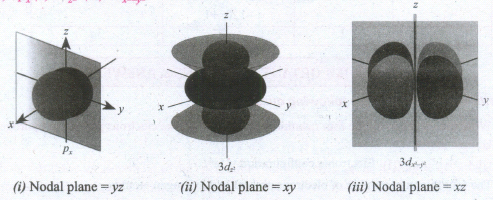
17.
Angular momentum of electron in any orbital = \(\sqrt{l(l+1)}\times\frac{h}{2\pi}\)
(i) for 2s orbital, l = 0
Therefore angular momentum = \(\sqrt{0(0+1)}\times\frac{h}{2\pi}=0\)
(ii) for 4f orbital, I = 3
Therefore angular momentum = \(\sqrt{3(3+1)}\times\frac{h}{2\pi}\)
= \(2\sqrt{3}\frac{h}{2\pi}\)
\(=\sqrt{3}\frac{h}{\pi}\)
18.
Similarities:
(i) Both have similar shape.
(ii) Both have same angular momentum = \(\sqrt{l(l+1)} \frac{h}{2\pi}\)
Dissimilarities:
(i) Is orbital has no node while 2s orbital has one node.
(ii) Energy of 2s orbital is greater than Is orbital.
(iii) The size of the 2s orbital is larger than Is orbital.
19.
This is because, according to this principle, if one electron of an atom has same particular values, for the four quantum numbers, then all the other electrons in that atom are excluded from having the same set of values.
20.
(iii) \(\overset { 0 }{ \underset { \underset { 2e^{ - } }{ \downarrow } }{ Cu } } { O }_{ 7 }+H\overset { +5 }{ \underset { { 1e }^{ - } }{ \underset { \uparrow }{ N } } } { O }_{ 3 }\longrightarrow \overset { +2 }{ Cu } \left( { No }_{ 3 } \right) _{ 2 }+\overset { +4 }{ N } { O }_{ 2 }+{ H }_{ 2 }O\)
Cu +2HNO3 \(\longrightarrow \) Cu(NO3)2 + NO2 + H2O
Cu + 2HNO3 + 2HNO3 \(\longrightarrow \) Cu(NO3)2 + 2NO2 + 2H2O
Cu + 4HNO3 \(\longrightarrow \) Cu (NO3)2 + 2No2 + 2H2O
21.
(ii) \({ K }\overset { +7 }{ \underset { \underset { 3e^{ - } }{ \uparrow } }{ M } } n{ O }_{ 4 }+{ Na }_{ 2 }\overset { +4 }{ \underset { { 2e }^{ - } }{ \underset { \downarrow }{ S } } } { O }_{ 3 }\longrightarrow \overset { +4 }{ M } { nO }_{ 2 }+{ Na }_{ 2 }\overset { +6 }{ s } { O }_{ 4 }+KOH\)
\(\Rightarrow\) 2KMnO4 + 3Na2SO3 \(\longrightarrow \) MnO2 + Na2SO4 + KOH
\(\Rightarrow\) 2KMnO4 + 3Na2SO3 \(\longrightarrow \) 2MnO2 + 3Na2SO4 + KOH
\(\Rightarrow\) 2KMNO4 + 3NaSO3 + H2O \(\longrightarrow \) 2MnO2 + 3Na2SO4 +2KOH
22.
(i) Atoms consist of huge positively charged centers called nuclei.
(ii) Most of the space inside the atom is empty.
23.
According to this theory, atom was assumed to consist of a sphere of uniform distribution of about 10-10 m positive charge with electrons embedded in it such that the number of electrons equal to the number of positive charges and the atom as a whole is electrically neutral.
24.
(i) ground state :
| \(\upharpoonleft \) | \(\upharpoonleft \) | \(\upharpoonleft \) | \(\upharpoonleft \) | \(\upharpoonleft \) |
This type of electronic configuration have ten possible arrangement (i.e. Half filled configuration is More).
25.
a) Principal quantum number defines energy and size of an orbital.
b) Azimuthal quantum number defines shape of an orbital
c) Magnetic quantum number defines spatial orientation (direction) of an orbital.
26.
| Orbital | n | 1 | Radial node n-1-1 | Angular node 1 |
| 2s | 2 | 0 | 1 | 0 |
| 4p | 4 | 1 | 2 | 1 |
| 5d | 5 | 2 | 2 | 2 |
| 4f | 4 | 3 | 0 | 3 |
27.
Energy electrons symmetry
This is due to the symmetrical distribution and exchange energy of given d- electrons. Symmetry leads to stability.
Exchange energy:
If two or more electrons with the same spin are present in degenerate orbitals, there is a possibility for exchanging their positions. During exchange process, the energy is released and the released energy is called exchange energy. If more number of exchanges are possible, more exchange energy in released. More number of exchanges are possible only in case of half filled and fully filled configurations.
For example, in chromium the electronic configuration is [Ar]3d5 4s1. The 3d orbital is half filled and there are ten possible exchanges as shown in figure. On the other hand only six exchanges are possible for [Ar]3d4 4s2 configuration. Hence, exchange energy for the half filled configuration is more. This increases the stability of half filled 3d orbitals.
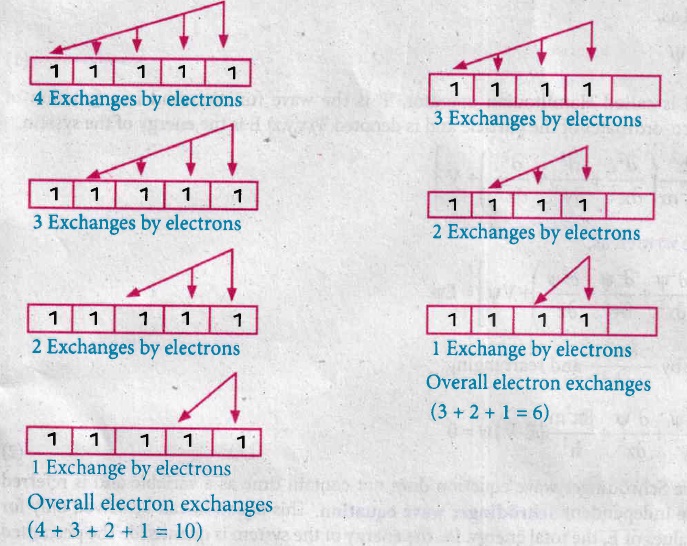
The exchange energy is the basis for Hund's rule, which allows maximum multiplicity, that is electron pairing is possible only when all the degenerate orbitals contain one electron each.
28.
Average atomic mass
= \(\frac { (78.99\times 23.99)+(10\times 24.99)+(11.01\times 25.98) }{ 100 } \)
= \(\frac { 2430.9 }{ 100 } \)
= 24.31 u
29.
Mol.mass = 3(H) + 1(B) + 3(0)
= 3(1) + 1(11) + 3(16)
= 3 + 11 + 48 = 62
30.
i) urea [CO(NH2)2]
Mol.mass = 1 (C) + 2(N) + 4(H) + 1(0)
= 1(12) + 2(14) + 4(1) + 1(16)
= 12 + 28 + 4 + 16 = 60
ii) Acetone [CH3 COCH3]
Mol.mass = 3(C) + 6(H) + 1(0)
= 3(12) + 6(1) + 1(16)
= 36 + 6 + 16 = 58
iii) Boric Acid [H3 BO3]
Mol.mass = 3(H) + 1(B) + 3(0)
= 3(1) + 1(11) + 3(16)
= 3 + 11 + 48 = 62
iv) Sulphuric Acid [H2 SO4]
Mol.mass = 2(H) + 1(S) + 4(0)
= 2(1) + 1(32) + 4(16)
= 2 + 32 + 64 = 98
31.
Gram equivalent mass of an element, compound or ion is the mass that combines or displaces 1.008 g hydrogen or 8 g oxygen or 35.5 g chlorine.
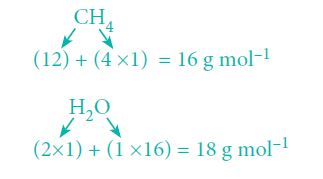
32.
CH4(g) + 2O2 \(\rightarrow\) CO2 + 2H2O
16g (2x18)g
As per stoichiometric equation,
16 g of methane produces 36 g of H2O
\(\therefore\) 32 g of methane will produce = \(\frac { 36 }{ 16 } \times 32=72\) g of water.
33.
\(\mathrm{E}_{n}=\frac{-13.6}{\mathrm{n}^{2}} \mathrm{eV}\)
Second excited state
\(\therefore E_{3}=\frac{-13.6}{9} \mathrm{eV}\)
n = 3
E3 = -1.51 eV
34.
i) 25Mn - 1s2, 2S2, 2p6, 3s2, 3p6, 4s2, 3d5
23Mn2+ - 1s2, 2S2, 2p6, 3s2, 3p6, 3d5
ii) 24Cr - 1s2, 2S2,2p6, 3s2, 3p6, 4s1, 3d3
21Cr3+ - 1s2, 2S2,2p6, 3s2, 3p6, 3d3
35.
| n | 1 | Sub Energy | m1values | Number of orbitals |
| 4 | 2 | 4d | -2,-1,0+1,+2 | Five 4d orbitals |
| 5 | 3 | 5f | -3,-2,-1,0,+1,+2,+3, | seven 5f orbitals |
| 7 | 0 | 7s | 0 | one 7s orbitals |
36.
De Broglie wavelength of the tennis ball equal to 5400 \(\overset { 0 }{ A } \).
m = 54 g
V = ?
\(\lambda=\frac{h}{mV}\)
\(V=\frac{h}{m\lambda}\)
\(\mathrm{v}=\frac{6.626 \times 10^{-34} \mathrm{JS}}{54 \times 10^{-3} \mathrm{~kg} \times 5400 \times 10^{-10} \mathrm{~m}}=2.27 \times 10^{-26} \mathrm{~ms}^{-1}\)
37.
| Oxidation | Reduction | |
| 1. | Addition of oxygen | Addition of Hydrogen |
| 2. | Removal of Hydrogen | Removal of oxygen |
| 3. | Addition of an electronegative element. | Addition of an electro positive element |
| 4. | Removal of an electro positive element | Removal of an electro negative element |
| 5. | Loss of electron | Gain of electron |
| 6. | Increase in oxidation state / number | Decrease in oxidation state/ number. |
38.
(i) no. of electrons: 35 (given)
no. of protons : 35
(ii) Electronic configuration
1s2 2S2 2p6 3s2 3p6 4s2 3d10 4p5
(iii) Last electron:
| \(\downharpoonleft\upharpoonright\) | \(\upharpoonleft\downharpoonright\) | \(\upharpoonleft\) |
4Px 4Py 4pz
last electron present in 4Py orbital y
n = 4, l = 1 m1 = either + 1 or -1 and s = -1/2
39.
half reaction \(\Rightarrow \) \({ S }_{ 2 }{ O }_{ 3 }^{ 2- }\longrightarrow { S }_{ 4 }{ O }_{ 6 }^{ 2- }\)
\({ I }_{ 2 }\longrightarrow { I }^{ - }\)
.png)
40.
The solution to Schrodinger equation gives the permitted total energy values called eigen values and the corresponding wave function represent atomic orbitals.
| Orbital | n | l |
| 3px | 3 | 1 |
| 4dx2-y2 | 4 | 2 |

11th Standard Syllabus & Materials
11th Standard
TN 11th Tamil பீடு பெற நில் - செய்யுள் - காவடிச்சிந்து Important Questions And Answers Study Material - QB365 Set A
NEW11th Standard
TN 11th Tamil பீடு பெற நில் - உரைநடை - மலை இடப்பெயர்கள் : ஓர் ஆய்வு Important Questions And Answers Study Material - QB365 Set A
NEW11th Standard
TN 11th Tamil மாமழை போற்றுதும் - துணைப்பாடம் - யானை டாக்டர் Important Questions And Answers Study Material - QB365 Set A
NEW11th Standard
TN 11th Tamil மாமழை போற்றுதும் - செய்யுள் - ஐங்குறுநூறு Important Questions And Answers Study Material - QB365 Set A



Tamilnadu Stateboard 11th Standard Subjects

Maths

Commerce

Economics

Biology

Business Maths and Statistics

Accountancy

Computer Science

Physics
Chemistry
Maths
Biology
Economics
Physics
Chemistry

History
Business Maths and Statistics

Computer Science
Accountancy

Computer Applications
History
Computer Technology
Commerce
Computer Applications
Computer Technology

Tamil

English

French
Tamilnadu Stateboard Standards
