
 100% FREE ACCESS
11th Standard Syllabus & Materials
11th Standard
TN 11th Tamil இயற்கை வேளாண்மை,சுற்றுச்சூழல் -செய்யுள் - மனோன்மணீயம் Important Questions And Answers Study Material - QB365 Set A
NEW11th Standard
TN 11th Tamil என்னுயிர் என்பேன் -துணைப்பாடம் - இசைத்தமிழர் இருவர் Important Questions And Answers Study Material - QB365 Set A
NEW11th Standard
TN 11th Tamil மொழி கலை -செய்யுள் - ஒவ்வொரு புல்லையும் Important Questions And Answers Study Material - QB365 Set A
NEW11th Standard
TN 11th Tamil பீடு பெற நில் - இலக்கணம் - பகுபத உறுப்புகள் Important Questions And Answers Study Material - QB365 Set A
NEW11th Standard
TN 11th Tamil பீடு பெற நில் - துணைப்பாடம் - வாடிவாசல் Important Questions And Answers Study Material - QB365 Set A
NEW11th Standard
TN 11th Tamil பீடு பெற நில் - செய்யுள் - குறுந்தொகை Important Questions And Answers Study Material - QB365 Set A

Published on: 02/08/2018
Some of the important questions are covered in this question paper from the chapter Biomolecules.
Teachers can prepared question paper with answer key within five minutes. Please Click Here for subscribe.
Download Tamil Nadu 11th Standard Biology question papers, model tests, one-mark questions, important questions, and public exam papers in PDF format. Free study materials and answer keys for TN State Board students.
Questions + Answers key
Take MCQ Biology Test1.
Insulin is a polymer of____________________________
sucrose
fructose
glucose
maltose
2.
Membrane lipids are ____________.
Phospholipids
Steroids
Waxes
Wax
3.
Proteins perform many physiological functions. For example some functions as enzymes. One of the following represents an additional function that some proteins discharge:
Antibiotics
Pigment conferring colour to skin
Pigments making colours of flowers
Hormones
4.
Enzymes that catalyse interconversion of optical, geometrical or positional isomers are ______________
Ligases
Lyases
Hydrolases
Isomerases
5.
An example of feedback inhibition is
Cyanide action on cytochrome
Sulpha drug on folic acid synthesizing bacteria
Allosteric inhibition of hexokinase by glucose-6-phosphate
The inhibition of succinic dehydrogenase by malonate
6.
The most basic amino acid is
Arginine
Histidine
Glycine
Glutamine
7.
Mention any two sulphur containing amino acids.
8.
Define the terms nucleotide and nucleoside?
9.
Explain briefly anabolic reactions.
10.
Define the term amphoteric.
11.
What is chitin made up of?
12.
Define monosaccharide.
13.
What is tRNA?
14.
Distinguish between nitrogenous base and a base found in inorganic chemistry.
15.
Explain ribosomal RNA. Add a note on its function.
16.
What are Allosteric enzymes? Explain with suitable example.
17.
Define triglycerides. Explain with examples.
18.
Describe the test for reducing sugars.
19.
Explain Polysaccharide with an example.
20.
Differentiate Prokaryotic mRNA and Eukaryotic mRNA?
21.
Describe the types of RNA.
22.
Explain the different types of protein bonding
1.
(b)
fructose
2.
(a)
Phospholipids
3.
(d)
Hormones
4.
(d)
Isomerases
5.
(c)
Allosteric inhibition of hexokinase by glucose-6-phosphate
6.
(a)
Arginine
7.
Methionine and cysteine.
8.
DNA and RNA are polymers of monomers called nucleotides, each of which is composed of a nitrogen base, a pentose sugar and a phosphate. A purine or a pyrimidine and a ribose or deoxyribose sugar is called nucleoside.
9.
Anabolic (building up of organic molecules). Synthesis of proteins from amino acids and synthesis of polysaccharides from simple sugars are examples of anabolic reactions.
10.
(NH2), an acidic carboxylic group (COOH) and a hydrogen atom (H) and side chain or variable R group. The amino acid is both an acid and a base is called amphoteric.
11.
Chitin is a homopolysaccharide with amino acids added to form mucopolysaccharide. The basic unit is a nitrogen-containing glucose derivative known as N-acetyl glucosamine. It forms the exoskeleton of insects and other arthropods. It is also present in the cell walls of fungi.
12.
Monosaccharides are relatively small molecules constituting single sugar unit. Glucose has a chemical formula of C6H12O6 It is a six carbon molecule and hence is called as hexose.
13.
1. It is an RNA which translates the code from mRNA and transfers amino acids to the ribosome to build proteins.
2. It is highly folded into an elaborate 3D structure and comprises about 15% of total RNA
14.
| Nitrogenous base | Inorganic base |
| In nitrogenous base the basic character is because of lone pair electron called lewis base | Inorganic base is because of hydroxyl ion that is Arrhenius base |
| Eg: Pyridine, Pyrimidine | Eg: NaOH |
15.
rRNA (ribosomal RNA): Single-stranded, metabolically stable, make up the two subunits of ribosomes. It constitutes 80% of the total RNA. It is a polymer with varied length from 120 - 3000 nucleotides and gives ribosomes their shape. Genes for rRNA are highly conserved and employed for phylogenetic studies.
16.
They modify enzyme activity by causing a reversible change in the structure of the enzyme active site. This, in turn, affects the ability of the substrate to bind to the enzyme. Such compounds are called Allosteric inhibitors. e.g. The enzyme hexokinase which catalysis glucose to glucose-6 phosphate in glycolysis is inhibited by glucose 6 phosphate. This is an example for feedback allosteric inhibitor.
17.
Triglycerides are composed of single molecule of glycerol bound to 3 fatty acids. These include fats and oils. Fatty acids are long chain hydrocarbons with a carboxyl group at one end which binds to one of the hydroxyl groups of glycerol, thus forming an ester bond. Fatty acids are structural unit of lipids and are carboxylic acid of long chain hydrocarbons. The hydrocarbon can vary in length from 4 - 24 carbons and the fat may be saturated or unsaturated. In saturated fatty acids the hydrocarbon chain is single bonded.
eg. Palmitic acid, Stearic acid and in unsaturated fatty acids.
eg. Oleic acid, linoleic acid) the hydrocarbon chain is double bonded (one/two/three). In general solid fats are saturated and oils are unsaturated, in which most are globules.
18.
Aldoses and ketoses are reducing sugars. This means that, when heated with an alkaline solution of copper (II) sulphate (a blue solution called Benedict's solution), the aldehyde or ketone group reduces Cu2+ ions to Cu+ ions forming brick red precipitate of copper (I) oxide. In the process, the aldehyde or ketone group is oxidised to a carboxyl group (- COOH). This reaction is used as test for reducing sugar and is known as Benedict's test. The results of Benedict's test depends on concentration of the sugar. If there is no reducing sugar it remains blue.
(i) Sucrose is not a reducing sugar.
(ii) The greater the concentration of reducing sugar, the more is the precipitate formed and greater is the colour change.
19.
(i) These are made of hundreds of monosaccharide units. Polysaccharides also called "Glycans".
(ii) Long chain of branched or unbranched monosaccharides are held together by glycosidic bonds.
(iii) Polysaccharide is an example of giant molecule, a macromolecule and consists of only one type of monomer.
(iv) Polysaccharides are insoluble in water and are sweetless. Cellulose is an example built from repeated units of glucose monomer.
(v) Depending on the function, polysaccharides are of two types: Storage Polysaccharide and structural Polysaccharide.
20.
1. Prokaryotic mRNA (Polycistronic) carry coding sequences for many polypeptides.
2. Eukaryotic mRNA (Monocistronic) contains information for only one polypeptide.
21.
Ribonucleic acid (RNA): Ribonucleic acid (RNA) is a polymeric molecule essential in various biological roles in coding, decoding, regulation and expression of genes. RNA is single-stranded and is unstable when compared to DNA.
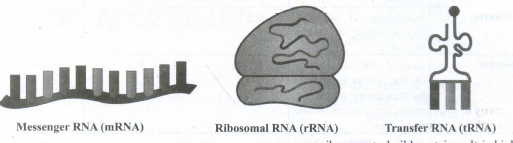
Types of RNA:
1. mRNA (messenger RNA) - Single-stranded, carries a copy of instructions for assembling amino acids into proteins. It is very unstable and comprises 5% of total RNA polymer. Prokaryotic mRNA (Polycistronic) carry coding sequences for many polypeptides. Eukaryotic mRNA (Monocistronic) contains information for only one polypeptide.
2. tRNA (transfer RNA) - Translates the code from mRNA and transfers amino acids to the ribosome to build proteins. It is highly folded into an elaborate 3D structure and comprises about 15% of total RNA. It is also called soluble RNA.
3. rRNA (ribosomal RNA) - Single-stranded, metabolically stable, makeS up the two subunits of ribosomes. It constitutes 80% of the total RNA. It is a polymer with varied length from 120 - 3000 nucleotides and gives ribosomes their shape. Genes for rRNA are highly conserved and employed for phylogenetic studies.
22.
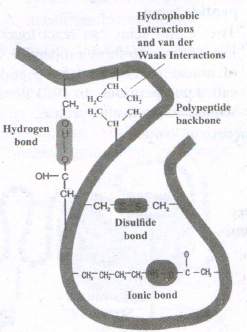
Hydrogen Bond:
1. It is formed between some hydrogen atoms of oxygen and nitrogen in a polypeptide chain. The hydrogen atoms have a small positive charge and oxygen and nitrogen have small negative charge. Opposite charges attract to form hydrogen bonds.
2. Though these bonds are weak, large number of them maintains the molecule in 3D shape.
Ionic Bond:
1. It is formed between any charged groups that are not joined together by peptide bond. It is stronger than hydrogen bond and can be broken by changes in pH and temperature.
Disulfide Bond:
1. Some amino acids like cysteine and methionine have sulphur.
2. These form disulphide bridge between sulphur atoms and amino acids.
Hydrophobic Bond:
1. This bond helps some protein to maintain structure.
2. When globular proteins are in solution, their hydrophobic groups point inwards away from water.

11th Standard Syllabus & Materials
11th Standard
TN 11th Tamil பீடு பெற நில் - செய்யுள் - காவடிச்சிந்து Important Questions And Answers Study Material - QB365 Set A
NEW11th Standard
TN 11th Tamil பீடு பெற நில் - உரைநடை - மலை இடப்பெயர்கள் : ஓர் ஆய்வு Important Questions And Answers Study Material - QB365 Set A
NEW11th Standard
TN 11th Tamil மாமழை போற்றுதும் - துணைப்பாடம் - யானை டாக்டர் Important Questions And Answers Study Material - QB365 Set A
NEW11th Standard
TN 11th Tamil மாமழை போற்றுதும் - செய்யுள் - ஐங்குறுநூறு Important Questions And Answers Study Material - QB365 Set A



Tamilnadu Stateboard 11th Standard Subjects

Maths

Commerce

Economics
Biology

Business Maths and Statistics

Accountancy

Computer Science

Physics

Chemistry
Maths
Biology
Economics
Physics
Chemistry

History
Business Maths and Statistics

Computer Science
Accountancy

Computer Applications
History
Computer Technology
Commerce
Computer Applications
Computer Technology

Tamil

English

French
Tamilnadu Stateboard Standards

