
12th Standard CBSE Syllabus & Materials
12th Standard CBSE
CBSE 12th Biology Sexual Reproduction in Flowering Plants Important Questions And Answers Study Material - QB365 Set B
NEW12th Standard CBSE
CBSE 12th Biology Sexual Reproduction in Flowering Plants Assertion and Reason Study Material - QB365 Set D
NEW12th Standard CBSE
CBSE 12th Biology Sexual Reproduction in Flowering Plants Assertion and Reason Study Material - QB365 Set C
NEW12th Standard CBSE
CBSE 12th Biology Sexual Reproduction in Flowering Plants Assertion and Reason Study Material - QB365 Set B
NEW12th Standard CBSE
CBSE 12th Biology Sexual Reproduction in Flowering Plants Assertion and Reason Study Material - QB365 Set A
NEW12th Standard CBSE
CBSE 12th Standard Biology Sexual Reproduction in Flowering Plants Sample Question Papers Study Material - QB365 Set 1

Published on: 03/08/2026
Download CBSE Class 12th Standard CBSE Biology question papers, sample papers, important questions, and previous year solved papers in PDF format. Get free study materials, NCERT solutions, and exam preparation resources for Class 12th Standard CBSE Biology
Questions + Answers key
Take MCQ Biology Test
1.
How many haploid cells are present in a mature female gametophyte of a flowering plant? Name them.
2.
Differentiate between the two cells enclosed in a mature male gametophyte of an angiosperm.
3.
Write the importance of bagging of unisexual flowers in a crop improvement programme.
4.
Explain any two ways by wich apomictic seeds get developed.
5.
How do plants produce seeds through apomixis? Explain with the help of an example.
6.
Why is emasculation of a bisexual flower necessary in crop improvement programme?
7.
Explain with help of a diagram, the development of a mature embryo sac from a megaspore mother cell in an angiosperm.
8.
(a) Draw a labelled diagram of L.S. of an embryo of grass (any six labels).
(b) Give reason for each of the following:
(i) Anthers of angiosperm flowers are described as dithecous.
(ii) Hybrid seeds have to be produced year after year.
9.
Draw the diagram of a microsporangium and label its wall layers. Write briefly about the wall layers.
10.
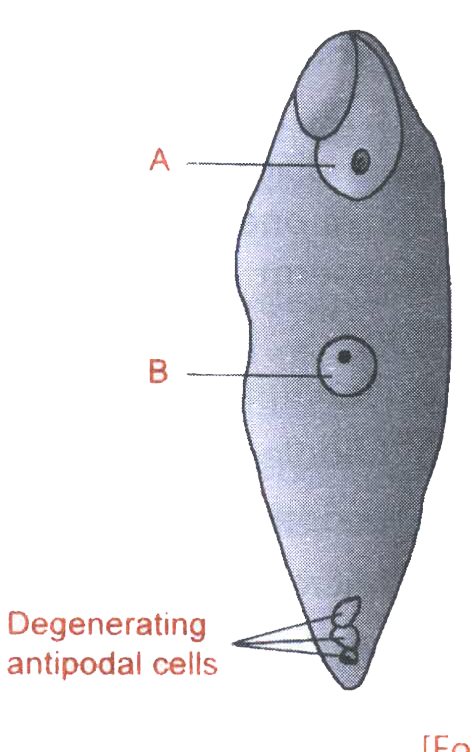
(a) Name the structures which the parts 'A' and 'B' shown in the diagram below respectively develop into.
(b) Explain the process of development which 'B' undergoes in albuminous and exalbuminous seeds. Give one
example of each of these seeds.
11.
"Incompability is a natural barrier in the fussion of gametes." Justify the statement.
12.
What do the following parts form in a fruit? Ovary wall, outer integument, inner integument, zygote, primary endosperm nucleus, ovule.
13.
Write briefly the role of pollination in an angiosperm
14.
Match the items in Column (A) with Column (B). Each point in column (A) has minimum one match in column (B) and maximum two matches.
| Column (A) | Column (B) |
| 1. Autogamy | (a) Megasporangia |
| 2. Apomixis | (b) Xenogamy |
| 3. Pollen sacs | (c) Female gametophyte |
| 4. Ovules | (d) Asexual reproduction |
| 5. Embryosac | (e) Allogamy |
| 6. Pollar nuclei | (f) Secondary nucleus |
| 7. Cross pollination | (g) Microsporangia |
| (h) Agamospermy | |
| (i) Self pollination |
15.
A _______ is the development of seeds from unfertilised female gamete.
B. Parthenocarpy is the development of______in an unfertilised flower, resulting in a_______
C. Polyembryony is the presence of more than one_______ in the_______
D. There are usually three germ pores in _______and one in _______
E. The anther wall is composed of_______to_______layers.
F. The flowers producing _______ and _______ with bright _______ attract the insects.
G. Plants with reduced power of _______ reproduction, _______ dormant period of seed or _______ viability are propagated through vegetative reproduction.
H. The integuments of ovule surround the_______all around expect at the apex, leaving a narrow passage, called the _______.
I. The wind-pollinated flowers are generally _______sexual.
J. In many dicots, the reserves in the _______ and consumed by the developing embryo.
16.
Observe the figure carefully and the answer of the following question:
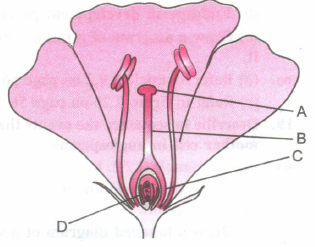
(a) Write whether ovary is superior or inferior?
(b) What is the type of flower - hypogynous, perigynous or epigynous?
(c) What type of ovule is shown the figure?
(d) What changes occur in C after fertilization?
(e) What does A, B, C, D represent in the figure.
17.
Plants of which one of the following groups of genera are pollinated by the same agency?
Triticum, Cocos, Mangifera
Ficus, Kigelia, Casuarina
Salvia, Morus, Euphorbia
Bombax, Butea, Bauhinia
18.
Which one of the following is surrounded by a callose wall?
Male gamete
Egg
Pollen grain
Microspore mother cell
19.
Male gametes in angiosperms are formed by the division of
Generative cell
vegetative cell
Microspore mother cell
Microspore
20.
Identify the wrong statement regarding post-fertilization development
The ovary wall develops into pericarp
The outer integument of the ovule develop into tegmen
The fusion nucleus (triple fusion) develops into endosperm
The ovule develops into seed
The ovary develops into fruit
21.
Double fertilization is the process in plants that includes
Syngamy and triple fusion
only triple fusion
Development of antipodal cells
Name of the above
22.
Endosperm is consumed by developing embryo in the seed of
Pea
Maize
Coconut
Castor
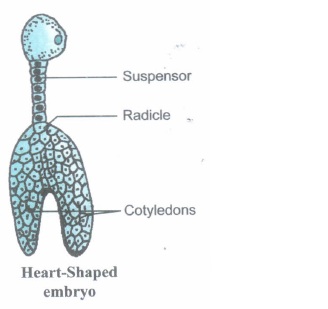
23.
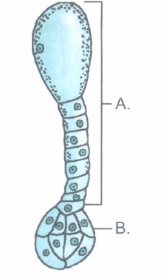
(a) Identify the parts A and B.
(b) Name (i) the initial cell from which it has developed and (ii) stage of embryo prior to this.
(c) Draw a labelled diagram ofthe stage of embryo succeding this.
24.
Hybrid varieties of several of our food crops are being extensively cultivated. Cultivation of hybrids has increased the crop production tremendously. But, the problem of hybrids is that the hybrid seeds have to be produced every year.
(a) Name and explain the mechanism by which seeds from hybrid plants are developed that are able to retain the desired hybrid characters in the progeny.
(b) What is polyembryony?
25.
Assertion: Self-sterility inhibits self pollination.
Reason: Dichogamy is the condition in which only self pollination occurs
Codes:
(a) Both assertion and reason are true and reason is the correct explanation of assertion.
(b) Both assertion and reason are true but reason is not the correct explanation of assertion.
(c) Assertion is true but reason is false.
(d) Both assertion and reason are false
26.
Assertion: In angiosperms, the first fertilization is called syngamy.
Reason: Second fertilization is called vegetative fertilization
Codes:
(a) Both assertion and reason are true and reason is the correct explanation of assertion.
(b) Both assertion and reason are true but reason is not the correct explanation of assertion.
(c) Assertion is true but reason is false.
(d) Both assertion and reason are false
1.
There are six haploid cells. They are: three antipodal cells, two synergids and one female gamete.
2.
| Vegetative cell |
Generative cell |
|
It is larger and irregularly-shaped. Its cytoplasm is less dense and nucleus is large and irregular in shape. It has abundant food reserve. It does not divide further. |
It is smaller and spindle-shaped. It has a dense cytoplasm and a small round nucleus. It does not have food reserve. It divides mitotically to form two male gametes. |
3.
1. In crop breeding programmes, pollen grains from the selected male parent only are used.
2. So, to prevent contamination of the stigma of the unisexual/female flower, they are bagged.
4.
(i) Certain nucellar cells around the embryo sac divide, protrude into embryo sac and develop into embryos, e.g. Citrus, mango, etc.
(ii) The diploid egg cell of the embryo sac, formed without meiosis develops into embryo without fertilisation.
5.
(i) Certain nucellar cells around the embryo sac divide, protrude into embryo sac and develop into embryos, e.g. Citrus, mango, etc.
(ii) The diploid egg cell of the embryo sac, formed without meiosis develops into embryo without fertilisation.
6.
1. In crop improvement programmes, pollen grains of the selected male parent only, are used for pollination.
2. So, emasculation of a bisexual flower is necessary to prevent contamination of the sigma with self-pollen.
7.
Development of Female Gametophyte:
- The megaspore mother cell undergoes meiosis to form four megaspores.
- Three of them degenerate and the functional megaspore enlarges to form the embryo sac.
- Its haploid nucleus undergoes a mitotic division and the two daughter nuclei move towards the poles.
- Each of them undergoes two successive mitotic divisions.
- Cell wall formation starts in the 8-nucleate stage.
- Three of them at the micropylar end form the egg apparatus, consisting of a female gamete and two synergids.
- Three of them at the chalazal end form the antipodal cells.
- One nucleus from each of the poles moves to the centre; they are called polar nuclei.
- The two polar nuclei fuse in the centre (now the central cell) to form a diploid secondary nucleus.
- Thus, the mature embryo sac is 7-celled and 8-nucleate.
8.
(b) (i) Since the anthers of angiosperm flowers are bilobed with two thecae (sporangia) in each lobe, they are called dithecous.
(ii) The plants grown from the hybrid seeds show segregation of traits and do not maintain the hybrid characters; so hybrid seeds have to be produced every year.
9.
A typical microsporangium is surrounded by four wall layers, i.e. the epidermis, endothecium, middle layers and the tapetum. The outer three wall layers are protective in function and help in dehiscence of anther to release pollen grains.
The innermost layer (tapetum) nourishes the developing microspores or pollen grains. The cells of tapetum possess dense cytoplasm and generally have more than one nucleus.
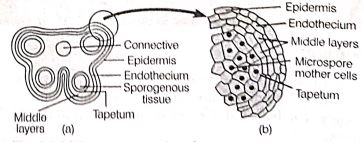
When the anther is young, a group of compactly arranged homogenous cells called the sporogenous tissue occupies the centre of each microsporangium.
10.
(a) A develops into the embryo.
B develops into the endosperm.
(b) 1. The endosperm development starts from the primary endosperm cell containing the primary endosperm nucleus.
2. In the most common type of endosperm development, the primary endosperm nucleus undergoes successive free nuclear divisions to give rise to a number of free nuclei; at this stage, it is called free nuclear endosperm.
3. Subsequently wall formation takes place from the periphery and proceeds towards the centre and the endosperm becomes cellular.
4. This type of endosperm development is seen in coconut; the water of the tender coconut represents the free nuclear endosperm with thousands of nuclei in it and the white kernel around it represents the cellular endosperm.
5. In albuminous seeds, some amount of endosperm persists in the mature seed, as the developing' embryo does not consume it fully, e.g. wheat/maize.
6. In exalbuminous seeds, the endosperm is completely consumed by the developing embryo before seed maturation, e.g. groundnut and pea.
11.
The incompability is considered as the most widespread and effective device to prevent inbreeding and promote outbreeding. It acts as a natural barrier by the interaction of chemical substance produced by the male gametophyte and the tissue of style. Normally, the functional pollens belonging to right mating type germinate on stigma, develop pollen tube and bring about fertilisation. The pollen grains belonging to other mating types are discarded.
12.
Formation of the parts in a fruit areas follows:-
| Ovary Wall | Pericarp or fruit wall Outer integument | Testa of seed |
| Inner integument | Tegmen of seed Zygote | Embryo |
| Primary endosperm nucleus | Endosperm Ovule | Seed |
13.
Pollination is the transferral of pollen grains from the opened anther of the stamen to the receptive stigma of the carpel. It is an important process that brings about male and female gametes close to each other and helps in the process of fertilisation in angiosperms.
14.
1.(i); 2. (d), (h), 3. (g); 4. (a); 5. (c); 6.(f) ; 7.(b), (e)
15.
A. Parthengenesis
B. fruit, seedless
C. embryo, seed
D. dicots, monocots
E. 4 to 5
F. nectar fragrance, colours
G. sexual, long, poor
H. nucellus, micropyle
I. uni
J. endosperm.
16.
(a) Ovary is superior
(b) Flower is hypogynous because all the floral arise from thalamus below the level of ovary
(c) Ovule is anatropous because it is completely inverted. The micropyle is near the hilum and faces down towards the placenta.The embryo sac is straight.
(d) The ovary of the flower gets converted into fruit after fertilization.
(e) A = Stigma, B = Style, C = Ovary and D = Ovule
17.
(d)
Bombax, Butea, Bauhinia
18.
(d)
Microspore mother cell
19.
(a)
Generative cell
20.
(b)
The outer integument of the ovule develop into tegmen
21.
(a)
Syngamy and triple fusion
22.
(a)
Pea
23.
(a) A - Suspensor
B - Globular embryo
(b) (i) Zygote
(ii) Proembryo
24.
(a) (i) Apomixis is the mechanism.
(ii) It refers to the form of asexual reproduction that mimics sexual reproduction and seeds are formed without fertilisation.
(iii) Since there will be no segregation of the hybrid characters in the progeny plants, they will be maintained for a number of generations.
(b) Polyembryony refers to the occurrence of more than one embryo in a seed.
25.
(c) Self-sterility is the condition in which the pollen of a flower has no fertilizing effect on the stigma of the same flower. Cross-pollination is thus the only method in them for the production of seeds. In many bisexual flowers the anther and stigma often mature at different times. This condition is known as dichogamy. Dichogamy often stands as a barrier to self pollination. There are two conditions of dichogamy.
(i) protogyny - when the gynoecium matures earlier than the anthers of the same flowers
(ii) protandry - when the anthers mature earlier than the stigma of the same flower. In both cases only cross pollination is possible.
26.
(b) Fusion of the egg nucleus with sperm nucleus is called syngamy. As, in this process fusion product is diploid zygote or oospore, it is called generative fertilization. It is also called first fertilization as the first sperm fuses with the egg. The second male gamete fuses with the diploid secondary nucleus of the central cell to form a triploid primary endosperm cell. It is known as vegetative fertilization.

12th Standard CBSE Syllabus & Materials
12th Standard CBSE
CBSE 12th Chemistry d- and f- Block Elements Important Questions And Answers Study Material - QB365 Set B
NEW12th Standard CBSE
CBSE 12th Chemistry d- and f- Block Elements Important Questions And Answers Study Material - QB365 Set A
NEW12th Standard CBSE
CBSE 12th Chemistry Chemical Kinetics Important Questions And Answers Study Material - QB365 Set B



NCERT Books

Syllabus

Exam Pattern

Sample Question Papers

Previous year Question Papers

Important Notes

MCQ Practice test

NCERT Exemplers

Case study Questions

Image Based Questions

Passage based Questions

HOT Questions

Value Based Questions

Model Questions Papers
NCERT ( Book Back ) Questions

Assertion and Reason
Important Questions And Answers

CBSE 12th Standard CBSE Subjects
CBSE Standards








