100% FREE ACCESS
9th Standard CBSE Syllabus & Materials
9th Standard CBSE
CBSE 9th Science Is matter around us pure? - New Model Questions Papers Study Material - QB365 Set A
NEW9th Standard CBSE
CBSE 9th Science Matter in our surroundings - New Model Questions Papers Study Material - QB365 Set A
NEW9th Standard CBSE
CBSE 9th Mathematics Heron's Formula Sample Question Papers Study Material - QB365 Set A
NEW9th Standard CBSE
CBSE 9th Mathematics Circles Sample Question Papers Study Material - QB365 Set A
NEW9th Standard CBSE
CBSE 9th Mathematics Quadrilaterals Sample Question Papers Study Material - QB365 Set A
NEW9th Standard CBSE
CBSE 9th Mathematics Triangles Sample Question Papers Study Material - QB365 Set A

Published on: 29/10/2025
Download CBSE Class 9th Standard CBSE Mathematics question papers, sample papers, important questions, and previous year solved papers in PDF format. Get free study materials, NCERT solutions, and exam preparation resources for Class 9th Standard CBSE Mathematics
Questions + Answers key
Take MCQ Mathematics Test
1.
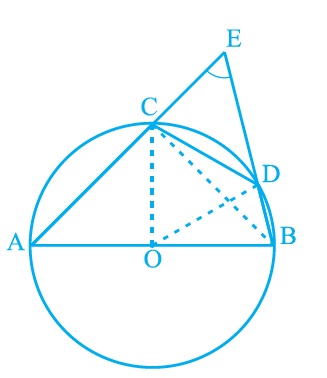
AB is a diameter of the circle, CD is a chord equal to the radius of the circle. AC and BD when extended intersect at a point E. Prove that \(\angle\) AEB = 60°.
2.
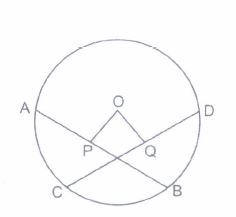
In the adjoining figure, O is the centre of the circle and OP = OQ. If AP = 4 cm, then find the length of CD.
3.
If a line is drawn parallel to the base of an isosceles triangle to intersect its equal sides, prove that the quadrilateral so formed is cyclic.
4.
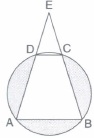
In \(\Delta\)ABE, AE = BE. Circle through A and B intersects AE and BE at D and C. Prove that DC II AB.
5.
Prove that if any two chords of a circle are drawn, then the one which is nearer to the centre, is larger.
6.
Two equal chords AB and CDof a circle when produced, intersect at a point P. Prove that PB = PD.
7.
Bisectors of angles A, Band C of a triangle ABC intersect its circumcircle at D, E and F respectively. Prove that the angles of the triangle DEF are \(90°-\frac { 1 }{ 2 } A,\ 90°-\frac { 1 }{ 2 } B\) and .\(90°-\frac { 1 }{ 2 } C\).
8.
ABCD is a parallelogram. The circle through A, B and C intersect CD (produced if necessary) at E. Prove that AE = AD.
9.
Prove that the circle drawn with any side of a rhombus as diameter, passes through the point of intersection of its diagonals.
10.
Prove that a cyclic parallelogram is a rectangle.
11.
ABC and ADC are two right triangles with common hypotenuse AC. Prove that \(\angle CAD=\angle CBD\) .
12.
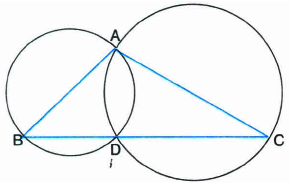
Two circles intersect at two points A and B. AD and AC are diameters to the two circles (see Fig). Prove that B lies on the line segment DC.
13.
Prove that an isosceles trapezium is cyclic
14.
If the non-parallel sides of a trapezium are equal, prove that it is cyclic.
15.
If diagonals of a cyclic quadrilateral are diameters of the circle through the vertices of the quadrilateral, prove that it is a rectangle.
16.
A circular park of radius 20 m is situated in a colony. Three boys Ankur, Syed and David are sitting at equal distance on its boundary each having a toy telephone in his hands to talk each other. Find the length of the string of each phone.
17.
Three girls Reshma, Salma and Mandip are playing a game by standing on a circle of radius 5 m drawn in a park. Reshma throws a ball to Salma, Salma to Mandip, Mandip to Reshma. If the distance between Reshma and Salma and between Salma and Mandip is 6 m each, what is the distance between Reshma and Mandip?
18.
If two equal chords of a circle intersect within the circle, prove that the line joining the point of intersection to the centre makes equal angles with the chords.
19.
If two equal chords of a circle intersect within the circle, prove that the segments of one chord are equal to corresponding segments of the other chord.
20.
If two circles intersect at two points, prove that their centres lie on the perpendicular bisector of the common chord.
1.
Join OC, OD and BC.
Triangle ODC is equilateral
Therefore, \(\angle\) COD = 60°
Now, \(\angle\) CBD =\(\frac{1}{2}\) \(\angle\) COD
This gives \(\angle\) CBD = 30°
Again, \(\angle\) ACB = 90°
So, \(\angle\) BCE = 180° – \(\angle\) ACB = 90°
Which gives \(\angle\) CEB = 90° – 30° = 60°, i.e., \(\angle\) AEB = 60°
2.
∵ OP = OQ
∴ Chord AB and chord CD are equidistant from the centre.
⇒ \(\overline{\mathrm{AB}}=\overline{\mathrm{CD}}\)
⇒ \(\frac{1}{2} \overline{\mathrm{AB}}=\frac{1}{2} \overline{\mathrm{CD}}\)
⇒ \(\overline{\mathrm{AP}}=\frac{1}{2} \overline{\mathrm{CD}}\)
⇒ 4 cm = \(\frac{1}{2} \overline{\mathrm{CD}}\)
⇒ \(\overline{\mathrm{CD}}\) = 2 x 4 cm
⇒ \(\overline{\mathrm{CD}}\) = 8 cm
Thus, the required length of CD is 8 cm.
3.
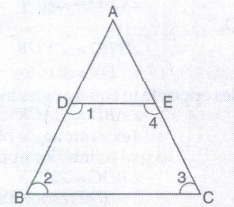
Given ED II BC
AB =AC
\(\Rightarrow\) \(\angle\)2 = \(\angle\)3 ...(i)
(Opp. Ls to opp. side are always equal)
In an isosceles II
\(\angle\)1 + \(\angle\)2 = 180° [Interior \(\angle\)s)
\(\therefore\) \(\angle\)3 + \(\angle\)4 = 1800
\(\therefore\) \(\angle\)1 + \(\angle\)3 = 1800
\(\angle\)2 + \(\angle\)4 = 180°
but these are opp angles of a quad.
\(\therefore\) BCDE is a cyclic quad.
4.
AE = BE
\(\angle\)A = \(\angle\)B (angle opposite to equal sides of a \(\Delta\)are equal)
\(\angle\)EDC = \(\angle\)B;
\(\angle\)ECD = \(\angle\)A (exterior angle of cyclic quad.)
\(\therefore\) \(\angle\)EDC = \(\angle\)A (Corresponding Angles)
\(\therefore\) AB II DC Proved.
5.
Given Two chordsAB and CD of a circle C (O, r), such that OL < OM, where OL and OM are perpendiculars from O on AB and CD, respectively.
To prove AB > CD
Construction Join OA and OC.
Proof Since, the perpendicular from the centre of a circle to a chord bisects the chord.
\(\therefore\) AL = 1/2 AB and CM = 1/2 CD
In right angled flOLA and flOMC, we have
OA2 = OL2 + AL2
and OC2 = OM2 + CM2 [by Pythagoras theorem]
\(\Rightarrow\) AL2 = OA2 - OL2... (i)
and CM2 = OC2- OM2......(ii)
Now, OL
\(\Rightarrow\)- OL2> - OM2
[multiplying by (-) on both sides]
\(\Rightarrow\) OA2 - OL2> OA2- OM2
[adding OA2 on both sides]
\(\Rightarrow\) OA2 - OL2> OC2- OM2 [\(\because\)OA2= OC2]
\(\Rightarrow\) AL2 > CM2 [from Eqs. (i) and (ii)]
\(\Rightarrow\) AL> CM
\(\Rightarrow\) 2AL> 2 CM [multiplying by 2]
\(\Rightarrow\) AB > CD
Hence proved.
6.
Given Two equal chords AB and CD of a circle intersecting at a point P.
To prove PB = PD
Construction JoinOP .DrawOL\(\bot\)ABandOM\(\bot\)CD.
Proof Since, equal chords are equidistant from the centre
\(\therefore\) OL = OM [proved above]
In \(\Delta\)OLP and \(\Delta\)OMP,[each 900]
OL = OM[common sides]
\(\angle\)OLP= \(\angle\)OMP
OP = OP
\(\therefore\)\(\Delta\)OLP \(\cong\) \(\Delta\)OMP
[by RHS congruence rule]
\(\Rightarrow\) LP = MP
Now, AB = CD
\(\Rightarrow\) 1/2(AB) = 1/2(CD)
\(\Rightarrow\) BL = DM
[\(\because\) perpendicular drawn from centre to the circle bisects the chord i.e. AI = LB and CM = MD]
On subtracting Eq. (ii) from Eq. (i), we get
\(\Rightarrow\)LP-BL = MP-DM \(\Rightarrow\) PB = PD(1)
7.
Given: Bisectors of angles A, Band C of a triangle ABC intersect its circumcircle at D, E and F respectively.
To Prove: The angles of the \(\Delta DEF\) are \(90°-\frac { A }{ 2 } ,90°-\frac { B }{ 2 } \) and \(90°-\frac { C }{ 2 } \) respectively.
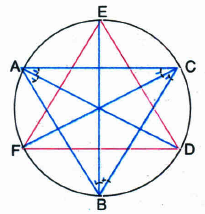
Proof: \(\angle FDE=\angle FDA+\angle EDA\)
\(=\angle FCA+\angle EBA\)
| ∵ Angles in the same segment of a circle are equal
\(=\frac { 1 }{ 2 } \angle C+\frac { 1 }{ 2 } \angle B\)
⇒ \(\angle D=\frac { \angle C+\angle B }{ 2 } \)
\(=\frac { 180°-\angle A }{ 2 } \)
| ∵ In \(\Delta ABC,\quad \angle A+\angle B+\angle C=180°\) (Angle Sum Property)
\(=90°-\frac { \angle A }{ 2 } \)
Similarly, we can show that
\(E=90°-\frac { \angle B }{ 2 } \)
and \(F=90°-\frac { \angle C }{ 2 } \).
8.
Given: ABCD is a parallelogram. The circle through A, B and C intersects CD (produced, if necessary) at E.
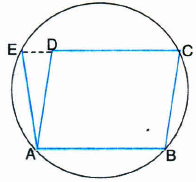
To Prove: AE = AD.
Proof: In cyclic quadrilateral ABCE,
\(\angle AED+\angle ABC=180°\) ....(1)
| ∵ Opposite angles of a cyclic quadrilateral are supplementary.
Also, \(\angle ADE+\angle ADC=180°\)
I Linear Pair Axiom
But \(\angle ADC=\angle ABC\)
Opposite angles of a || gm
∴ \(\angle ADE+\angle ABC=180°\) ....(2)
From (1) and (2), we have
\(\angle AED+\angle ABC=\angle ADE+\angle ABC\)
⇒ \(\angle AED=\angle ADE\)
∴ In triangle ADE,
AE = AD
| ∵ Sides opposite to equal angles of a triangle are equal.
Hence Proved.
9.
∴ Given: AB DC is a rhombus. E is the point of intersection of its diagonals.
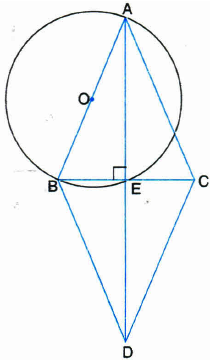
To Prove: The circle drawn with any sides AB of rhombus AB DC as a diameter passes through the point E.
Proof: In \(\Delta AEB\) and \(\Delta AEC\),
AB = AC | Given
\(\angle BEA+\angle CEA=180°\) | Linear Pair Axiom
⇒ \(90°+\angle CEA=180°\)
I Angle in a semi-circle is 90°
⇒ \(\angle CEA=90°\)
∴ \(\angle BEA=\angle CEA=180°\)
AE = AE | Common
∴ \(\Delta AEB\cong \Delta AEC\) | RHS
∴ BE = CE
⇒ E is the mid-point of BC.
⇒ E is the point of intersection of diagonals.
Hence, the circle drawn with AB as diameter passes through the point E.
Similarly, we can prove that the circle drawn with AC as diameter passes through the point D which is the point of intersection of its diagonals.
10.
Given: ABCD is a cyclic parallelogram.
To Prove: ABCD is a rectangle.
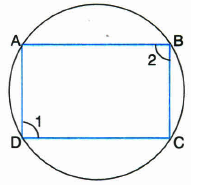
Proof: ABCD is a cyclic quadrilateral
∴ \(\angle 1+\angle 2=180°\) ...(1)
| ∵ Opposite angles of a cyclic quadrilateral are supplementary
∵ ABCD is a parallelogram
∴ \(\angle 1=\angle 2\) ...(2)
| Opp. angles of a || gm
From (1) and (2),
\(\angle 1=\angle 2=90°\)
∴ || gm ABCD is a rectangle.
[A parallelogram with one of its angles 90° is a rectangle]
11.
Given: ABC and ADC are two right triangles with common hypotenuse AC
To Prove:\(\angle CAD=\angle CBD\)
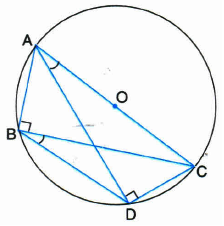
Proof: ∵ AC is the common hypotenuse of two right triangles ABC and ADC.
∴ \(\angle ABC=90°=\angle ADC\)
⇒ Both the triangles are in the same semi-circle.
∴ Points A, B, D and C are concyclic.
∴ DC is a chord
∴ \(\angle CAD=\angle CBD\).
| ∵ Angles in the same segment of a circle are equal
12.
Given: Circles are drawn with sides AB and AC of a triangle ABC as diameters. They intersect at a point D.
To Prove: D lies on the third side BC of \(\Delta \)ABC
Construction: Join AD
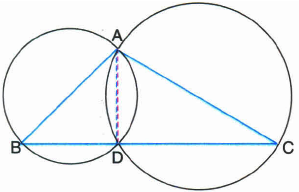
Proof: ∵ Circle drawn on AB as diameter intersects BC in D.
∴ \(\angle ADB=90°\)
| Angle in a semi-circle
But \(\angle ADB+\angle ADC=180°\)
Linear Pair Axiom
∴ \(\angle ADC=90°\)
Hence, the circle described on AC as diameter must pass through D.
Thus, the two circles intersect in D.
Now, \(\angle ADB+\angle ADC=180°\).
∴ Points B, D, C are collinear.
∴ D lies on BC.
13.
Given: ABCD is a trapezium whose nonparallel sides AD and BC are equal.
To Prove: Trapezium ABCD is cyclic.
Construction: Draw BE 11 AD.
Proof: ∵ AB || DE I Given
and AD || BE I By construction
∴ Quadrilateral ABCD is a parallelogram.
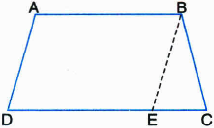
∴ \(\angle BAD=\angle BED\) ....(1)
| Opp.\(\angle \) s of a || gm are equal
and AD = BE ...(2)
Opp. sides of a || gm are equal
But AD = BC .......(3) I Given
From (2) and (3),
BE=BC
∴ \(\angle BEC=\angle BCE\) ....(4)
| Angles opposite to equal sides of a triangle are equal
\(\angle BEC+\angle BED=180°\)| Linear Pair Axiom
⇒ \(\angle BCE+\angle BAD=180°\) I From (4) and (1)
⇒ Trapezium ABCD is cyclic.
∵ If the sum of a pair of opposite angles of a quadrilateral is 180°, then the quadrilateral is cyclic.
14.
Given: ABCD is a trapezium whose nonparallel sides AD and BC are equal.
To Prove: Trapezium ABCD is cyclic.
Construction: Draw BE 11 AD.
Proof: ∵ AB || DE I Given
and AD || BE I By construction
∴ Quadrilateral ABCD is a parallelogram.
∴ \(\angle BAD=\angle BED\) ....(1)
| Opp.\(\angle \) s of a || gm are equal
and AD = BE ...(2)
Opp. sides of a || gm are equal
But AD = BC ...(3) I Given
From (2) and (3),
BE = BC
∴ \(\angle BEC=\angle BCE\) ....(4)
| Angles opposite to equal sides of a triangle are equal
\(\angle BEC+\angle BED=180°\) | Linear Pair Axiom
⇒ \(\angle BCE+\angle BAD=180°\) I From (4) and (1)
⇒ Trapezium ABCD is cyclic.
I ∵ If the sum of a pair of opposite angles of a quadrilateral is 180°, then the quadrilateral is cyclic
15.
In \(\Delta OAB\) and \(\Delta OCD\),
OA = OC | Radii of a circle
OB = OD | Radii of a circle
\(\angle AOB=\angle COD\) | Vertically Opposite Angles
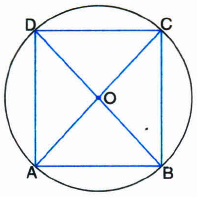
∴ \(\Delta OAB\cong \Delta OCD\) | SAS Rule
∴ AB = CD I CPCT
⇒ Arc AB = Arc CD ....(1)
Similarly, we can show that
Arc AD = Arc CB
Adding (1) and (2), we get
Arc AB + Arc AD = Arc CD + Arc CB ...(2)
⇒ Arc BAD = Arc BCD
⇒ BD divides the circle into two equal parts (each a semicircle)
∴ \(\angle A=90°,\ \angle C=90°\) Angle in semi-circle is 90°
Similarly, we can show that
\(\angle B=90°,\ \angle D=90°\)
∴ \(\angle A=\angle B=\angle C=\angle D=90°\)
∴ ABCD is a rectangle.
16.
Let BD = x m
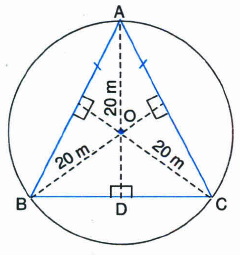
Then in right triangle ODB,
OB2 = OD2 + BD2
By Pythagoras Theorem
⇒ (20)2 = OD2 + x2
⇒ OD2= 400 - x2⇒ OD =\(\sqrt { 400-x^{ 2 } } \)
Again, area of equilateral triangle ABC
= Area of \(\Delta OBC\) + Area of \(\Delta OCA\) + Area of \(\Delta OAB\)
= 3 Area of \(\Delta OBC\)= 3\(\frac { \left( BC \right) \left( OD \right) }{ 2 } \)
\(=3x\sqrt { 400-x^{ 2 } } \) ....(2)
⇒ \(\sqrt { 3 } \sqrt { 400-x^{ 2 } } =x\)
Squaring both sides,
3(400 - x2) = x2
⇒ 1200 - 3x2 = x2
⇒ 4x2 = 1200 ⇒ x2 = 300
⇒ \(x=10\sqrt { 3 } \) ⇒ BD=\(10\sqrt { 3 } \)
⇒ \(2BD=20\sqrt { 3 } \) ⇒ \(BC=20\sqrt { 3 } \)
Hence, the length of string of each phone is \(20\sqrt { 3 } \) m.
17.
Construction: Draw OL 丄 RS.
Let KR = xm
\(ar\left( \Delta ORS \right) =ar\left( \Delta ORK \right) +ar\left( \Delta SRK \right) \)
\(=\frac { \left( OK \right) \left( KR \right) }{ 2 } +\frac { \left( KS \right) \left( KR \right) }{ 2 }\)
\( \\ =\frac { \left( KR \right) \left( OK+KS \right) }{ 2 } =\frac { \left( KR \right) \left( OS \right) }{ 2 } \)
\(=\frac { \left( x \right) \left( 5 \right) }{ 2 } \ ...........(1)\)
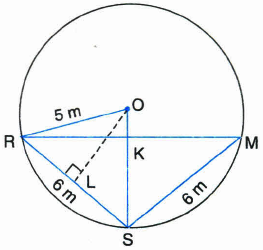
Again, ar \(\left( \Delta ORS \right) \)
\(=\frac { RS\times OL }{ 2 } =\frac { 6\times OL }{ 3 } \)
\(=\frac { 6\times \sqrt { OR^{ 2 }-RL^{ 2 } } }{ 2 } \) I By Pythagoras Theorem
\(=\frac { 6\times \sqrt { 25-9 } }{ 2 } =\frac { 6\times 4 }{ 2 } =12\quad m\) .........(2)
From equations (1) and (2),
\(\frac { \left( x \right) \left( 5 \right) }{ 2 } =12\Rightarrow x=\frac { 12\times 2 }{ 5 } =\frac { 24 }{ 5 } =4.8\quad m\)
⇒ KR = 4.8 m
∴ RM = 2KR = 2 x (4.8) = 9.6 m
Hence, the distance between Reshma and Mandip is 9.6 m.
18.
Given: Two equal chords AB and CD of a circle with centre 0 intersect within the circle. Their point of intersection is E.
To Prove: \(\angle OEA=\angle OED\) .
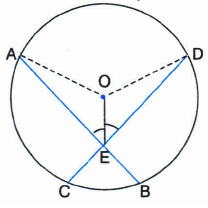
Construction: Join OA and OD.
Proof: In \(\Delta OEA\) and \(\Delta OED\) ,
OE = OE I Common
OA = OD I Radii of a circle
AE = DE
| Proved in Example 2 above
∴\(\Delta OEA\cong \Delta OED\) I SSS Rule
∴ \(\angle OEA=\angle OED.\) I CPCT
19.
Given: A circle with centre O. Its two equal chords AB and CD intersect at E.
To prove: AE = DE and CE = BE.
Construction: Draw OM 丄 AB and ON 丄 CD join OE.
Proof: In \(\Delta OME\) and \(\Delta ONE\) ,
OM = ON
| ∵ Equal chords of a circle are equidistant from the centre
OE = OE I Common
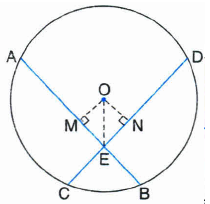
∴\(\Delta OME\cong \Delta ONE\) | RHS Rule
∴ ME = NE I CPCT
⇒AM + ME = DN + NE
∵ \(AB=CD\Rightarrow \frac { 1 }{ 2 } AB=\frac { 1 }{ 2 } CD\Rightarrow AM=DN\)
⇒ AE = DE
⇒ AB - AE = CD - DE | ∵ AB=CD
⇒ B E= CE. | Given
20.
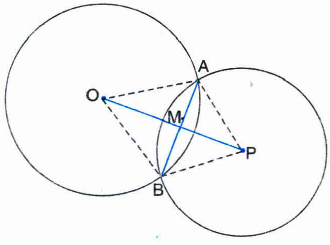
Given: Two circles with centres O and P intersecting at A and B.
Prove: OP is the perpendicular bisector of AB.
Construction: Join OA, OB, PA and PB. Let OP intersect AB at M.
Proof: In \(\Delta \) OAP and \(\Delta \) OBP,
OA = OB | Radii of a circle
PA = PB I Radii of a circle
OP = OP I Common
∴ \(\Delta \ OAP\cong \Delta \ OBP\) I SSS Rule
∴ \(\angle AOP=\angle BOP\) I CPCT
⇒\(\angle AOM=\angle BOM\) ...(1)
In \(\Delta \) AOM and \(\Delta \) BOM,
OA = OB I Radii of a circle
\(\angle AOM=\angle BOM\) | From (1)
OM = OM I Common
∴\(\Delta AOM\cong \Delta BOM\) I SAS Rule
∴ AM = BM ...(2)
I CPCT
and \(\angle AMO=\angle BMO\) ... (3)
I CPCT
But \(\angle AMO+\angle BMO=180°\) I Linear Pair Axiom
∴ \(\angle AMO+\angle BMO=90°\) ...(4)
∴ OM, i.e., OP is the perpendicular bisector of AB. I From (2) and (4)

9th Standard CBSE Syllabus & Materials
9th Standard CBSE
CBSE 9th Mathematics Lines and Angles Sample Question Papers Study Material - QB365 Set A
NEW9th Standard CBSE
CBSE 9th Mathematics Introduction to Euclid's Geometry Sample Question Papers Study Material - QB365 Set A
NEW9th Standard CBSE
CBSE 9th Mathematics Linear Equations in Two Variables Sample Question Papers Study Material - QB365 Set A
NEW9th Standard CBSE
CBSE 9th Mathematics Coordinate Geometry Sample Question Papers Study Material - QB365 Set A



NCERT Books

Syllabus

Exam Pattern

Sample Question Papers

Previous year Question Papers

Important Notes

MCQ Practice test

NCERT Exemplers

Case study Questions

Image Based Questions

Passage based Questions

HOT Questions

Value Based Questions

Model Questions Papers
NCERT ( Book Back ) Questions

Assertion and Reason
Important Questions And Answers

CBSE 9th Standard CBSE Subjects
CBSE Standards