100% FREE ACCESS
9th Standard CBSE Syllabus & Materials
9th Standard CBSE
CBSE 9th Science Is matter around us pure? - New Model Questions Papers Study Material - QB365 Set A
NEW9th Standard CBSE
CBSE 9th Science Matter in our surroundings - New Model Questions Papers Study Material - QB365 Set A
NEW9th Standard CBSE
CBSE 9th Mathematics Heron's Formula Sample Question Papers Study Material - QB365 Set A
NEW9th Standard CBSE
CBSE 9th Mathematics Circles Sample Question Papers Study Material - QB365 Set A
NEW9th Standard CBSE
CBSE 9th Mathematics Quadrilaterals Sample Question Papers Study Material - QB365 Set A
NEW9th Standard CBSE
CBSE 9th Mathematics Triangles Sample Question Papers Study Material - QB365 Set A

Published on: 29/10/2025
Download CBSE Class 9th Standard CBSE Mathematics question papers, sample papers, important questions, and previous year solved papers in PDF format. Get free study materials, NCERT solutions, and exam preparation resources for Class 9th Standard CBSE Mathematics
Questions + Answers key
Take MCQ Mathematics Test
1.
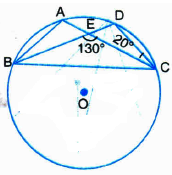
In the above figure, chords BD and AC intersect at the point E such that \(\angle BEC=130°\) and \(\angle ECD=20°\). Find the measure of \(\angle BAC\).
2.
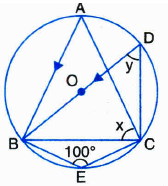
In the given figure, \(\Delta ABC\) is inscribed in a circle, with centre 0, such that AB = AC and \(\angle BEC= 100°\). Find the values of x and y.
3.
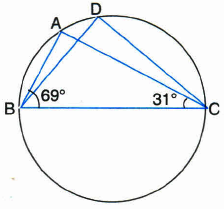
In figure, \(\angle ABC=69°,\ \angle ACB=31°\), find \(\angle BDC\) .
4.
A circular park of radius 20 m is situated in a colony. Three boys Ankur, Syed and David are sitting at equal distance on its boundary each having a toy telephone in his hands to talk each other. Find the length of the string of each phone.
5.
(i) The centre of a circle lies in __________ of the circle. (exterior/interior).
(ii) A point, whose distance from the centre of a circle is greater than its radius lies in___________ of the circle. (exterior/interior).
(iii) The longest chord of circle is a ________ of the circle.
(iv) An arc is a _____________ when its ends are the ends of a diameter.
(v) Segment of a circle is the region between an arc and __________ of the circle.
(vi) A circle divides the plane, on which it lies, ___________ parts.
6.
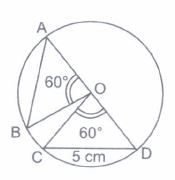
In the adjoining figure, O is the centre of the circle. Find the length of AB.
7.
Prove that" equal chords of a circle subtend equal angles at the centres."
8.
Write true or false. Give reason for your answer.
(i) Line segment joining the centre to any point on the circle is a radius ofthe circle.
(ii) A circle has only finite number of equal chords.
(iii) If a circle is divided into three equal arcs, each is a major arc.
(iv) A chord of a circle, which is twice as long as its radius, is a diameter of the circle.
(v) Sector is the region between the chord and its corresponding arc.
(vi) A circle is a plane figure.
9.
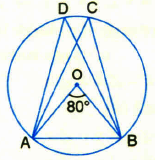
In figure, O is the centre of the circle. If \(\angle AOB= 80°\). then find the measures of \(\angle ABD\) and \(\angle ACB\) .
10.
A chord 12 cm long is 8 cm away from the centre of the circle. What is the length of a chord which is 6 cm away from the centre?
11.
Find the length of a chord of a circle which is at a distance of 4 cm from the centre of the circle with radius 5 cm.
12.
Find the angle marked as x in each of following figures where O is the centre of the circle:
(i)
.png)
(ii)
.png)
(iii)
.png)
(iv)
.png)
(v)
.png)
13.
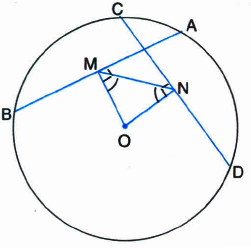
In figure, AB and CD are equal chords of a circle whose centre is O. If OM 丄 AB and ON 丄 CD, prove that \(\angle OMN=\angle ONM\)
14.
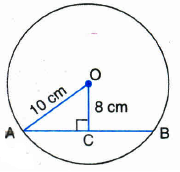
In the following figure, O is the centre of the circle. OA = 10 cm and perpendicular OC on chord AB = 8 cm, then the length of the chord AB is
8 cm
10 cm
12 cm
16 cm
15.
A chord of length 24 cm of a circle is at a distance of 5 cm from the centre. The radius of the circle is
13 cm
12 cm
11 cm
19 cm.
16.
The perpendicular from the centre of a circle bisects the:
circle
circumference
chord
radius.
17.
In the figure, \(\angle AOB=\angle COD=60°\), chord CD = 4 cm and 0 is the centre of the circle. Length of chord AB will be:
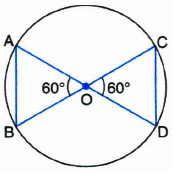
4 cm
8 cm
2 cm
6 cm.
18.
The centre of a circle lies
outside the circle
inside the circle
on the circle
none of these
19.
If a line segment joining two points subtends equal angles at two other points lying on the same side of the line containing the line segment, the four points lie on a circle (i.e. they are concyclic).
20.
Raja, Renu and Reena are three friends. They decided to sweep a circular park near their homes. They divided the park into three parts by two equal chords AB and AC for convenience.
(i) Prove that the centre of the park lies on the angle bisector of \(\angle\)BAC
(ii) Which mathematical concept is used in the above problem?
(iii) By deciding sweeping, which value is depicted by the three friends?
1.
110°
2.
50°, 80°
3.
In \(\Delta ABC\),
\(\angle BAC+\angle ABC+\angle ACB=180°\)
Sum of all the angles of a triangle is 180°
⇒ \(\angle BAC+69°+31°=180°\)
⇒ \(\angle BAC+100°=180°\)
⇒ \(\angle BAC=180°-100°=80°\) .........(1)
Now, \(\angle BDC=\angle BAC\)
Angles in the same segment of a circle are equal = 80°. Using (1)
4.
Let BD = x m
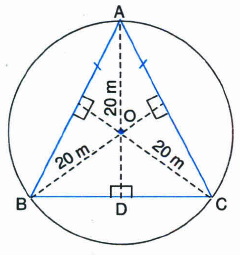
Then in right triangle ODB,
OB2 = OD2 + BD2
By Pythagoras Theorem
⇒ (20)2 = OD2 + x2
⇒ OD2= 400 - x2⇒ OD =\(\sqrt { 400-x^{ 2 } } \)
Again, area of equilateral triangle ABC
= Area of \(\Delta OBC\) + Area of \(\Delta OCA\) + Area of \(\Delta OAB\)
= 3 Area of \(\Delta OBC\)= 3\(\frac { \left( BC \right) \left( OD \right) }{ 2 } \)
\(=3x\sqrt { 400-x^{ 2 } } \) ....(2)
⇒ \(\sqrt { 3 } \sqrt { 400-x^{ 2 } } =x\)
Squaring both sides,
3(400 - x2) = x2
⇒ 1200 - 3x2 = x2
⇒ 4x2 = 1200 ⇒ x2 = 300
⇒ \(x=10\sqrt { 3 } \) ⇒ BD=\(10\sqrt { 3 } \)
⇒ \(2BD=20\sqrt { 3 } \) ⇒ \(BC=20\sqrt { 3 } \)
Hence, the length of string of each phone is \(20\sqrt { 3 } \) m.
5.
(i) The centre of circle lies in interior of the circle.
(ii) A point distance from the centre of a circle is greater than its radius lies in exterior of the circle.
(iii) The longest chord of a circle is a diameter of the circle.
(iv) An arc is a semicircle when its ends are the ends of a diameter.
(v) Segment of a circle is the region between an arc and the chord of the circle.
(vi) A circle divides the plane, on which it lies, in three parts.
6.
Since chord AB and chord CD subtend equal angles at the centre,
i.e. ∠AOB = ∠COD [Each = 60°]
∴ Chord AB = Chord CD
⇒ Chord AB = 5 cm [∴ Chord CD = 5 cm]
Thus, the required lenth of chord AB is 5 cm.
7.
Given AB and CD are the chords of a circle with centre at O such that AB = CD
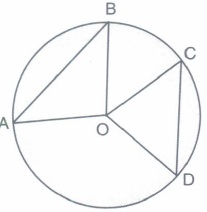
To Prove: \(\angle\)AOB = \(\angle\)COD
Proof: In \(\Delta\)AOB and \(\Delta\)COD
AO = CO (radii of same circle)
AB = CD (given)
BO = DO (radii of same circle)
\(\Delta\)AOB\(\cong \) \(\Delta\)COD (SSS)
\(\angle\)AOB = \(\angle\)COD (c.p.c.t.) 2 Hence Proved.
8.
(i) True. Because all points on the circle are equidistant from the centre of the circle and this equal distance is called radius of the circle.
(ii) False. Because in circle, infinitely many equal chordscan be drawn.
(iii) False. Because all three arcs are equal, so there is no difference berween the major and minor arcs.
(iv) True. By the definition of diameter, it is rwice the radius of a circle.
(v) False. Because the sector is the region between two radii and an arc.
(vi) True. Because circle is a rwo dimensional figure and it can also be referred as plane figure.
9.
40°, 40°
10.
The perpendicular from the center bisects the chord.
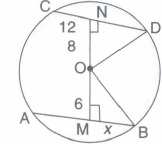
\(\Rightarrow\) DN =1/2 CD = 6cm
and BM = x,
OD =OB (Radius of the same circle)
OD2 = OB2
\(\Rightarrow\) ON2 + ND2 = OM2 + MB2
\(\Rightarrow\) 82 + 62 = 62 + x2
\(\Rightarrow\) x = 8 cm
\(\Rightarrow\) BM =8
\(\Rightarrow\) AB = 2BM
= 2x8
\(\Rightarrow\) AB = 16 cm.
11.
6 cm
12.
(i) x = 2 x 35° = 70°
I ∵ Angle subtended by an arc of a circle at the centre is double the angle subtended by it at any point of the remaining part of the circle
(ii) \(x=\frac { 1 }{ 2 } \times 110°=55°\)
| ∵ Angle subtended by an arc of a circle at the centre is double the angle subtended by it at any point of the remaining part of the circle
(iii) \(x=\frac { 1 }{ 2 } \times 70°=35°\)
I ∵ Angle subtended by an arc of a circle at the centre is double the angle subtended by it at any point of the remaining part of the circle
(iv) x = 180° - (90° + 55°) I ∵ Angle in a semi-circle is 90°
= 180° - 145° = 35°
(v) \(x=\frac { 1 }{ 2 } \times \left( 180°-120° \right) \)
| ∵ Angle subtended by an arc of a circle at the centre is double the angle subtended by it at any point of the remaining part of the circle \(=\frac { 1 }{ 2 } \left( 60° \right) =30°\).
13.
Given: In figure, AB and CD are equal chords of a circle whose centre is O. OM 丄 AB and ON 丄 CD.
To Prove: \(\angle OMN=\angle ONM\).
Proof: ∵ Chord AB = Chord CD
∴ OM=ON .........(1)
| Equal chords of a circle are equidistant from the centre of the circle
In \(\Delta OMN\),
OM=ON I From (1)
∴ \(\angle OMN=\angle ONM\) | Angles opposite to equal sides of a triangle are equal.
14.
\(AC=\sqrt { OA^{ 2 }+OC^{ 2 } }\)
\(\quad =\sqrt { 10^{ 2 }-8^{ 2 } } =6\quad cm\)
\(\therefore AB=2AC=12\quad cm\)
15.
\(AC=BC=\frac { 1 }{ 2 } AB=\frac { 1 }{ 2 } (24)=12\quad cm\)
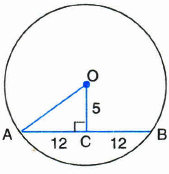
\(OA=\sqrt { OC^{ 2 }+AC^{ 2 } } \)
\(=\sqrt { 5^{ 2 }+12^{ 2 } } =13\quad cm\)
16.
Theorem
17.
\(\Delta AOB\cong \Delta COD\)
18.
See a circle
19.
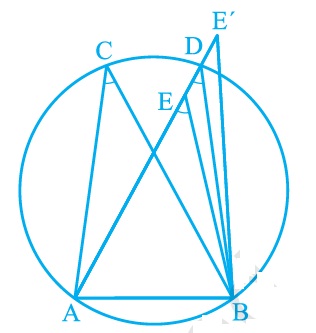
AB is a line segment, which subtends equal angles at two points C and D. That is
\(\angle\) ACB = \(\angle\) ADB
To show that the points A, B, C and D lie on a circle let us draw a circle through the points A, C and B. Suppose it does not pass through the point D. Then it will intersect AD (or extended AD) at a point, say E (or E').
If points A, C, E and B lie on a circle,
\(\angle\) ACB = \(\angle\) AEB
But it is given that \(\angle\) ACB = \(\angle\) ADB.
Therefore, \(\angle\) AEB = \(\angle\) ADB.
This is not possible unless E coincides with D.
Similarly, E' should also coincide with D.
20.
(i) Given: A circle C(O, r) and chord AB = chord AC. AD is bisector of \(\angle\)CAB.
To Prove: Centre O lies on the bisector of \(\angle\)BAC
Construction Join Be, meeting bisector AD of \(\angle\)BAC, at M.
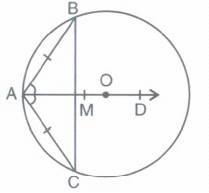
Proof: In triangles BAM and CAM,
AB=AC (given)
\(\angle\)BAM= \(\angle\)CAM (given)
AM=AM (Common)
\(\triangle BAM\cong \triangle CAM\) (SAS)
\(\Rightarrow\) BM=CM
and \(\angle\)BMA = \(\angle\)CMA
As \(\angle\)BMA + \(\angle\)CMA = 1800 (linear pair)
\(\Rightarrow\) \(\angle\)BMA = \(\angle\)CMA = 900
\(\Rightarrow\) AM is the perpendicular bisector of the chord BC
\(\Rightarrow\) AM passes through the centre O.
[\(\because\) Perpendicular bisector of chord of a circle passes through the centre of the circle]
Hence, the centre of the park lies on the angle bisector of \(\angle\)BAC
(ii) Congruency of triangles by SAS axiom (Geometry)
(iii) Cleanliness and respect for labour.

9th Standard CBSE Syllabus & Materials
9th Standard CBSE
CBSE 9th Mathematics Lines and Angles Sample Question Papers Study Material - QB365 Set A
NEW9th Standard CBSE
CBSE 9th Mathematics Introduction to Euclid's Geometry Sample Question Papers Study Material - QB365 Set A
NEW9th Standard CBSE
CBSE 9th Mathematics Linear Equations in Two Variables Sample Question Papers Study Material - QB365 Set A
NEW9th Standard CBSE
CBSE 9th Mathematics Coordinate Geometry Sample Question Papers Study Material - QB365 Set A



NCERT Books

Syllabus

Exam Pattern

Sample Question Papers

Previous year Question Papers

Important Notes

MCQ Practice test

NCERT Exemplers

Case study Questions

Image Based Questions

Passage based Questions

HOT Questions

Value Based Questions

Model Questions Papers
NCERT ( Book Back ) Questions

Assertion and Reason
Important Questions And Answers

CBSE 9th Standard CBSE Subjects
CBSE Standards