100% FREE ACCESS
9th Standard CBSE Syllabus & Materials
9th Standard CBSE
CBSE 9th Science Is matter around us pure? - New Model Questions Papers Study Material - QB365 Set A
NEW9th Standard CBSE
CBSE 9th Science Matter in our surroundings - New Model Questions Papers Study Material - QB365 Set A
NEW9th Standard CBSE
CBSE 9th Mathematics Heron's Formula Sample Question Papers Study Material - QB365 Set A
NEW9th Standard CBSE
CBSE 9th Mathematics Circles Sample Question Papers Study Material - QB365 Set A
NEW9th Standard CBSE
CBSE 9th Mathematics Quadrilaterals Sample Question Papers Study Material - QB365 Set A
NEW9th Standard CBSE
CBSE 9th Mathematics Triangles Sample Question Papers Study Material - QB365 Set A

Published on: 29/10/2025
Download CBSE Class 9th Standard CBSE Mathematics question papers, sample papers, important questions, and previous year solved papers in PDF format. Get free study materials, NCERT solutions, and exam preparation resources for Class 9th Standard CBSE Mathematics
Questions + Answers key
Take MCQ Mathematics Test
1.
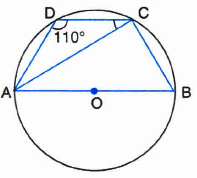
In the given figure, O is the centre of the circle. ABCD is a trapezium in which AB || DC and \(\angle ADC=110°\) The measure of \(\angle ADC\) is equal to:
35°
70°
20°
55°
2.
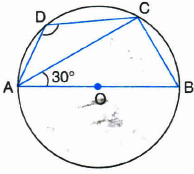
In the following figure, 0 is the centre of the circle. \(\angle BAC=30°\). Then, the measure of \(\angle ADC\) is
60°
45°
90°
120°
3.
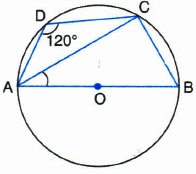
In the following figure, ABCD is a cyclic quadrilateral whose side AB is a diameter of the circle. If \(\angle ADC=120°\), then the value of \(\angle CAB\) is
30°
45°
60°
90°
4.
In the following figure, O is the centre of the circle. \(\angle POR=60°\). Then, \(\angle PQR=\)
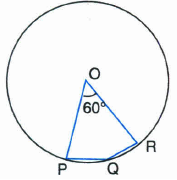
60°
80°
120°
150°
5.
In the given figure, if \(\angle POR\) is 110°, then the value of \(\angle PQR\) is:
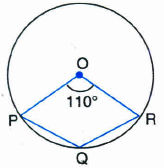
140°
125°
60°
70°
6.
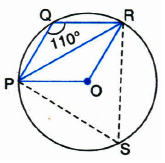
In figure, O is the centre of the circle and \(\angle PQR=110°\). \(\angle OPR\) equals to:
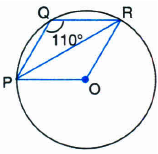
55°
20°
40°
70°
7.
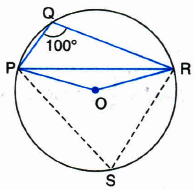
In the adjoining figure, O is the centre of the circle and P, Q and R are points on the circle such that \(\angle PQR=100°\), then \(\angle OPR\) equals:
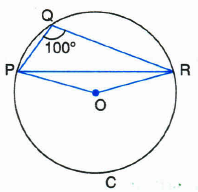
80°
10°
100°
60°
8.
In the figure below, PQRS is cyclic quadrilateral. If \(\angle SPR=25°\) and \(\angle PRS=60°\), the value of x is:
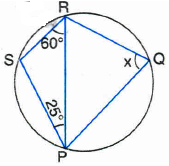
105°
85°
95°
115°
9.
In the figure, \(\angle ABD=70°\) , \(\angle ADB=30°\) then \(\angle BCD\) is equal to:
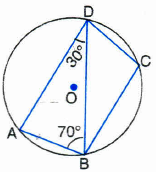
80°
110°
120°
100°
10.
In the figure, the magnitude of angle ABC if angle AOC = 120° will be:
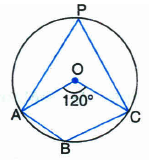
125°
120°
130°
135°
11.
In the figure, O is the centre of a circle and \(\angle AOC=130°\), \(\angle ABC\) will be:
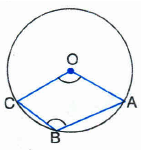
120°
115°
90°
65°
12.
In the figure, arc ABC of the circle subtends angle of 130° at the centre O. If AB is produced to D, then \(\angle CBD\) will be:
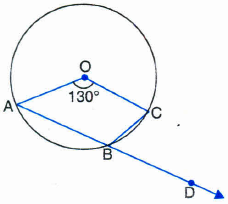
60°
65°
70°
130°
13.
In the figure, O is the centre of the circle. Quadrilateral PQTS is a cyclic quadrilateral. If \(\angle POT=130°\) , then the measure of \(\angle x\) is:
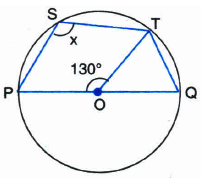
50°
65°
115°
130°
14.
In the following figure, ABCD is a cyclic quadrilateral whose side AD is a diameter of the circle and the point O is the centre of the circle. If \(\angle OCD=50°\) , then the measure of \(\angle ABC\) is
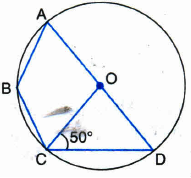
100°
120°
110°
130°
15.
In the given figure, AB || DC. If \(\angle A=50°\), then measure of \(\angle ABC\) is:
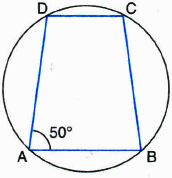
50°
130°
100°
80°
16.
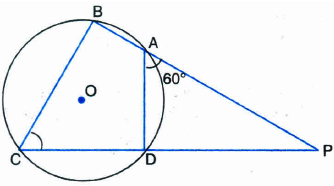
Two secants PAB and PDC drawn from P to a circle ABCD to intersect it at points A, B and C, D respectively. If \(\angle PAD=60°\) , then the degree measure of \(\angle BCD\) is
30°
120°
60°
150°
17.
The opposite angles of a cyclic quadrilateral
are complementary
are supplementary
are equal
form a linear pair.
18.
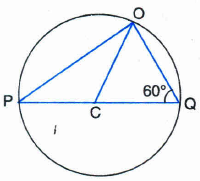
In the following figure, PCQ is a diameter of the circle and C is the centre. The point O lies on the circle. If \(\angle OQP=60°\),then \(\angle OCP=\)
80°
100°
120°
130°
19.
In a semi-circle, \(\Delta PQR\) is formed on diameter PQ. If \(\angle RPQ=\angle RQP\), \(\angle PQR\) has measure
30°
45°
60°
75°
20.
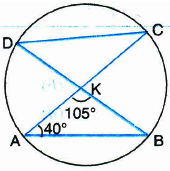
In the following figure, \(\angle CAB=40°\), \(\angle AKB=105°\) . Then measure of \(\angle KCD\) is
72.5°
40°
35°
65°
21.
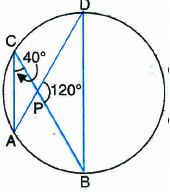
In the figure, \(\angle ACP=40°\) and \(\angle BPD=120°\) . Then \(\angle CBD=\)
40°
60°
20°
30°
22.
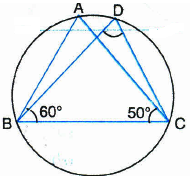
In the following figure, \(\angle BAC\) and \(\angle DBC\) are the angles on the same segment of a circle. If the measure of \(\angle ABC=60°\) and the measure of \(\angle ACB=50°\), then the measure of \(\angle BDC\) is equal to
120°
100°
70°
60°
23.
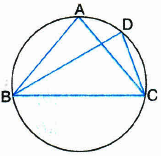
In this figure AB = AC and \(\angle ABC=50°\). Then \(\angle BDC\) is equal to:
50°
65°
90°
80°
24.
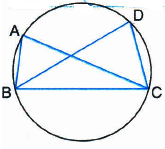
In the given figure, \(\angle ABC=80°\), \(\angle BDC=40°\) then \(\angle ACB\) is:
120°
60°
80°
40°
25.
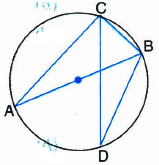
In the figure, AB is a diameter. \(\angle BDC=35°\) then \(\angle ABC\) is:
35°
55°
90°
125°
26.
In the given figure, AD || BC and \(\angle BCA=40°\). The measure of \(\angle DBC\) is equal to:
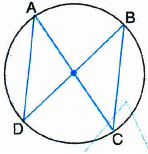
50°
80°
40°
20°
27.
In the figure, O is the centre of the circle. The value of x is:
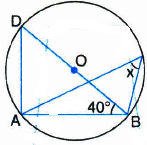
50°
40°
60°
20°
28.
A and B are points on the circle with centre O. If a chord CD of the circle subtends an angle of 50° at the point A on the circle and \(\angle BDC=70°\), then \(\angle BCD\) equals:
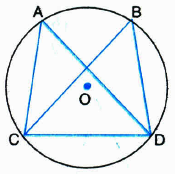
60°
50°
70°
90°
29.
In the given figure, A, B, C and D are points on the circle such that \(\angle ACB=40°\) and \(\angle DAB=60°\),the measure of \(\angle DBA\) is
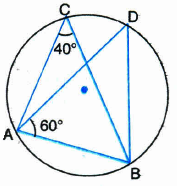
70°
80°
60°
100°
30.
In the figure, O is the centre of the circle. If \(\angle BAD=48°\) , then \(\angle BCD=\)
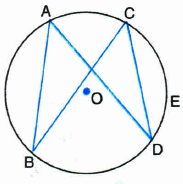
96°
48°
42°
84°
31.
In figure, if \(\angle ABE=65°\), then value of \(\angle ADC\) is
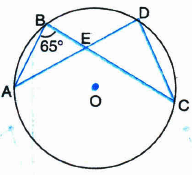
35°
25°
65°
115°
32.
In the figure, if \(\angle BAC=50°\) and \(\angle DBC=40°\), then \(\angle BDC\)is equal to:
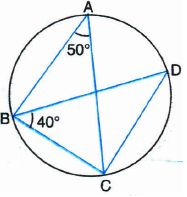
140°
40°
50°
90°
33.
In the following figure, there are two congruent circles whose centres are O and O' and chord AB = chord CD. If \(\angle CO'D=60°\) , then the measure of \(\angle APB\) is equal to
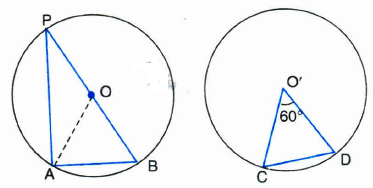
45°
40°
30°
15°
34.
The degree measure of an angle of a segment of a circle is 60°. The degree measure of the angle subtended by the chord of the segment at the centre of the circle is
60°
90°
120°
150°
35.
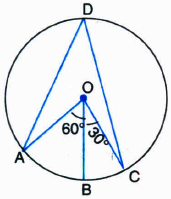
In the circle with centre O, \(\angle AOB=60°\) and \(\angle BOC=30°\), the measure of \(\angle ADC\) is:
30°
45°
60°
90°
36.
In the figure 'O' is the centre of the circle, \(\angle ABO=20°\) and \(\angle ACO=30°\) where A, B, C are points on the circle. The value of x is:
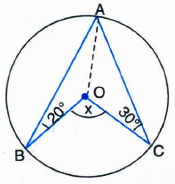
120°
130°
100°
150°
37.
In the given figure, is the centre of circle, \(\angle ACO=35°\) and \(\angle ABO=45°\), then \(\angle BOC\) is:
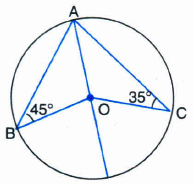
80°
160°
90°
70°
38.
In the following figure, O is the centre of the circle PAB. If \(\angle PAO=15°\) and \(\angle PBO=30°\) , then the measure of \(\angle AOB\) is
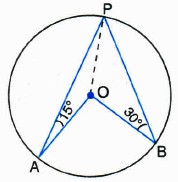
30°
60°
90°
45°
39.
The value of x in figure is:
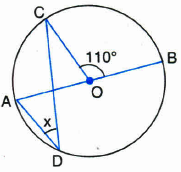
35°
45°
55°
30°
40.
O is the centre of the circle. If \(\angle BOC=140°\), then x = .............
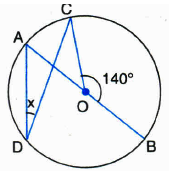
70°
40°
35°
20°
41.
In figure, O is the centre of the circle and \(\angle ABC=40°\) , then \(\angle AOC\) is:
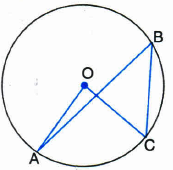
140°
40°
20°
80°
42.
In the given figure, \(\angle AOB=90°\) and \(\angle ABC=30°\), then \(\angle CAB\) is equal to:
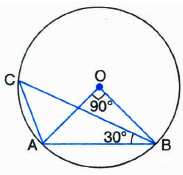
30°
105°
90°
60°
43.
\(\angle ADB=90°\) and \(\angle ABC=30°\) then \(\angle ACB\) is:
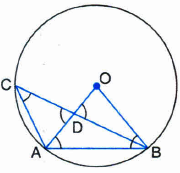
30°
45°
90°
60°
44.
A chord of a circle is equal to its radius, \(\angle BAC\) is equal to:
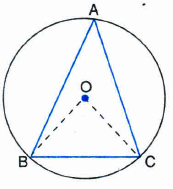
90°
60°
30°
45°
45.
In the figure, O is the centre and AB is a diameter of the circle. \(\angle APC\) is equal to:
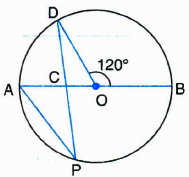
68°
40°
50°
30°
46.
Find x in the adjoining figure, O is the centre of the circle:
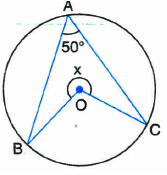
100°
200°
250°
260°
47.
The length of a chord of a circle is equal to its radius. Find the measure of the angle subtended by that chord in major segment.
30°
60°
45°
none of these.
48.
In the following figure, O is the centre of the circle. If measure of \(\angle BAC=50°\), then the measure of \(\angle BOC\)
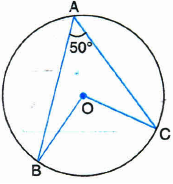
120°
100°
80°
70°
49.
In the following figure, O is the centre of the circle PAB and \(\Delta OAB\) is equilateral. The measure of \(\angle APB\) is equal to
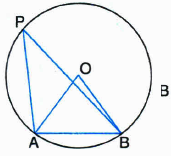
60°
45°
40°
30°
50.
In the given figure, if AOB is the diameter of the circle and AC = BC, then L CAB is equal to:
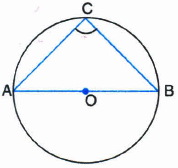
30°
60°
90°
45°
51.
In the figure, AOB is a diameter of the semicircle. If \(\angle A=60°\) , then \(\angle B\) is equal
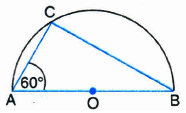
60°
30°
50°
40°
52.
In the figure, AOB is the diameter of the circle. Measure of \(\angle ACB\) is
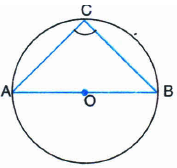
80°
70°
90°
50°
53.
The angle of a minor segment is
acute
right
obtuse
straight.
54.
The measure of the angle of a semi -circle is
30°
45°
60°
90°
55.
In the adjacent figure, what is the relation between AB and CD?
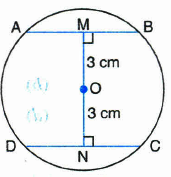
AB > CD
AB < CD
AB = CD
AB = 2CD
56.
Equal chords of a circle are equidistant from
the centre
an extremity of a diameter
any point on the circumference
any point on the diameter
57.
Three chords AB, CD and EF of a circle are respectively 3 cm, 3.5 cm and 3.8 cm away from the centre. Then which of the following is correct?
AB > CD > EF
AB < CD < EF
AB = CD = EF
AB = CD < EF.
58.
How many points are sufficient to determine a line?
1
2
3
none of these
59.
To determine a unique circle, the number of points required is:
1
2
3 non collinear points
3 collinear points
60.
How many circles can pass through three given non-collinear points?
one and only one
two
three
infinitely many.
61.
In the figure below, O is the centre of the circle. Its radius is 5 cm, chord AB = 8 cm and chord CD = 6 cm. PQ is equal to:
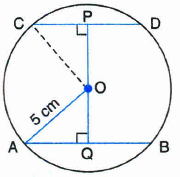
8 cm
6 cm
9 cm
7 cm
62.
In figure, if OA = 5 cm, AB = 8 cm and OD丄AB then CD is equal to:
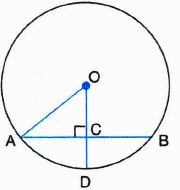
3 cm
2 cm
4 cm
5 cm
63.
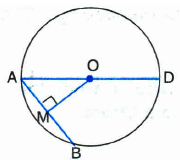
AD is a diameter of a circle and AB is a chord. If AD = 34 cm and AB = 30 cm, the distance of AB from the centre of the circle is:
17 cm
15 cm
4 cm
8 cm
64.
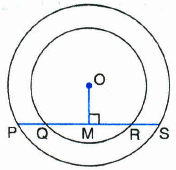
In the figure, two concentric circles with centre O are given. OM丄PS. If PS = 20 cm and QR = 15 cm, then PQ is:
5 cm
3 cm
2.5 cm
4 cm.
65.
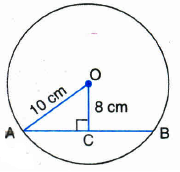
In the following figure, O is the centre of the circle. OA = 10 cm and perpendicular OC on chord AB = 8 cm, then the length of the chord AB is
8 cm
10 cm
12 cm
16 cm
66.
The length of the perpendicular from the centre of a circle of radius 5 cm on a chord of it of length 8 cm is
6 cm
5 cm
4 cm
3 cm
67.
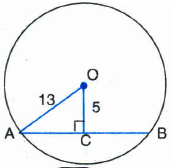
The length of the chord of a circle, of radius 13 cm, at a distance of 5 cm from the centre is
12 cm
18 cm
20 cm
24 cm
68.
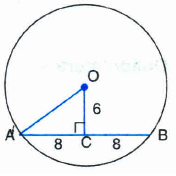
The length of a chord of a circle is 16 cm and its distance from the centre is 6 cm. The measure of the radius of the circle is
6 cm
8 cm
10 cm
12 cm.
69.
A chord of length 24 cm of a circle is at a distance of 5 cm from the centre. The radius of the circle is
13 cm
12 cm
11 cm
19 cm.
70.
A chord of length 12 cm of a circle is at a distance of 8 cm from its centre. The radius of the circle is
4 cm
6 cm
8 cm
10 cm
71.
Given a circle with centre O and smallest chord AB is of length 6 cm and the longest chord CD of the circle is of length 10 cm, then the radius of the circle is:
15 cm
6 cm
5 cm
3.5 cm.
72.
The perpendicular from the centre of a circle bisects the:
circle
circumference
chord
radius.
73.
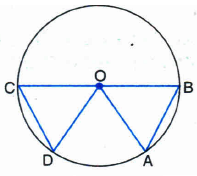
In the given figure, O is the centre of the circle. \(\Delta AOB\) is equilateral. CD = AB, then \(\angle COD=\)
30°
45°
60°
90°
74.
Equal chords of a circle subtend equal angles at
the centre
any interior point
any exterior point
any point of a diameter
75.
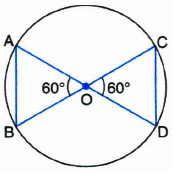
In the figure, \(\angle AOB=\angle COD=60°\), chord CD = 4 cm and 0 is the centre of the circle. Length of chord AB will be:
4 cm
8 cm
2 cm
6 cm.
76.
In the given figure, O is the centre of the circle. \(\angle AOB=\angle COD=50°\) and CD = 5 cm then AB is equal to:
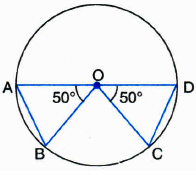
2.5 cm
10cm
\(\frac { 10 }{ 3 } \) cm
5 cm
77.
The minute hand of a clock is at 12 and the smaller hour's hand is at 2. The angle between the hands of the clock is
10°
20°
30°
60°
78.
The centre of a circle lies
outside the circle
inside the circle
on the circle
none of these
79.
The longest chord of a circle is called
radius
diameter
segment
sector.
80.
The wheels of a vehicle are in
rectangular
triangular
circular shape
trapezoidal
81.
The shape of the coin of RS 1 is
triangle
rhombus
circle
trapezium
82.
The path traced by the tip of the second's hand is a
circle
square
rectangle
straight line
1.
\(\angle ABC=180°-\angle ADC=180°-110°=70°\)
\(\angle ACB=90°\)
\(\therefore \angle BAC=20°\)
\(\angle ACD=\angle BAC\) | Alternate interior angles
2.
(d)
120°
3.
\(\angle ADC+\angle ABC=180°\)
⇒ \(120°+\angle ABC=180°\)
⇒ \(\angle ABC=60°\)
\(\angle CAB=180°-\left( \angle ABC+\angle ACB \right) \)
\(=180°-(60°+90°)=30°\)
4.
\(\angle PSR=\frac { 1 }{ 2 } \angle POR=30°\)
\(\angle PSR+\angle PQR=180°\)
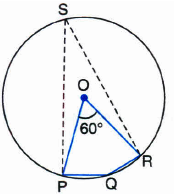
⇒ \(30°+\angle PQR=180°\)
⇒ \(\angle PQR=150°\)
5.
\(\angle POR=180°-\frac { 1 }{ 2 } (110°)=125°\)
6.
\(\angle POR=2\angle PSR=2(180°-\angle PQR)\)
\(=2(180°-110°)\)
\(=140°\)
∵ OP=OR
∴ \(\angle OPR=\angle ORP\)
7.
\(\angle POR=2\angle PSR=2(180°-\angle PQR)\)
\( =2(180°-100°)=160°\)
OP=OR
∴ \(\angle OPR=\angle ORP\)
8.
\(\angle PSR=95°\)
\(\angle PSR+x=180°\)
9.
\(\angle BAD+\angle BCD=180°\)
10.
\(\angle APC=\frac { 1 }{ 2 } AOC=60°\)
\(\angle APC+\angle ABC=180°\)
⇒ \(\angle ABC=180°-60°=120°\)
11.
\(\angle ABC=180°-\frac { 1 }{ 2 } \angle COA\)
\(=180°-\frac { 1 }{ 2 } \times 130°=115°\)
12.
\(\angle CBD=\frac { 1 }{ 2 } \angle AOC\)
13.
\(\angle QOT=50°\)
\(\therefore\angle OQT+\angle OTQ=130°\)
But \(\angle OQT=\angle OTQ\)
∴ \(\angle OQT=\angle OTQ=65°\)
\(x+\angle OQT=180°\)
14.
\(\therefore \angle OCD=\angle ODC=50°\)
\(\angle ABC+\angle ADC=180°\)
\(\Rightarrow \angle ABC+50°=180°\)
\(\Rightarrow \angle ABC=130°\)
15.
\(\angle BCD=180°-\angle BAD=180°-50°=130°\)
\(\angle BCD+\angle ABC=180°\)
16.
\(\angle BCD=\angle PAD=60°\)
17.
Theorem
18.
\(\because CO=CQ\)
\(\therefore \angle COQ=\angle CQO=60°\)
\(\therefore \angle OCP=\angle COQ+\angle CQO=120°\)
19.
\(\angle PQR=90°\)
\(\therefore\angle RPQ+\angle PQR=90°\)
But \(\angle RPQ=\angle PQR\)
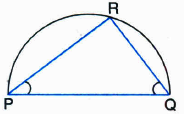
\(\angle PQR=45°\)
20.
\(\angle DKC=\angle AKB=105°\)
\(\angle CDB=\angle CAB=40°\)
\(\therefore\angle KCD=180°-(\angle DKC+\angle CDB)\)
21.
\(\angle ADB=\angle ACB=40°\)
22.
\(\angle BDC=\angle BAC\)
\(=180°-\left( \angle ABC+\angle ACB \right) \)
\(=180°(60°+50°)=70°\)
23.
\(\because AB=AC\)
\(\therefore \angle ABC=\angle ACB=50°\)
\(\therefore\angle BAC=80°\)
24.
\(\angle BAC=\angle BDC=40°\)
25.
\(\angle BAC=\angle BDC=35°\)
\(\angle ACB=90°\)
26.
\(\angle BDA=\angle BCA=40°\) [Angles in the same segment]
Now, Since AD || BC
\(\angle\)DBC=\(\angle\)BDA [Alternate interior angles]
\(\therefore\) \(\angle\)DBC=40o
27.
\(\angle BAD=90°\)
\(\therefore \angle ABD=50°\)
\(x=\angle ABD=50°\)
28.
\(\angle CBD=\angle CAD=50°\)
29.
\(\angle ADB=\angle ACB=40°\)
30.
\(\angle BCD=\angle BAD\)
31.
\(\angle ADC=\angle ABE\)
32.
\(\angle BDC=\angle BAC=50°\)
33.
\(\angle AOB=\angle CO'D=60°\)
\(\therefore \ \angle APB=\frac { 1 }{ 2 } \angle AOB=30°\)
34.
Required angle\(=\angle AOB=2\angle ACB=120°\) .
35.
\(\angle ADC=\frac { 1 }{ 2 } \angle AOC\)
36.
\(\angle OAB=\angle OBA=20°\)
\(\angle OAC=\angle OCA=30°\)
\(x=2\angle BAC\)
37.
\(\angle OAB=\angle OBA=45^o\)
\(\angle OAC=\angle OCA=35°\)
\(\angle BOC=2\angle BAC\)
38.
\(\because OP=OB\)
\(\therefore \angle OPB=\angle OPB=30°\)
\(\because OP=OA\)
\(\therefore \angle OPA=\angle OAP=15°\)
\(\therefore \angle APB=\angle OPA+\angle OPB\)
\( =15°+30°=45°\)
\(\therefore \angle AOB=2\angle APB=90°\)
39.
\(\angle AOC=180°-\angle BOC=70°\)
\(x=\frac { 1 }{ 2 } \angle AOC=35°\)
40.
\(\angle AOC=180°-\angle BOC \)
\(x=\frac { 1 }{ 2 } \angle AOC\)
41.
\(\angle AOC=2\angle ABC\)
42.
\(\angle ACB=\frac { 1 }{ 2 } \angle AOB\)
43.
\(\angle ABD=90°\)
\(\angle ABD=30°\)
\(\therefore \angle DAB=60°\)
\(\therefore \angle OAB=60°\)
\(\therefore\angle OAB=\angle OBA=60°\)
\(\therefore \angle AOB=60°\)
\(\therefore\angle ACB=\frac { 1 }{ 2 } \angle AOB=30°\)
44.
OB=OC=BC
∴ \(\angle BOC=60°\)
∴ \(\angle BAC=\frac { 1 }{ 2 } 60°\angle BOC=30°\)
45.
\(\angle AOD=180°-120°=60°\)
\(\angle APC=\frac { 1 }{ 2 } \angle AOD=30°\)
46.
\(\angle BOC=2\angle BAC=100°\)
\(x+\angle BOC=360°\)
47.
\(\therefore \ OA=OB=AB\)
\(\therefore \ \angle AOB=60°\)
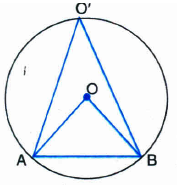
\(\therefore \angle AO'B=\frac { 1 }{ 2 } \angle AOB=30°\)
48.
\(\angle BOC=2\angle BAC=100°\).
49.
∵ \(\Delta OAB\) is equilateral
∴ \(\angle AOB=60°\)
∴ \(\angle APB=\frac { 1 }{ 2 } \angle AOB=30°\)
50.
\(\angle ACB=90°\)
\(\because AC=BC\)
\(\therefore \angle CAB=\angle CBA\)
51.
\(\angle ACB=90°\)
52.
Theorem
53.
Theorem
54.
Theorem
55.
If two chords of a circle are equidistant from the centre, then they are equal.
56.
(a)
the centre
57.
Of any two chords of a circle, one which is larger is nearer to the centre.
58.
Visualise
59.
Theorem
60.
Theorem
61.
\(AQ=QB=\frac { 1 }{ 2 } AB=4\quad cm\)
\(OA^{ 2 }=OQ^{ 2 }+AQ^{ 2 }\)
\(⇒\ OQ=3cm\)
\(CP=PD=\frac { 1 }{ 2 } CD=3\ cm\)
\(OC^{ 2 }=OP^{ 2 }+CP^{ 2 }x\)
\( ⇒\ OP=4\ cm\)
\(PQ=OP+OQ=7\ cm\)
62.
\(AC=CB=\frac { 1 }{ 2 } AB=4\ cm\)
\(OA^{ 2 }=OC^{ 2 }+AC^{ 2 }\)
⇒ OC=3 cm
CD=OD-OC=5-3=2 cm
63.
\(AO=OD=\frac { 1 }{ 2 } AD=\frac { 15 }{ 2 } \ cm\)
\( AM=MB=\frac { 1 }{ 2 } AB=15cm\)
\(OA^{ 2 }=OM^{ 2 }+AM^{ 2 }\)
64.
\(QM=MR=\frac { 1 }{ 2 } QR=\frac { 15 }{ 2 } cm\)
\(PM=MS=\frac { 1 }{ 2 } PS=\frac { 20 }{ 2 } cm=10cm\)
\(\ PQ=PM-QM\)
65.
\(AC=\sqrt { OA^{ 2 }+OC^{ 2 } }\)
\(\quad =\sqrt { 10^{ 2 }-8^{ 2 } } =6\quad cm\)
\(\therefore AB=2AC=12\quad cm\)
66.
(d)
3 cm
67.
\(AC=\sqrt { OA^{ 2 }+OC^{ 2 } } \)
\(\quad =\sqrt { 13^{ 2 }-5^{ 2 } } =12\quad cm\)
68.
\(AC=CB=\frac { 1 }{ 2 } AB=\frac { 1 }{ 2 } \times 16=8\quad cm\)
\(OA=\sqrt { OC^{ 2 }+AC^{ 2 } }\)
\(=\sqrt { 6^{ 2 }+8^{ 2 } } =10\quad cm\)
69.
\(AC=BC=\frac { 1 }{ 2 } AB=\frac { 1 }{ 2 } (24)=12\quad cm\)
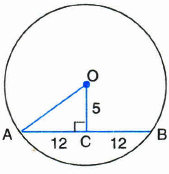
\(OA=\sqrt { OC^{ 2 }+AC^{ 2 } } \)
\(=\sqrt { 5^{ 2 }+12^{ 2 } } =13\quad cm\)
70.
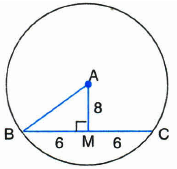
\(BM=MC=\frac { 1 }{ 2 } BC=\frac { 1 }{ 2 } (12)=6 \ cm\)
\(AB=\sqrt { AM^{ 2 }+BM^{ 2 } } =\sqrt { 8^{ 2 }+6^{ 2 } } =10\ cm\)
71.
A diameter is the largest chord. Diameter\(=2\times \)Radius.
72.
Theorem
73.
Each angle of an equilateral triangle is 60°. Equal chords subtend equal angles at the centre.
74.
Equal chords subtend equal angles at the centre.
75.
\(\Delta AOB\cong \Delta COD\)
76.
∵ \(\angle AOB=\angle COD\)
∴ AB=CD=5 cm
77.
Required angle\(=\frac { 2 }{ 12 } \times 360°=60°\)
78.
See a circle
79.
Definition of diameter
80.
(c)
circular shape
81.
(c)
circle
82.
(a)
circle

9th Standard CBSE Syllabus & Materials
9th Standard CBSE
CBSE 9th Mathematics Lines and Angles Sample Question Papers Study Material - QB365 Set A
NEW9th Standard CBSE
CBSE 9th Mathematics Introduction to Euclid's Geometry Sample Question Papers Study Material - QB365 Set A
NEW9th Standard CBSE
CBSE 9th Mathematics Linear Equations in Two Variables Sample Question Papers Study Material - QB365 Set A
NEW9th Standard CBSE
CBSE 9th Mathematics Coordinate Geometry Sample Question Papers Study Material - QB365 Set A



NCERT Books

Syllabus

Exam Pattern

Sample Question Papers

Previous year Question Papers

Important Notes

MCQ Practice test

NCERT Exemplers

Case study Questions

Image Based Questions

Passage based Questions

HOT Questions

Value Based Questions

Model Questions Papers
NCERT ( Book Back ) Questions

Assertion and Reason
Important Questions And Answers

CBSE 9th Standard CBSE Subjects
CBSE Standards