100% FREE ACCESS
9th Standard CBSE Syllabus & Materials
9th Standard CBSE
CBSE 9th Science Is matter around us pure? - New Model Questions Papers Study Material - QB365 Set A
NEW9th Standard CBSE
CBSE 9th Science Matter in our surroundings - New Model Questions Papers Study Material - QB365 Set A
NEW9th Standard CBSE
CBSE 9th Mathematics Heron's Formula Sample Question Papers Study Material - QB365 Set A
NEW9th Standard CBSE
CBSE 9th Mathematics Circles Sample Question Papers Study Material - QB365 Set A
NEW9th Standard CBSE
CBSE 9th Mathematics Quadrilaterals Sample Question Papers Study Material - QB365 Set A
NEW9th Standard CBSE
CBSE 9th Mathematics Triangles Sample Question Papers Study Material - QB365 Set A

Published on: 29/10/2025
Download CBSE Class 9th Standard CBSE Mathematics question papers, sample papers, important questions, and previous year solved papers in PDF format. Get free study materials, NCERT solutions, and exam preparation resources for Class 9th Standard CBSE Mathematics
Questions + Answers key
Take MCQ Mathematics Test
1.
In the figure, AB = AC = BC. Which of the following relations true?
AD = AC
AD < AB
AD> AB
2.
In ΔABC, if ㄥA > ㄥB > ㄥC then:
AB > AC
AC < BC
AB > BC
AC > BC
3.
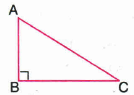
If ΔABC is right angled at B, then:
AB = AC
AC < AB
AB=BC
AC > Ab
4.
Two sides of a triangle are 12 cm and 13 cm.The length of the third side cannot be:
0.8cm
5cm
4cm
6cm
5.
The sum of the three altitudes of a triangle is the perimeter of the triangle.
greater than
equal to
half of
less than
6.
In given figure, AD = BC and ㄥBAD = ㄥABC, then ㄥACB equals:
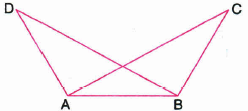
ㄥABD
ㄥBAD
ㄥBDA
ㄥBAC
7.
In the given figure, AD is the median, then ΔBAD is
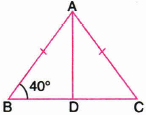 ∵
∵
550
500
1000
400
8.
In triangles ABC and DEF, AB = DE, BC = EF and ㄥA = ㄥ D. Are the triangles congruent? If yes, by which congruency rule?
yes, by SAS
No
yes, by SSS
yes, by RHS
9.
In the given figure, if AB = DC, ㄥABD = ㄥCDB, which congruence rule would you apply to prove ΔABD ≅ CDB?
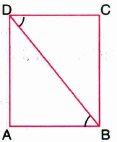
SAS
SSS
AAS
SAS
10.
Two circles are congruent.If the radius of one circle is 1cm, then the diameter of the other circle is
1 cm
2 cm
4 cm
0.5 cm
11.
A triangle has
2 verticles
3 verticles
4 verticles
5 verticles
12.
An exterior angle of a triangle is \(105^{ 0 }\) and its two interior opposite angles are equal Each of these equal angles is:
\(37\frac { 1^{ 0 } }{ 2 } \)
\(52\frac { 1^{ 0 } }{ 2 } \)
\(72\frac { 1^{ 0 } }{ 2 } \)
\(75^{ 0 }\)
13.
One of the angles of a triangle is \(75^{ 0 }\) if the difference of the other two angles is \(35^{ 0 }\) then the largest angle of the triangle has a measure of :
\(80^{ 0 }\)
\(75^{ 0 }\)
\(100^{ 0 }\)
\(135^{ 0 }\)
14.
In figure the value of x is :
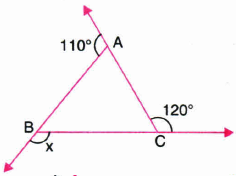
\(120^{ 0 }\)
\(130^{ 0 }\)
\(110^{ 0 }\)
\(100^{ 0 }\)
15.
In figure ,AB || CD the value of x is:
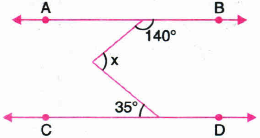
\(35^{ 0 }\)
\(40^{ 0 }\)
\(60^{ 0 }\)
\(75^{ 0 }\)
16.
In the figure \(PS\bot L\) and RQ \(\bot \)l the degree measure of y is:
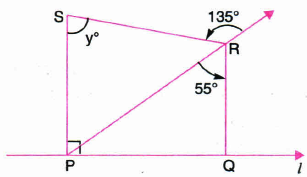
\(55^{ 0 }\)
\(90^{ 0 }\)
\(80^{ 0 }\)
\(135^{ 0 }\)
17.
A line indicates
Only one direction
two directions
no direction
None of these
18.
Two angles measure \((30-a)^{ 0 }\) and \((125+2a)^{ 0 }\) If each one is the supplement of the other then the value of a is
\(45^{ 0 }\)
\(35^{ 0 }\)
\(25^{ 0 }\)
\(65^{ 0 }\)
19.
Find the measure of the angle which is complement of itself
\(30^{ 0 }\)
\(90^{ 0 }\)
\(45^{ 0 }\)
\(180^{ 0 }\)
20.
A straight angle
is greater than \(90^{ 0 }\) but less than \(180^{ 0 }\)
is exactly equal to \(90^{ 0 }\)
measures between \(0^{ 0 }\) and \(90^{ 0 }\)
is exactly equal to \(180^{ 0 }\)
21.
An angle which is greater than \(90^{ 0 }\) and less than \(180^{ 0 }\) is called
a right angle
a straight angle
an acute angle
an obtuse angle
22.
Two angles whose sum is \(90^{ 0 }\) are called
Supplementary angles
complimentary angles
corresponding angles
alternate angles
23.
The angles whose sum is \(180^{ 0 }\) are called
supplementary angles
complementary angles
alternate angles
corresponding angles
24.
Euclid stated that things which are equal to the same thing are equal to one another in the form of:
an axiom
a definition
a postulate
a proof
25.
The number of line segments determined by three collinear points is:
two
Three
Only one
Four
26.
How many numbers of lines do pass through two distinct points?
1
2
3
4
27.
Number of dimension(s) a surface:
0
1
2
3
28.
In ancient India, the shapes of altars used for household rituals were
squares and circles
triangles and rectangles
trapeziums and phyramids
rectangles and squares
29.
In Indus Valley Civilisation (about 300 b.C), The brick used for construction work were having dimension in the ration
1 : 3 : 4
4 : 2 : 1
4 : 4 : 1
4 : 3 : 2
30.
x=4 is a line:
parallel to y=-4
parallel to x-axis
passing through origin
parallel to x=-4
31.
The graph of y=a is a straight line parallel to
x-axis
y-axis
line y=x
line x+y=0
32.
The graph of the linear equation, x-2y=0, will pass through
III and IV quadrants
I quadrant and III quadrant
II quadrant and IV quadrant
I quadrant and II quadrant
33.
The coordinates of the point where lines ax=by and ay=bx intersect are:
(1,1)
(2,-2)
(-3, 3)
(0,0)
34.
In the figure, l is the graph of the equation:
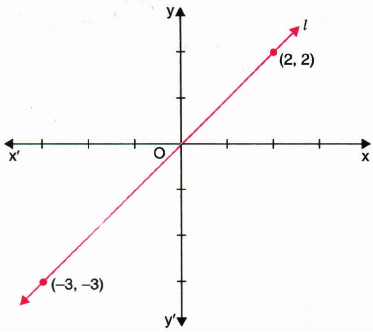
y=x
x+y=0
x=2y
y=2x
35.
The maximum number of points that lie on the graph of a linear equation in two variables is:
two
infinite
three
None of these
36.
Find the value of k if (4, 1) is a solution of 3x+2y=k
14
12
10
16
37.
If the point (4, 1) lies on the line x-ky=2, then the value of k is
1
-1
-2
2
38.
If (3, 2) is the solution of the equation 3x-ky=5, then equals:
2
4
3
\(1\over2\)
39.
The equation in 3x+4y=12 has
a unique solution
no solution
two solution
infinitely may solution
40.
The distance of the point (1,0) from O is:
0
1
2
None of these
41.
If the point A(0,2), B(0,-6) aand C(a,3) lie on y - axis, then the value of a is:
0
2
3
-6
42.
If a point is on negative side of y-axis at a distance of 3 units from origin then, the co-ordinates of the point are :
(0,3)
(0,-3)
(3,0)
(-3,0)
43.
Write the name of the quadrant in which the point (-3,-5) lies:
first quadrant
second quadrant
third quadrant
fourth quadrant
44.
In which quadrant does the point (-1,-1) lie?
I
II
III
IV
45.
In which quadrant does the point (-1,2) lie?
I
II
III
IV
46.
In which quadrant does the point (2,3) lie?
I
II
III
IV
47.
Where do the four quadrants meet?
at O
in x - axis
in y axis
do not meet
48.
The line of intersection of I and III quadrants is
x - axis
y - axis
horizontal axis
None of these
49.
If x is positive and y is negative, then the point (x,y) lies in
III quadrant
IV quadrant
II quadrant
I quadrant
50.
Assertion: Two angles measures a – 60° and 123° – 2a. If each one is opposite to equal sides of an isosceles triangle, then the value of a is 61°.
Reason: Sides opposite to equal angles of a triangle are equal.
51.
Assertion : ΔABC and ΔDBC are two isosceles triangles on the same base BC and vertices A and D are on the same side of BC. If AD is extended to intersect BC at E, then ΔABD ≅ ΔACD
Reason : If in two right triangles, hypotenuse and one side of a triangle are equal to the hypotenuse and one side of other triangle, then the two triangles are congruent.
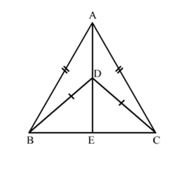
52.
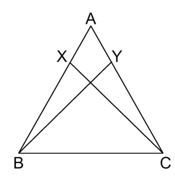
Assertion : In the adjoining figure, X and Y are respectively two points on equal
sides AB and AC of ∆ABC such that AX = AY then CX = BY.
Reason : If two sides and the included angle of one triangle are equal to two sides and the included angle of the other triangle, then the two triangles are congruent.
53.
Assertion : In ∆ABC, BC = AB and ∠B = 80°. Then, ∠A = 50°
Reason : In a triangle, angles opposite to two equal sides are equal.
54.
Assertion: The angles of a triangle are in the ratio 2 : 3 : 4. The largest angle of the triangle is 80о.
Reason: The sum of all the interior angles of a triangle is 180о.
Codes
(a) Both assertion (A) and reason (R) are true and reason (R) is the correct explanation of assertion (A).
(b) Both assertion (A) and reason (R) are true but reason (R) is not the correct explanation of assertion (A).
(c) Assertion (A) is true but reason (R) is false.
(d) Assertion (A) is false but reason (R) is true.
55.
Assertion : Sum of the pair of angles 120о and 60о is supplementary.
Reason : Two angles, the sum of whose measures is 180о, are called supplementary angles.
Codes
(a) Both assertion (A) and reason (R) are true and reason (R) is the correct explanation of assertion (A).
(b) Both assertion (A) and reason (R) are true but reason (R) is not the correct explanation of assertion (A).
(c) Assertion (A) is true but reason (R) is false.
(d) Assertion (A) is false but reason (R) is true.
56.
Assertion : If two internal opposite angles of a triangle are equal and external angle is given to be 110о, then each of the equal internal angle is 55о.
Reason : A triangle with one of its angle 90о, is called a right triangle.
Codes
(a) Both assertion (A) and reason (R) are true and reason (R) is the correct explanation of assertion (A).
(b) Both assertion (A) and reason (R) are true but reason (R) is not the correct explanation of assertion (A).
(c) Assertion (A) is true but reason (R) is false.
(d) Assertion (A) is false but reason (R) is true.
57.
Assertion : Supplement of angle is one fourth of itself. The measure of the angle is 144о.
Reason : Two angles are said to be supplementary if their sum of measure of angles is 180о.
Codes
(a) Both assertion (A) and reason (R) are true and reason (R) is the correct explanation of assertion (A).
(b) Both assertion (A) and reason (R) are true but reason (R) is not the correct explanation of assertion (A).
(c) Assertion (A) is true but reason (R) is false.
(d) Assertion (A) is false but reason (R) is true.
58.
Assertion: x + y = 3 is the equation of a line passing through the origin.
Reason: y = 2x is the equation of a line passing through the origin.
Codes:
(a) Both assertion (A) and reason (R) are true and reason (R) is the correct explanation of assertion (A).
(b) Both assertion (A) and reason (R) are true but reason (R) is not the correct explanation of assertion (A).
(c) Assertion (A) is true but reason (R) is false.
(d) Assertion (A) is false but reason (R) is true.
59.
Assertion : If x = 2k – 1 and y = k is a solution of the equation 3x – 5y – 7 = 0, then the value of k is 10
Reason : A linear equation in two variables has infinitely many solutions.
Codes:
(a) Both assertion (A) and reason (R) are true and reason (R) is the correct explanation of assertion (A).
(b) Both assertion (A) and reason (R) are true but reason (R) is not the correct explanation of assertion (A).
(c) Assertion (A) is true but reason (R) is false.
(d) Assertion (A) is false but reason (R) is true.
60.
Assertion : If x = 2, y = 1 is a solution of the equation 2x + 3y = k, then the value of k is 7.
Reason : The solution of the line will satisfy the equation of the line.
Codes:
(a) Both assertion (A) and reason (R) are true and reason (R) is the correct explanation of assertion (A).
(b) Both assertion (A) and reason (R) are true but reason (R) is not the correct explanation of assertion (A).
(c) Assertion (A) is true but reason (R) is false.
(d) Assertion (A) is false but reason (R) is true.
61.
Assertion : A linear equation 3x + 5y = 2 has a unique solution.
Reason : A linear equation in two variables has infinitely many solutions.
Codes:
(a) Both assertion (A) and reason (R) are true and reason (R) is the correct explanation of assertion (A).
(b) Both assertion (A) and reason (R) are true but reason (R) is not the correct explanation of assertion (A).
(c) Assertion (A) is true but reason (R) is false.
(d) Assertion (A) is false but reason (R) is true.
62.
Assertion: A point whose abscissa is 2 and ordinate is -3 lies in fourth quadrant
Reason: Points of the type (–, +) lie in the second quadrant.
Codes:
(a) Both assertion (A) and reason (R) are true and reason (R) is the correct explanation of assertion (A).
(b) Both assertion (A) and reason (R) are true but reason (R) is not the correct explanation of assertion (A).
(c) Assertion (A) is true but reason (R) is false.
(d) Assertion (A) is false but reason (R) is true.
63.
Assertion : The point (-2, 0) lies on y -axis and (0, 4) on x -axis.
Reason : Every point on the x -axis has zero distance from x -axis and every point on the y -axis has zero distance from y -axis.
Codes:
(a) Both assertion (A) and reason (R) are true and reason(R) is the correct explanation of assertion (A).
(b) Both assertion (A) and reason (R) are true but reason (R) is not the correct explanation of assertion (A).
(c) Assertion (A) is true but reason (R) is false.
(d) Assertion (A) is false but reason (R) is true.
64.
Assertion : The point (0, 4) lies on y -axis.
Reason : The x co-ordinate on the point on y -axis is zero.
Codes:
(a) Both assertion (A) and reason (R) are true and reason (R) is the correct explanation of assertion (A).
(b) Both assertion (A) and reason (R) are true but reason (R) is not the correct explanation of assertion (A).
(c) Assertion (A) is true but reason (R) is false.
(d) Assertion (A) is false but reason (R) is true.
65.
Assertion: The abscissa of a point (5, 2) is 5.
Reason: The perpendicular distance of a point from y-axis is called its abscissa.
Codes:
(a) Both assertion (A) and reason (R) are true and reason (R) is the correct explanation of assertion (A).
(b) Both assertion (A) and reason (R) are true but reason (R) is not the correct explanation of assertion (A).
(c) Assertion (A) is true but reason (R) is false.
(d) Assertion (A) is false but reason (R) is true.
1.
(c)
AD> AB
2.
ㄥA > ㄥB > ㄥC
BC > AC
3.
ㄥB > ㄥC
∴ AC > AB
4.
The difference of the lengths of any two sides of a triangle is always smaller than the length of the third side.Here, 13 - 12 = 1, 1> 0.8.
5.
Theorem
6.
(c)
ㄥBDA
7.
(b)
500
8.
This is Ass which is not a congruency rule.So, No
9.
(a)
SAS
10.
Two circles of the same radii are congruent
11.
(b)
3 verticles
12.
\(x^{ 0 }+x^{ 0 }=105^{ 0 }\)
\(\Rightarrow 2x^{ 0 }=105^{ 0 }\)
\(\Rightarrow x^{ 0 }=\frac { 105^{ 0 } }{ 2 } =52\frac { 1^{ 0 } }{ 2 } \)
13.
\(\angle A=75^{ 0 }\)
\(A+B+\angle C=180^{ 0 }\)
\(\Rightarrow \angle B+\angle C=105^{ 0 }\)
\(\angle B-\angle C=35^{ 0 }\)
\(\therefore \angle B=70^{ 0 },\angle C=35^{ 0 }\)
14.
\(x=(180^{ 0 }-120^{ 0 })+(180^{ 0 }-110^{ 0 })\)
15.
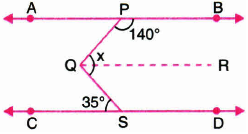
\(x=\angle PQS=\angle PQR+\angle SQR\)
\(=(180^{ 0 }-\angle QPR)+\angle CSQ\)
16.
\(\therefore PS\bot L\) and RQ \(\bot\) L
PS || PQ
\(y^{ 2 }+\angle SRQ=180^{ 0 }\)
17.
(b)
two directions
18.
\((30-a)^{ 0 }+(125+2a)^{ 0 }=180^{ 0 }\)
19.
\(\theta =90^{ 0 }-\theta \)
20.
Definition of straight angle
21.
Definition of an obuse angle
22.
Definition of complimentary angles
23.
Definition of complementary angles
24.
(a)
an axiom
25.
(b)
Three
26.
(a)
1
27.
(c)
2
28.
(a)
squares and circles
29.
(b)
4 : 2 : 1
30.
x=4 and x=-4 both are parallel to y-axis
31.
(a)
x-axis
32.
x-2y=0 ⇒ x=2y x is + or - according as y is + or -.
33.
(0,0) satisfies ax=by and ay=bx both
34.
(2,2) and (-3,-3) both satisfy y=x
35.
For each value of x, we get the corresponding value of y.
36.
3(4)+2(1)=k ⇒ k=14
37.
4-k(1)=2 ⇒ k=2
38.
3(3)-k(2)=5 ⇒ k=2
39.
(d)
infinitely may solution
40.
(b)
1
41.
(a)
0
42.
(b)
(0,-3)
43.
(c)
third quadrant
44.
(c)
III
45.
(b)
II
46.
(a)
I
47.
(a)
at O
48.
(b)
y - axis
49.
(b)
IV quadrant
50.
We know that Sides opposite to equal angles of a triangle are equal.
So, Reason is correct.
Since angles opposite to equal sides of an isosceles triangle are equal,
therefore a – 60° = 123° – 2a
⇒ 3a = 123° + 60° = 183°
⇒ a = = 61°
So, Assertion is also correct.
But reason (R) is not the correct explanation of assertion (A)
Correct option is (b) Both assertion (A) and reason (R) are true and reason (R) is not the correct explanation of assertion (A).
51.
We know that “If in two right triangles, hypotenuse and one side of a triangle are equal to the hypotenuse and one side of other triangle, then the two triangles are congruent.” – This is RHS Congruence Rule
So, Reason is correct
In ΔABD and ΔACD,
BD = CD (Given)
AB = AC (Given)
and AD = AD (Common side)
∴ By SSS congruence criteria, ΔABD ≅ ΔACD
So, Assertion is also correct.
Correct option is (b) Both assertion (A) and reason (R) are true and reason (R) is not the correct explanation of assertion (A).
52.
We know that “If two sides and the included angle of one triangle are equal to two sides and the included angle of the other triangle, then the two triangles are congruent” - This is SAS Congruence Rule.
So, Reason is correct.
In △AXC and △AYB, we have
AC = AB (Given)
AX = AY (Given)
and ∠BAC = ∠CAB (Common)
∴ △AXC ≅ △AYB (SAS criterion)
⇒ CX = BY (CPCT)
So, Assertion is also correct
Correct option is (a) Both assertion (A) and reason (R) are true and reason (R) is the correct explanation of assertion (A).
53.
We know that “In a triangle, angles opposite to two equal sides are equal.”
So, Reason is correct.
In ∆ABC, AB = BC
⇒ ∠A = ∠C (Angles opposite to equal sides)
Let ∠A = ∠C = x
Using angle sum property of a triangle,
∠A + ∠B + ∠C = 180°
⇒ x + 80°+ x = 180° ⇒ 2x = 180°− 80°
⇒ 2x = 100° ⇒ x = 50° ⇒ ∠A = 50°
So, Assertion is also correct
Correct option is (a) Both assertion (A) and reason (R) are true and reason (R) is the correct explanation of assertion (A).
54.
We know that the sum of all the interior angles of a triangle is 1800. So, Reason (R) is true.
Let the angles of a triangle be 2x, 3x and 4x then we have 2x + 3x + 4x = 180о
⇒ 9x = 180о
⇒ x = 20о.
Hence, Largest angle = 4 x 20о = 80о. So, Assertion (A) is also true.
Also, Reason (R) is a correct explanation of Assertion (A).
Correct option is (a) Both assertion (A) and reason (R) are true and reason
(R) is the correct explanation of assertion (A).
55.
We know that two angles are said to be supplementary if their sum of measure of angles is 180о.
So, Reason is correct.
Now, 120о + 60о = 180о ⇒ Sum of the pair of angles 120о and 60о is supplementary.
So, Assertion is also correct
Also, reason (R) is the correct explanation of assertion (A).
Correct option is (a) Both assertion (A) and reason (R) are true and reason (R) is the correct explanation of assertion (A).
56.
For Assertion: We know that the exterior angle is equal to the sum of its interior opposite angles. So, x + x =110о.
⇒ 2x = 110о
⇒ x = 55о
So, Assertion is correct
Also, we know that a triangle with one of its angle 90о, is called a right triangle.
So, Reason is also correct.
But reason (R) is not the correct explanation of assertion (A).
Correct option is (b) Both assertion (A) and reason (R) are true and reason (R) is not the correct explanation of assertion (A).
57.
We know that two angles are said to be supplementary if their sum of measure of angles is 180о.
So, Reason is correct.
Let the angle be x . Supplement of x = \(\frac{1}{4}\)x
So, x + \(\frac{1}{4}\)x = 180о ⇒ \(\frac{5}{4}\)x = 180о ⇒ x = 144о
So, Assertion is also correct
Also, reason (R) is the correct explanation of assertion (A).
Correct option is (a) Both assertion (A) and reason (R) are true and reason (R) is the correct explanation of assertion (A).
58.
For Assertion: The given linear equation is x + y = 3
Since x = 0 and y = 0 is not satisfying x + y = 3, therefore it is not passing through the origin.
So, Assertion is not correct.
Since x = 0 and y = 0 is not satisfying y = 2x, therefore it is passing through the origin.
So, Reason is correct.
Correct option is (d) Assertion (A) is false but reason (R) is true.
59.
We know that a linear equation in two variables has infinitely many solutions. So, Reason is correct.
Since x = 2k - 1 and y = k is solution of the given linear equation, we have 3 x (2k – 1) – 5k – 7 = 0 ⇒ 6k – 3 – 5k – 7 = 0 ⇒ k – 10 = 0 ⇒ k = 10.
So, Assertion is also correct
But reason (R) is not the correct explanation of assertion (A).
Correct option is (b) Both assertion (A) and reason (R) are true and reason (R) is not the correct explanation of assertion (A).
60.
We know that the solution of the line will satisfy the equation of the line.
So, Reason is correct.
Since x = 2, y =1 is a solution of the given linear equation, we have
2 x 2 + 3 x 1 – k = 0 ⇒ 4 + 3 – k = 0 ⇒ k =7.
So, Assertion is also correct
Correct option is (a) Both assertion (A) and reason (R) are true and reason (R) is the correct explanation of assertion (A).
61.
We know that a linear equation in two variables has infinitely many solutions.
So, Reason is correct.
Hence, Assertion is not correct
Correct option is (d) Assertion (A) is false but reason (R) is true.
62.
We know that Points of the type (–, +) lie in the second quadrant. So, Reason is correct.
Also, we know that Points of the type (+, –) lie in the fourth quadrant.
Hence, point whose abscissa is 2 and ordinate is -3 lies in fourth quadrant So, Assertion is also correct but Reason is the not the correct explanation of Assertion.
Correct option is (b) Both assertion (A) and reason (R) are true but reason (R) is not the correct explanation of assertion (A).
63.
We know that Every point on the x -axis has zero distance from x -axis and every point on the y -axis has zero distance from y -axis.
So, Reason is correct.
Now, point (-2, 0) lies on x-axis and (0, 4) on y-axis So, Assertion is not correct
Correct option is (d) Assertion (A) is false but reason (R) is true.
64.
We know that the if the point lies on y-axis, its x-coordinate is 0.
So, Reason is correct.
The x co-ordinate of the point (0, 4) is zero.
So, Point (0, 4) lies on y -axis.
So, Assertion is also correct
Correct option is (a) Both assertion (A) and reason (R) are true and reason (R) is the correct explanation of assertion (A).
65.
We know that the perpendicular distance of a point from y-axis is called its x-coordinate or abscissa.
So, Reason is correct.
The x co-ordinate of the point (5, 2) is 5.
So, Assertion is also correct
Correct option is (a) Both assertion (A) and reason (R) are true and reason (R) is the correct explanation of assertion (A).

9th Standard CBSE Syllabus & Materials
9th Standard CBSE
CBSE 9th Mathematics Lines and Angles Sample Question Papers Study Material - QB365 Set A
NEW9th Standard CBSE
CBSE 9th Mathematics Introduction to Euclid's Geometry Sample Question Papers Study Material - QB365 Set A
NEW9th Standard CBSE
CBSE 9th Mathematics Linear Equations in Two Variables Sample Question Papers Study Material - QB365 Set A
NEW9th Standard CBSE
CBSE 9th Mathematics Coordinate Geometry Sample Question Papers Study Material - QB365 Set A



NCERT Books

Syllabus

Exam Pattern

Sample Question Papers

Previous year Question Papers

Important Notes

MCQ Practice test

NCERT Exemplers

Case study Questions

Image Based Questions

Passage based Questions

HOT Questions

Value Based Questions

Model Questions Papers
NCERT ( Book Back ) Questions

Assertion and Reason
Important Questions And Answers

CBSE 9th Standard CBSE Subjects
CBSE Standards