100% FREE ACCESS
9th Standard CBSE Syllabus & Materials
9th Standard CBSE
CBSE 9th Science Is matter around us pure? - New Model Questions Papers Study Material - QB365 Set A
NEW9th Standard CBSE
CBSE 9th Science Matter in our surroundings - New Model Questions Papers Study Material - QB365 Set A
NEW9th Standard CBSE
CBSE 9th Mathematics Heron's Formula Sample Question Papers Study Material - QB365 Set A
NEW9th Standard CBSE
CBSE 9th Mathematics Circles Sample Question Papers Study Material - QB365 Set A
NEW9th Standard CBSE
CBSE 9th Mathematics Quadrilaterals Sample Question Papers Study Material - QB365 Set A
NEW9th Standard CBSE
CBSE 9th Mathematics Triangles Sample Question Papers Study Material - QB365 Set A

Published on: 29/10/2025
Download CBSE Class 9th Standard CBSE Mathematics question papers, sample papers, important questions, and previous year solved papers in PDF format. Get free study materials, NCERT solutions, and exam preparation resources for Class 9th Standard CBSE Mathematics
Questions + Answers key
Take MCQ Mathematics Test
1.
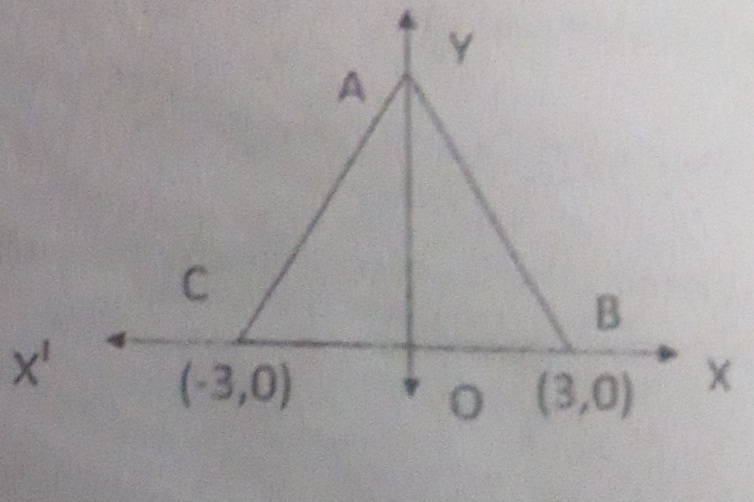
In the given figure, ABC is an equilateral triangle. The coordinates of vertices B and C are (3, 0) and (- 3, 0). respectively. Find the coordinates of its vertex A. Also, find its area.
2.
Find the image of point (- 4, 6) under
(i) X-axis
(ii) Y-axis
(iii) Origin
3.
In ΔABC, the sides AB and AC of ΔABC are produced to points E and D, respectively. If bisectors BO and CO of ㄥCBE and ㄥBCD, respectively meet at point O, then prove that ㄥBOC = 90° -\(\frac{1}{2}\) ㄥBAC.
4.
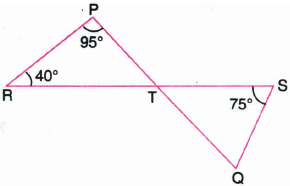
In figure if lines PQ and RS intersect at point T, such that \(\angle \) PRT=\(40^{ 0 }\) \(\angle \)RPT=\(95^{ 0 }\) and \(\angle \)TSQ=\(75^{ 0 }\) find \(\angle \)SQT
5.
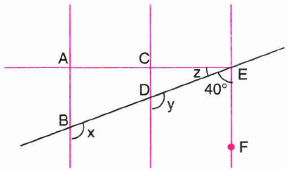
In figure AB || CD and CD || EF Also EA \(\bot \) AB if \(\angle BEF=40^{ 0 }\) , then find x,y,z
6.
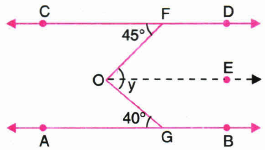
In figure if AB || CD then find the value of y.
7.
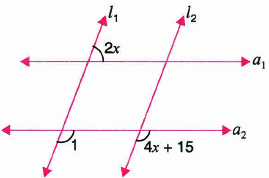
In the figure below \(l_{ 1 }||l_{ 2 }\) and \(a_{ 1 }||a_{ 2 }\) find the value of x.
8.
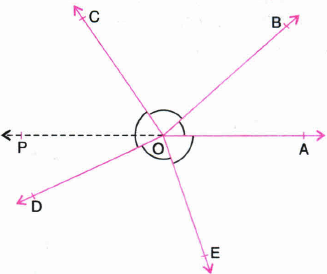
Rays OA,OB, OC,OD, and OE have the common initial point O Show the \(\angle \)AOB+\(\angle \)BOC+\(\angle \)COD+\(\angle \)DOE+\(\angle \)EOA=\(360^{ 0 }\).Draw a ray OP opposite to ray OA.
9.
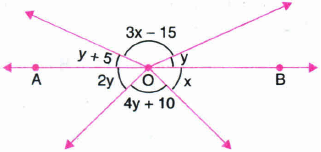
In figure, if y=\(20^{ 0 }\) , prove that the line AOB is a straight line.
10.
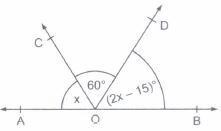
In the following figure. AOB is a straight line. Find ∠AOC and ∠BOD.
11.
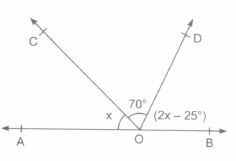
In the adjoining figure, find ∠AOC and ∠BOD.
12.
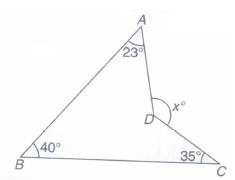
In the given figure, find the value of xo
13.
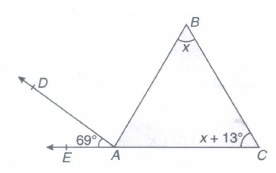
In the given figure, \(\angle CAB:\angle BAD=1:2,\) find all the internal angles of \(\triangle ABC.\)
14.
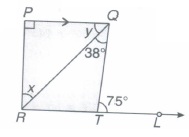
In figure, \(PQ\bot PR, QP||RL, \angle RQT=38^o\) and \(\angle QTL=75^o\). Find x and y.
15.
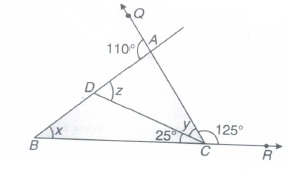
In the given figure, if \(\angle BCD=25^0,\angle BAQ=110^o\ and\ \angle ACR=125^o\), then find the values of x, y, z.
16.
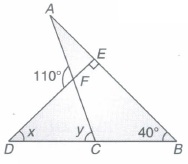
In the given figure \(DE\bot AB.\) Find the value of x and y.
17.
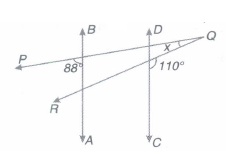
In figure, if AB||CD, then find the measure of x.
18.
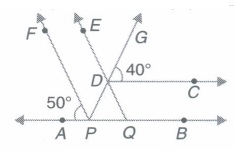
In the figure AB||CD and DE||PF. If \(\angle APF=50^o\) and \(\angle CDG=40^o.\) Find
\((i)\angle AQD\)
\((ii)\angle EDG\)
\((iii) \angle DPF\)
19.
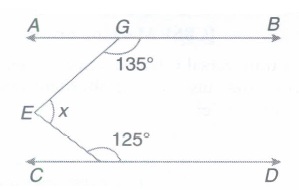
In figure, AB||CD, then find x.
20.
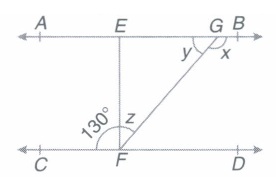
In the figure, AB||CD,\(EF\bot CD\) and \(\angle GFC=130^o\). Find x, y and z
21.
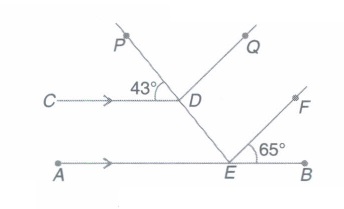
In the figure, AB||CD, EF||DQ. Determine \(\angle PDQ, \angle AED\ and \angle DEF.\)
22.
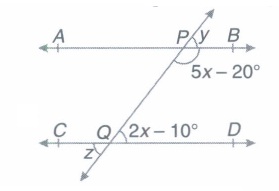
In the given figure, if AB||CD,\(\angle BPQ=(5x-20^o) and \angle PQD=(2x-10^o),\) Find the value of y and z.
1.
Since, BC = 3 + 3 = 6
\(\therefore\) Length of altitude \(OA=\frac { \sqrt { 3 } }{ 2 } \times BC=\frac { \sqrt { 3 } }{ 2 } \times 6=3\sqrt { 3 } \)
[ \(\because\) Altitude of an equilateral triangle, \(AO=\frac { \sqrt { 3 } }{ 2 } \times Side\)]
Coordinate of A are (0, \(\sqrt { 3 } \))
\(\therefore\) Area of \(\triangle ABC\) = \(\frac { 1 }{ 2 } \times BC\times AO=\frac { 1 }{ 2 } \times 6\times 3\sqrt { 3 } \)
\(=9\sqrt { 3 } \) sq units
2.
(i) (-4,- 6) (ii) (4,6) (iii) (4, - 6)
3.
Given In ΔABC, the exterior bisectors of ㄥB and ㄥC meet at point O.
To prove
ㄥBOC = 90° -\(\frac{1}{2}\)ㄥBAC
Proof Since, ㄥABC and ㄥCBE form a linear pair.
ஃ ㄥABC + ㄥCBE = 180° ... (i)
and BO is the bisector of ㄥCBE.
ஃ ㄥCBE = 2 ㄥ1
Then, from Eq. (i), we get
ㄥABC+2ㄥ1=180° ⇒ 2ㄥ1=180°-ㄥABC
⇒ ㄥ1 = 90° - \(\frac{1}{2}\) ㄥABC ...(i)
[dividing both sides by 2]
Again, ㄥACB and ㄥBCD form a linear pair.
ஃ ㄥACB + ㄥBCD = 180° ... (ii)
and CO is the bisector of ㄥBCD, therefore ㄥBCD = 2ㄥ2
Then, from Eq. (ii), we get
ㄥACB + 2ㄥ2 = 180° ⇒ 2ㄥ2 = 180° - ㄥACB
⇒ ㄥ2 = 90° - \(\frac{1}{2}\)ㄥACB ...(iii)
[dividing both sides by 2]
In ΔOBC, we have ㄥ1 + ㄥ2 + ㄥBOC = 180° ... (iv)
[since, sum of all the angles of a triangle is 180°]
From Eqs. (i), (iii) and (iv), we get
90° -\(\frac{1}{2}\) ㄥABC + 90° - \(\frac{1}{2}\) ㄥACB + ㄥBOC = 180°
⇒ 180° - \(\frac{1}{2}\) (ㄥABC + ㄥACB) + ㄥBOC = 180° ... (v)
Now, in ΔABC, we have
ㄥA + ㄥB +ㄥC =180°
[since, sum of all the angles of a triangle is 180°]
⇒ ㄥB + ㄥC = 180° - ㄥA ...(vi)
From Eqs. (v) and (vi), we get
180° -\(\frac{1}{2}\) (180° - ㄥA) + ㄥBOC = 180°
⇒ ㄥBOC = 180° -180° + \(\frac{1}{2}\) (180° -ㄥA)
⇒ ㄥBOC = \(\frac{1}{2}\) (180° - ㄥBAC)
ஃ ㄥBOC = 90° -\(\frac{1}{2}\)ㄥBAC
4.
In \(\triangle \) PRT
\(\angle PTR\angle PRT+\angle RPT=180^{ 0 }\)
The sum of all angles of a triangle is \(180^{ 0 }\)
\(\Rightarrow \angle PTR+40^{ 0 }+95^{ 0 }=180^{ 0 }\)
\(\Rightarrow \angle PTR+135^{ 0 }=180^{ 0 }\)
\(\Rightarrow \angle PTR+45^{ 0 }\)
\(\Rightarrow \angle QTS=\angle PTR=45^{ 0 }\)
|Vertically Opposite Angles
In TSQ
\(\Rightarrow \angle QTS+\angle TSQ+\angle SQT=180^{ 0 }\)
The sum of all the angles of a triangle is \(180^{ 0 }\)
\(\Rightarrow 45^{ 0 }+75^{ 0 }+\angle SQT=180^{ 0 }\)
\(\Rightarrow 120^{ 0 }+\angle SQT=180^{ 0 }\)
=\(60^{ 0 }\)
5.
\(\therefore \) CD || EF
and a transversal DE intersect them
\(\therefore y+40^{ 0 }\)=\(180^{ 0 }\)
Sum of the consecutive interior on the same side of a traversal is \(180^{ 0 }\)
\(\Rightarrow Y=180^{ 0 }-40^{ 0 }=140^{ 0 }\)
\(\therefore \) AB||CD and a traversal BD intersects them
\(\therefore \) c=y | corresponding angles
\(\Rightarrow x=140^{ 0 }\)
\(\therefore EA\quad \bot \quad AB\quad and\quad AB||EF\)
\(\therefore EA\quad \bot \quad EF\quad \)
If a line is perpendicular to a line then it is perpendicular to the parallel line also
\(\Rightarrow \angle AEF=90^{ 0 }\)
\(\Rightarrow Z+40^{ 0 }=90^{ 0 }\)
\(\Rightarrow Z+50^{ 0 }\)
6.
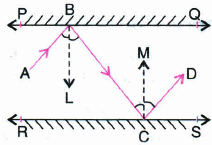
Through O draw OE || AB || CD
Now y= \(\angle FOG\)
=\(\angle \)FOE + \(\angle GOE\)
=\(\angle \)CFO+\(\angle \) AGO
=\(\angle \)FOE ==\(\angle \) CFO (Alternate Interior angles)
=\(\angle \)GOE=\(\angle \)AGO (Alternate Interior Angles)
=\(45^{ 0 }\)+\(40^{ 0 }\)=\(85^{ 0 }\)
7.
\(\angle \)1=4x+15 | Corresponding angles
2x=180-\(\angle \)1 |Corresponding angles
\(\Rightarrow \) 2x=\(180^{ 0 }\) -(4x+15)
\(\Rightarrow \) 2x=165-4x
\(\Rightarrow \) 6x=165 \(\Rightarrow \)\(x=\frac { 165 }{ 6 } =27\frac { 1^{ 0 } }{ 2 } \)
8.
Construction Draw a ray OP opposite to ray OA.
Proof : \(\angle \) AOB+\(\angle \) BOC+\(\angle \) COP+=\(180^{ 0 }\) ...(1)
| \(\because \) A straight angle = \(180^{ 0 }\)
\(\angle \)POD+ \(\angle \)DOE + \(\angle \)EOA =\(180^{ 0 }\) ....(2)
| \(\because \) a straight angle = \(180^{ 0 }\)
Adding (1) and (2) , we get
\(\angle \)AOB+ \(\angle \)BOC+\(\angle \)COP+\(\angle \)POD+\(\angle \)DOE+\(\angle \)EOA=\(180^{ 0 }+180^{ 0 }=360^{ 0 }\)
\(\Rightarrow \) \(\angle \) AOB+\(\angle \)BOC+\(\angle \)COD+\(\angle \)DOE+\(\angle \)EOA=\(360^{ 0 }\).
9.
\(\because \) Sum of all the angle round a point is equal to \(360^{ 0 }\)
\(\therefore \) y+(3x-15)+(y+15)+2y+(4y+10)+x=\(360^{ 0 }\)
\(\Rightarrow \) 4x+8y=\(360^{ 0 }\)
\(\Rightarrow \) x+2y=\(90^{ 0 }\)
\(\Rightarrow \) x+2(\(20^{ 0 }\))=\(90^{ 0 }\)
\(\Rightarrow \) x+\(40^{ 0 }\)=\(90^{ 0 }\)
\(\Rightarrow x=50^{ 0 }\)
Now, y+3x-15+y+5=3x+2y-10
= 3(\(50^{ 0 }\))+2(\(20^{ 0 }\))-10
\(=150^{ 0 }+40^{ 0 }-10^{ 0 }\)
= \(180^{ 0 }\)
\(\therefore \) AOB is straight line.
10.
Since AOB is a straight line.
∴ The sum of all the angles on the same side of AOB at a point on it is 180o.
∠AOC + ∠COD + ∠DOB = 180°
∴ x + 60° + (2x - 15)° = 180°
or 3x + 60° - 15° = 180°
or 3x = 180° - 60° + 15° = 135°
or x = \(\frac{135^{\circ}}{3}\) = 45°
Now 2x - 15 = 2(45) - 15 = 75°
or ∠AOC = 45о and ∠BOD = 75°
11.
∵ AOB is a straight line, then
∠AOC + ∠COD + ∠DOB =180°
⇒ x + 70° + (2x - 25°) = 180°
⇒ x + 2x = 180° + 25° - 70°
⇒ 3x = 205° - 70° = 135°
⇒ x = \(\frac{135^{\circ}}{3}\) = 45о
∴ ∠AOC = 45°
⇒ ∠BOD = 2x - 25° = 2(45°) - 25°
= 90° - 25° = 65°
12.
\(23^o+40^o+35^o+\angle D=360^o\) (Angle sum property of a quadrilateral)
\(\angle D=262^o\)
\(x^o=Reflex\angle D=360^o-262^0\)
=98o
13.
\(\angle EAD+\angle DAC=180^o\) (Linear pair)
\(\Rightarrow 69^o+\angle DAC=180^o\)
\(\Rightarrow \angle DAC=180^o-69^o=111^o\)
Let, \(\angle CAB=y\)
\(\angle BAD=2y \)
Then, y+2y+69=180(Adjacent angles)
3y=180-69=111
y=37o
\(\angle CAB=y=37\)
\(\angle BAD=2y=2\times 37^o=74^o\)
x+x+13o=69o+74o=143o (Exterior angles)
2x=130o
x=65o
\(\angle C=x+13^o=65^o+13^o=78^o\)
\(\angle B=x=65^o\)
Thus, \(\angle BAC=37^o\)
14.
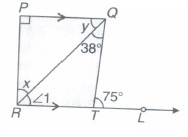
Given :
\(PQ\bot PR\)
\(PQ||RL\)
\(\angle RQT=38^o\)
\(\angle QTL=75^o\)
To find: x and y
\(\angle 1=\angle y..(1)\)
[alt. interior angles]
Now, in \(\triangle QRT\)
\(\angle QTL=\angle TQR+\angle QRT\) [by exterior property of triangles]
\(\Rightarrow 75^o=38^o+\angle 1\)
\(\Rightarrow \angle 1=37^o\)
\(\Rightarrow \angle y=37^o ....(2)\)[from eq(1)]
Now, in \(\triangle QTR\)
\(\angle QPR+\angle x+\angle y=180^o\)[by ASPT]
\(\Rightarrow 90^o+\angle x+37^o=180^o\)
\(\angle x=53^o\) [From eq(2)]
15.
y=180o-(25o+125o)(Linear pair)
\(\Rightarrow\) y=30o
y+z=110o (Exterior angle)
z=110o-30o=80o
x+25o=z (Exterior angle)
x=80o-25o=55o
16.
In \(\triangle BDE,\)
\(\angle B+\angle D+\angle DEB=180^o\)( Angle sum property of a triangle)
\(\Rightarrow\) 40o+x+90o=180o
\(\Rightarrow\)x=50o
In \(\triangle DCF,\)
\(\angle D+\angle FCD=\angle AFD\) (Exterior angle is the sum of the two interior opposite angles)
\(\Rightarrow \)50o+y=110o
y=60o
17.
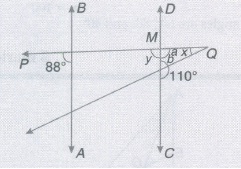
y=88o (Corresponding angles)
a=180o-88o=92o (linear pair)
b=180o-110o=70o (linear pair)
x=180o-(92+70)o (Angle sum property)
=180o-162o
=18o
18.
EQ||FP and transversal cut them
\(\therefore \angle AQD=\angle APF\) (Conresponding angles)
\(\angle AQD=50^o\)
\(\therefore \angle DQB=180^o-50^o=130^o\)
AB||CD and transversal EQ cuts them
\(\therefore \angle EDG=\angle DQB=130^o\)
\(\therefore \angle EDG=130^o-40^o=90^o\)
FP||EQ and transversal PG cut them
\(\therefore \angle FPD=\angle EDG=90^o\)
19.
Draw, EH||AB
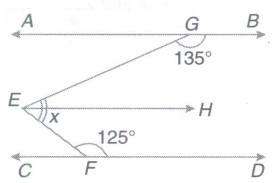
Now, EH||AB and AB||CD,
Therefore, EH||CD
Now, \(\angle BGE+\angle GEH=180^o\) (Co-interior \(\angle S)\)
(AB||EH, Co-interior angles)
\(135^o+\angle GEH=180^o\)
\(\angle GEH=180^o-135^o=45^o...(1)\)
Again, \(\angle DFE+\angle FEH=180^o\)
(CD||EH, Co-interior angles)
\(\Rightarrow 125^o+\angle FEH=180^o\)
\(\Rightarrow \angle FEH=180^o-125^o\)
=55o
Adding (1) and (2), we get
\(\angle GEH+\angle FEH=45^o+55^o\)
x=100o
20.
\(EF\bot CD\Rightarrow CFE=90^o\)
\(90^o+z=\angle CFG\)
z=130o-90o=40o
\(x=\angle CFG\) (Alt. int angles)
=130o
x+y=180o(Linear pair)
130o+y=180o
y=50o
21.
\(\angle AED=\angle CDP=43^o\)(Corres. angles)
\(\angle AED+\angle DEF+\angle BEF=180^o\)
\(\Rightarrow 43^o+\angle DEF+65^o=180^o\)
\(\Rightarrow \angle DEF=180^o-108^o=72^o\)
\(\therefore \angle PDQ=\angle DEF=72^o\) (Corres. angles)
22.
5x-20o+2x-10o=180o (Corresponding interior angles)
\(\Rightarrow\)7x=180o+30o=210o
\(\Rightarrow\)x=30o
y=180o-(5x-20o)
=180o-(150o-20o)
\(\Rightarrow\)y=180o-130o=50o
z=2x-10o
=60o-10o=50o

9th Standard CBSE Syllabus & Materials
9th Standard CBSE
CBSE 9th Mathematics Lines and Angles Sample Question Papers Study Material - QB365 Set A
NEW9th Standard CBSE
CBSE 9th Mathematics Introduction to Euclid's Geometry Sample Question Papers Study Material - QB365 Set A
NEW9th Standard CBSE
CBSE 9th Mathematics Linear Equations in Two Variables Sample Question Papers Study Material - QB365 Set A
NEW9th Standard CBSE
CBSE 9th Mathematics Coordinate Geometry Sample Question Papers Study Material - QB365 Set A



NCERT Books

Syllabus

Exam Pattern

Sample Question Papers

Previous year Question Papers

Important Notes

MCQ Practice test

NCERT Exemplers

Case study Questions

Image Based Questions

Passage based Questions

HOT Questions

Value Based Questions

Model Questions Papers
NCERT ( Book Back ) Questions

Assertion and Reason
Important Questions And Answers

CBSE 9th Standard CBSE Subjects
CBSE Standards