100% FREE ACCESS
9th Standard CBSE Syllabus & Materials
9th Standard CBSE
CBSE 9th Science Is matter around us pure? - New Model Questions Papers Study Material - QB365 Set A
NEW9th Standard CBSE
CBSE 9th Science Matter in our surroundings - New Model Questions Papers Study Material - QB365 Set A
NEW9th Standard CBSE
CBSE 9th Mathematics Heron's Formula Sample Question Papers Study Material - QB365 Set A
NEW9th Standard CBSE
CBSE 9th Mathematics Circles Sample Question Papers Study Material - QB365 Set A
NEW9th Standard CBSE
CBSE 9th Mathematics Quadrilaterals Sample Question Papers Study Material - QB365 Set A
NEW9th Standard CBSE
CBSE 9th Mathematics Triangles Sample Question Papers Study Material - QB365 Set A

Published on: 29/10/2025
Download CBSE Class 9th Standard CBSE Mathematics question papers, sample papers, important questions, and previous year solved papers in PDF format. Get free study materials, NCERT solutions, and exam preparation resources for Class 9th Standard CBSE Mathematics
Questions + Answers key
Take MCQ Mathematics Test
1.
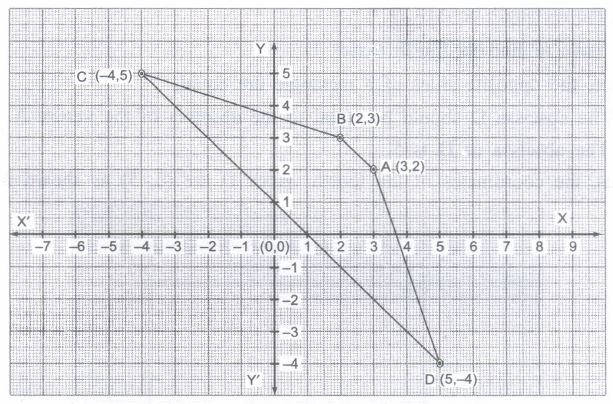
Draw a quadrilateral whose vertices are (3, 2), (2, 3), (-4, 5) and (5, -4).
2.
In which quadrants do the following points lie?
(i) (5, -3)
(ii) (-8, 4)
(iii) (-3, -6)
(iv) (5, 4)
3.
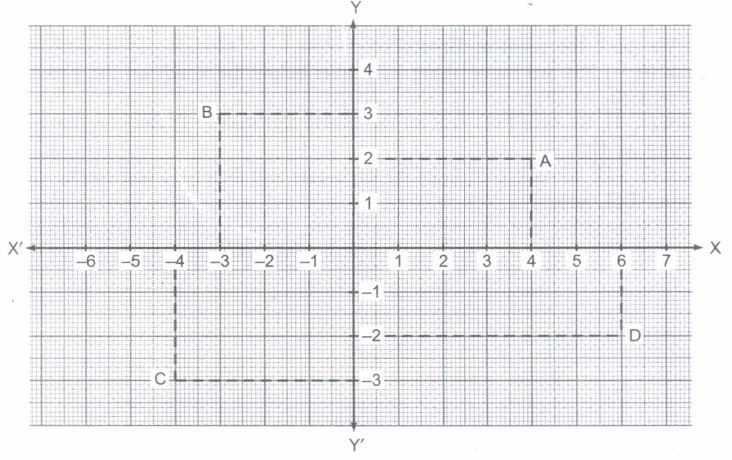
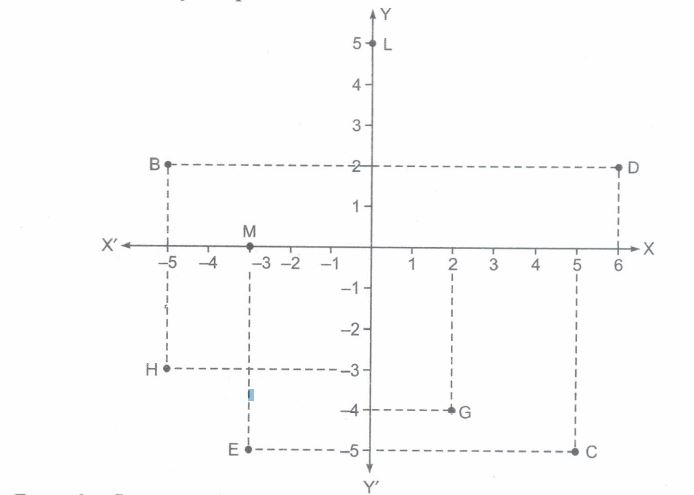
Look at the following figure and fill in the blanks:
(i) The abscissa and the ordinate of the point B are ____ and ____ respectively. Hence, the coordinates of B are (____, ____).
(ii) The x-coordinate and the y-coordiante of the point A are ____ and ____ respectively. Hence, the coordinates of A are (____, ____).
(iii) The x-coordinate and the y-coordinate of the point D are ____ and ____ respectively. Hence, the coordinates of D are (____, ____).
4.
Write the coordinates of the vertices of a rectangle, whose length and breadth are 6 units and 3 units respectively, one vertex at the origin, the longer side lies on the Y-axis and one of the vertices lies in the II quadrant. Also, find the area of the rectangle.
5.
In which quadrant or on which axis each of the following points lie?
(-3,5). (4, -1). (2, 0). (2, 2). (-3, - 6)
6.
A point lies on X-axis at a distance of 9 units from Y-axis. What are its coordinates? What will be the coordinates of a point, if it lies on Y-axis at a distance of 9 units from X-axis in negative direction?
7.
If the coordinates of two points are A(3,4) and B(-2,5), then find (Abscissa of A) - (Abscissa of B).
8.
If the coordinates of a point M are (2,9) which can also be expressed as (1 + x,y2) and y > 0, then find in which quadrant do the following points lie: P(x,y), Q(2,x), R(x2,y-1), S(2x,-3y)
9.
Locate and write the coordinates of a point:
(a) above x-axis lying on y-axis at a distance of 5 units from origin.
(b) below x-axis lying on y-axis at a distance of 3 units from origin.
(e) lying on x-axis to the right of origin at a distance of 5 units.
(d) lying on x-axis to the left of origin at a distance of 2 units.
10.
(Street Plan):A city has two main roads cross each other at the centre of the city. These two roads are along the North-South direction and East-West direction.All the other streets of the city run parallel to these roads and are 200 m apart.There are 5 streets in each direction.Using 1 cm = 200 m, draw a model of the city on your notebook.Represent the roads/streets by single line.
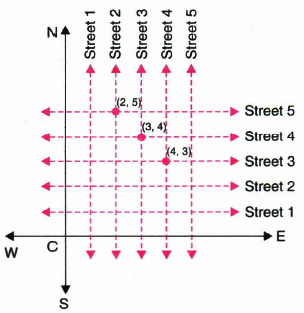
There are many cross-streets in your model.A particular cross-street is made by two streets, one running in the North-South direction and another in the East- West direction.Each cross-street is referred to in the following manner: If the 2nd street running in the North-South direction and 5th in the East-West direction meet at some crossing, then we will call this cross-street (2, 5).Using this convention, find:
(i) how many cross-streets can be referred to as (4,3)?
(ii) how many cross-streets can be referred to as (3,4)?
11.
In which quadrant does a point lie. whose both coordinates are negative?
12.
Find the distance of point 5(-3,6) from Y-axis.
13.
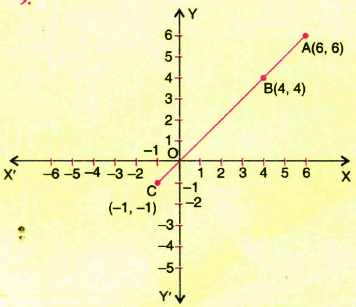
Plot the points A(6,6), B(4,4), C(-1,-1) in the Cartesian plane and show that the points are collinear.
14.
(i) Plot the points A(0,4), B(-3,0), C(0,-4), D(3,0)
(ii) Name the figure obtained by joining the points A, B, C, D.
(iii) Also, name the quadrants in which sides AB and AD lie.
15.
Plot the points A(-3,-3), B(3,-3), C(3,3), D(-3,3) in the Cartesian plane.Also, find the length of the line segment AB.
16.
Observe figure and answer the following:
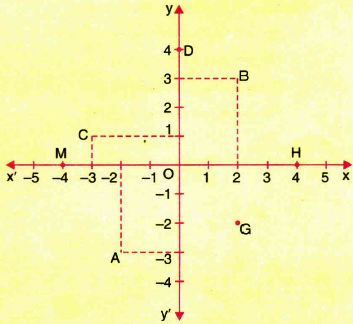
(a) coordinates of B
(b) point identified by the coordinates (-2, -3)
(c) abscissa of point D
(d) ordinate of point H
(e) points with the same abscissa
(f) points with the same ordinate
17.
The perpendicular distance of a point from the x-axis is 4 units and the perpendicular distance from the y-axis is 5 units.Write the coordinates of such a point if lies in the:
(i) I quadrant
(ii) II quadrant
(iii) III quadrant
(iv) IV quadrant
18.
Find the coordinates of the point which lies on y-axis at a distance of 4 units in negative direction of y-axis.
(a) (-4,0) (b) (4,0) (c) (0,-4) (d) (0,4)
19.
In which quadrant do the given point lie? (-4,-5)
20.
In which quadrant do the given point lie? (2,-1)
21.
In which quadrant does the point (1,-2) lie?
I
II
III
IV
22.
Abscissa of a point is positive in:
I and II quadrants
I and IV quadrants
I quadrant only
IV quadrant only
23.
In fourth quadrant, y is
-ve
+ve
0
None of these
24.
Where do the four quadrants meet?
at O
in x - axis
in y axis
do not meet
25.
Where do the I and III quadrants meet?
in x - axis
in y - axis
at O
do not intersect
26.
The line of intersection of IV and I quadrants is
x - axis
y - axis
vertical axis
None of these
27.
The line of intersection of I and III quadrants is
x - axis
y - axis
horizontal axis
None of these
28.
If x is negative and y is positive, then the point (x,y) lies in
II quadrant
III quadrant
IV quadrant
I quadrant
29.
Which of the following is an example of a geometrical line?
Black Board
Sheet of paper
Meeting place of two walls
Tip of the sharp pencil
30.
Rene Descartes was a
French mathematician
Indian mathematician
Russian mathematician
British mathematician
31.
KGB schools provide free education to girls students from weaker sections. The local body of a town want to open a KGB school in the town for which a rectangular plot ABCD, as shown in the following figure, is very suitable. But this plot belongs to Rati Ram. Rati Ram agrees to exchange it with triangular plot PQR as shown in the same figure. The co-ordinates of the vertices of both the plots are shown in the figure:
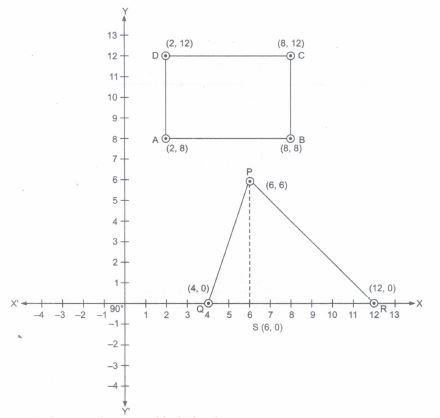
(i) Compare the areas of both the plots.
(ii) Which mathematical concept is used in the above problem?
(iii) By opening KGB school in the town, which value is depicted by the local body?
32.
See the figure given below and write the following:
(i) The co-ordinates of B.
(ii) The co-ordinates of C.
(iii) The point identified by the co-ordinates (-3, -5).
(iv) The point identified by the co-ordinates (2, -4).
(v) The abscissa of the point D.
(vi) The ordinate of the point H
(vii) The co-ordinates of the point L.
(viii) The co-ordinates of the point M.
1.
First, we draw the coordinate axes XOX' and YOY'. Now let the vertices of the required quadrilateral are A(3, 2), B(2, 3), C(-4, 5) and D(5, -4).
Therefore, plot the point A, B, C and D and join them.
We get the quadrilateral ABCD as shown in the following figure.
2.
(i) ∴ Points of type (+, -) lie in the 4th quadrant.
∴ Point (5, -3) lies in the quadrant IV.
(ii)∴ Points of the type h+) lie in the 2nd quadrant.
∴ The point (-8, 4) lies in the quadrant II.
(iii)∴ The points of the type (-, -) lie in the 3rd quadrant.
∴ The point (-3, --6) lies in the quadrant III.
(iv) ∴ The points of the type (+, +) lie in the 1st quadrant.
∴ The point (5, 4) lies in the quadrant I.
3.
(i) The abscissa and the ordinate of the point B are -3 and 3 respectively. Hence, the coordinates of B are (-3, 3).
(ii) The x-coordinate and the y-coordinate of the point A are 4 and 2 respectively. Hence the coordinates of A are (4,2).
(iii) The x-coordinate and y-coordiante of the point D are 6 and -2 respectively. Hence, the coordinates of D are (6,-2).
4.
Let us draw the coordinate axes XOX' and YOY " and choose a suitable units of distance on the axes.
Let 1 cm = 1 unit.
Mark a point A on Y-axis at a 6 units distance in positive direction of Y-axis and mark a point C on X-axis at a 3 units distance in negative direction of X-axis.
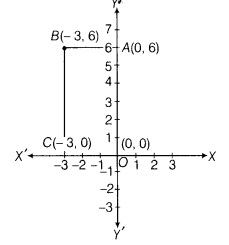
Now, draw a perpendicular lines from C and A, which meets at a point B. Thus, we get the rectangle OABC whose vertices are O(0,0), A(0, 6), B(-3, 6) and C(-3, 0), respectively.
.\(\because \) Area of the rectangle = Length x Breadth
\(\therefore \) Area of rectangle OABC = 6 x 3 = 18 sq units
5.
(i) For point (-3, 5), x-coordinate is negative and y-coordinate is positive, so it lies in II quadrant.
(ii) For point (4, -1), x-coordinate is positive and y-coordinate is negative, so it lies in IV quadrant.
(iii) For point (2, 0), x-coordinate is positive and y-coordinate is zero, so it lies on X-axis.
(iv) For point (2, 2), x-coordinate and y-coordinate both are positive, so it lies in I quadrant.
(v) For point (-3, - 6), x-coordinate and y-coordinate both are negative, so it lies in III quadrant.
6.
We know that, coordinates of any point lies on X-axis atthe distance' a' from the Y -axis are (a, 0) and (- a, 0). Since, the given point lies on X-axis at a distance of9 units from Y-axis, so its coordinates are (9, O)or (- 9, 0). Now, if point lies on Y-axis at a distance of9 units from X-axis in negative direction, then its coordinates are (0, 9) and (0, - 9).
7.
Given, Point A (3, 4) i.e. abscissa of A = 3
and Point B (- 2, 5), i.e. abscissa of B = - 2
\(\therefore\) Abscissa of A - Abscissa of B
= 3 - (-2) = 3 + 2 = 5
8.
\(P\rightarrow I\)
\(\\ Q\rightarrow I\)
\(\\ R\rightarrow I\)
\(\\ S\rightarrow IV\)
9.
(a) (0,5)
(b) (0,-3)
(c) (5,0)
(d) (-2,0)
10.
Both the cross-streets are marked in the figure given.They are uniquely found because of the two reference lines we have used for locating them.
11.
III quadrant
12.
The distance of a point 8(-3, 6) from Y-axis is equal to x-coordinate of S. i.e. 3 units.
13.
14.
(i)
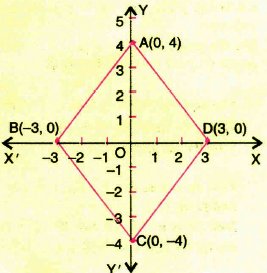
(ii) Rhombus
(iii) II, I
15.
6 Units.
16.
(a) (2,3)
(b) A
(c) 0
(d) 0
(e) M, O, D, H; B, G
(f) M, H, O
17.
(i) (5,4) (ii) (-5,4) (iii) (-5,-4) iv (5,-4)
18.
(c) (0,-4)
19.
III
20.
IV
21.
(d)
IV
22.
(b)
I and IV quadrants
23.
(a)
-ve
24.
(a)
at O
25.
(c)
at O
26.
(a)
x - axis
27.
(b)
y - axis
28.
(a)
II quadrant
29.
(c)
Meeting place of two walls
30.
(a)
French mathematician
31.
(i) For rectangle ABCD:
AB = 8 - 2 = 6 units ← Length
AD = 12 - 8 = 4 units ← Breadth
∴ Area of rectangle ABCD = AB x AD
= 6 units x 4 units
= 24 sq. units.
For triangle PQR:
QR = 12 - 4 = 8 units ← Base
SP = 6 - 0 = 6 units ← Height
∴ Area of ΔPQR = \(\frac{1}{2}\) base x height
= \(\frac{1}{2}\) x 8 x 6 sq. units
= 24 sq. units.
⇒ \(\left[\begin{array}{l} \text { area of } \\ \text { rect. } \mathrm{ABCD} \end{array}\right]=\left[\begin{array}{l} \text { area of } \\ \Delta \mathrm{PQR} \end{array}\right]\)
(ii) Co-ordinate Geometry.
(iii) Community or social upliftment.
32.
From the figure, we have
(i) The co-ordinates of B are (-5, 2).
(ii) The co-ordinates of C are (5, -5).
(iii) The point E is identified by the co-ordinates (-3, -5)
(iv) The point G is identified by the co-ordinates (2, -4).
(v) The abscissa of the point D is 6.
(vi) The ordinate of the point H is -3.
(vii) The co-ordinates of the point L are (0, 5).
(viii) The co-ordinates of the point M are (-3, 0).
Plotting a point in the plane when coordinates of the point are given
To plot a point in the coordinate plane we draw the coordinate axes and choose our units such that we can mark equal distances on the x-axis or on the y-axis or on both the axes. We take origin as zero for x-axis as well as on y-axis. The distances marked along OX and OY are taken as positive and those along OX and OY are taken as negative.

9th Standard CBSE Syllabus & Materials
9th Standard CBSE
CBSE 9th Mathematics Lines and Angles Sample Question Papers Study Material - QB365 Set A
NEW9th Standard CBSE
CBSE 9th Mathematics Introduction to Euclid's Geometry Sample Question Papers Study Material - QB365 Set A
NEW9th Standard CBSE
CBSE 9th Mathematics Linear Equations in Two Variables Sample Question Papers Study Material - QB365 Set A
NEW9th Standard CBSE
CBSE 9th Mathematics Coordinate Geometry Sample Question Papers Study Material - QB365 Set A



NCERT Books

Syllabus

Exam Pattern

Sample Question Papers

Previous year Question Papers

Important Notes

MCQ Practice test

NCERT Exemplers

Case study Questions

Image Based Questions

Passage based Questions

HOT Questions

Value Based Questions

Model Questions Papers
NCERT ( Book Back ) Questions

Assertion and Reason
Important Questions And Answers

CBSE 9th Standard CBSE Subjects
CBSE Standards