100% FREE ACCESS
9th Standard CBSE Syllabus & Materials
9th Standard CBSE
CBSE 9th Science Is matter around us pure? - New Model Questions Papers Study Material - QB365 Set A
NEW9th Standard CBSE
CBSE 9th Science Matter in our surroundings - New Model Questions Papers Study Material - QB365 Set A
NEW9th Standard CBSE
CBSE 9th Mathematics Heron's Formula Sample Question Papers Study Material - QB365 Set A
NEW9th Standard CBSE
CBSE 9th Mathematics Circles Sample Question Papers Study Material - QB365 Set A
NEW9th Standard CBSE
CBSE 9th Mathematics Quadrilaterals Sample Question Papers Study Material - QB365 Set A
NEW9th Standard CBSE
CBSE 9th Mathematics Triangles Sample Question Papers Study Material - QB365 Set A

Published on: 29/10/2025
Download CBSE Class 9th Standard CBSE Mathematics question papers, sample papers, important questions, and previous year solved papers in PDF format. Get free study materials, NCERT solutions, and exam preparation resources for Class 9th Standard CBSE Mathematics
Questions + Answers key
Take MCQ Mathematics Test
1.
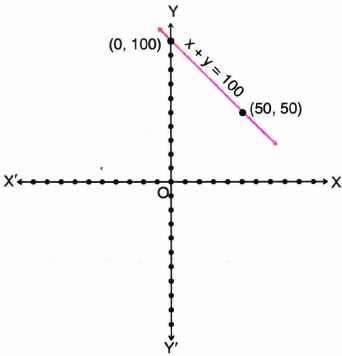
Yamini and Fatima, two students of Class IX of a school, together contributed Rs.100 towards the Prime Minister's Relief Fund to help the earthquake victims.Write a linear equation which satisfies this data. (You may take their contributions as Rs.x and Rs.y) Draw the graph of the same.
2.
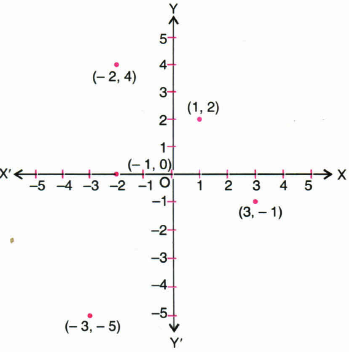
In which quadrant or on which axis do each of the points (-2,4), (3,-1), (-1,0), (1,2) and (-3,-5) lie?Verify your answer by locating them on the Cartesian plane.
3.
Which of the following expressions are polynomials in one variable and which are not? State reasons for your answer.
\({ 4x }^{ 2 }-3x+7\)
4.
Is zero a rational number?can you write it in the form \(\frac { p }{ q } \),where p and q are integers and \(q\neq 0\)?
5.
Given the point (1, 2), can you give the equation of a line on which it lies? How many such equations are there?
6.
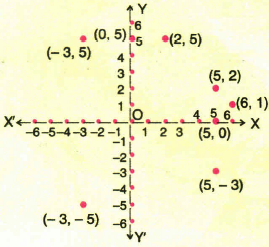
Locate the points (5,0), (0,5), (2,5), (5,2), (-3,5), (-3,-5),(5,-3) and (6,1) in the Cartesian plane.
7.
Chech whether -2 and 2 are zeroes of the polynomial x+2.
8.
Rationalize the denominator of \(\frac { 1 }{ \sqrt { 2 } } \)
9.
Add \(2\sqrt { 2 } +5\sqrt { 3 } \sqrt { 2 } -3\sqrt { 3 } \)
10.
Write a, b, c for the equation 2x=5
2, 0, -5
0,2,-5
0,0,-5
2,0,5
11.
\(\sqrt{2}y+ \sqrt{3}=0\) is
a linear equation in one variable
not a linear equation in one variable
a linear equation in two variables
none of these
12.
Which of the following is an example of a geometrical line?
Black Board
Sheet of paper
Meeting place of two walls
Tip of the sharp pencil
13.
Rene Descartes belonged to
15th Century
16th Century
17th Century
18th Century
14.
Select the correct statement from the following:
Degree of a zero polynomial is zero.
Degree of a zero polynomial is not defined.
Degree of a constant polynomial is not defined
Zero of the polynomial is not defined
15.
Which of the following is an algebraic identity?
\((x+y)^2=x^2+2xy+y^2\) is an algebraic identity
\((x+y)^2=x^2-2xy+y^2\)
\((x+y)^2=x^2+2xy-y^2\)
\((x+y)^2=x^2+2xy+y^2\)
\((x+y)^2=-x^2+2xy+y^2\)
16.
A rational number lying between -3 and 3 is:
0
-4.3
-3.4
1.101 1001 10001...
17.
Which of the following is a rational number?
\(1+\sqrt { 3 } \)
\(\pi \)
\(2\sqrt { 3 } \)
0
18.
Factorise:
(i) 4x2 + 9y2 + 16z2 + 12xy - 24yz - 16xz
(ii) 2x2 + y2+ 8z2 - 2 \(\sqrt{2}\)xy + 4\(\sqrt{2}\) yz - 8xz
19.
Write four solutions for each of the following equations:
(i) 2x + y = 7
(ii) πx + y = 9
(iii) x = 4y
20.
A city has two main roads which cross each other at the centre of the city. These two roads are along the North-South direction and East-West direction.
All the other streets of the city run parallel to these roads and are 200 m apart. There are 5 streets in each direction.
Using 1cm = 200 m, draw a model of the city on your notebook. Represent the roads/streets by single lines. There are many cross-streets in your model. A particular cross-street is made by two streets, one running in the North-South direction and another in the East-West direction. Each cross-street is referred to in the following manner:
If the 2nd street running in the North-South direction and 5th in the East-West direction meet at some crossing, then we will call this cross-street (2, 5).
Using this convention, find
(i) how many cross-streets can be referred to as (4,3)?
(ii) how many cross-streets can be referred to as (3,4) ?
21.
Rationalise the denominators of the following:
(i) \(\frac { 1 }{ \sqrt { 7 } } \)
(ii) \(\frac { 1 }{ \sqrt { 7 } -\sqrt { 6 } } \)
(iii) \(\frac { 1 }{ \sqrt { 5 } +\sqrt { 2 } } \)
(iv) \(\frac { 1 }{ \sqrt { 7 } -2 } \)
1.
Let the contributions ofYarnini and Fatima be Rs.x and Rs.y respectively.
Then according to the question
x + y = 100
This is the linear equation which the given data satisfies.
Now, x + y = 100
⇒ y = 100-x
Table of solution
| X | 0 | 50 |
|---|---|---|
| Y | 100 | 50 |
We plot the points (0, 100) and (50, 50) on the graph paper and join the same by a ruler to get the line which is the graph of the equation x + y = 100.
2.
(i) The point (-2,4) lies in the II quadrant.
(ii) The point (3, -1) lies in the IV quadrant.
(iii) The point (- 1,0) lies on the negative x-axis.
(iv) The point (1, 2) lies in the I quadrant.
(v) The point (- 3, - 5) lies in the Ill quadrant.
3.
This expression is a polynomial in one variable x because in the expression there is only one variable (x) and all the indices of x are whole numbers.
4.
Yes! zero is a rational number.We can write zero in the form \(\frac { p }{ q } \),where p and q are integers and \(q\neq 0\)as follows:
\(0=\frac { 0 }{ 1 } =\frac { 0 }{ 2 } =\frac { 0 }{ 3 } \)etc.
5.
Here (1, 2) is a solution of a linear equation you are looking for. So, you are looking for any line passing through the point (1, 2). One example of such a linear equation is x + y = 3. Others are y – x = 1, y = 2x, since they are also satisfied by the coordinates of the point (1, 2). In fact, there are infinitely many linear equations which are satisfied by the coordinates of the point (1, 2).
6.
7.
Let p(x) = x + 2.
Then p(2) = 2 + 2 = 4, p(–2) = –2 + 2 = 0
Therefore, –2 is a zero of the polynomial x + 2, but 2 is not.
8.
We want to write \(\frac { 1 }{ \sqrt { 2 } } \)as an equivalent expression in which the denominator is a rational number. We know that \(\sqrt{2} \cdot \sqrt{2} \) is rational. We also know that multiplying \(\frac{1}{\sqrt{2}} \text { by } \frac{\sqrt{2}}{\sqrt{2}}\) will give us an equivalent expression, since \(\frac{\sqrt{2}}{\sqrt{2}}=1\) . So, we put these two facts together to get
\(\frac{1}{\sqrt{2}}=\frac{1}{\sqrt{2}} \times \frac{\sqrt{2}}{\sqrt{2}}=\frac{\sqrt{2}}{2}\)
In this form, it is easy to locate \(\frac{1}{\sqrt{2}}\) on the number line. It is half way between 0 and \(\sqrt{2} \text {. }\)
9.
\((2 \sqrt{2}+5 \sqrt{3})+(\sqrt{2}-3 \sqrt{3})=(2 \sqrt{2}+\sqrt{2})+(5 \sqrt{3}-3 \sqrt{3})\)
\(=(2+1) \sqrt{2}+(5-3) \sqrt{3}=3 \sqrt{2}+2 \sqrt{3}\)
10.
2x+0y-5=0
11.
(a)
a linear equation in one variable
12.
(c)
Meeting place of two walls
13.
(c)
17th Century
14.
Convention
15.
(c)
\((x+y)^2=x^2+2xy+y^2\)
16.
(a)
0
17.
(d)
0
18.
(i) 4x2 + 9y2 + 16z2 + 12xy - 24yz - 16xz
= (2x)2 + (3y)2 + (-4z)2 + 2(2x)(3y) + 2(3y)(-4z) + 2(-4z)(2x)
= (2x + 3y - 4z)2 [Using Identity V]
= (2x + 3y - 4z)(2x + 3y - 4z)
(ii) 2x2 + y2+ 8z2 - 2 \(\sqrt{2}\)xy + 4\(\sqrt{2}\) yz - 8xz
= (-2 \(\sqrt{2}\)x)2 + (y)2 + (2\(\sqrt{2}\)z)2 + 2 (-\(\sqrt{2}\)x)(y) + 2 (2\(\sqrt{2}\)z)(y) + 2 (2\(\sqrt{2}\)z) (-\(\sqrt{2}\)x)
= (-\(\sqrt{2}\)x + y + 2 \(\sqrt{2}\))2
= (-\(\sqrt{2}\)x + y + 2\(\sqrt{2}\)z)( -\(\sqrt{2}\)x + y + 2\(\sqrt{2}\)z)
19.
(i) 2x + y = 7
When x = 0, 2(0) + y = 7
⇒ 0+ y = 7
⇒ y = 7
∴ Solution is (0, 7).
When x = 1, 2(1) + y = 7
⇒ y = 7 - 2
⇒ y = 5
∴ Solution is (1, 5).
When x = 2, 2(2) + y = 7
⇒ y = 7 - 4
⇒ y = 3
∴ Solution is (2, 3).
When x = 3, 2(3) + y = 7
⇒ y = 7 - 6
⇒ y = 1
∴ Solution is (3, 1).
(ii) πx + y = 9
When x = 0, π(0) + y = 9
⇒ y = 9 - 0
⇒ y = 9
∴ Solution is (0, 9).
When x = 1, π(1) + y = 9
⇒ y =9-π
∴ Solution is {1, (9 - π)}.
When x = 2, π(2) + y = 9
⇒ y = 9 - 2π
∴ Solution is {2, (9 - 2π)}.
When x = -1, π(-1) + y = 9
⇒ -π+ y = 9
⇒ y=9+π
∴ Solution is {-1, (9 + π)}.
(iii) x = 4y
When x = 0, 4y = 0
⇒ y = 0
∴ Solution is (0, 0).
When x = 1, 4y = 1
⇒ y= \(\frac{1}{4}\)
∴ Solution is (1,\(\frac{1}{4}\)).
When x = 4, 4y = 4
⇒ y = \(\frac{4}{4}\) = 1
∴ Solution is (4, 1).
When x =-4, 4y =-4
y = \(\frac{-4}{4}\) =-1
∴ Solution is (-4, -1).
20.
Let EW and NS be two main roads such that the road EW is along the East-West direction and road NS is along the North-South direction. Then, the angle between the two roads is 90°, i.e. the roads EW and NS are perpendicular to each other.
Let us consider EW along X-axis and NS along Y-axis and let the center of ciry is 0
Here, the distance be in two consecutive streets in same direction is 200 m and all the streets are parallel to the main
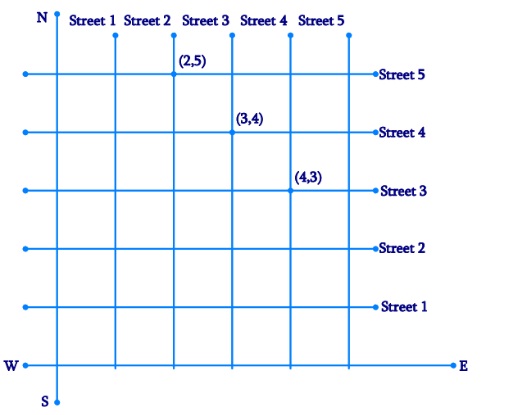
The street plan is shown in the above figure:
(i) Because of the two reference lines that we have used for locating them, there is only one cross-street which can be referred to as (4, 3).
(ii) Similarly, there is only one cross-street which can be referred to as (3, 4).
21.
(i) We have, \(\frac { 1 }{ \sqrt { 7 } } \)
On multiplying both numerator and denominator by \(\sqrt { 7 } \) , we get
\(\frac { 1 }{ \sqrt { 7 } } \times \frac { \sqrt { 7 } }{ \sqrt { 7 } } =\frac { \sqrt { 7 } }{ 7 } \)
(ii) We have,\(\frac { 1 }{ \sqrt { 7 } -\sqrt { 6 } } \)
On multiplying both numerator and denominator by \(\sqrt { 7 } +\sqrt { 6 } ,\) we get
\(\frac { 1 }{ \sqrt { 7 } -\sqrt { 6 } } \times \frac { \left( \sqrt { 7 } +\sqrt { 6 } \right) }{ \left( \sqrt { 7 } +\sqrt { 6 } \right) } \)
\(=\frac { \sqrt { 7 } +\sqrt { 6 } }{ { \left( \sqrt { 7 } \right) }^{ 2 }-{ \left( \sqrt { 6 } \right) }^{ 2 } } [\because (a-b)(a+b)={ a }^{ 2 }-{ b }^{ 2 }]\)
\(=\frac { \sqrt { 7 } +\sqrt { 6 } }{ 7-6 } =\frac { \sqrt { 7 } +\sqrt { 6 } }{ 1 } \)
\(=\sqrt { 7 } +\sqrt { 6 } \)
(iii) \(\left[ \frac { \sqrt { 5 } -\sqrt { 2 } }{ 3 } \right] \)
(iv) \(\left[ \frac { \sqrt { 7 } +1 }{ 3 } \right] \)

9th Standard CBSE Syllabus & Materials
9th Standard CBSE
CBSE 9th Mathematics Lines and Angles Sample Question Papers Study Material - QB365 Set A
NEW9th Standard CBSE
CBSE 9th Mathematics Introduction to Euclid's Geometry Sample Question Papers Study Material - QB365 Set A
NEW9th Standard CBSE
CBSE 9th Mathematics Linear Equations in Two Variables Sample Question Papers Study Material - QB365 Set A
NEW9th Standard CBSE
CBSE 9th Mathematics Coordinate Geometry Sample Question Papers Study Material - QB365 Set A



NCERT Books

Syllabus

Exam Pattern

Sample Question Papers

Previous year Question Papers

Important Notes

MCQ Practice test

NCERT Exemplers

Case study Questions

Image Based Questions

Passage based Questions

HOT Questions

Value Based Questions

Model Questions Papers
NCERT ( Book Back ) Questions

Assertion and Reason
Important Questions And Answers

CBSE 9th Standard CBSE Subjects
CBSE Standards