100% FREE ACCESS
9th Standard CBSE Syllabus & Materials
9th Standard CBSE
CBSE 9th Science Is matter around us pure? - New Model Questions Papers Study Material - QB365 Set A
NEW9th Standard CBSE
CBSE 9th Science Matter in our surroundings - New Model Questions Papers Study Material - QB365 Set A
NEW9th Standard CBSE
CBSE 9th Mathematics Heron's Formula Sample Question Papers Study Material - QB365 Set A
NEW9th Standard CBSE
CBSE 9th Mathematics Circles Sample Question Papers Study Material - QB365 Set A
NEW9th Standard CBSE
CBSE 9th Mathematics Quadrilaterals Sample Question Papers Study Material - QB365 Set A
NEW9th Standard CBSE
CBSE 9th Mathematics Triangles Sample Question Papers Study Material - QB365 Set A

Published on: 29/10/2025
Download CBSE Class 9th Standard CBSE Mathematics question papers, sample papers, important questions, and previous year solved papers in PDF format. Get free study materials, NCERT solutions, and exam preparation resources for Class 9th Standard CBSE Mathematics
Questions + Answers key
Take MCQ Mathematics Test
1.
Prove that" equal chords of a circle subtend equal angles at the centres."
2.
State any two Euclid's axioms.
3.
Find three solutions of linear equation 7x-5y=35 in two variables.
4.
The blood group of 30 students are recorded as follows:
| A, | B, | O, | A, | AB, | O, |
| A | O, | B, | A, | O, | B, |
| A | AB, | B, | A, | AB, | B, |
| A, | A, | O, | A, | AB, | B, |
| A, | O, | B, | A, | B, | A |
Prepare a freqeuncy distribution table for the data.
5.
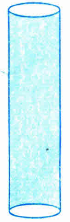
The diameter of a circular wall is 4.5 m and its depths is 14 m.Find the cost of cementing the inner surface of the wall at Rs. 120 per sq. m.
6.
The unequal side of an isosceles triangle is 6 cm and its perimeter is 24 cm. Find its area.
7.
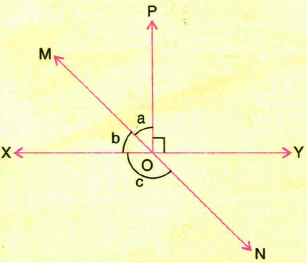
In the figure lines XY and MN Intersect at O if POY = \(90^{ 0 }\) and a:b =3 find the value of c
8.
Find an irrational number between 1/7 and 2/7.
9.
Two coins are tossed simultaneously 1000 times and we get
Two heads: 200 times
One head: 600 times
No head: 200 times
Find the probability of getting 1 head is
\(\frac { 1 }{ 5 } \)
\(\frac { 2 }{ 5 } \)
\(\frac { 3 }{ 5 } \)
\(\frac { 4 }{ 5 } \)
10.
The upper limit of the class 36 - 40 is
36
38
40
41.
11.
Which of the following is a solid figure?
Circle
Cylinder
Square
Rectangle.
12.
Area of a triangle is 60 cm2.Its base is 15 cm.Its altitude is
30 cm
4 cm
8 cm
10 cm
13.
The perpendicular from the centre of a circle bisects the:
circle
circumference
chord
radius.
14.
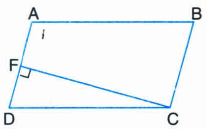
In the figure, ABCD is a parallelogram of area 128 cm2 . If CF = 16 cm, the length of AD is
8 cm
4 cm
16 cm
10 cm
15.
If a pair of opposite sides of a quadrilateral is equal and parallel, then the quadrilateral is a
parallelogram
rectangle
rhombus
square
16.
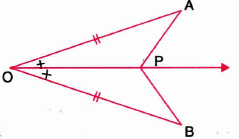
Given ΔOAP ≌ ΔOBP in figure, the criteria by which the triangles are congruent:
SAS
SSS
RHS
ASA
17.
Find the measure of the angle which is supplement of itself
\(30^{ 0 }\)
\(90^{ 0 }\)
\(45^{ 0 }\)
\(180^{ 0 }\)
18.
Which of the following statement is incorrect?
A line segment has defined length
Three line are concurrent id and only if they have a common point
two lines drawn in a plane always intersected at a point
One and only one line can be drawn passing through a given point parallel to a given line
19.
The things which are double of same thing are:
equal
halves of same thing
unequal
double of the same thing
20.
Write a, b, c for the equation 2x=5
2, 0, -5
0,2,-5
0,0,-5
2,0,5
21.
In which quadrant does the point (-1,2) lie?
I
II
III
IV
22.
In fourth quadrant, x is
+ve
-ve
0
None of these
23.
Which of the following is cubic polynomial?
\(x^3+3x^2-4x+3\)
\(x^2+4x-7\)
\(3x^2+4\)
\(3(x^2+x+1)\)
24.
Which of the following numbers is an irrational number?
\(\sqrt { 23 } \)
\(\sqrt { 225 } \)
0.3796
\(7.\overline { 478 } \)
25.
Construct a triangle PQR in which QR = 6 cm,ㄥQ = 60o and PR - PQ = 2 cm
26.
Show how √5 can be represented on the number line.
27.
A metal pipe is 77 cm long. The inner diameter of a cross section is 4 cm, the outer diameter being 4.4 cm. Find its.
(i) inner curved surface area,
(ii) outer curved surface area,
(iii) total surface area.
28.
The sides of a triangle are in the ratio of 25: 17: 12 and its perimeter is 1080 cm. Find its area.
29.
Find the value of k if x=2, y=1 is a solution of the equations 2x+3y=k and 3x+y=k
30.
If \(x+y+z=0\) show that \(x^3+y^3+z^3=3xyz.\)
31.
A cone of height 24 cm has a curved surface area 550 cm2. Find us volume.
32.
AD and BC are equal perpendiculars to a line segment AB (see figure).
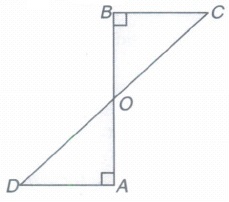
(i) Show that CD bisects AB.
(ii) Which mathematical concept is used in this problem?
(iii) What is its value?
33.
The % of marks obtained by students in the annual examination of a class in mathematics are given below:
| Percentage of marks | No. of students |
|---|---|
| 0-10 | 8 |
| 10-30 | 32 |
| 30-45 | 18 |
| 45-50 | 10 |
(i) How many students get less than 30% of marks?
(ii) Represent the data by histogram.
(iii) Which value is depicted by a student Ram obtaining the highest marks in the interval 45-50?
1.
Given AB and CD are the chords of a circle with centre at O such that AB = CD
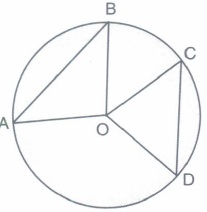
To Prove: \(\angle\)AOB = \(\angle\)COD
Proof: In \(\Delta\)AOB and \(\Delta\)COD
AO = CO (radii of same circle)
AB = CD (given)
BO = DO (radii of same circle)
\(\Delta\)AOB\(\cong \) \(\Delta\)COD (SSS)
\(\angle\)AOB = \(\angle\)COD (c.p.c.t.) 2 Hence Proved.
2.
Euclid's axioms
(i) Things which are equal to the same thing are equal to one another.
(ii) If equals are added to equals, the wholes are equal.
3.
So, when \(y=\frac{7x-35}{5}\)
| x | 5 | 0 | 10 |
| y | 0 | -7 | 7 |
4.
| O | 6 |
| A | 12 |
| B | 8 |
| AB | 4 |
5.
Rs. 23760
6.
\(18\sqrt { 2 } \)cm2
7.
c=\(126^{ 0 }\)
8.
\(\frac{1}{7}=0.142857142857 \ldots=0 . \overline{142857}\) and \(\frac{2}{7}=0.28571428571428 \ldots=0 . \overline{285714}\)
Here, the two decimal expansions are non-terminating recurring.
Hence, 1/7 and 2/7 are two rational numbers.
We know, between any two rational numbers, there are infinitely many irrational numbers.
An irrational number has non-terminating non-recurring decimal expansions.
Then an irrational number between \(\frac{1}{7} \text { and } \frac{2}{7}\) is 0.15015001500015.
Similarly, 0.21020020002... is another irrational number between \(\frac{1}{7} \text { and } \frac{2}{7}\)
9.
Required probability=\(\frac { 600 }{ 1000 } =\frac { 3 }{ 5 } \)
10.
(c)
40
11.
(b)
Cylinder
12.
(c)
8 cm
13.
Theorem
14.
(a)
8 cm
15.
Theorem
16.
(a)
SAS
17.
X=\(180^{ 0 }\)-x\(\Rightarrow \)x\(90^{ 0 }\)
18.
(c)
two lines drawn in a plane always intersected at a point
19.
(a)
equal
20.
2x+0y-5=0
21.
(b)
II
22.
(a)
+ve
23.
Degree of \(x^3+3x^2-4x+3\) is 3
24.
(a)
\(\sqrt { 23 } \)
25.
Steps of construction:
i) Draw a line segment QR = 6cm.At point Q construct an angle = 60o i.e ㄥXQR = 60o
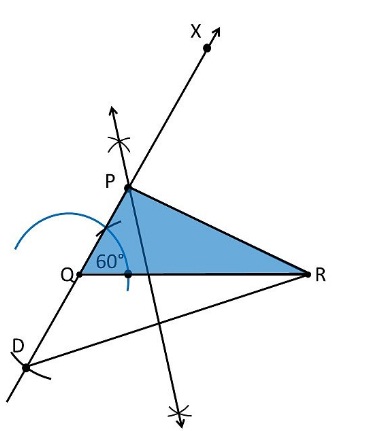
ii) Cut a line segment QS = 2 cm from the line segment QT extended on opposite side of line segment XQ.
(As PR > PQ and PR - PQ = 2cm) join SR
iii) Draw perpendicular bisector AB of line segment SR,which intersects QX at point P.Join PQ,PR. ΔPQR is the required triangle.
26.
We know that \(\sqrt{5}=\sqrt{4+1}=\sqrt{2^{2}+1^{2}}\)
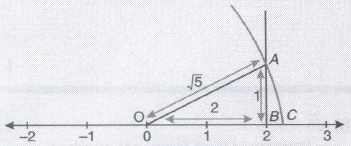
Draw a right angled ∆OBA, such that
OB = 2 units, AB = 1unit and ∠OBA = 90°
Now, by using Pythagoras theorem, we have
OA2 = OB2 + AB2 = 22 +12
⇒ OA = \(\sqrt{4+1}=\sqrt{5}\)
Now, take O as centre, OA =√5 as radius, draw an arc which intersects the line at point C.
Hence, the point C represents √5.
27.
h = 77 cm
2r = 4 cm
r = 2 cm
2R = 4.4 cm
R = 2.2 cm
(i) Inner curved surface area \(=2\pi rh\)
\(=2\times \frac { 22 }{ 7 } \times 2\times 77=968{ cm }^{ 2 }\)
(ii) Outer curved surface area =
\(=2\times \frac { 22 }{ 7 } \times 2.2\times 77=1064.8{ cm }^{ 2 }\)
(iii) Total surface area
\(=2\pi Rh+2\pi rh+2\pi \left( { R }^{ 2 }-{ r }^{ 2 } \right) \)
\(\\ =1064.8+2\times \frac { 22 }{ 7 } \times 2\times 77+2\times \frac { 22 }{ 7 } \times \left\{ { \left( 2.2 \right) }^{ 2 }-{ \left( 2 \right) }^{ 2 } \right\} \)
\(\\ =1064.8+968+2\times \frac { 22 }{ 7 } \times \left( 4.84-4 \right) \)
\(\\ =1064.8+968+2\times \frac { 22 }{ 7 } \times 0.84\)
\(\\ =1064.8+968+5.28=2038.08{ cm }^{ 2 }.\)
28.
36000 cm2
29.
k=7
30.
We know that
\(x^3+y^3+z^3=3xyz\)
\(=(x+y+z)(x^2+y^2+z^2-xy-yz-zx)\) Using Identify VII
\(=(0)(x^2+y^2+z^2-xy-yz-zx)\) \(\because x+y+z=0\)
= 0
\(\Rightarrow x^3+y^3+z^3=3xyz\)
31.
Height of the cone(h) = 24 cm
Let r cm be the radius of the base and l cm an can be the slant height of the cone, then
\(l=\sqrt { { r }^{ 2 }+{ h }^{ 2 } } \)
\(=\sqrt { { r }^{ 2 }+{ 24 }^{ 2 } } \)
\(=\sqrt { { r }^{ 2 }+576 } \)
Now, curved surface area=\(\pi\)rl
\(\Rightarrow \ \frac { 22 }{ 7 } \times r\times \sqrt { { r }^{ 2 }+576 } =550\)
\(\Rightarrow \ r\sqrt { { r }^{ 2 }+576 } =550\times \frac { 7 }{ 22 } \)
\(\Rightarrow \ r\sqrt { { r }^{ 2 }+576 } =175\)
Squaring both the sides we get
r2 (r2 + 576) = 30625
(r2)2 + 576r2-30625 = 0
Let r2 = x
x2 + 576x - 30625 = 0
\(\Rightarrow\) x2 + 625x - 49x - 30625 = 0
\(\Rightarrow\) x(x + 625)- 49(x + 625) = 0
\(\Rightarrow\) (x + 625)(x - 49) = 0
\(\Rightarrow\) x + 625=0 or x - 49 = 0
\(\Rightarrow\) x = 625 or x = 49
not possible x = 49
\(\therefore\) r2= 49
\(\Rightarrow\) r = 7 cm
Volume & the cone = \(\frac { 1 }{ 3 } \pi { r }^{ 2 }h\)
\(=\frac { 1 }{ 3 } \times \frac { 22 }{ 7 } \times { 7 }^{ 2 }+24\)
= 1232 cm3.
32.
(i) AB and CD intersect atO0
\(\therefore\) \(\angle\)AOD = \(\angle\)BOC
(Vertically opp. angles) ...(i)
In \(\triangle\)AOD and \(\triangle\)BOC, we have
\(\angle\)AOD = \(\angle\)BOC ...(ii)
\(\angle\)DAO = \(\angle\)CBO = 90° (Given)
and AD = BC (Given)
\(\triangle AOD\cong \triangle BOC\)
(By AAS congruence criterion)
\(\Rightarrow\) OA = OB (By c.p.c.t.)
i.e., O is the mid-point of AB
Hence, CD bisects AB.
(ii) Congruency of triangles.
(iii) Equality is the sign of democracy.
33.
(i) Required number of students = 8 + 32 = 40
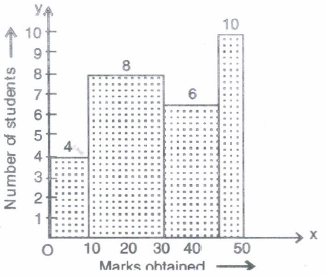
(ii) Here, We notice that classes are continuous but class-size is not the same for all the classes. We notice minimum class-size is of class 45-50, i.e., 5. We will first find proportionate length of rectangle (adjusted frequency) for each class.
Length of rectangle (adjusted frequency) =\(\frac { Frequency\ of\ Class }{ Width\ of\ class } \times Minimum\ class-size\)
| Marks (C.I.) |
Number of students(f) | Width of class (Clss-size) |
Length of rectangle |
|---|---|---|---|
| 0-10 | 8 | 10 | \(\frac{8}{10}\)x 5 = 4 |
| 10-30 | 32 | 20 | \(\frac{32}{20}\) x 5 = 8 |
| 30-45 | 18 | 15 | \(\frac{18}{15}\) x 5 = 6 |
| 45-50 | 10 | 5 | \(\frac{10}{5}\) x 5 = 10 |
Now, we construct rectangles with respective class-intervals as widths and adjusted frequencies as heights.
Histogram representing marks obtained by students in unit test of Mathematics.
(iii) Hardwork and Dilligence.

9th Standard CBSE Syllabus & Materials
9th Standard CBSE
CBSE 9th Mathematics Lines and Angles Sample Question Papers Study Material - QB365 Set A
NEW9th Standard CBSE
CBSE 9th Mathematics Introduction to Euclid's Geometry Sample Question Papers Study Material - QB365 Set A
NEW9th Standard CBSE
CBSE 9th Mathematics Linear Equations in Two Variables Sample Question Papers Study Material - QB365 Set A
NEW9th Standard CBSE
CBSE 9th Mathematics Coordinate Geometry Sample Question Papers Study Material - QB365 Set A



NCERT Books

Syllabus

Exam Pattern

Sample Question Papers

Previous year Question Papers

Important Notes

MCQ Practice test

NCERT Exemplers

Case study Questions

Image Based Questions

Passage based Questions

HOT Questions

Value Based Questions

Model Questions Papers
NCERT ( Book Back ) Questions

Assertion and Reason
Important Questions And Answers

CBSE 9th Standard CBSE Subjects
CBSE Standards