100% FREE ACCESS
9th Standard CBSE Syllabus & Materials
9th Standard CBSE
CBSE 9th Science Is matter around us pure? - New Model Questions Papers Study Material - QB365 Set A
NEW9th Standard CBSE
CBSE 9th Science Matter in our surroundings - New Model Questions Papers Study Material - QB365 Set A
NEW9th Standard CBSE
CBSE 9th Mathematics Heron's Formula Sample Question Papers Study Material - QB365 Set A
NEW9th Standard CBSE
CBSE 9th Mathematics Circles Sample Question Papers Study Material - QB365 Set A
NEW9th Standard CBSE
CBSE 9th Mathematics Quadrilaterals Sample Question Papers Study Material - QB365 Set A
NEW9th Standard CBSE
CBSE 9th Mathematics Triangles Sample Question Papers Study Material - QB365 Set A

Published on: 29/10/2025
Download CBSE Class 9th Standard CBSE Mathematics question papers, sample papers, important questions, and previous year solved papers in PDF format. Get free study materials, NCERT solutions, and exam preparation resources for Class 9th Standard CBSE Mathematics
Questions + Answers key
Take MCQ Mathematics Test
1.
The distance of a point (0,-3) from the origin is:
0 units
Cannot be determined
-3 units
3 units
2.
The distance of the point (0,1) from O is:
0
1
-1
None of these
3.
Write the coordinates of P
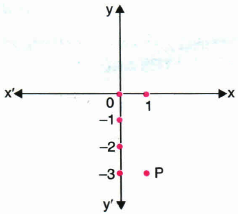
(1,-3)
(1,3)
(-1,-3)
(-1,3)
4.
Write the coordinates of P
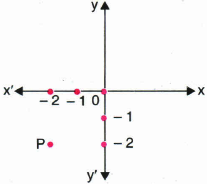
(-2,-2)
(2,2)
(2,-2)
(-2,2)
5.
Write the coordinates of P
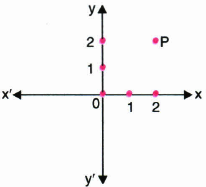
(2,2)
(-1,-2)
(1,-2)
(-1,2)
6.
Mirror image of point (3,9) in x - axis is
(-3,9)
(9,3)
(3,9)
(3,-9)
7.
If (x+2,4)=(5,y-2), then the coordinates (x,y) are:
(7,12)
(6,3)
(3,6)
(2,1)
8.
The co-ordinates of a point whose ordinate is 6 and which lies on y-axis are:
(0,6)
(0,-6)
(6,0)
(-6,0)
9.
If a point is on negative side of y-axis at a distance of 3 units from origin then, the co-ordinates of the point are :
(0,3)
(0,-3)
(3,0)
(-3,0)
10.
The co-ordinates of point Q are:
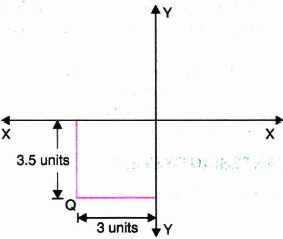
(3,3.5)
(3.5,3)
(-3,3.5)
(-3,-3.5)
11.
Abscissa of all the points on y - axis is:
1
any number
0
-1
12.
The co-ordinates of any point on the x - axis are of the form:
(x,0)
(o,y)
(0,0)
(x,y)
13.
In which quadrant does the point (-1,2) lie?
I
II
III
IV
14.
The points (-5,2) and (2,-5) lie in the:
Same quadrant
II and III quadrants respectively
II and IV quadrants respectively
IV and III quadrants respectively
15.
In fourth quadrant, x is
+ve
-ve
0
None of these
16.
Where do the I and III quadrants meet?
in x - axis
in y - axis
at O
do not intersect
17.
The line of intersection of I and II quadrants is
x - axis
y - axis
vertical axis
None of these
18.
If x is positive and y is negative, then the point (x,y) lies in
III quadrant
IV quadrant
II quadrant
I quadrant
19.
North-South direction and East-West direction
are perpendicular to each other
are parallel to each other
are opposite to each other
None of these
20.
Rene Descartes belonged to
15th Century
16th Century
17th Century
18th Century
21.
In which quadrants x and y coordinates have different sign?
22.
The abscissa of a point is 5 and it lies on the x-axis. What are its coordinates?
23.
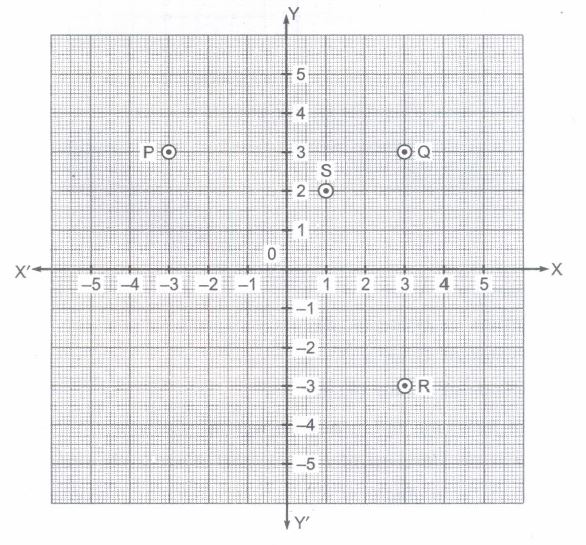
In the following figure, which point has its abscissa as -3?
24.
If the y-coordinate of a point is zero, then where does this point lie?
25.
Which of the following statements are true?
(i) The point (0, -4) lies on y-axis
(ii) The perpendicular distance of the point (5, 7) from the x-axis is 5.
(iii) Point (1, -1) and (-1, 1) lie in the same quadrant.
26.
Find the perpendicular distance of the point P(7,5) from the Y-axis
27.
Find the point, whose ordinate is -3 and which lies on Y-axis
28.
If the perpendicular distance of a point P from the X-axis is 5 units and the foot of perpendicular lies on the negative direction of X-axis, then find the y-coordinate of P.
29.
If(x + 2, 4) = (5, Y - 2), then find the coordinates (x, y).
30.
In which quadrants, the abscissa of a point is negative?
31.
In which quadrants do the given points lie?
(i) (4, -2)
(ii) (-3, 7)
(iii) (-1, -2)
(iv) (3, 6)
32.
In which quadrant or on which axis each of the following points lie?
(-3,5). (4, -1). (2, 0). (2, 2). (-3, - 6)
33.
In the given figure, LM is a line parallel to the Y-axis at a distance of 3 units.
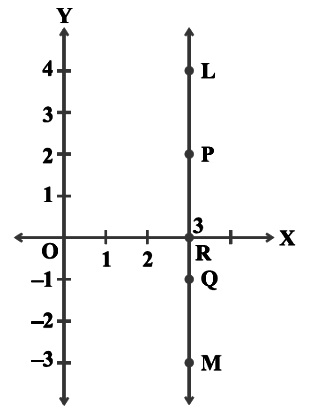
(i) What are the coordinates of the points P,R and Q ?
(ii) What is the difference between the abscissa of the points L and M ?
34.
A point lies on X-axis at a distance of 9 units from Y-axis. What are its coordinates? What will be the coordinates of a point, if it lies on Y-axis at a distance of 9 units from X-axis in negative direction?
35.
Assertion: A point whose abscissa is 2 and ordinate is -3 lies in fourth quadrant
Reason: Points of the type (–, +) lie in the second quadrant.
Codes:
(a) Both assertion (A) and reason (R) are true and reason (R) is the correct explanation of assertion (A).
(b) Both assertion (A) and reason (R) are true but reason (R) is not the correct explanation of assertion (A).
(c) Assertion (A) is true but reason (R) is false.
(d) Assertion (A) is false but reason (R) is true.
36.
Assertion: A point whose abscissa is -3 and ordinate is 2 lies in second quadrant
Reason: Points of the type (–, +) lie in the second quadrant.
Codes:
(a) Both assertion (A) and reason (R) are true and reason (R) is the correct explanation of assertion (A).
(b) Both assertion (A) and reason (R) are true but reason (R) is not the correct explanation of assertion (A).
(c) Assertion (A) is true but reason (R) is false.
(d) Assertion (A) is false but reason (R) is true.
37.
Assertion: The perpendicular distance of the point A(3, 4) from the y-axis is 4
Reason: The perpendicular distance of a point from y-axis is called its x-coordinate.
Codes:
(a) Both assertion (A) and reason (R) are true and reason (R) is the correct explanation of assertion (A).
(b) Both assertion (A) and reason (R) are true but reason (R) is not the correct explanation of assertion (A).
(c) Assertion (A) is true but reason (R) is false.
(d) Assertion (A) is false but reason (R) is true.
38.
Assertion : The points (-1, 2) and (2,- 1) are at different positions in the coordinate plane.
Reason : Point (-1, 2) lies in II-quadrant and (2,- 1) lies in IV quadrant
Codes:
(a) Both assertion (A) and reason (R) are true and reason (R) is the correct explanation of assertion (A).
(b) Both assertion (A) and reason (R) are true but reason (R) is not the correct explanation of assertion (A).
(c) Assertion (A) is true but reason (R) is false.
(d) Assertion (A) is false but reason (R) is true.
39.
Assertion : The point (-2, 0) lies on y -axis and (0, 4) on x -axis.
Reason : Every point on the x -axis has zero distance from x -axis and every point on the y -axis has zero distance from y -axis.
Codes:
(a) Both assertion (A) and reason (R) are true and reason(R) is the correct explanation of assertion (A).
(b) Both assertion (A) and reason (R) are true but reason (R) is not the correct explanation of assertion (A).
(c) Assertion (A) is true but reason (R) is false.
(d) Assertion (A) is false but reason (R) is true.
40.
Assertion : The point (0, 4) lies on y -axis.
Reason : The x co-ordinate on the point on y -axis is zero.
Codes:
(a) Both assertion (A) and reason (R) are true and reason (R) is the correct explanation of assertion (A).
(b) Both assertion (A) and reason (R) are true but reason (R) is not the correct explanation of assertion (A).
(c) Assertion (A) is true but reason (R) is false.
(d) Assertion (A) is false but reason (R) is true.
1.
(d)
3 units
2.
(b)
1
3.
(a)
(1,-3)
4.
(a)
(-2,-2)
5.
(a)
(2,2)
6.
(d)
(3,-9)
7.
(c)
(3,6)
8.
(a)
(0,6)
9.
(b)
(0,-3)
10.
(d)
(-3,-3.5)
11.
(c)
0
12.
(a)
(x,0)
13.
(b)
II
14.
(c)
II and IV quadrants respectively
15.
(a)
+ve
16.
(c)
at O
17.
(a)
x - axis
18.
(b)
IV quadrant
19.
(a)
are perpendicular to each other
20.
(c)
17th Century
21.
()
II and IV quadrants.
22.
()
(5, 0).
23.
()
The point p(-3, 3) has its abscissa as -3.
24.
()
It lies on the x-axis.
25.
()
Only the statement (i) is true.
26.
()
7 units
27.
()
(0,-3)
28.
()
We know that, the perpendicular distance of a point from the X-axis gives y-coordinate of that point. Here, foot of perpendicular lies on the negative direction of X-axis, so the point lies either in II or III quadrant. Hence, the point P has y-coordinate as 5 or -5.
29.
()
(3,6)
30.
()
II and III quadrants
31.
()
(I) .\(\because \) Points of the type (+, -) lie in IV quadrant. \(\therefore \) The point (4, -2) lies in IV quadrant.
(i/) . \(\because \) Points of the type (-, +) lie in II quadrant. .\(\therefore \) The point (-3, 7) lies in II quadrant.
(iil) .\(\because \) Points of the type (-, -) lie in III quadrant \(\therefore \) The point (-1, -2) lies in III quadrant.
(iv) .\(\because \) Points of the type (+, +) lie in I quadrant. \(\therefore \) The point (3, 6) lies in I quadrant.
32.
()
(i) For point (-3, 5), x-coordinate is negative and y-coordinate is positive, so it lies in II quadrant.
(ii) For point (4, -1), x-coordinate is positive and j-coordinate is negative, so it lies in IV quadrant.
(iii) For point (2, 0), x-coordinate is positive and y-coordinate is zero, so it lies on X-axis.
(iv) For point (2, 2), x-coordinate and y-coordinate both are positive, so it lies in I quadrant.
(v) For point (-3, - 6), x-coordinate and y-coordinate both are negative, so it lies in III quadrant.
33.
()
Given, LM is a line parallel to the Y-axis and its perpendicular distance from Y-axis is 3 units.
(i) Coordinates of point P are (3, 2).
[since, its perpendicular distance from X-axis is 2 units] Coordinates of point Q are (3, -1) [since its perpendicular distance from X-axis is 1, in negative direction of Y-axis]
:coordinatess of point R are (3,0)
[since, it lies on X-axis, so its j-coordinate is zero 1
(ii) Abscissa of point L = 3, abscissa of point M = 3 Difference between the abscissa of points L and M = 3-3 =0
34.
()
We know that, coordinates of any point lies on X-axis at the distance' a' from the Y -axis are (a, 0) and (- a, 0).
Since, the given point lies on X-axis at a distance of9 units from Y-axis, so its coordinates are (9, O)or (- 9, 0).
Now, if point lies on Y-axis at a distance of9 units from X-axis in negative direction, then its coordinates are (0, 9) and (0, - 9).
Note : If direction of the axis is not given, then we take negative as well as positive direction.
35.
We know that Points of the type (–, +) lie in the second quadrant. So, Reason is correct.
Also, we know that Points of the type (+, –) lie in the fourth quadrant.
Hence, point whose abscissa is 2 and ordinate is -3 lies in fourth quadrant So, Assertion is also correct but Reason is the not the correct explanation of Assertion.
Correct option is (b) Both assertion (A) and reason (R) are true but reason (R) is not the correct explanation of assertion (A).
36.
We know that Points of the type (–, +) lie in the second quadrant.
So, Reason is correct.
Hence, point whose abscissa is -3 and ordinate is 2 lies in second quadrant
So, Assertion is also correct and Reason explains Assertion
Correct option is (a) Both assertion (A) and reason (R) are true and reason(R) is the correct explanation of assertion (A).
37.
We know that the perpendicular distance of a point from y-axis is called its x-coordinate or abscissa.
So, Reason is correct.
The x co-ordinate of the point (3, 4) is 3.
So, Assertion is not correct
Correct option is (d) Assertion (A) is false but reason (R) is true.
38.
We know that Point (-1, 2) lies in II-quadrant and (2,- 1) lies in IV quadrant
So, Reason is correct.
Hence the points (-1, 2) and (2,- 1) are at different positions in the coordinate plane.
So, Assertion is also correct
Correct option is (a) Both assertion (A) and reason (R) are true and reason (R) is the correct explanation of assertion (A).
39.
We know that Every point on the x -axis has zero distance from x -axis and every point on the y -axis has zero distance from y -axis.
So, Reason is correct.
Now, point (-2, 0) lies on x-axis and (0, 4) on y-axis So, Assertion is not correct
Correct option is (d) Assertion (A) is false but reason (R) is true.
40.
We know that the if the point lies on y-axis, its x-coordinate is 0.
So, Reason is correct.
The x co-ordinate of the point (0, 4) is zero.
So, Point (0, 4) lies on y -axis.
So, Assertion is also correct
Correct option is (a) Both assertion (A) and reason (R) are true and reason (R) is the correct explanation of assertion (A).

9th Standard CBSE Syllabus & Materials
9th Standard CBSE
CBSE 9th Mathematics Lines and Angles Sample Question Papers Study Material - QB365 Set A
NEW9th Standard CBSE
CBSE 9th Mathematics Introduction to Euclid's Geometry Sample Question Papers Study Material - QB365 Set A
NEW9th Standard CBSE
CBSE 9th Mathematics Linear Equations in Two Variables Sample Question Papers Study Material - QB365 Set A
NEW9th Standard CBSE
CBSE 9th Mathematics Coordinate Geometry Sample Question Papers Study Material - QB365 Set A



NCERT Books

Syllabus

Exam Pattern

Sample Question Papers

Previous year Question Papers

Important Notes

MCQ Practice test

NCERT Exemplers

Case study Questions

Image Based Questions

Passage based Questions

HOT Questions

Value Based Questions

Model Questions Papers
NCERT ( Book Back ) Questions

Assertion and Reason
Important Questions And Answers

CBSE 9th Standard CBSE Subjects
CBSE Standards