100% FREE ACCESS
9th Standard CBSE Syllabus & Materials
9th Standard CBSE
CBSE 9th Science Is matter around us pure? - New Model Questions Papers Study Material - QB365 Set A
NEW9th Standard CBSE
CBSE 9th Science Matter in our surroundings - New Model Questions Papers Study Material - QB365 Set A
NEW9th Standard CBSE
CBSE 9th Mathematics Heron's Formula Sample Question Papers Study Material - QB365 Set A
NEW9th Standard CBSE
CBSE 9th Mathematics Circles Sample Question Papers Study Material - QB365 Set A
NEW9th Standard CBSE
CBSE 9th Mathematics Quadrilaterals Sample Question Papers Study Material - QB365 Set A
NEW9th Standard CBSE
CBSE 9th Mathematics Triangles Sample Question Papers Study Material - QB365 Set A

Published on: 29/10/2025
Download CBSE Class 9th Standard CBSE Mathematics question papers, sample papers, important questions, and previous year solved papers in PDF format. Get free study materials, NCERT solutions, and exam preparation resources for Class 9th Standard CBSE Mathematics
Questions + Answers key
Take MCQ Mathematics Test
1.
A policeman and a thief are equidistant from a jewel box. On considering jewel box as origin. the position of policeman is (0. 5). If the ordinate of the position of thief is zero (0). then find the position of thief.
2.
Give the geometric interpretation of 7x + 6 = 2x - 4 as an equation:
(i) in one variable
(ii) in two variables
3.
The taxi fare in a city is as follows: for the first kilometer, the fare is Rs.10 and for the subsequent distance it is Rs.6 per km. Taking the distance covered as x km and total fare as Rs.y, write a linear equation for this information, and draw its graph.
4.
Give the equation of two lines passing through (3,4). How many more such lines are there and why?
5.
Check whether (3, 1), (1, 3) and (0, 8) are the solutions of the equation 3x-y=8
6.
Write the following equations in the form ax+by+c=0 and indicate the values of a, b and c
2x+3y=4.37
7.
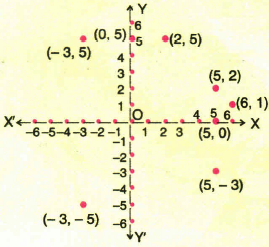
Locate the points (5,0), (0,5), (2,5), (5,2), (-3,5), (-3,-5),(5,-3) and (6,1) in the Cartesian plane.
8.
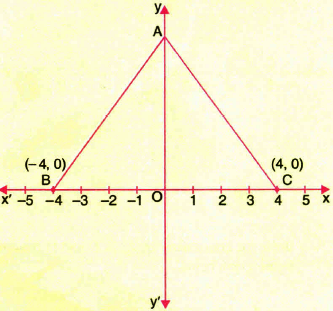
In figure, \(\triangle ABC\) is an equilateral triangle with coordinates of B and C as (-4,0) and (4,0) respectively.Find the coordinates of the vertex.
9.
The lengths of perpendiculars PM and PN drawn from a point P, on x-axis and y-axis are of 3 and 2 units respectively.Find the coordinates of points P,M and N.
10.
Any point on the line y=x is of the form:
(a,a)
(0,a)
(a, 0)
(a, -a)
11.
Find the value of k if (4, 1) is a solution of 3x+2y=k
14
12
10
16
12.
If (3, 2) is the solution of the equation 3x-ky=5, then equals:
2
4
3
\(1\over2\)
13.
Write a, b, c for the equation 3y+4=0
0,3,4
3,0,4
4,0,3
4,3,0
14.
The equation \(x+\sqrt{2}=0\) has
no solution
infinitely many solutions
only one solution
only two solution
15.
If the point A(0,2), B(0,-6) aand C(a,3) lie on y - axis, then the value of a is:
0
2
3
-6
16.
Abscissa of all the points on y - axis is:
1
any number
0
-1
17.
The point whose abscissa and ordinates have different single will lie in:
I and II Quadrants
II and III Quadrants
I and III Quadrants
II and IV Quadrants
18.
If x is negative and y is negative, then the point (x,y) lies in
I quadrant
II quadrant
III quadrant
IV quadrant
19.
If x is negative and y is positive, then the point (x,y) lies in
II quadrant
III quadrant
IV quadrant
I quadrant
20.
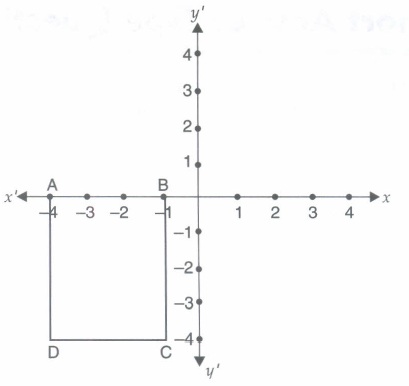
ABCD is a rectangle. Write the equation of its sides. Also, find its area.
21.
(i) Plot the points P(1, 0), Q{4, 0) and S(1, 3). Find the coordinates of the point R such that PQRS is a square.
(ii) Determine the length of line segment SR in figure PORS.
22.
Draw the quadrilateral with vertices (- 4, 4), (- 6,0), (- 4, - 4) and (- 2, 0). Also, name the type of quadrilateral and find its area.
23.
Give the equations of two lines passing through (-3, 4). How many more such lines are possible?
24.
Write four solutions for each of the following equations:
\(\pi x+y=9\)
25.
Express the following linear equation in the form ax+by+c=0 and indicate the values of a, b and c in each case:
\(x-{y\over 5}-10=0\)
1.
Either (5,0) or (-5, 0).
2.
x=-2
3.
y=10+6(x-1) ⇒ y=4+6x
4.
x+y=7; y=x+1; infinitely many
5.
Yes, no, no
6.
2x+3y-4.37=0;
a=2, b=3 and c=-4.37
7.
8.
\(\left( 0,4\sqrt { 3 } \right) \)
9.
(2,3), (2,0), (0,3)
10.
(a,a) satisfies y=x
11.
3(4)+2(1)=k ⇒ k=14
12.
3(3)-k(2)=5 ⇒ k=2
13.
0x+3y+4=0
14.
(c)
only one solution
15.
(a)
0
16.
(c)
0
17.
(d)
II and IV Quadrants
18.
(c)
III quadrant
19.
(a)
II quadrant
20.
Equation of the sides are,
AB: Y=0
BC: X=-1
CD: Y=-4
DA; X=-4
Area=4 X 3
=12 sq. units
21.
(i) Let us draw mutually perpendicular axes XOX' and YOY' and choose a suitable units of distance on the axes.
Let 1 crn = 1 unit. In point P(1, 0), y-coordinate is zero, so it lies on X-axis at a distance of 1 unit from Y-axis.
In point Q (4, O),y-coordinate is zero, so it lies on X-axis at a distance of 4 units from Y-axis. The point S(1, 3) is at a distance of 1 unit from Y-axis and 3 units from X-axis.
On plotting these points, we get the below graph
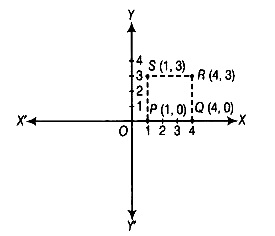
Now, we need to take a point R on the graph such that PQRS is a square. For this, draw a line passing through Q and parallel to PS and draw a line passing through S and parallel to PQ. Both lines intersect each other at a point, say R. Thus, we get a square PQRS. Clearly, abscissa of R will be equal to abscissa of Q, i.e. 4 and ordinate of R will be equal to ordinate of S, i.e. 3. Hence, the coordinates of point R
are (4, 3).
(ii) We have, S (1, 3) and R (4,3)
Here, we see that y-coordinate of both points S and R are same.
\(\therefore\) Length of the line segment SR
= Difference of x-coordinate of both points S and R
= 4 - 1 = 3 units
22.
Firstly, draw two mutually perpendicular lines on a graph paper, which intersect at point O. Now, plot all the given points on the graph paper and join them to get a quadrilateral and then find the area of the quadrilateral.
Let us draw the coordinates axes XOX' and YOY', and choose a suitable unit of distance on the axes.
Let 1 cm = 1 unit. Then, the points A (-4,4), B( -6,0), C (-4, - 4) and D (-2, 0) can be plotted as shown below.
Now, join all these points in order to form the quadrilateral.
It is clear from the figure that, AB = BC = CD = DA and sides are not perpendicular to each other. So, it forms a rhombus.
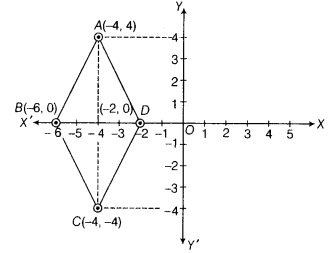
\(\therefore \) Area of rhombus = \(\frac { 1 }{ 2 } \times d_{ 1 }\times d_{ 2 }\)
\(=\frac { 1 }{ 2 } \times 8\times 4\)
\([\therefore \ d_{ 1 }=AC=4+4=8\ and\ d_{ 2 }=BD=4]\)
= 16 sq units
23.
x+y+1=0, 2x+x=2, 3y+x=9; infinitely many
24.
\(\pi x+y=9\)
\(y=9-\pi x\)
Put x=0, we get y=9-\(\pi\)(0)=9-0=9
Put x=1, we get y=9-\(\pi\)(1)=9-\(\pi\)
Put x=-1, we get y=9-\(\pi\)(-1)=9+\(\pi\)
Put \(x={9\over \pi}\), we get \(y=9-\pi\left(9\over\pi\right)=9-9=0\)
Four solution are (o, 9), (1, 9-\(\pi\)), (-1, 9+\(\pi\)) and \(\left({9\over \pi},0\right)\)
25.
\(x-{y\over 5}-10=0\)
Comparing with ax+by+c=0, we get
a=1, b=\(-{1\over 5 }\), c=-10

9th Standard CBSE Syllabus & Materials
9th Standard CBSE
CBSE 9th Mathematics Lines and Angles Sample Question Papers Study Material - QB365 Set A
NEW9th Standard CBSE
CBSE 9th Mathematics Introduction to Euclid's Geometry Sample Question Papers Study Material - QB365 Set A
NEW9th Standard CBSE
CBSE 9th Mathematics Linear Equations in Two Variables Sample Question Papers Study Material - QB365 Set A
NEW9th Standard CBSE
CBSE 9th Mathematics Coordinate Geometry Sample Question Papers Study Material - QB365 Set A



NCERT Books

Syllabus

Exam Pattern

Sample Question Papers

Previous year Question Papers

Important Notes

MCQ Practice test

NCERT Exemplers

Case study Questions

Image Based Questions

Passage based Questions

HOT Questions

Value Based Questions

Model Questions Papers
NCERT ( Book Back ) Questions

Assertion and Reason
Important Questions And Answers

CBSE 9th Standard CBSE Subjects
CBSE Standards