100% FREE ACCESS
9th Standard CBSE Syllabus & Materials
9th Standard CBSE
CBSE 9th Science Is matter around us pure? - New Model Questions Papers Study Material - QB365 Set A
NEW9th Standard CBSE
CBSE 9th Science Matter in our surroundings - New Model Questions Papers Study Material - QB365 Set A
NEW9th Standard CBSE
CBSE 9th Mathematics Heron's Formula Sample Question Papers Study Material - QB365 Set A
NEW9th Standard CBSE
CBSE 9th Mathematics Circles Sample Question Papers Study Material - QB365 Set A
NEW9th Standard CBSE
CBSE 9th Mathematics Quadrilaterals Sample Question Papers Study Material - QB365 Set A
NEW9th Standard CBSE
CBSE 9th Mathematics Triangles Sample Question Papers Study Material - QB365 Set A

Published on: 29/10/2025
Download CBSE Class 9th Standard CBSE Mathematics question papers, sample papers, important questions, and previous year solved papers in PDF format. Get free study materials, NCERT solutions, and exam preparation resources for Class 9th Standard CBSE Mathematics
Questions + Answers key
Take MCQ Mathematics Test
1.
Evaluate: \(\sqrt{5+2\sqrt{6}}+\sqrt{8-2\sqrt{15}}\)
2.
Draw a quadrilateral ABCD, whose vertices are A(3,2), B(2,3), C(-4,5), and D(5,-3)
3.
Plot the points P(-1,-1), Q(2,3) and R(8,11).Show that they are collinear.
4.
Find the coordinates of the vertices of a rectangle placed in III quadrant, in the Cartesian plane with length 'p' units on x-axis and breadth 'q' units on y-axis.
5.
Verify: \(3^3+y^3=(x+y)(x^3-xy+y^2)\)
6.
Factorise each of the following: \(8a^3-b^3-12a^2b+6ab^2\)
7.
Express 0.99999...in the form p/q.Are you surprised by your answer?With your teacher and classmates discuss why the answer makes sense.
8.
Expand by using identity (2x-y+z)2
9.
Simplify: 2√50 x 3√32 x 4√18
10.
Find the remainder when the polynomial f(x) = 4x3-12x2+14x-3 is divided by (2x-2).
11.
The lengths of perpendiculars PM and PN drawn from a point P, on x-axis and y-axis are of 3 and 2 units respectively.Find the coordinates of points P,M and N.
12.
In which quadrant do the given point lie? (-4,-5)
13.
Find the rational numbers a and b such that \(\frac { 2+5\sqrt { 7 } }{ 2-5\sqrt { 7 } } =a+\sqrt { 7 } b\)
14.
Plot the points (2,3), (-2,3), (-2,-3) and (2,-3) on a graph sheet.Join these points.Name the figure obtained.Also, find the area of the figure so obtained.
15.
Plot the points A(5,5) and B(-5,5) in Cartesian plane.Join AB, OA and OB.Name the figure obtained.
16.
Find the values of a and b, if \(x^2-4\) is a factor of \(a{ x }^{ 4 }+2{ x }^{ 3 }-3{ x }^{ 2 }+bx-4\) and hence factories it completely.
17.
Let \(R_1\) and \(R_2\)are the remainders when the polynomials \({ x }^{ 3 }+2{ x }^{ 2 }-5ax-7\) and \({ x }^{ 3 }+2{ x }^{ 2 }-5ax-7\) are divided by (x+1) and (x-2) respectively. If 2\(R_1\)+\(R_2\)=6, Find the value of a.
18.
Locate \(\sqrt { 4.5 } \) on the number line.By measurement, BD=2.2 units
19.
If \(\frac { 2 }{ \sqrt { 3 } +\sqrt { 5 } } +\frac { 5 }{ \sqrt { 3 } -\sqrt { 5 } } =a\sqrt { 3 } +b\sqrt { 5 } \), find a and b
20.
Calculate the value of \(\frac { { 83 }^{ 3 }+{ 17 }^{ 3 } }{ { 83 }^{ 2 }-83\times 17+{ 17 }^{ 2 } } \)
21.
Simplify: \(\left( x+\frac { 1 }{ 2 } \right) \left( x+\frac { 3 }{ 2 } \right) \)
22.
Write the factors of the polynomial: x2+5\(\sqrt { 2 } \)x+12.
23.
Write the factors of polynomial 4x2+y2+4xy+8x+4y+4
24.
Write the factors of a3-1.
25.
Factorize: 8y3-125x3.
26.
Factorize: 6-x+x2.
27.
Factorize: 20x2-9x+1.
28.
Find the value of k, if 2x-1 is a factor of the polynomial 6x2+kx-2.
29.
If f(x) be a polynomial such that \(f\left( -\frac { 1 }{ 3 } \right) \)=0, then calculate one factor of f(x).
30.
Factorize: 12a2b-6ab2.
31.
Factorize: x2-3x.
32.
Calculate the value of \({ \left[ { \left\{ { \left( 81 \right) }^{ \frac { -1 }{ 2 } } \right\} }^{ \frac { -1 }{ 4 } } \right] }^{ 2 }\)
33.
Find the value of \(\sqrt[3]{625^{-2}}\)
34.
Simplify: (5 + √5)(5 - √5)
35.
Is the product of two irrational numbers always an irrational number?
36.
Identify an irrational number among the following numbers: 0.13, \(0.13\overline{15}\) , \(0.\overline{1315}\) , 0.3013001300013...
37.
Calculate the \(\frac{p}{q}\) form of 0.777, where p and q are integers and q≠0.
38.
Express the rational number \(0.\bar{9}\) in the form \(\frac{p}{q}\), where p and q are integers and q≠0.
39.
Insert three rational numbers between \(\frac{-1}{3}\) and \(\frac{-2}{3}\)
40.
Calculate the decimal which represents the fraction \(\frac{7}{8}\)
41.
Write the simplest form of a rational number \(\frac{177}{413}\)
42.
Write the zeroes of the polynomial p(x) = x(x - 2) (x-3).
43.
Write the number of zeroes in a cubic polynomial.
44.
What is the zero of the zero polynomial?
45.
What is the degree of the polynomial (x3+5) (4-x5)?
46.
Name the polynomial containing two non-zero terms.
47.
Write an example of a constant polynomial.
48.
What is x+\(\frac { 1 }{ x } \)?
49.
Write the expression which represents polynomial.
1.
\(\sqrt{5+2\sqrt{6}}=\sqrt{3+2+2\sqrt{6}}\)
=\(\sqrt{(\sqrt{3}+\sqrt{2})^{2}}\)
=\(\sqrt{3}+\sqrt{2}\)
\(\sqrt{8-2\sqrt{15}}=\sqrt{5+3-2\sqrt{15}}\)
=\(\sqrt{(\sqrt{5}-\sqrt{3})^{2}}=\sqrt{5}-\sqrt{3}\)
\(\sqrt{5+2\sqrt{6}}+\sqrt{8-2\sqrt{15}}\)=\(\sqrt{3}+\sqrt{2}+\sqrt{5}-\sqrt{3}\)
=\(\sqrt{2}+\sqrt{5}\)
2.
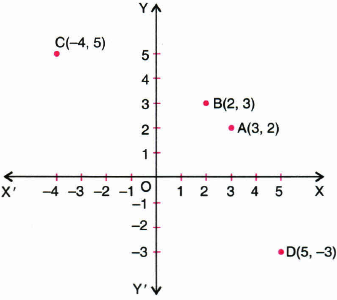
3.
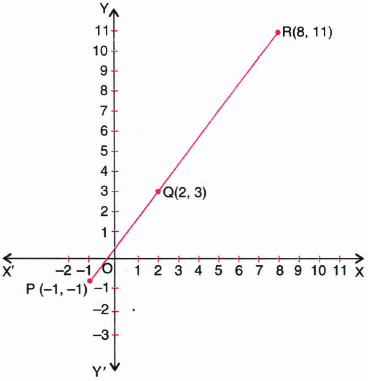
4.
(0,0); (-p,0); (5,0); (0,-q)
5.
We know that \(3^3+y^3=(x+y)(x^3-xy+y^2)\)
\(\Rightarrow\ x^3+y^3=(x+3)^3-3xy(x+y)\)
\(\Rightarrow\ x^3+y^3=(x+y){(x+y)^2-3xy}\)
\(\Rightarrow x^3+y^3=(x+y)(x^2+2xy+y^2-3xy)\) Using Identity
\(\Rightarrow\ x^3+y^3=(x+y)(x^2-xy+y^2)\)
6.
\(8a^3-b^3-12a^2b+6ab^2\)
\(=(2a)^3-(b)^3-3(2a)(b)(2a-b)\)
\(=(2a-b)^3\) | Using Identity VII
\(=(2a-b)(2a-b)(2a-b)\)
7.
Let x = 0.99999...
Multiplying both sides by 10 we get,
10x = 0.99999...
10x = 9 + 0.99999...
10x = 9 + x
10x - x = 9
9x = 9
x = 9/9 = 1
Thus, 0.99999...= 1 =1/1
Here p = 1
q = 1
Since 0.99999...goes on for ever, so there is no gap between 1 and 0.99999...and hence they are equal.
8.
(2x-y+z)2=4x2+y2+z2-4xy+2yz+4zx
9.
2√50 x 3√32 x 4√18
= 10√2 x 12√2 x 12√2
= 2880√2
10.
2x-1 = 0
\(\Rightarrow \ x=\frac { 1 }{ 2 } \)
By remainder theorem, if f(x) is divided by 2x-1, the remainder is \(f\left( \frac { 1 }{ 2 } \right) \)
\(\therefore \quad f\left( \frac { 1 }{ 2 } \right) =4{ \left( \frac { 1 }{ 2 } \right) }^{ 3 }-12{ \left( \frac { 1 }{ 2 } \right) }^{ 2 }+14\left( \frac { 1 }{ 2 } \right) -3\)
\(=4\times \frac { 1 }{ 8 } -12\times \frac { 1 }{ 4 } +14\times \frac { 1 }{ 2 } -3\)
\(=\frac { 1 }{ 2 } -3+7-3\)
\(=\frac { 1 }{ 2 } +1\)
\(=\frac { 3 }{ 2 } \)
Hence required remainder is \(\frac { 3 }{ 2 } \).
11.
(2,3), (2,0), (0,3)
12.
III
13.
\(\quad a=-\frac { 179 }{ 171 } ,b=\frac { -20 }{ 171 } \)
14.
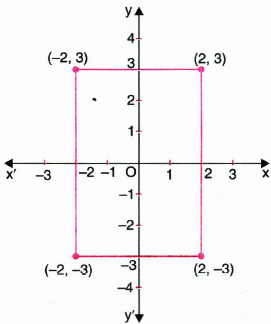
The figure obtained is a rectangle
Area of the rectangle = 4 x 6
=24 square units.
15.
The figure obtained is a right angled triangle.
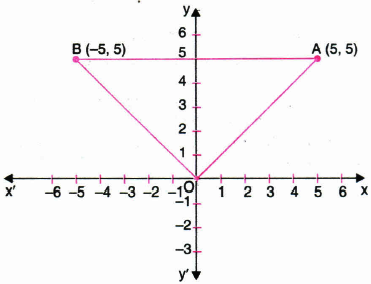
16.
\({ x }^{ 2 }-4={ x }^{ 2 }-{ 2 }^{ 2 }=(x+2)(x-2)\)
Let \(p(x)=a{ x }^{ 4 }+2{ x }^{ 3 }-3{ x }^{ 2 }+bx-4\)
If \(x^2-4\) is a factor of p(x), then clearly each of x+2 and x-2 will be a factor of p(x).
If x+2 is a factor of p(x), then by factor theorem
\(p(-2)=0\ |x+2=0\Rightarrow x=-2\)
\(\Rightarrow a{ (-2) }^{ 4 }+2{ (-2) }^{ 3 }-3{ (-2) }^{ 2 }+b(-2)-4=0\)
\(\Rightarrow 16a-16-12-2b-4=0\)
\(\Rightarrow 16a-2b-32=0\)
\(\Rightarrow -b-16=0\ \ .......(1)\)
| Dividing throughout by 2
If x-2 is a factor of p(x), then by factor theorem
\(p(2)=0\ \ \ |x-2=0\Rightarrow x=2\)
\(\Rightarrow a{ (2) }^{ 4 }+2{ (2) }^{ 3 }-3{ (2) }^{ 2 }+b(-2)-4=0\)
\(\Rightarrow \ 16a+16-12+2b-4=0\)
\(\Rightarrow -2b=0\)
\(\Rightarrow 8a-b=0 \ \ .........(2)\)
Dividing throughout by 2
Solving (1) and (2), we get
\(a=1, b=-8\)
\(\therefore p(x)=a{ x }^{ 4 }+2{ x }^{ 3 }-3{ x }^{ 2 }+bx-4\)
\(={ x }^{ 2 }({ x }^{ 2 }-4)+1({ x }^{ 2 }-4)+2x({ x }^{ 2 }-4)\)
\(=({ x }^{ 2 }-4)({ x }^{ 2 }+2x+1)\)
\((x-2)(x+2)(x+1)(x+1)\)
17.
Let \(f(x)={ x }^{ 3 }+2{ x }^{ 2 }-5ax-7\)
and \(g(x)={ x }^{ 3 }-a{ x }^{ 2 }-12x+6\)
By remainder theorem,
\(f(-1)={ R }_{ 1 }\ \ \ \ ........(1)\)
\(x+1=0\Rightarrow x=-1\)
\(\Rightarrow { (-1) }^{ 3 }+2{ (-1) }^{ 2 }-5a(-1)-7={ R }_{ 1 }\)
\(\Rightarrow \ -1+2+5a-7={ R }_{ 1 }\)
\(\Rightarrow { R }_{ 1 }=a-6 \ \ ................(2)\)
and \(g(2)={ R }_{ 2 }\ \ ...........(3)\)
\(x-2=0\Rightarrow x=2\)
\(\Rightarrow { (2) }^{ 3 }+a{ (2) }^{ 2 }-12(2)+6={ R }_{ 2 }\)
\(\Rightarrow 8+4a-24+6={ R }_{ 2 }\)
\(\Rightarrow { R }_{ 2 }=4a-10\ \ \ .....(4)\)
According to the question,
\(2{ R }_{ 1 }+{ R }_{ 2 }=6\)
\(\Rightarrow 2(5a-6)+(4a-10)=6\)
\(\Rightarrow -12+4a-10=6\)
\(\Rightarrow 14a=28\)
\(\Rightarrow a=2\)
18.
Mark the distance 4.5 units from a fixed point A on a given line to obtain a point B such that AB=4.5 units.From B, mark a distance of 1 unit and mark the new point as C.Find the mid-point of AC and mark that point as O.Draw a semi-circle with centre O and radius OC.Draw a semi-circle with Centre O and radius OC.Draw a line perpendicular to AC passing through B and intersecting the semi-circle at D.Then BD=\(\sqrt { 4.5 } \). By measurement,
BD = 2.2 units
\(\sqrt { 4.5 } \)= 2.2
Now, let us treat the line BC as the number line, with B as zero, C as 1 and so on.Draw an arc with centre B and radius BD, which intersects the number line in E.
19.
\(\frac { 2 }{ \sqrt { 3 } +\sqrt { 5 } } +\frac { 5 }{ \sqrt { 3 } -\sqrt { 5 } } =a\sqrt { 3 } +b\sqrt { 5 } \)
\(\\ =\frac { 2\left( \sqrt { 3 } -\sqrt { 3 } \right) }{ \left( \sqrt { 3 } -\sqrt { 5 } \right) } +\frac { 5 }{ \sqrt { 3 } -\sqrt { 5 } } \frac { \sqrt { 3 } +\sqrt { 5 } }{ \sqrt { 3 } +\sqrt { 5 } } \)
\(\\ =a\sqrt { 3 } +b\sqrt { 5 } \)
\(\\ \frac { 2\left( \sqrt { 3 } -\sqrt { 5 } \right) }{ 3-5 } +\frac { 5\left( \sqrt { 3 } +\sqrt { 5 } \right) }{ 3-5 } =a\sqrt { 3 } +b\sqrt { 5 } \)
\(\\ -\left( \sqrt { 3 } -\sqrt { 5 } \right) -\frac { 5 }{ 2 } \left( \sqrt { 3 } +\sqrt { 5 } \right) =a\sqrt { 3 } +b\sqrt { 5 } \)
\(\\ -\frac { 7 }{ 2 } \sqrt { 3 } -\frac { 3 }{ 2 } \sqrt { 5 } =a\sqrt { 3 } +b\sqrt { 5 } \)
\(\\ a=-\frac { 7 }{ 2 } ,\ b=-\frac { 3 }{ 2 } \)
20.
()
\(\frac { { 83 }^{ 3 }+{ 17 }^{ 3 } }{ { 83 }^{ 2 }-83\times 17+{ 17 }^{ 2 } } =\frac { (83+17)({ 83 }^{ 2 }-83\times 17+{ 17 }^{ 2 }) }{ ({ 83 }^{ 2 }-83\times 17+{ 17 }^{ 2 }) } \)
\(\because\) a3+b3=(a+b) (a2+b2-ab)
=83+17=100
21.
()
\(\left( x+\frac { 1 }{ 2 } \right) \left( x+\frac { 3 }{ 2 } \right) \)\(={ x }^{ 2 }+\frac { 3 }{ 2 } x+\frac { 1 }{ 2 } x+\frac { 3 }{ 4 } \)
\(={ x }^{ 2 }+2x+\frac { 3 }{ 4 } \)
22.
()
x2+5\(\sqrt { 2 } \)x+12=x2+3\(\sqrt { 2 } \)x+2\(\sqrt { 2 } \)x+12
= x x (x+3\(\sqrt { 2 } \))+2\(\sqrt { 2 } \)(x+3\(\sqrt { 2 } \))
=(x+3\(\sqrt { 2 } \))(x+2\(\sqrt { 2 } \)).
Factors are x+3\(\sqrt { 2 } \) and x+2\(\sqrt { 2 } \)
23.
()
4x2+y2+4xy+8x+4y+4 = (2x)2+(y)2+(2)2+2\(\times\)2x\(\times\)y+2\(\times\)2x\(\times\)2+2\(\times\)y\(\times\)2
= (2x+y+2)2.
Factor is 2x + y + 2.
24.
()
a3-1=(a-1)(a2+1+a\(\times\)1)
Then factors of (a3-1) are (a-1) and (a2+1+a).
25.
()
8y3-125x3=(2y)3-(5x)3
=(2y - 5x)(4y2+10xy+25x2)
26.
()
6x-x-x2 = 6-3x+2x-x2
= 3(2-x)+x(2-x)
= (2-x)(3+x)
27.
()
20x2-9x+1 = 20x2-5x-4x+1
=5x(4x-1)-1(4x-1)
=(4x-1)(5x-1)
28.
()
2x-1 is factor of p(x)=6x2+kx-2
\(\Rightarrow\) \(p\left( \frac { 1 }{ 2 } \right) =0\)
\(\Rightarrow \quad 6.\frac { 1 }{ 4 } +k.\frac { 1 }{ 2 } -2=0\)
\(\Rightarrow\) k = 1
29.
()
Since, \(f\left( -\frac { 1 }{ 3 } \right) \) =0
\(\therefore -\frac { 1 }{ 3 } \) is a zero of polynomial f(x)
So, x+\(\frac { 1 }{ 3 } \)or 3x+1 is a factor of f(x).
30.
()
12a2b-6ab2=6ab(2a-b)
31.
()
x2-3x=x(x-3)
32.
()
\({ \left[ { \left\{ { \left( 81 \right) }^{ \frac { -1 }{ 2 } } \right\} }^{ \frac { -1 }{ 4 } } \right] }^{ 2 }\)= {(81)-1/2}-1/2
= (81)1/4 = (34)1/4
= 3
33.
()
\(\sqrt[3]{625^{-2}}\) = (625-2)1/4 = (625-2x1/4)
= (625-1/2)
= \((\frac{1}{625})^{1/2}=\frac{1}{25}\)
34.
()
(5 + √5)(5 - √5) = {52 - (√5)2}
= {25 - 5}
= 20
35.
()
No, it may be rational or irrational.
36.
()
0.13 is a terminating number. So, it is not an irrational number.
\(0.13\overline{15}\) = 0.131515...,15 is representing continuously, so it is not an irrational number.
\(0.\overline{1315}\) = 0.13151315..., is representing continuously, so it is not an irrational number.
0.3013001300013..., non-terminating and non-recurring decimal. Hence, it is an irrational number. So, 0.3013001300013 is an irrational number.
37.
()
Let x = 0.777...
⇒ 10x = 7.777...
⇒ 10x - x = (7.777...)-(0.777...)
⇒ 9x = 7
⇒ x = \(\frac{7}{9}\)
38.
()
Let, x = 0.999...
⇒ 10x = 9.999...
⇒ 10x - x = (9.999...)-(0.999...)
⇒ 9x = 9
⇒ x = 1
39.
()
\(\frac{-1}{3}\)=\(-\frac{4}{12}\)
and \(-\frac{2}{3}=-\frac{8}{12}\)
So three rational numbers are \(-\frac{5}{12},-\frac{6}{12}\) and -\(\frac{7}{12}\)
40.
()
\(\frac{7}{8}\)=0.875
41.
()
\(\frac{177}{413}\)= \(\frac{59\times3}{59\times7}=\frac{3}{7}\)
42.
()
For zeroes, put p(x) = 0
x(x-2)(x-3) =0,
then, x = 0,2,3.
43.
()
No. of zeroes of cubic polynomial = 3
44.
()
Every real number is a zero of the zero polynomial.
45.
()
Degree of x3+5 = 3
Degree of 4-x5 = 5
Degree of (x3-5) (4-x5) = 3+5 = 8.
46.
()
Binomial.
47.
()
Constant polynomial is 7.
48.
()
Not a polynomial.
49.
()
\(\sqrt { 3 } { x }^{ 2 }-x-1\)

9th Standard CBSE Syllabus & Materials
9th Standard CBSE
CBSE 9th Mathematics Lines and Angles Sample Question Papers Study Material - QB365 Set A
NEW9th Standard CBSE
CBSE 9th Mathematics Introduction to Euclid's Geometry Sample Question Papers Study Material - QB365 Set A
NEW9th Standard CBSE
CBSE 9th Mathematics Linear Equations in Two Variables Sample Question Papers Study Material - QB365 Set A
NEW9th Standard CBSE
CBSE 9th Mathematics Coordinate Geometry Sample Question Papers Study Material - QB365 Set A



NCERT Books

Syllabus

Exam Pattern

Sample Question Papers

Previous year Question Papers

Important Notes

MCQ Practice test

NCERT Exemplers

Case study Questions

Image Based Questions

Passage based Questions

HOT Questions

Value Based Questions

Model Questions Papers
NCERT ( Book Back ) Questions

Assertion and Reason
Important Questions And Answers

CBSE 9th Standard CBSE Subjects
CBSE Standards