100% FREE ACCESS
9th Standard CBSE Syllabus & Materials
9th Standard CBSE
CBSE 9th Science Is matter around us pure? - New Model Questions Papers Study Material - QB365 Set A
NEW9th Standard CBSE
CBSE 9th Science Matter in our surroundings - New Model Questions Papers Study Material - QB365 Set A
NEW9th Standard CBSE
CBSE 9th Mathematics Heron's Formula Sample Question Papers Study Material - QB365 Set A
NEW9th Standard CBSE
CBSE 9th Mathematics Circles Sample Question Papers Study Material - QB365 Set A
NEW9th Standard CBSE
CBSE 9th Mathematics Quadrilaterals Sample Question Papers Study Material - QB365 Set A
NEW9th Standard CBSE
CBSE 9th Mathematics Triangles Sample Question Papers Study Material - QB365 Set A

Published on: 29/10/2025
Download CBSE Class 9th Standard CBSE Mathematics question papers, sample papers, important questions, and previous year solved papers in PDF format. Get free study materials, NCERT solutions, and exam preparation resources for Class 9th Standard CBSE Mathematics
Questions + Answers key
Take MCQ Mathematics Test
1.
Given below is the frequency distribution of salary in Rs of 80 workers in a factory.
| Salary | No.of workers |
| 1000-2000 | 8 |
| 2000-3000 | 14 |
| 3000-4000 | 20 |
| 4000-5000 | 24 |
| 5000-6000 | 14 |
Find the probability that the salary of a worker selected at random is:
(i) Less than 4000
(ii) More than or equal to 3000
(iii) More than or equal to 2000 but less than 5000
2.
A field is in the shape of a trapezium whose parallel sides are 25 m and 10 m. The non-parallel sides are 14 m and 13 m. Find the area of the field.
3.
Find the cost of leveling a ground in the form of a triangle with sides 40 m, 70 m and 90 m at Rs.4 per square metre. (Use\(\sqrt { 5 } \) = 2.24).
4.
Factorise: \(x^3-3x^2-10x+24\)
5.
Simplify: \(\frac { 2\sqrt { 6 } }{ \sqrt { 2 } +\sqrt { 3 } } +\frac { 6\sqrt { 2 } }{ \sqrt { 6 } +\sqrt { 3 } } -\frac { 8\sqrt { 3 } }{ \sqrt { 6 } +\sqrt { 2 } } \)
6.
In \(\triangle ABC, if\ \angle A=(2x-5^o),\angle B=(5x+5^o),\angle C=(3x+50^o)\), then find the value of x, \(\angle A, \angle B\ and\ \angle C.\)
7.
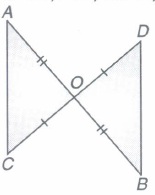
In the figure below, O is the mid-point of AB and CD, Prove that AC = BD.
8.
Two coins are tossed simultaneously 500 times, and we get
| Result | 2 heads | 1 head | No head |
| Frequency | 105 | 275 | 120 |
Find the probability of occurrence of
(i) two heads
(ii) all tails.
9.
Find the area of a triangle, two sides of which are 60 cm and 100 cm and the perimeter is 300 cm.
10.
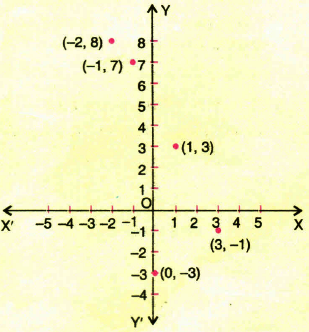
Plot the points on graph (-2,8), (-1,7), (0,-3), (1,3), (3,-1).
11.
Factorise: \(4x^2+y^2+z^2-4xy-2yz+4xz.\)
12.
Write \((3a+4b+5c)^2\) in expanded form.
13.
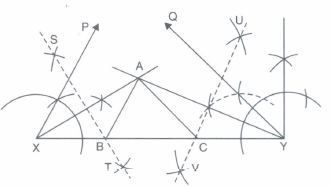
Construct a triangle ABC, in which ㄥB = 60o,ㄥC = 45o and AB + BC + CA = 11 cm
14.
Diagonals AC and BD of a quadrilateral ABCD intersect each other at O. Prove that:
AB + BC + CD + DA > AC + BD.
15.
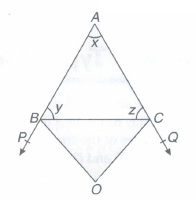
The sides AB and AC of \(\triangle ABC\) are produced to points P and Q respectively. If bisectors BO and CO of \(\angle CBP\) and \(\angle BCQ\) respectively meet point O, then prove that \(\angle BOC=90^o-\frac{1}{2}x\)
16.
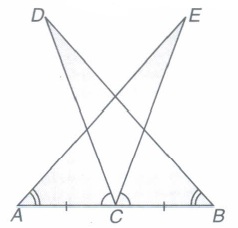
In the given figure, if AC = BC, \(\angle\)DCA = \(\angle\)ECB and \(\angle\)DBC = \(\angle\)EAC, then prove that BD = AE.
17.
Find a and b, if \(\frac { 2\sqrt { 5 } +\sqrt { 3 } }{ 2\sqrt { 5 } -\sqrt { 3 } } +\frac { 2\sqrt { 5 } -\sqrt { 3 } }{ 2\sqrt { 5 } +\sqrt { 3 } } =a+\sqrt { 15 } b\)
18.
Show by long division that 2x+3 is a factor of p(x)=4x4+8x3+5x2+x-3.
19.
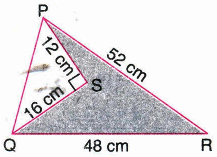
In the following figure, calculate the area of the shaded portion:
20.
If two lines intersect each other, then the vertically opposite angles are equal. prove it
1.
\((i)\frac { 21 }{ 40 }\)
\((ii)\frac { 29 }{ 40 }\)
\((iii)\frac { 29 }{ 40 } \)
2.
Let the given field be in the shape of a trapezium ABCD in which AB=25 m, CD= 10 m, BC = 13 m and AD = 14 m.
From D, draw DE 11 BC meeting AB at E. Also, draw DF \(\bot \) AB.
\(\therefore \) DE = BC =13 m
AE = AB - EB = AB - DC
= 25 - 10 = 15 m
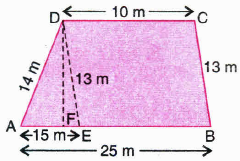
For AED
a = 14 m, b = 13 m, c= 15 m
\(\therefore s=\frac { a+b+c }{ 2 } =\frac { 14+13+15 }{ 2 } =\frac { 42 }{ 2 } =21\) m
\(\therefore \) Area of the \(\Delta \)AED \(=\sqrt { s(s-a)(s-b)(s-c) } \)
\(=\sqrt { 21(21-14)(21-13)(21-15) }\)
\( \\ =\sqrt { 21(7)(8)(6) } =\sqrt { \left( 7\times 3 \right) (7)\left( 4\times 2 \right) \left( 2\times 3 \right) } \)
\(=7\times 3\times 2\times 2=84\) m2
\(\Rightarrow \frac { 1 }{ 2 } \times \)AE\(\times \)DE = 84
\(\Rightarrow \ \frac { 1 }{ 2 } \times \)15\(\times \)DF = 84
\(\Rightarrow \) DF = \(\frac { 84\times 2 }{ 15 } \)
\(\Rightarrow \) DF= \(\frac { 56 }{ 5 } \) m = 11.2 m
\(\Rightarrow\) Height of the trapezium is 11.2 m.
\(\therefore \) Area of parallelogram EBCD = Base \(\times \) Height
= EB\(\times \) DF = 10 \(\times \)\(\frac { 56 }{ 5 } \) = 112 m2
\(\therefore \) Area of the field = Area of AED + Area of parallelogram EBCD = 84 m2 + 112 m2 = 196 m2.
3.
Rs.5376
4.
(x-2)(x-4)(x-3)
5.
0
6.
In \(\triangle ABC\)
\(\angle A+\angle B+\angle C=180^o\) (Angle Sum prop. of \(\triangle)\)
2x-5o+5x+5o+3x+50o=180o
10x=130o
x=13o
\(\angle A=2x-5^o=21^o\)
\(\angle B=5x+5^o=70^o\)
\(\angle C=3x-50^o=89^o\)
7.
OA = OB (O is the mid-point of AB)
\(\angle\)AOC = \(\angle\)BOD (Vertically opposite angles)
OC = OD (O is the mid-point of CD)
\(\triangle AOC\cong \triangle BOD\)
\(\Rightarrow\) AC = BD. (By c.p.c.t) Proved.
8.
\((i)\frac { 21 }{ 100 }\)
\((ii)\frac { 6 }{ 25 } \)
9.
\(1500\sqrt { 3 } \) cm2
10.
11.
\((2x-y+z)^2\)
12.
Comparing the given expression with (x + y + z)2, we find that
x = 3a, y = 4b and z = 5c.
Therefore, using Identity V, we have
(3a + 4b + 5c)2 = (3a)2 + (4b)2 + (5c)2 + 2(3a)(4b) + 2(4b)(5c) + 2(5c)(3a)
= 9a2 + 16b2 + 25c2 + 24ab + 40bc + 30ac
13.
Steps of construction:
i) Draw a line segment XY = 11 cm (As AB+ BC + CA = 11cm)
ii) Construct an angle PXY of 60o at point X and an angle ㄥQYZ of 45o at point Y
iii) Bisect ㄥPXY and ㄥQYZ .These bisectors intersect each other at point A
iv) Draw perpendicular bisectors ST of XA and UV of YA.
v) Perpendicular bisector ST intersects XY at B and UV intersects XY at C Join AB, AC MBC is the required triangle.
14.
By triangle inequality property,
In \(\triangle\) ABC, AB + BC>AC ...(1)
In \(\triangle\)BCD, BC + CD > BD ...(2)
In \(\triangle\)CDA, CD + DA >AC ...(3)
In \(\triangle\)DAB, DA +AB > BD ...(4)
using the fact that sum of two sides of a triangle is greater than the third side
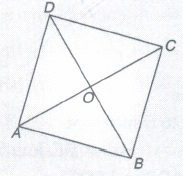
Adding (1), (2), (3) and (4), we get
AB + BC + BC + CD + CD + DA + DA + AB > AC + BD + AC + BD
\(\Rightarrow\) 2(AB + BC + CD + DA) > 2(AC + BD)
Hence,Perimeter > Sum of its diagonals.
15.
\(\angle PBC=x+z\)
\(\Rightarrow 2\angle OBC=x+z\)
\(\angle QCB=x+y\)
\(\Rightarrow 2\angle OCB=x+y\)
\(\therefore \angle BOC+\angle OCB+\angle OBC=180^o\) (Angle sum prop. of \(\triangle)\)
\(\Rightarrow 2\angle BOC+2\angle OCB+2\angle OBC=360^o\) (Multiply by 2 both sides)
\(\Rightarrow 2\angle BOC+x+y+x+z=360^o\)
\(\Rightarrow 2\angle BOC+180^o+x=360^o\)
\(\Rightarrow 2\angle BOC=180^o-x\)
\(\Rightarrow 2\angle BOC=90^o-\frac{1}{2}x\)
16.
Given, \(\angle\)DCA = \(\angle\)ECB
Adding \(\angle\)DCE to both sides, we get
\(\angle\)DCA + \(\angle\)DCE = \(\angle\)ECB + \(\angle\)DCE
\(\Rightarrow\) \(\angle\)ECA = \(\angle\)DCB
In \(\triangle\)ACE and \(\triangle\)BCD,
AC = BC (Given)
\(\angle\)ECA = \(\angle\)DCB (Proved)
\(\angle\)EAC = \(\angle\)DBC (Given)
\(\triangle ACE\cong \triangle BCD\) (By AAS cong.)
\(\therefore\) BD = AE.
17.
\(LHS=\frac { { \left( 2\sqrt { 5 } +\sqrt { 3 } \right) }^{ 2 }+{ \left( 2\sqrt { 5 } -\sqrt { 3 } \right) }^{ 2 } }{ \left( 2\sqrt { 5 } -\sqrt { 3 } \right) \left( 2\sqrt { 5 } +\sqrt { 3 } \right) } \)
\(=\frac { 4\times 5+3+2\times 2\sqrt { 5 } \times \sqrt { 3 } +4\times 5+3-2\times 2\sqrt { 5 } \times \sqrt { 3 } }{ { \left( 2\sqrt { 5 } \right) }^{ 2 }-{ \left( \sqrt { 3 } \right) }^{ 2 } } \)
\(=\frac { 20+3+4\sqrt { 15 } +20+3-4\sqrt { 15 } }{ 20-3 } \)
\(=\frac { 46 }{ 17 } =\frac { 46 }{ 17 } +\sqrt { 15 } \times \left( 0 \right) \)
\(\therefore \frac { 46 }{ 17 } +\sqrt { 15 } \times \left( 0 \right) =a\sqrt { 15 } b=RHS\)
Comparing both sides, we get
a=\(\frac{46}{17}\) , b = 0
18.
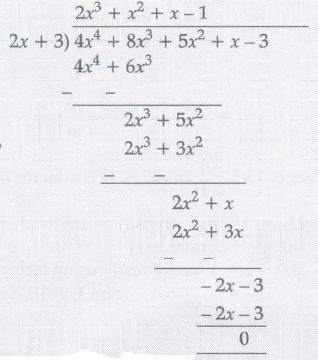
\(\therefore\) Quotient = 2x3+x2+x-1
Remainder=0
Hence, (2x+3) is factor of
p(x)=4x4+8x3+5x2+x-3
19.
In right triangle PSQ, PQ\(\frac { 1 }{ 2 } \)2 = PS2 + QS2 |By Pythagoras Theorem
= (12)2 + (16)2
= 144 + 256 =400
\(\Rightarrow \) PQ = \(\sqrt { 400 } \) = 20 cm
Now, for \(\Delta \)PQR
a = 20cm, b = 48cm, c = 52cm
\(\therefore s=\frac { a+b+c }{ 2 } =\frac { 20+48+52 }{ 2 } =60\) cm
\(\therefore \) Area of \(\Delta \)PQR \(=\sqrt { s(s-a)(s-b)(s-c) } \)
\(=\sqrt { 60(60-20)(60-48)(60-52) }\)
\( \\ =\sqrt { (60)(40)(12)(8) } \)
\(=\sqrt { \left( 6\times 10 \right) \left( 4\times 10 \right) \left( 6\times 2 \right) \left( 8 \right) } \)
\(=6\times 10\times 8=480\) cm2
Area of \(\Delta \) PSQ = \(\frac { 1 }{ 2 } \)\(\times \)Base\(\times \)Altitude
=\(\frac { 1 }{ 2 } \)\(\times \)16\(\times \)12=96 cm2
\(\therefore \) Area of the shaded portion =Area of \(\Delta \)PQR - Area of \(\Delta \)PSQ
= 480 - 96 = 384 cm2
20.
Let AB and CD two lines intersecting at O
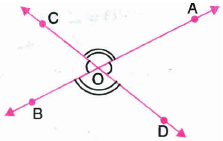
This leads to two pairs of vertically opposite angles,namely
(i) \(\angle \)AOC and \(\angle \)BOD
(II) \(\angle \)AOD and \(\angle \)BOC
We are to prove that
(i) \(\angle \)AOC and \(\angle \)BOD
(II) \(\angle \)AOD and \(\angle \)BOC
\(\therefore \) Ray OA stands on line CD
Therefore (i) \(\angle \)AOC and \(\angle \)AOD=\(180^{ 0 }\)
|Linear Pair Axiom
From (1) and (2)
\(\angle \)AOC and \(\angle \)AOD= \(\angle \)AOD and \(\angle \)BOD \(\angle \)AOC and \(\angle \)BOD
\(\Rightarrow \) Similarly we can prove that
\(\angle \)AOD and \(\angle \)BOC

9th Standard CBSE Syllabus & Materials
9th Standard CBSE
CBSE 9th Mathematics Lines and Angles Sample Question Papers Study Material - QB365 Set A
NEW9th Standard CBSE
CBSE 9th Mathematics Introduction to Euclid's Geometry Sample Question Papers Study Material - QB365 Set A
NEW9th Standard CBSE
CBSE 9th Mathematics Linear Equations in Two Variables Sample Question Papers Study Material - QB365 Set A
NEW9th Standard CBSE
CBSE 9th Mathematics Coordinate Geometry Sample Question Papers Study Material - QB365 Set A



NCERT Books

Syllabus

Exam Pattern

Sample Question Papers

Previous year Question Papers

Important Notes

MCQ Practice test

NCERT Exemplers

Case study Questions

Image Based Questions

Passage based Questions

HOT Questions

Value Based Questions

Model Questions Papers
NCERT ( Book Back ) Questions

Assertion and Reason
Important Questions And Answers

CBSE 9th Standard CBSE Subjects
CBSE Standards