100% FREE ACCESS
9th Standard CBSE Syllabus & Materials
9th Standard CBSE
CBSE 9th Science Is matter around us pure? - New Model Questions Papers Study Material - QB365 Set A
NEW9th Standard CBSE
CBSE 9th Science Matter in our surroundings - New Model Questions Papers Study Material - QB365 Set A
NEW9th Standard CBSE
CBSE 9th Mathematics Heron's Formula Sample Question Papers Study Material - QB365 Set A
NEW9th Standard CBSE
CBSE 9th Mathematics Circles Sample Question Papers Study Material - QB365 Set A
NEW9th Standard CBSE
CBSE 9th Mathematics Quadrilaterals Sample Question Papers Study Material - QB365 Set A
NEW9th Standard CBSE
CBSE 9th Mathematics Triangles Sample Question Papers Study Material - QB365 Set A

Published on: 29/10/2025
Download CBSE Class 9th Standard CBSE Mathematics question papers, sample papers, important questions, and previous year solved papers in PDF format. Get free study materials, NCERT solutions, and exam preparation resources for Class 9th Standard CBSE Mathematics
Questions + Answers key
Take MCQ Mathematics Test
1.
The sides of a triangle are 11cm, 60 cm and 61 cm. Find the altitude of the smallest side.
2.
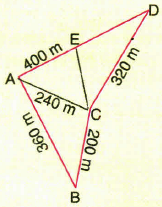
Kamla has a triangular field with sides 240 m, 200 m, 360 m, where she grew wheat. In another triangular field with sides 240 m, 320 m, 400 m adjacent to the previous field, she wanted to grow potatoes and onions. She divided the field in two parts by joining the mid-point of the longest side to the opposite vertex and grew potatoes in one part and onions in the other part. How much area (in hectares) has been used for wheat, potatoes, and onions? (l hectare = 10000 m2).
3.
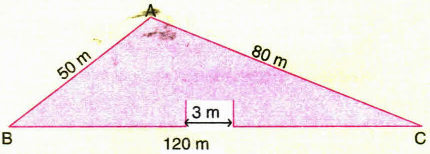
A triangular park ABC has sides 120 m, 80 m and 50 m. A gardener Dhania has to put a fence all around it and also plant grass inside. How much area does she need to plant? Find the cost of fencing it with barbed wire at the rate of Rs. 20 per metre leaving a space 3 m wide for a gate on one side.
4.
The sides of a triangular plot are in the ratio 3: 5: 7 and its perimeter is 300 m. Find its area
5.
Find the area of a triangle whose sides are 6.5 cm. 7 cm and 7.5 cm.
6.
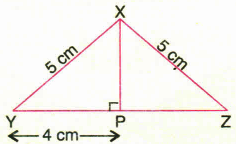
Find the area of an isosceles triangle with two equal sides as 5 cm each and unequal side as 8 cm.
7.
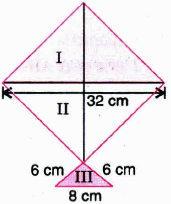
A kite in the shape of a square with a diagonal 32 cm and an isosceles triangle of base 8 cm and side 6cm each is to be made of three different shades as shown in figure. How much paper of each shade has been used in it?
8.
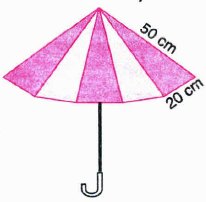
An umbrella is made by stitching 10 triangular pieces of cloth of two different colours (see figure). each piece measuring 20 cm, 50 cm, and 50 cm. How much cloth of each colour is required for the umbrella?
9.
The sides of a triangular park are in the ratio 3: 5:7 and its perimeter is 300 m. Find its area.
10.
Find the area of a triangle two sides of which are 18cm and 10 cm and the perimeter is 42 cm.
11.
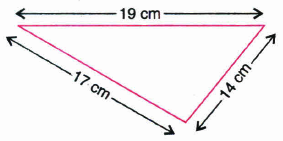
(a) Find the area of the triangle.
(b) Find the area of a triangle whose sides are 16 cm, 14 cm, nd 10 cm.
(c) The sides of a triangle are 7 cm, 12 cm, and 13 cm. Find its area.
d) Find the area of a triangle whose sides are 11 m, 60 m and 61 m.
12.
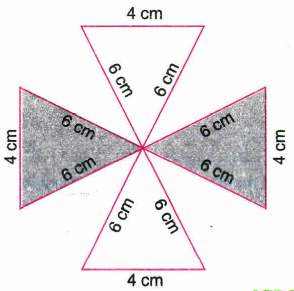
Black and white coloured triangular sheets are used to make a toy as shown in figure. Find the total area of black and white colour sheets used for making the toy.
13.
Find the area of a right-angled triangle if the radius of its circumcircle is 3 cm and altitude drawn to the hypotenuse is 2 cm.
14.
The perimeter of an equilateral triangle is 60 m.Its area is
\(10\sqrt { 3 } \) m2
\(100\sqrt { 3 } \)m2
\(15\sqrt { 3 } \)m2
\(20\sqrt { 3 } \)m2
15.
The side of an isosceles right triangle of hypotenuse \(5\sqrt { 2 } \) cm is
10 cm
8 cm
5 cm
\(3\sqrt { 2 } \) cm
16.
Area of a triangle is 60 cm2.Its base is 15 cm.Its altitude is
30 cm
4 cm
8 cm
10 cm
17.
The area of \(\triangle \)ABC in which AB = BC = 4 cm and \(\angle B=90°\) is
16 cm2
8 cm2
4 cm2
12 cm2
18.
Base of a triangle =
\(\frac { 2\times Area }{ Height } \)
\(\frac { Area }{ Height } \)
\(\frac { Area }{ 2\quad Height } \)
\(\frac { Area }{ 4\quad Height } \)
19.
A triangle and a parallelogram have the same base and the same area. If the sides of the triangle are 26 cm, 28 cm and 30 cm and the parallelogram stands on the base 28 cm, find the height of the parallelogram.
20.
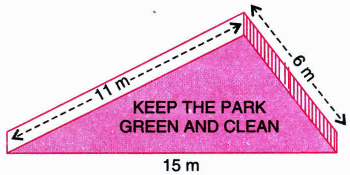
There is a slide in a park. One of its side walls has been painted in some colour with a message 'KEEP THE PARK GREEN AND CLEAN'. If the sides of the wall are 15 m, 11 m and 6 m, then find the area painted in colour.
1.
Let the sides of triangle are a = 11 cm, b = 60 cm and c = 61cm.
Then, semi-perimeter of triangle,
\(s=\frac{a+b+c}{2}=\frac{11+60+61}{2}=\frac{132}{2}=66m\)
Now, area of triangle= \(=\sqrt{s(s-a)(s-b)(s-c)}\)
\(=\sqrt{66(66-11)(66-60)(66-61)}\)
\(=\sqrt{66\times55\times6\times5}=\sqrt{11\times6\times11\times5\times6\times5}\)
\(=11\times6\times5\times330cm^2\)
Here, we have to find the altitude of the smallest side, so we consider the base as smallest side.
∵ Area of a triangle = \(\frac{1}{2}\) x base x height
\(\therefore\ 330=\frac{1}{2}\times11\times b\Rightarrow b=\frac{330\times2}{11}=60cm\)
Hence, the altitude of the smallest side is 60 cm.
2.
Let ABC be the field where wheat is grown. Also let ACD be the field which has been divided in two parts by joining C to the mid-point E of AD. For the area of triangle ABC, we have
a = 200 m, b = 240 m, c = 360 m
Therefore, s = \(\frac{200+240+360}{2} \mathrm{~m}=400 \mathrm{~m}\)
So, area for growing wheat
\(=\sqrt{400(400-200)(400-240)(400-360)} \mathrm{m}^{2}\)
\(=\sqrt{400 \times 200 \times 160 \times 40} \mathrm{~m}^{2}\)
\(=16000 \sqrt{2} \mathrm{~m}^{2}=1.6 \times \sqrt{2} \text { hectares }\)
= 2.26 hectares (nearly)
Let us now calculate the area of triangle ACD
Here, we have s \(=\frac{240+320+400}{2} \mathrm{~m}=480 \mathrm{~m}\)
So, area of \(\Delta \mathrm{ACD}=\sqrt{480(480-240)(480-320)(480-400)} \mathrm{m}^{2}\)
\(=\sqrt{480 \times 240 \times 160 \times 80} \mathrm{~m}^{2}=38400 \mathrm{~m}^{2}=3.84 \text { hectares }\)
We notice that the line segment joining the mid-point E of AD to C divides the triangle ACD in two parts equal in area. They have the bases AE and ED equal and, of course, they have the same height.
Therefore, area for growing potatoes = area for growing onions
= (3.84 ÷ 2) hectares = 1.92 hectares.
3.
For finding area of the park, we have
2s = 50 m + 80 m + 120 m = 250 m.
i.e., s = 125 m
Now, s – a = (125 – 120) m = 5 m,
s – b = (125 – 80) m = 45 m,
s – c = (125 – 50) m = 75 m.
Therefore, area of the park = \(\sqrt{s(s-a)(s-b)(s-c)}\)
\(=\sqrt{125 \times 5 \times 45 \times 75} \mathrm{~m}^{2}\)
\(=375 \sqrt{15} \mathrm{~m}^{2}\)
Also, perimeter of the park = AB + BC + CA = 250 m
Therefore, length of the wire needed for fencing = 250 m – 3 m (to be left for gate)
= 247 m
And so the cost of fencing = Rs.20 x 247 = RS. 4940
4.
Suppose that the sides, in metres, are 3x, 5x and 7x (see Fig.).
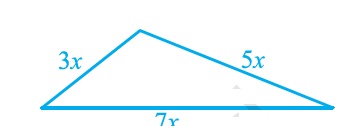
Then, we know that 3x + 5x + 7x = 300 (perimeter of the triangle)
Therefore, 15x = 300, which gives x = 20.
So the sides of the triangle are 3 x 20 m, 5 x 20 m and 7 x 20 m
i.e., 60 m, 100 m and 140 m.
We have s \(=\frac{60+100+140}{2} \mathrm{~m}=150 \mathrm{~m}\)
and area will be \(\sqrt{150(150-60)(150-100)(150-140)} \mathrm{m}^{2}\)
\(=\sqrt{150 \times 90 \times 50 \times 10} \mathrm{~m}^{2}\)
\(=1500 \sqrt{3} \mathrm{~m}^{2}\)
5.
21 cm2
6.
12 cm2
7.
Area of paper of shade I \(2\times \left( \frac { 1 }{ 2 } \times 16\times 16 \right) =256\)cm2
Similarly, Area of paper of shade II = 256 cm2
For area of paper of shade III
a = 8 cm, b = 6 cm, c = 6cm
\(\therefore s=\frac { a+b+c }{ 2 } =\frac { 8+6+6 }{ 2 } =10\) cm
\(\therefore \) Area of paper of shade III = \(\sqrt { s(s-a)(s-b)(s-c) } \)
\(=\sqrt { 10(10-8)(10-6)(10-6) } \)
\(=\sqrt { (10)(2)(4)(4) } =8\sqrt { 5 } \)
= 17.89 cm2
8.
For one triangular piece = 20 cm, b = 50 cm, c = 50 cm
\(\therefore s=\frac { a+b+c }{ 2 } =\frac { 20+50+50 }{ 2 } =\frac { 120 }{ 2 } =60\) cm
\(\therefore \) Area of one triangle \(=\sqrt { s(s-a)(s-b)(s-c) } \)
\(=\sqrt { 60(60-20)(60-50)(60-50) } \)
\(=\sqrt { (60)(40)(10)(10) } =200\sqrt { 6 } \) cm2
\(\therefore \) Area of 5 triangles of one colour \(=5(200\sqrt { 6 } )\) cm2 = 1000\(\sqrt { 6 } \) cm2
Hence, 1000\(\sqrt { 6 } \) cm2 cloth of each colour is required for the umbrella.
9.
\(1500\sqrt { 3 } \) cm2
10.
a = 18 cm, b = 10 cm
Perimeter = 42 cm
\(\Rightarrow a+b+c=42\)
\(\\ \Rightarrow 18+10+c=42\)
\(\\ \Rightarrow 28+c=42\)
\(\\ \Rightarrow c=42-28\)
\(\Rightarrow \ c=14\quad \)cm
\(s=\frac { 42 }{ 2 } =21\)cm
\(\therefore \) Area of the triangle \(=\sqrt { s(s-a)(s-b)(s-c) } \quad \quad \)
\(=\sqrt { 21(21-18)(21-10)(21-14) } \)
\(\\ =\sqrt { 21(3)(11)(7) }\)
\( \\ =\sqrt { (7)(3)(3)(11)(7) } \)
\(=(7)(3)\sqrt { 11 } =21\sqrt { 11 } \)cm2
11.
(a) 114.89 cm2
(b) \(40\sqrt { 3 } \)cm2
(c) \(24\sqrt { 3 } \)cm2
(d) 330 m2
12.
For one black colour sheet a= 4 cm, b = 6 cm
\(\therefore \) Area \(=\frac { a }{ 4 } \sqrt { 4{ b }^{ 2 }-{ a }^{ 2 } } \) | Sheet is an isosceles triangle
\(=\frac { 4 }{ 4 } \sqrt { 4{ (6) }^{ 2 }-4^{ 2 } } \) \(=\sqrt { 128 } =8\sqrt { 2 } \) cm2
\(\therefore \) Area of 2 black colour sheets = 2\(\times 8\sqrt { 2 } \) = \( 16\sqrt { 2 } \) cm2
Similarly, area of 2 white colour sheets = \( 16\sqrt { 2 } \) cm2
\(\therefore \) Total area of black and white colour sheets = \( 16\sqrt { 2 } \) + \( 16\sqrt { 2 } \) = \( 32\sqrt { 2 } \) cm2
13.
Let ABC be the right angled triangle right angled at B. Let O be the centre of the circumcircle.
Then, O is the midpoint of the hypotenuse AC. I by geometry
OA = OB =OC
= Radius of the circumcircle = 3 cm
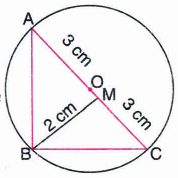
\(\therefore \) Hypotenuse AC = Diameter of the circle
= 2 \(\times \) Radius of the circumcircle
= 2 \(\times \) 3 = 6 cm
Let BM be the perpendicular from B on AC.
\(\therefore \) BM =2 cm
\(\therefore \) Area of the right angled triangle ABC
= \(\frac { 1 }{ 2 } \) \(\times \)Base \(\times \) Altitude
= \(\frac { 1 }{ 2 } \)\(\times \) AC \(\times \) BM = \(\frac { 1 }{ 2 } \)\(\times \) 6\(\times \) 2 = 6 cm2.
14.
Side (a) = \(\frac { 60 }{ 3 } =20\)m
\(\therefore \) Area =\(\quad =\frac { \sqrt { 3 } }{ 4 } { a }^{ 2 }=\frac { \sqrt { 3 } }{ 4 } { (20) }^{ 2 }=100\sqrt { 3 } \) m2
15.
(c)
5 cm
16.
(c)
8 cm
17.
Area = \(\frac { AB\times BC }{ 2 } =\frac { 4\times 4 }{ 2 } \)= 8 cm2
18.
Formula
19.
Let the sides of triangle be a = 26 cm, b = 28 cm and c = 30 cm. Let s be the semi-perimeter of the triangle
Then,
\(s=\frac{a+b+c}{2}=\frac{26+28+30}{2}=\frac{84}{2}=42cm\)
and area of triangle \(=\sqrt{s(s-a)(s-b)(s-c)}\)
\(=\sqrt{42\times(42-26)(42-28)(42-30)}\)
\(=\sqrt{42\times16\times14\times12}\)
\(=\sqrt{7\times6\times16\times7\times2\times6\times2}=336cm^2\)
Let h be the height of the parallelogram.
Then, area of parallelogram = base x height = 28 x b
∵ area of parallelogram =Area of triangle
ஃ \(28\times b=336\Rightarrow b=\frac{336}{28}\Rightarrow b=12cm\)
Hence, the height of the parallelogram is 12 cm.
20.
Let given sides of the wall be a = 15m, b = 11m and c = 6 m.
ஃ Semi-perimeter, \(s=\frac{a+b+c}{2}=\frac{15+11+6}{2}=\frac{32}{2}=16m\)
Now, area of the wall= \(=\sqrt{s(s-a)(s-b)(s-c)}\)
\(=\sqrt{16(16-15)(16-11)(16-6)}\)
\(=\sqrt{16\times1\times5\times10}=\sqrt{4\times4\times5\times5\times2}=5\times4\sqrt2\)
\(=20\sqrt{2}m^2\)
Hence, the area painted in colour is \(=20\sqrt{2}m^2\)

9th Standard CBSE Syllabus & Materials
9th Standard CBSE
CBSE 9th Mathematics Lines and Angles Sample Question Papers Study Material - QB365 Set A
NEW9th Standard CBSE
CBSE 9th Mathematics Introduction to Euclid's Geometry Sample Question Papers Study Material - QB365 Set A
NEW9th Standard CBSE
CBSE 9th Mathematics Linear Equations in Two Variables Sample Question Papers Study Material - QB365 Set A
NEW9th Standard CBSE
CBSE 9th Mathematics Coordinate Geometry Sample Question Papers Study Material - QB365 Set A



NCERT Books

Syllabus

Exam Pattern

Sample Question Papers

Previous year Question Papers

Important Notes

MCQ Practice test

NCERT Exemplers

Case study Questions

Image Based Questions

Passage based Questions

HOT Questions

Value Based Questions

Model Questions Papers
NCERT ( Book Back ) Questions

Assertion and Reason
Important Questions And Answers

CBSE 9th Standard CBSE Subjects
CBSE Standards