100% FREE ACCESS
9th Standard CBSE Syllabus & Materials
9th Standard CBSE
CBSE 9th Science Is matter around us pure? - New Model Questions Papers Study Material - QB365 Set A
NEW9th Standard CBSE
CBSE 9th Science Matter in our surroundings - New Model Questions Papers Study Material - QB365 Set A
NEW9th Standard CBSE
CBSE 9th Mathematics Heron's Formula Sample Question Papers Study Material - QB365 Set A
NEW9th Standard CBSE
CBSE 9th Mathematics Circles Sample Question Papers Study Material - QB365 Set A
NEW9th Standard CBSE
CBSE 9th Mathematics Quadrilaterals Sample Question Papers Study Material - QB365 Set A
NEW9th Standard CBSE
CBSE 9th Mathematics Triangles Sample Question Papers Study Material - QB365 Set A

Published on: 29/10/2025
Download CBSE Class 9th Standard CBSE Mathematics question papers, sample papers, important questions, and previous year solved papers in PDF format. Get free study materials, NCERT solutions, and exam preparation resources for Class 9th Standard CBSE Mathematics
Questions + Answers key
Take MCQ Mathematics Test
1.
On a construction site, a deep pit is barricaded from the remaining portion by using 100 hollow cones made of recycled plastic. Each one has a base diameter 20 cm and height half a meter.
(a) What is the cost of painting all the cones, if the outer side of each of cone is to be painted red and cost of painting is Rs 30 per m2.[\(\pi\)= 3.14, \(\sqrt { 26 } =5.1\)]
(b) Which values is depicted by using recyclic plastic?
2.
Mr. Kakkad's son Cheeku is sufering from a disease for 20 days and is hospitalised. Doctor asks Mr.Kakkad to donate blood in order to fulfill Cheeku's need. A pathologist tests and tells Mr.Kakkad, "Your blood group cannot be given to your son." After this Mr.Kakkad thinks of an idea and uploads a request of blood requirement on Facebook as soon as possible. In a short time, 85 blood of only three of them may be used for Cheeku.
(i) What is the probability that the blood group of a person chosen at random out of the donors cannot be given to Cheeku?
(ii) Which value is depicted by Mr.Kakkad regarding his son?
(iii) Which value (s) is (are) depicted by 85 blood donors?
3.
50 plants were sown in fice different colonies A, B, C, D and E. After 30 days, the number of plants survived as follows:
| Colony | A | B | C | D | E |
| No. of plants survivied | 40 | 45 | 42 | 38 | 41 |
What is the probability that:
(i) more than 40 plants survived in a colony?
(ii) less than 41 plants survived in a colony?
(iii) Which values are depicted from above data?
4.
Two dice are thrown simultaneously 500 times. Each time the sum of two numbers appearing on their tops is noted and recorded as given in the following table:
| Sum of numbers | Frequency |
| 2 | 19 |
| 3 | 30 |
| 4 | 22 |
| 5 | 55 |
| 6 | 52 |
| 7 | 75 |
| 8 | 70 |
| 9 | 53 |
| 10 | 26 |
| 11 | 28 |
| 12 | 70 |
| Total | 500 |
If the dice are thrown once more, find the probability of getting a sum
(i) of 7
(ii) more than 11
(iii) less than or equal to 6
(iv) between 5 and 10
5.
A right angled \(\Delta \)ABC with sides 3 cm, 4 cm and 5 cm is revolved about the fixed side of 4 cm. Find the volume of the solid generated. Also, find the total surface area of the solid.
6.
The ratio of dimensions of a cuboidal box is 2:3:4. the difference between the cost of wrapping the box at the rate of Rs 4 per square meter and Rs 4.50 per square meter is Rs 416. find the dimensions of the cuboidal box.
7.
An open box is made of wood 3 cm thick. Its external dimensions are 1.4 m and 1.1 m & 0.8 m. Find the cost of painting the outer surface of box at 75 paise per 100 cm2.
8.
An insurance company selected 1600 drivers at random in a particular city to find a relationship between age and number of accidents. The data obtained are given in the following table:
| Age of drivers (in years) |
No.of accidents(in one year) | ||||
| 0 | 1 | 2 | 3 | More than 3 | |
| 18-25 | 320 | 125 | 75 | 45 | 30 |
| 25-40 | 400 | 45 | 50 | 15 | 10 |
| 40-55 | 150 | 85 | 13 | 8 | 10 |
| Above 55 | 150 | 25 | 17 | 20 | 7 |
Find the number of drivers
(a) in the age of 25-40 years and has more than 2 accidents in the year.
(b) in the age above 40 years and has accidents more than 1 but less than 3.
9.
A survey of 500 families was conducted to know their opinion about a particular detergent powder. If 375 families liked the detergent powder and the remaining families disliked it, find the probability that a family chosen at random
(i) likes the detergent powder
(ii) does not like it.
10.
The mean of 200 items was 50. Later on, it was discovered that the two items were misread as 92 and 8 instead of 192 and 88. Find the correct mean.
11.
Find the mode of the observations 17,23,25,18,17,23,19,23,17,26,23. If 4 is subtracted from each observation, What will be the mode of the new observations?
12.
The following observations have been arranged in ascending order. If the median of the data in 65, find the value of x.
32,35,50,51,x,x+2,73,76,83,90
13.
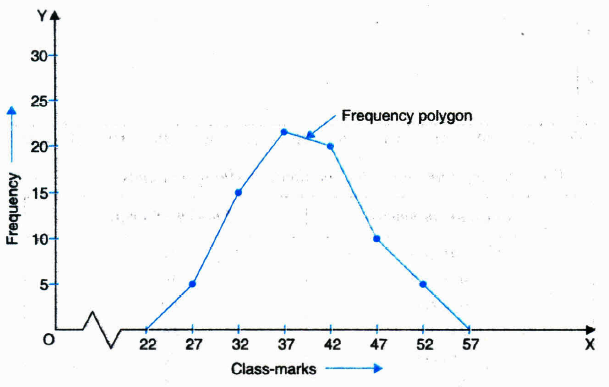
Draw a frequency polygon to represent the following information:
| Class | Frequency |
|---|---|
| 25-29 | 5 |
| 30-34 | 15 |
| 35-39 | 23 |
| 40-44 | 20 |
| 45-49 | 10 |
| 50-54 | 7 |
14.
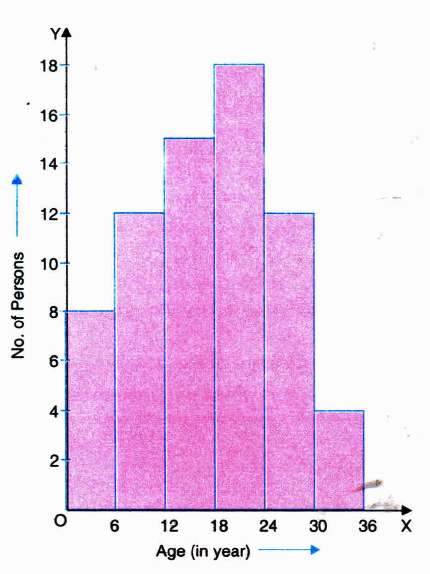
For the following data, draw a histogram.
| Age (in years) | Number of persons |
| 0-6 | 8 |
| 6-12 | 12 |
| 12-18 | 15 |
| 18-24 | 18 |
| 24-30 | 12 |
| 30-36 | 4 |
15.
A triangle and a parallelogram have the same base and the same area.If the sides of the triangle are 15 cm, 14 cm, and 13 cm, and the parallelogram stands on the base 15 cm, find the height of the parallelogram.
16.
Find the area of a rhombus whose perimeter is 200 m and one of the diagonals is 80 m.
17.
The cross- section of a canal is in the shape of a trapezium.If the canal is 12 m wide at the top and 8 m wide at the bottom and the area of its cross-section is 84 m2, determine its depth.
18.
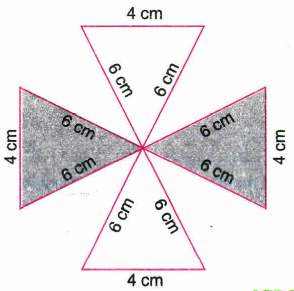
Black and white coloured triangular sheets are used to make a toy as shown in figure. Find the total area of black and white colour sheets used for making the toy.
19.
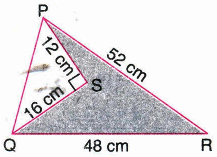
In the following figure, calculate the area of the shaded portion:
20.
Two solid spheres made of the same metal have masses 5920 g of and 740 g respectively. Determine the radius of the larger sphere, if the diameter of the smaller sphere is 5 cm.
21.
A cone of height 24 cm has a curved surface area 550 cm2. Find us volume.
1.
(a) Given, radius of cone
\(r=\frac { 20 }{ 2 } =10\quad cm=0.1\quad m\)
Height of cone h=\(\frac { 1 }{ 2 } m\)
Slant height of cone l=\(\sqrt { { h }^{ 2 }+{ r }^{ 2 } } \)
\(l=\sqrt { { \left( \frac { 1 }{ 2 } \right) }^{ 2 }+{ (0.1) }^{ 2 } } \)
\(l=\sqrt { \frac { 26 }{ 100 } } =\frac { 5.1 }{ 10 } \)
= 0.51 cm
Curved surface Area of 100 cones = (100 \(\times\)\(\pi\)rl)m2
= (100\(\times\)3.14\(\times\)0.1\(\times\)0.51)m2
= 16.014 m2
Total cost of painting = 30 \(\times\)16.014
= Rs 480.42.
(b) Social values, environmental protection.
2.
Total number blood donors = 85
(i) Number of donors whose blood is useful for Cheeku = 3
\(\therefore \) Number of favourable events = 85 - 3 = 82
Now, required probability\(=\frac{82}{85}\)
(ii) Responsible, rationality, love
(iii) Blood donation helps the needy. In fact it is a great act of charity and co-operation.
3.
We have total number of colonies = 5
(i) Number of colonies in which more than 40 plants survived = 3(B,C and E)
\(\therefore \) P(more than 40 plants survived in a colony)\(=\frac{3}{5}\)
(ii) Number of colonies in which less than 41 plants survived = 2(A and D)
P(less than 41 plants survived in colony)\(=\frac{2}{5}\)
(iii) In order to keep environment safe, we should grow more and more plants.
4.
(i) P(sum is 7)\(=\frac{75}{500}=\frac{3}{20}\)
(ii) P(sum is more than 11)\(=\frac{70}{500}=\frac{7}{50}\)
(iii) P(sum is less than or equal to 6)\(=\frac{19+30+22+52+55}{500}\)
\(=\frac{178}{500}=\frac{89}{250}\)
(iv) P(sum is between 5 and 10)\(=\frac{52+75+70+53}{50}\)
\(=\frac{250}{500}=\frac{1}{2}\)
5.
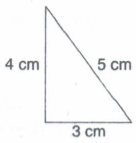
rcone = 3 cm
hcone = 4 cm
lcone= 5 cm
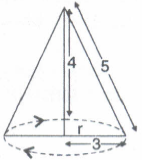
Above given cone is formed with radius 3 cm, height 4 cm and slant height 5 cm when revolved about the fixed side of 4 cm.
\(V=\frac { 1 }{ 3 } \pi { r }^{ 2 }h\)
\(=\frac { 1 }{ 3 } .\frac { 22 }{ 7 } .(3)(3)(4)\)
= 37.71 cm3
Total surface area=\(\pi\)rl+\(\pi\)r2
\(=\frac { 22 }{ 7 } \times 3(5+3)\)
= 75.43 cm2
6.
Given, ratio = 2:3:4
Let length = 2x, breadth = 3x, height = 4x
Total surface are of the box = 2(lb + bh + hl)
= 2(2x\(\times\)3x + 3x\(\times\)4x + 4x\(\times\)2x)
= 2(6x2+12x2+8x2)
= 52 x2
\(\therefore\) Cost of wrapping at the rate of Rs 4 per m2
= Rs 4 \(\times\) 52 x2
= Rs 208 x2
Cost of wrapping at the rate of Rs 4.50 per m2
= Rs 4.50 \(\times\) 52 x2
= Rs 234 x2
According to question,
234x2 - 208x2 = 416
\(\Rightarrow\) 26x2 = 416
\(\Rightarrow\) x2 = 16
\(\Rightarrow\) x = 4
\(\therefore\) Length = 2x = 2\(\times\)4 = 8 m
Breadth = 3x = 3\(\times\)4=12 m
Height = 4x = 4\(\times\)4 = 16 m
7.
l = 140 cm
b = 110 cm
h = 80 cm
Surface area of open box = lb + 2(bh + hl)
Cost of painting box
\(=Rs\frac { 75 }{ 100\times 100 } [154+2(88+112)]\times 100\)
\(=\frac { 3 }{ 4 } [554]=3(138.5)\)
= Rs 415.5
8.
(a) The number of drivers in the age of 25-40 years and has more than 2 accidents in the year
= 15 + 10 = 25
(b) The number of drivers the age of whose is above 40 years and has accidents more than 1 but less than 3
= 13 + 17 = 30.
9.
P(likes the detergent) = \(\frac { 375 }{ 500 } \)
= \(\frac { 3 }{ 4 } \)
(ii) P(does not like the detergent)
= 1-p(likes the detergent)
= \(1-\frac { 3 }{ 4 } =\frac { 1 }{ 4 } \)
10.
\(\therefore\) Mean of 200 items = 50
\(\therefore\) Sum of items \(= 200 \times 50 = 10000\)
Corrected sum = 10000 - (92 + 8) + (192 + 88)
= 10180
\(\therefore\) Correct mean \(= \frac {10180}{200}=50.9\)
11.
Arranging the data in ascending order, we have,
17,17,17,18,19,23,23,23,23,25,26
Here, 23 occurs most frequency (4 times)
\(\therefore\) Mode = 23
IF = f 4 is subtracted from each observation, then the new observations are
13,13,13,14,15,19,19,19,19,21,22
Here, 19 occurs most frequency (4 times)
\(\therefore\) Mode = 19
12.
Number of observations (n) = 10, which is even,
\(\therefore\) Median
\(=\frac { { \left( \frac { n }{ 2 } \right) }^{ th }observation+{ \left( \frac { n }{ 2 } +1 \right) }^{ th }observation }{ 2 } \)
\(\Rightarrow 65=\frac { 5^{ th }observation+6^{ th }observation }{ 2 } \)
\(\Rightarrow\) \(65 = \frac {x+\left(x+2\right)}{2}\)
\(\Rightarrow\) 2x + 2 = 130
\(\Rightarrow\) 2x = 130 - 2 = 128
\(\Rightarrow\) \(x = \frac {128}{2}=64\)
13.
We shall first make the class intervals continuous. Then, the modified table is as follows:
| Class | Class-marks | Frequency |
|---|---|---|
| 24.5-29.5 | 27 | 5 |
| 29.5-34.5 | 32 | 15 |
| 34.5-39.5 | 37 | 23 |
| 39.5-44.5 | 42 | 20 |
| 44.5-49.5 | 47 | 10 |
| 49.5-54.5 | 52 | 7 |
| Total | 80 |
14.
15.
For triangle a = 15 cm, b = 14 cm, c = 13 cm
\( \therefore \ =\frac { a+b+c }{ 2 } s=\frac { 15+14+13 }{ 2 } =21\)c m
\(\therefore \) Area = \(\sqrt { s(s-a)(s-b)(s-c) } \)
\(=\sqrt { 21(21-15)(21-14)(12-13) } \)
\(=\sqrt { 21(6)(7)(8) } =84\) cm2
Let the height of the parallelogram be h cm.
Then, area of the parallelogram = Base \(\times \) Height = 15 \(\times \) h = 15 cm2
According to the question, Area of the parallelogram = Area of the triangle
\(\Rightarrow \) 15h = 84
\(\Rightarrow \) \(\frac { 84 }{ 15 } \) = 5.6 cm
Hence, the height of the parallelogram is 5.6 cm.
16.
Let each of the equal sides of the rhombus be a cm.
Then, Perimeter = a + a + a + a = 4a m
According to the question, 4a = 200
\(\Rightarrow \) a= \(\frac { 200 }{ 4 } \) = 50 m
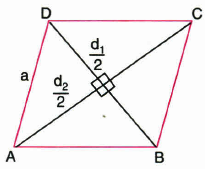
d1= 80 m
a2=\({ \left( \frac { { d }_{ 1 } }{ 2 } \right) }^{ 2 }+{ \left( \frac { { d }_{ 2 } }{ 2 } \right) }^{ 2 }\)
\(\Rightarrow \) (50)2 =( 40)2+\({ \left( \frac { { d }_{ 2 } }{ 2 } \right) }^{ 2 }\)
\(\Rightarrow \) \({ \left( \frac { { d }_{ 2 } }{ 2 } \right) }^{ 2 }\)= (50)2-(40)2 = 900= (30)2
\(\Rightarrow \) \(\frac { { d }_{ 2 } }{ 2 } \) = 30
\(\Rightarrow \) d2 = 60 m
\(\therefore \) Area of the rhombus = \(\frac { 1 }{ 2 } \) d1d2=\(\frac { 1 }{ 2 } \)\(\times \)80\(\times \)60 = 2400 m2
17.
Let the depth be h m
Area of trapezium = 84 m2
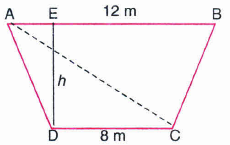
\(\Rightarrow \) Area of \(\Delta \)ABC +Area of \(\Delta \) ADC = 84 m2
\(\Rightarrow \) \(\frac { 1 }{ 2 } \)(AB)(DE) +\(\frac { 1 }{ 2 } \) (DC)(DE) = 84
\(\Rightarrow \) \(\frac { 1 }{ 2 } \) (12)(h) + (8)(h) = 84
\(\Rightarrow \) 6h + 4h = 84
\(\Rightarrow \) 10h = 84
\(\Rightarrow \) h =\(\frac { 84 }{ 10 } \) = 8.4
Hence, the depth of the canal is 8.4 m.
18.
For one black colour sheet a= 4 cm, b = 6 cm
\(\therefore \) Area \(=\frac { a }{ 4 } \sqrt { 4{ b }^{ 2 }-{ a }^{ 2 } } \) | Sheet is an isosceles triangle
\(=\frac { 4 }{ 4 } \sqrt { 4{ (6) }^{ 2 }-4^{ 2 } } \) \(=\sqrt { 128 } =8\sqrt { 2 } \) cm2
\(\therefore \) Area of 2 black colour sheets = 2\(\times 8\sqrt { 2 } \) = \( 16\sqrt { 2 } \) cm2
Similarly, area of 2 white colour sheets = \( 16\sqrt { 2 } \) cm2
\(\therefore \) Total area of black and white colour sheets = \( 16\sqrt { 2 } \) + \( 16\sqrt { 2 } \) = \( 32\sqrt { 2 } \) cm2
19.
In right triangle PSQ, PQ\(\frac { 1 }{ 2 } \)2 = PS2 + QS2 |By Pythagoras Theorem
= (12)2 + (16)2
= 144 + 256 =400
\(\Rightarrow \) PQ = \(\sqrt { 400 } \) = 20 cm
Now, for \(\Delta \)PQR
a = 20cm, b = 48cm, c = 52cm
\(\therefore s=\frac { a+b+c }{ 2 } =\frac { 20+48+52 }{ 2 } =60\) cm
\(\therefore \) Area of \(\Delta \)PQR \(=\sqrt { s(s-a)(s-b)(s-c) } \)
\(=\sqrt { 60(60-20)(60-48)(60-52) }\)
\( \\ =\sqrt { (60)(40)(12)(8) } \)
\(=\sqrt { \left( 6\times 10 \right) \left( 4\times 10 \right) \left( 6\times 2 \right) \left( 8 \right) } \)
\(=6\times 10\times 8=480\) cm2
Area of \(\Delta \) PSQ = \(\frac { 1 }{ 2 } \)\(\times \)Base\(\times \)Altitude
=\(\frac { 1 }{ 2 } \)\(\times \)16\(\times \)12=96 cm2
\(\therefore \) Area of the shaded portion =Area of \(\Delta \)PQR - Area of \(\Delta \)PSQ
= 480 - 96 = 384 cm2
20.
Let r and R be the radii of the smaller and larger spheres respectively, we have
\(r=\frac { 5 }{ 2 } cm\)
Volume of the smaller sphere \(=\frac { 4 }{ 3 } \pi { r }^{ 3 }=\frac { 4 }{ 3 } \pi { \left( \frac { 5 }{ 2 } \right) }^{ 3 }\)
\(=\frac { 4 }{ 3 } \times \pi \times \frac { 125 }{ 8 } { cm }^{ 3 }\)
Density of metal\(=\frac { mass }{ Valume } \)
\(=\frac { 740 }{ \frac { 4 }{ 3 } \pi \times \frac { 125 }{ 8 } } g\quad { cm }^{ 3 }\) ...........(i)
Volume of larger sphere = \(\frac { 4 }{ 3 } \pi { R }^{ 3 }\)
Density of metal=\(\frac { mass }{ Volume } =\frac { 5920 }{ \frac { 4 }{ 3 } \pi { R }^{ 3 } } \) ......(ii)
From (i) and (ii), we have
\(\frac { 740 }{ \frac { 4 }{ 3 } \pi \times \frac { 125 }{ 8 } } =\frac { 5920 }{ \frac { 4 }{ 3 } \pi { R }^{ 3 } } \)
\(\Rightarrow \quad { R }^{ 3 }=\frac { 5920\times 125 }{ 740\times 8 } \)
= 125
\(\Rightarrow\) R = 5 cm.
21.
Height of the cone(h) = 24 cm
Let r cm be the radius of the base and l cm an can be the slant height of the cone, then
\(l=\sqrt { { r }^{ 2 }+{ h }^{ 2 } } \)
\(=\sqrt { { r }^{ 2 }+{ 24 }^{ 2 } } \)
\(=\sqrt { { r }^{ 2 }+576 } \)
Now, curved surface area=\(\pi\)rl
\(\Rightarrow \ \frac { 22 }{ 7 } \times r\times \sqrt { { r }^{ 2 }+576 } =550\)
\(\Rightarrow \ r\sqrt { { r }^{ 2 }+576 } =550\times \frac { 7 }{ 22 } \)
\(\Rightarrow \ r\sqrt { { r }^{ 2 }+576 } =175\)
Squaring both the sides we get
r2 (r2 + 576) = 30625
(r2)2 + 576r2-30625 = 0
Let r2 = x
x2 + 576x - 30625 = 0
\(\Rightarrow\) x2 + 625x - 49x - 30625 = 0
\(\Rightarrow\) x(x + 625)- 49(x + 625) = 0
\(\Rightarrow\) (x + 625)(x - 49) = 0
\(\Rightarrow\) x + 625=0 or x - 49 = 0
\(\Rightarrow\) x = 625 or x = 49
not possible x = 49
\(\therefore\) r2= 49
\(\Rightarrow\) r = 7 cm
Volume & the cone = \(\frac { 1 }{ 3 } \pi { r }^{ 2 }h\)
\(=\frac { 1 }{ 3 } \times \frac { 22 }{ 7 } \times { 7 }^{ 2 }+24\)
= 1232 cm3.

9th Standard CBSE Syllabus & Materials
9th Standard CBSE
CBSE 9th Mathematics Lines and Angles Sample Question Papers Study Material - QB365 Set A
NEW9th Standard CBSE
CBSE 9th Mathematics Introduction to Euclid's Geometry Sample Question Papers Study Material - QB365 Set A
NEW9th Standard CBSE
CBSE 9th Mathematics Linear Equations in Two Variables Sample Question Papers Study Material - QB365 Set A
NEW9th Standard CBSE
CBSE 9th Mathematics Coordinate Geometry Sample Question Papers Study Material - QB365 Set A



NCERT Books

Syllabus

Exam Pattern

Sample Question Papers

Previous year Question Papers

Important Notes

MCQ Practice test

NCERT Exemplers

Case study Questions

Image Based Questions

Passage based Questions

HOT Questions

Value Based Questions

Model Questions Papers
NCERT ( Book Back ) Questions

Assertion and Reason
Important Questions And Answers

CBSE 9th Standard CBSE Subjects
CBSE Standards