100% FREE ACCESS
9th Standard CBSE Syllabus & Materials
9th Standard CBSE
CBSE 9th Science Is matter around us pure? - New Model Questions Papers Study Material - QB365 Set A
NEW9th Standard CBSE
CBSE 9th Science Matter in our surroundings - New Model Questions Papers Study Material - QB365 Set A
NEW9th Standard CBSE
CBSE 9th Mathematics Heron's Formula Sample Question Papers Study Material - QB365 Set A
NEW9th Standard CBSE
CBSE 9th Mathematics Circles Sample Question Papers Study Material - QB365 Set A
NEW9th Standard CBSE
CBSE 9th Mathematics Quadrilaterals Sample Question Papers Study Material - QB365 Set A
NEW9th Standard CBSE
CBSE 9th Mathematics Triangles Sample Question Papers Study Material - QB365 Set A

Published on: 29/10/2025
Download CBSE Class 9th Standard CBSE Mathematics question papers, sample papers, important questions, and previous year solved papers in PDF format. Get free study materials, NCERT solutions, and exam preparation resources for Class 9th Standard CBSE Mathematics
Questions + Answers key
Take MCQ Mathematics Test
1.
The score of 15 students in an examination out of 10 marks is as below: 3,9,7,5,6,3,7,6,7,4,7,7,4,8,2
Find the mean, mode and median.
2.
Find the mean of the following distribution:
| Variable(x) | 5 | 15 | 25 | 35 | 45 |
|---|---|---|---|---|---|
| Frequency(f) | 6 | 4 | 9 | 6 | 5 |
3.
The length, breadth and height of a rectangular box are as 1:2:3. Find the volume of the box, when its surface area is 1078 sq.m.
4.
The weights of 60 persons in a group are given below:
| Weight(in kg) | No.of persons |
| 60 | 5 |
| 61 | 18 |
| 62 | 4 |
| 63 | 16 |
| 64 | 5 |
| 65 | 12 |
Find the probability that a person selected at random has
(a) weight less than 70 kg
(b) weight between 61 and 64 kgs
(c) weight equal to more than 64 kg
5.
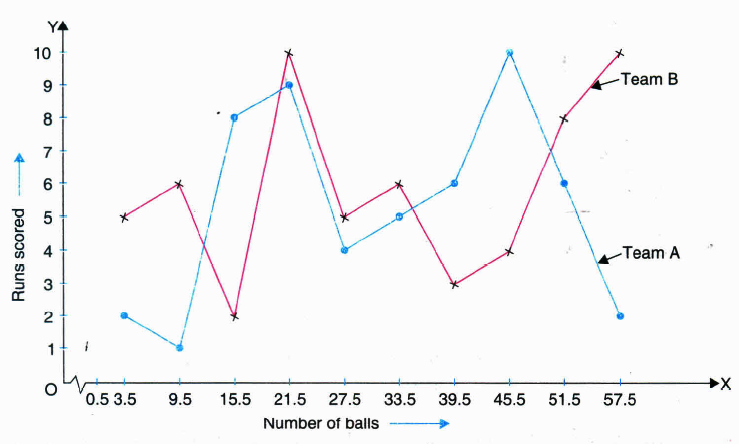
The runs scored by two teams A and B on the first60 balls in a cricket match are given below:
| Number of Balls | Team A | Team B |
| 1-6 | 2 | 5 |
| 7-12 | 1 | 6 |
| 13-18 | 8 | 2 |
| 19-24 | 9 | 10 |
| 25-30 | 4 | 5 |
| 31-46 | 5 | 6 |
| 37-42 | 6 | 3 |
| 43-48 | 10 | 4 |
| 49-54 | 6 | 8 |
| 55-60 | 2 | 10 |
Represent the data of both the teams on the same graph by frequency polygons.
6.
The students of a Vidyalaya were asked to participate in a competition for making and decorating penholders in the shape of a cylinder with a base, using cardboard. Each penholder was to be of radius 3 cm and height 10.5 cm. The Vidyalaya was to supply the competitors with cardboard. If there were 35 competitors, how much cardboard was required to be bought for the competition?
7.
The sides of a triangular park are in the ratio 3: 5:7 and its perimeter is 300 m. Find its area.
8.
The sides of a triangular plot are 50 m, 65 m, and 65 m. Find the cost of laying grass in this plot at the rate Rs.7 per m 2.
9.
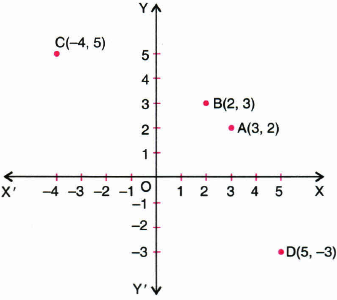
Draw a quadrilateral ABCD, whose vertices are A(3,2), B(2,3), C(-4,5), and D(5,-3)
10.
Evaluate after rationalising the denominator of \(\left( \frac { 25 }{ \sqrt { 40 } -\sqrt { 80 } } \right) \)It is being given that \(\sqrt { 5 } \)
11.
Mr. Kakkad's son Cheeku is sufering from a disease for 20 days and is hospitalised. Doctor asks Mr.Kakkad to donate blood in order to fulfill Cheeku's need. A pathologist tests and tells Mr.Kakkad, "Your blood group cannot be given to your son." After this Mr.Kakkad thinks of an idea and uploads a request of blood requirement on Facebook as soon as possible. In a short time, 85 blood of only three of them may be used for Cheeku.
(i) What is the probability that the blood group of a person chosen at random out of the donors cannot be given to Cheeku?
(ii) Which value is depicted by Mr.Kakkad regarding his son?
(iii) Which value (s) is (are) depicted by 85 blood donors?
12.
In 6 monthly test of all subjects, percentage of Rohit's marks are an average as follows:
| Jan | Feb | Mar | Apr | May | June |
| 96.25 | 98.11 | 96.66 | 95.90 | 98.89 | 99.01 |
The six marksheets associated with the six test above are duly shuffled and one of them is picked out at random.
(i) What is the probability that the marksheet picked out shows the marks 98.11% or 98.89%?
(ii)What is the probability that the marksheet picked out is associated with the month of July?
(iii) Which mathematical concept is used by you to answer(ii)
(iv) Which value is depicted by the student Rohit?
13.
Arithmetic mean of terms 21,16,24,x,29,15 is 23. Find this value of x.
14.
What is the mass of a metallic hollow cylindrical pipe 24 cm long with internal diameter 10 cm and made up of metal 5 mm thick. Density of the metal is 7 g per cm3
15.
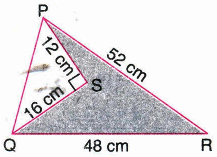
In the following figure, calculate the area of the shaded portion:
16.
Mark the points (2,2), (2,-2), (-2,-2) and (-2,2) on a graph paper and join these points.Name the figure that you obtain.Also, find the area of the figure so obtained.
17.
Evaluate:\(\frac { 40 }{ 2\sqrt { 10 } +\sqrt { 20 } +\sqrt { 40 } -2\sqrt { 5 } } \) when it is given that \(\sqrt { 10 } =3.162\)
18.
A boy has a spherical sweet of radius 4 cm. A girl has 8 spherical sweets each of radius 2 cm. Find the ratio of the volume of the sweets the boy has to the sweets the girl has.
19.
A triangle and a parallelogram have the same base and same area. If the sides of the triangle are 15 cm.14 cm and 13 cm and the parallelogram stands on the base 14 cm. find the height of the parallelogram.
20.
Find the area of a triangle whose sides are 6.5 cm. 7 cm and 7.5 cm.
21.
In which quadrant do the given point lie? (4,-1)
22.
Simplify: \({ \left( \frac { { 15 }^{ \frac { 1 }{ 3 } } }{ { 9 }^{ \frac { 1 }{ 4 } } } \right) }^{ -6 }\)
23.
When a coin is tossed 1000 times, the following outcomes were recorded:
Head: 460 times, Tail: 540 times
If now a coin is tossed once again, the probability of getting a Tail is
\(\frac { 27 }{ 100 } \)
\(\frac { 27 }{ 50 } \)
\(\frac { 23 }{ 50 } \)
\(\frac { 23 }{ 100 } \)
24.
The minimum probability of an event is
0
1
\(\frac { 1 }{ 2 } \)
-1
25.
The mean of five numbers is 18. If one number is removed, then the mean becomes 16. The removed number is
22
24
25
26.
26.
The lower limit of the class 31-35 is
31
33
35
30
27.
The dimensions of a box are 1 m, 80 cm and 50 cm. The area of its four walls is
6000 cm2
12000 cm2
18000 cm2
24000 cm2
28.
The side of a cube is 1 cm. The total surface area of the figure formed by joining two such cubes is
2(2 + 1 + 2) cm2
2(2 + 2 + 2) cm2
2(1 + 1 + 1) cm2
2(1 + 1 + 2) cm2
29.
The lateral surface area of a cube of side a is
4a2
6a2
3a2
2a2.
30.
Area of a quadrilateral =
\(\frac { 1 }{ 2 } \times \) a diagonal \(\times \) sum of the perpendicular on the diagonal
a diagonal \(\times \) sum of the perpendicular on the diagonal
\(\frac { 1 }{ 3 } \times \) a diagonal \(\times \) sum of the perpendicular on the diagonal
\(\frac { 1 }{ 4 } \times \) a diagonal \(\times \) sum of the perpendicular on the diagonal
31.
The area of a rhombus is 96 cm2.If one of its diagonals is 16 cm, then the length of its sides is
12 cm
10 cm
8 cm
6 cm
32.
Two sides of a triangle are 13 cm, and 14 cm and its semi-perimeter is 18 cm.Then third side of the triangle is
12 cm
11 cm
10 cm
9 cm
33.
The side of an isosceles right triangle of hypotenuse \(5\sqrt { 2 } \) cm is
10 cm
8 cm
5 cm
\(3\sqrt { 2 } \) cm
34.
Mirror image of the point (-1,2) in y - axis is:
(1,2)
(1,-2)
(2,1)
(2,-1)
35.
If the point A(0,2), B(0,-6) aand C(a,3) lie on y - axis, then the value of a is:
0
2
3
-6
36.
Rene Descartes belonged to
15th Century
16th Century
17th Century
18th Century
37.
(0.001)1/3 is equal to
0.1
0.001
0.01
0.0001
38.
Simplified value of \({ \left( 25 \right) }^{ \frac { 1 }{ 3 } }\times { \left( 5 \right) }^{ \frac { 1 }{ 3 } }\) is:
25
3
1
5
39.
A die is thrown, what will be the probability of getting an even number?
40.
The range of the data is: 25,18,20,22,16,6,17,12,30,32,10,19,8,11,20 is:
41.
Compute the curved surface area of a hemishpere whose diameter is 14 cm.
42.
Insert three rational numbers between \(\frac{-1}{3}\) and \(\frac{-2}{3}\)
43.
A cone of height 24 cm has a curved surface area 550 cm2. Find us volume.
44.
Geetha told her classmate Radha that "\(\sqrt { \frac { \left( \sqrt { 2 } -1 \right) }{ \left( \sqrt { 2 } +1 \right) } } \) is an irrational number." Radha replied that "you are wrong" and further claimed that "If there is a number 'x' such that x3 is an irrational number, then x5 is also irrational". Geetha said, "No Radha, you are wrong". Radha took some time and after verification accepted her mistakes and thanked Geetha for pointing out these mistakes.
(i) Justify both the statements.
(ii) What value is depicted from this question?
1.
Writing the given data in ascending order: 2,3,3,4,4,5,6,6,7,7,7,7,7,8,9
Here n = 15, Mean = \(\frac { \sum { x } }{ n } \)
=\(\frac{85}{15}\)= 5.7
Mode = 7, Median = 8th term = 6
2.
| x | f | fx |
| 5 | 6 | 30 |
| 15 | 4 | 60 |
| 25 | 9 | 225 |
| 35 | 6 | 210 |
| 45 | 5 | 225 |
| Total | ∑f=30 | ∑fx=750 |
Mean(\(\bar{x}\))=\(\frac { \sum { fx } }{ \sum { f } } =\frac { 750 }{ 30 } =25\)
3.
2(lb + bh + hl) = 1078
\(\Rightarrow\) lb + bh + hl = 539
Let dimensions be x, 2x, 3x.
\(\therefore\) 2x2 + 6x2 + 3x2 = 539
\(\Rightarrow\) 11x2 = 539
\(\Rightarrow\) x2 = 49
\(\Rightarrow\) x = 7
\(\Rightarrow\) l = 7 m, b = 14 m, h =21 m.
Volume of the box = lbh = 7\(\times\)14 \(\times\)21
= 2058 m3.
4.
(i) P(weight less than 65 kg)\(=\frac{5+18+4+16+5}{60}=\frac{48}{60}=\frac{4}{5}\)
(ii) P(weight between 61 and 64 kg)
\(=\frac{4+16}{60}=\frac{20}{60}=\frac{1}{3}\)
(iii) P(weight equal to or more than 64 kg)
\(=\frac{5+15}{60}=\frac{17}{60}\)
5.
Modified Table
| Number of balls | Class Marks | Team A | Team B |
| 0.50-0.6 | 3.5 | 2 | 5 |
| 6.5-12.5 | 9.5 | 1 | 6 |
| 12.5-18.5 | 15.5 | 8 | 2 |
| 18.5-24.5 | 21.5 | 9 | 10 |
| 24.5-30.5 | 27.5 | 4 | 5 |
| 30.5-36.5 | 33.5 | 5 | 6 |
| 36.5-42.5 | 39.5 | 6 | 3 |
| 42.5-48.5 | 45.5 | 10 | 4 |
| 48.5-54.5 | 51.5 | 6 | 8 |
| 54.5-60.5 | 57.5 | 2 | 10 |
6.
r = 3 cm
h = 10.5 cm
\(\therefore \) Cardboard required for 1 competitor
\(=2\pi rh+\pi { r }^{ 2 }\)
\(\\ =2\times \frac { 22 }{ 7 } \times 3\times 10.5+\frac { 22 }{ 7 } { \left( 3 \right) }^{ 2 }\)
\(\\ =198+\frac { 198 }{ 7 } =198\left( 1+\frac { 1 }{ 7 } \right) \)
\(\\ =\frac { 198\times 8 }{ 7 } { cm }^{ 2 }\)
Cardboard required for 35 competitors
\(=\frac { 198\times 8 }{ 7 } \times 35{ cm }^{ 2 }=7920{ cm }^{ 2 }\)
Hence, 7920 cm2 of cardboard was required to be bought for the competition.
7.
\(1500\sqrt { 3 } \) cm2
8.
Rs.10500
9.
10.
- 9.5425
11.
Total number blood donors = 85
(i) Number of donors whose blood is useful for Cheeku = 3
\(\therefore \) Number of favourable events = 85 - 3 = 82
Now, required probability\(=\frac{82}{85}\)
(ii) Responsible, rationality, love
(iii) Blood donation helps the needy. In fact it is a great act of charity and co-operation.
12.
(i) Marks 98.11 % and 98.89% are associated with the months February and May respectively. So the number of favourable outcomes=2.
Number of all possible outcomes= total number of marksheets=5
Required probability\(=\frac{2}{6}=\frac{1}{3}\)
(ii) There is no marksheet associated with the month of July.
\(\therefore \) Required probability = 0
(ii) The probability of an impossible event is zero.
(iv) Brilliant student.
13.
According to the question,
\(\frac {21+16+21+x+29+15}{6}=23\)
\(\Rightarrow\) 105 + x = 138
\(\Rightarrow\) x = 33
14.
Internal radius (r)=\(\frac{10}{2}\) cm = 5 cm
Thickness =5 mm =\(\frac{5}{10}\) cm = 0.5 cm
ஃ External radius (R)= 5 + 0.5 = 5.5 cm
Length (h) = 24 cm
ஃ Volume = \(\pi (R^2-r^2)h\)
\(=\frac{22}{7}(5.5)^2-(5)^2\ 24\ cm^3\)
\(=\frac{2772}{7}cm^3\)
ஃ Mass =\(\frac{2772}{7}\times 7\ g=2772\ g\)
15.
In right triangle PSQ, PQ\(\frac { 1 }{ 2 } \)2 = PS2 + QS2 |By Pythagoras Theorem
= (12)2 + (16)2
= 144 + 256 =400
\(\Rightarrow \) PQ = \(\sqrt { 400 } \) = 20 cm
Now, for \(\Delta \)PQR
a = 20cm, b = 48cm, c = 52cm
\(\therefore s=\frac { a+b+c }{ 2 } =\frac { 20+48+52 }{ 2 } =60\) cm
\(\therefore \) Area of \(\Delta \)PQR \(=\sqrt { s(s-a)(s-b)(s-c) } \)
\(=\sqrt { 60(60-20)(60-48)(60-52) }\)
\( \\ =\sqrt { (60)(40)(12)(8) } \)
\(=\sqrt { \left( 6\times 10 \right) \left( 4\times 10 \right) \left( 6\times 2 \right) \left( 8 \right) } \)
\(=6\times 10\times 8=480\) cm2
Area of \(\Delta \) PSQ = \(\frac { 1 }{ 2 } \)\(\times \)Base\(\times \)Altitude
=\(\frac { 1 }{ 2 } \)\(\times \)16\(\times \)12=96 cm2
\(\therefore \) Area of the shaded portion =Area of \(\Delta \)PQR - Area of \(\Delta \)PSQ
= 480 - 96 = 384 cm2
16.
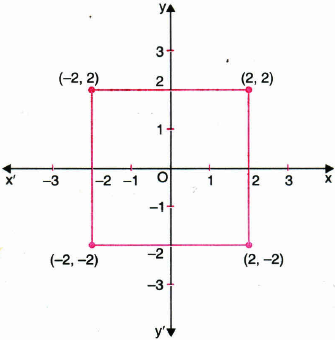
The figure we obtained is a square.
Area of the square = (4)2 = 16 square units.
17.
\(=\frac { 40 }{ 2\sqrt { 10 } +\sqrt { 2\times 2\times 5 } +\sqrt { 2\times 2\times 10 } -2\sqrt { 5 } } \)
\(\\ =\frac { 40 }{ 2\sqrt { 10 } +\sqrt { 20 } +\sqrt { 40 } -2\sqrt { 5 } } \)
\(\\ =\frac { 40 }{ 4\sqrt { 10 } } =\frac { 10 }{ \sqrt { 10 } } \)
\(\\ \sqrt { 10 } =3.162\)
18.
1:1
19.
6 cm
20.
21 cm2
21.
IV
22.
\(\frac { 27 }{ 225 } \)
23.
Required probability=\(\frac { 540 }{ 1000 } \)
24.
\(0\le P(E)\le 1\)
25.
\(5 \times 18 = 90\)
\(4 \times 16 = 64\)
\(90 -64 =26.\)
26.
Sixth class is 25 - 30.
27.
(c)
18000 cm2
28.
v = 5 \(\times\) (6 \(\times\) 2 \(\times\) 1.5)
29.
(a)
4a2
30.
Formula
31.
(b)
10 cm
32.
(d)
9 cm
33.
(c)
5 cm
34.
(a)
(1,2)
35.
(a)
0
36.
(c)
17th Century
37.
(a)
0.1
38.
(d)
5
39.
()
Favourable number of outcomes = 3(2,4,6)
Total number of outcomes = 6
Required probability\(=\frac{3}{6}=\frac{1}{2}\)
40.
()
26
41.
()
Given diameter of hemisphere = 14 cm
\(\therefore\) radius = 7 cm
\(\therefore\) Curved surface area = 2\(\pi\)r2
\(=2\times \frac { 22 }{ 7 } \times 7\times 7\)
= 308 cm2
42.
()
\(\frac{-1}{3}\)=\(-\frac{4}{12}\)
and \(-\frac{2}{3}=-\frac{8}{12}\)
So three rational numbers are \(-\frac{5}{12},-\frac{6}{12}\) and -\(\frac{7}{12}\)
43.
Height of the cone(h) = 24 cm
Let r cm be the radius of the base and l cm an can be the slant height of the cone, then
\(l=\sqrt { { r }^{ 2 }+{ h }^{ 2 } } \)
\(=\sqrt { { r }^{ 2 }+{ 24 }^{ 2 } } \)
\(=\sqrt { { r }^{ 2 }+576 } \)
Now, curved surface area=\(\pi\)rl
\(\Rightarrow \ \frac { 22 }{ 7 } \times r\times \sqrt { { r }^{ 2 }+576 } =550\)
\(\Rightarrow \ r\sqrt { { r }^{ 2 }+576 } =550\times \frac { 7 }{ 22 } \)
\(\Rightarrow \ r\sqrt { { r }^{ 2 }+576 } =175\)
Squaring both the sides we get
r2 (r2 + 576) = 30625
(r2)2 + 576r2-30625 = 0
Let r2 = x
x2 + 576x - 30625 = 0
\(\Rightarrow\) x2 + 625x - 49x - 30625 = 0
\(\Rightarrow\) x(x + 625)- 49(x + 625) = 0
\(\Rightarrow\) (x + 625)(x - 49) = 0
\(\Rightarrow\) x + 625=0 or x - 49 = 0
\(\Rightarrow\) x = 625 or x = 49
not possible x = 49
\(\therefore\) r2= 49
\(\Rightarrow\) r = 7 cm
Volume & the cone = \(\frac { 1 }{ 3 } \pi { r }^{ 2 }h\)
\(=\frac { 1 }{ 3 } \times \frac { 22 }{ 7 } \times { 7 }^{ 2 }+24\)
= 1232 cm3.
44.
\(\sqrt { \frac { \left( \sqrt { 2 } -1 \right) }{ \left( \sqrt { 2 } +1 \right) } } \)is an irrational number.
\(\sqrt { \frac { \left( \sqrt { 2 } -1 \right) }{ \left( \sqrt { 2 } +1 \right) } } =\sqrt { \frac { \left( \sqrt { 2 } -1 \right) }{ \left( \sqrt { 2 } +1 \right) } \times \frac { \left( \sqrt { 2 } -1 \right) }{ \left( \sqrt { 2 } -1 \right) } } \)
\(=\sqrt { \frac { { \left( \sqrt { 2 } -1 \right) }^{ 2 } }{ 2-1 } } \)
\(=\sqrt { \frac { { \left( \sqrt { 2 } -1 \right) }^{ 2 } }{ 1 } } =\sqrt { 2 } -1\)
which is an irrational number.
Let, there is a number x such that x3 is an irrational number but x5 is a rational number.
Let, x =\(\sqrt[5]{7}\) be the number.
⇒ x3 = (5√7)3 = (7)3/5
is an irrational number.
But x5 = (\(\sqrt[5]{7}\))5=(7)5/5 = 7
=7 is a rational number.
(ii) Accepting own mistakes gracefully, co-operative learning among the classmates.

9th Standard CBSE Syllabus & Materials
9th Standard CBSE
CBSE 9th Mathematics Lines and Angles Sample Question Papers Study Material - QB365 Set A
NEW9th Standard CBSE
CBSE 9th Mathematics Introduction to Euclid's Geometry Sample Question Papers Study Material - QB365 Set A
NEW9th Standard CBSE
CBSE 9th Mathematics Linear Equations in Two Variables Sample Question Papers Study Material - QB365 Set A
NEW9th Standard CBSE
CBSE 9th Mathematics Coordinate Geometry Sample Question Papers Study Material - QB365 Set A



NCERT Books

Syllabus

Exam Pattern

Sample Question Papers

Previous year Question Papers

Important Notes

MCQ Practice test

NCERT Exemplers

Case study Questions

Image Based Questions

Passage based Questions

HOT Questions

Value Based Questions

Model Questions Papers
NCERT ( Book Back ) Questions

Assertion and Reason
Important Questions And Answers

CBSE 9th Standard CBSE Subjects
CBSE Standards